
Verwandte Artikel zu Lightning Man: The Accursed Life of Samuel F.B. Morse
Inhaltsangabe
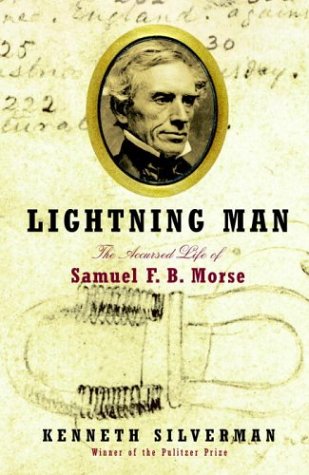
Profiles Morse as a gifted artist, political prospect, and innovator responsible for the American electromagnetic telegraph, describing the painful defeats that overshadowed his successes. By the Pulitzer Prize-winning author of The Life and Times of Cotton Mather. 20,000 first printing.
Die Inhaltsangabe kann sich auf eine andere Ausgabe dieses Titels beziehen.
Über die Autorinnen und Autoren
Born and raised in Manhattan, Kenneth Silverman is Professor Emeritus of English at New York University. His other books include Timothy Dwight, A Cultural History of the American Revolution, The Life and Times of Cotton Mather, Edgar A. Poe: Mournful and Never-ending Remembrance, and Houdini!!!: The Career of Ehrich Weiss. He is the winner of the Bancroft Prize in American History, the Pulitzer Prize for Biography, the Edgar Award of the Mystery Writers of America, and the Christopher Literary Award of the Society of American Magicians.
Kenneth Silverman is Professor Emeritus of English at New York University.
Aus dem Klappentext
In this brilliantly conceived and written biography, Pulitzer Prize winning Kenneth Silverman gives us the long and amazing life of the man eulogized by the New York Herald in 1872 as perhaps the most illustrious American of his age.
Silverman presents Samuel Morse in all his complexity. There is the gifted and prolific painter (more than three hundred portraits and larger historical canvases) and pioneer photographer, who gave the first lectures on art in America, became the first Professor of Fine Arts at an American college (New York University), and founded the National Academy of Design. There is the republican idealist, prominent in antebellum politics, who ran for Congress and for mayor of New York. But most important, there is the inventor of the American electromagnetic telegraph, which earned Morse the name Lightning Man and brought him the fame he sought.
In these pages, we witness the evolution of the great invention from its inception as an idea to its introduction to the world an event that astonished Morse s contemporaries and was considered the supreme expression of the country s inventive genius. We see how it transformed commerce, journalism, transportation, military affairs, diplomacy, and the very shape of daily life, ushering in the modern era of communication.
But we discover as well that Morse viewed his existence as accursed rather than illustrious, his every achievement seeming to end in loss and defeat: his most ambitious canvases went unsold; his beloved republic imploded into civil war, making it unlivable for him; and the commercial success of the telegraph engulfed him in lawsuits challenging the originality and ownership of his invention.
Lightning Man is the first biography of Samuel F. B. Morse in sixty years. It is a revelation of the life of a fascinating and profoundly troubled American genius.
Auszug. © Genehmigter Nachdruck. Alle Rechte vorbehalten.
One
Geography
(1789-1811)
On April 30, 1789, Jedediah Morse was installed as pastor of the First Congregational Church of Charlestown, Massachusetts. The occasion was triply significant to him. Twenty-seven years old, he had come to his vocation by study at Yale and graduate work in theology. He felt eager to promote the interests of religion but awed to contemplate the degenerate state of his fellow mortals, who every day crucified their Redeemer anew. The labor now to be undertaken by him was worthy but daunting, "a good work," he said, "but alas who is sufficient for these things."
The place mattered to Jedediah no less than the occasion. The First Church was one of the oldest in America, a fit pulpit for a man whose ancestors had emigrated to the New World in 1635, among the first settlers of Puritan New England. The church stood, too, in the shadow of Bunker's Hill. Just fourteen years earlier, armed provincials had defended the hill against three assaults by British infantry and marines.
And for Jedediah, the date was no less symbolic than the place. On the same day, on the balcony of New York City's Federal Hall, George Washington was inaugurated as the first President of the United States and called on the new nation to preserve "the sacred fire of liberty." Jedediah revered him as an epitome of republican virtue-self-sacrificing, pious, restrained, great because he was good, indeed, Jedediah said, "the greatest Man alive."
Two weeks after the momentous day of his settlement, Jedediah married twenty-three-year-old Elizabeth Finley, a granddaughter of the president of Princeton College. In appearance they were unlike, to judge from a later family portrait: Jedediah tall, slender, old-fashioned-looking in his knee breeches and black silk stockings; Elizabeth stoutish, buxom, jowly-"no dwarf," she said of herself. Their personalities differed, too. Jedediah's well-bred manner and sweet voice set him off from his wife's no-nonsense practicality and tart wit. Just the same they made a close, affectionate couple. In letters home he addressed her as "My dearest Life & Love." He borrowed the salutation, he explained, from a letter of George Washington to Martha Washington: "as he is an excellent pattern in almost everything, so in this I would imitate him, believing that my Love for you is as great as his for Mrs. W."
On April 27, 1791, two years after marrying, the couple had their first child, a son whom they named after Elizabeth's father and grandfather: Samuel Finley Breese Morse. Finley, as the family called him, spent his first seven years in the parsonage, a two-story wooden building near the First Church. The household included a pious Baptist
servant-nurse, Nancy Shepherd. For a time, a black boy named Abraham also lived with the family, tending the horse and cow. Jedediah ministered to the black population of nearby Boston and publicly condemned the slave trade as inconsistent with republican principles.
Few details of Finley's early childhood remain. When about a year and a half old he contracted smallpox during an epidemic that struck a thousand people in Boston. At the age of four he began attending a dame school near the parsonage. Nancy Shepherd sometimes took him to Bunker's Hill and recounted its historic battle, which she had witnessed.
During the first ten years of their marriage Jedediah and Elizabeth had six more children. Only two survived, Finley's younger brothers Richard and Sidney. In the same period Jedediah became a national figure. While writing sermons and preaching about mankind's fallen state, he issued atlases, school texts, and travel guides with such titles as The American Universal Geography (1793) and The American Gazeteer (1797). He put the books to press, arranged for British editions, looked after sales and distribution, each year publishing a new geography or revision of some earlier one.
Jedediah's geographies became second in popularity only to Noah Webster's spelling books and the Bible. Producing them put him in touch with notable men at home and abroad. He dined in Philadelphia with Benjamin Franklin and at Mount Vernon with George and Martha Washington. His many, far-flung correspondents included John Adams; the Bishop of London; and the French foreign minister, Talleyrand, who also visited him in Charlestown. His publications brought him an honorary degree from the University of Edinburgh and fame as America's pre-eminent geographer. He did not hide his renown. On the title page of American Universal Geography he identified himself as a Doctor of Divinity, Fellow of the American Antiquarian Society, and Fellow of the Historical Society-as "Jedediah Morse, D.D.F.A.A.S.H.S."
Jedediah became prominent in political life as well. Like the rest of the Congregationalist clergy he allied himself with the Federalist party. Against the more liberal, capitalistic social order taking shape in the wake of the American Revolution, he upheld the Calvinistic faith of his New England forebears, whose piety and sense of human dependence on God he considered essential to republican life. He hoped that the new United States would be left to itself, "kept out of the Whirlpool of European Politicks." But there was no insulating the country from the long war for supremacy between Great Britain and Napoleon's France. As the eighteenth century closed, Jedediah like most other Federalists viewed with growing alarm French interference in American affairs: use of American seaports as bases for privateering, attempted bribes to American envoys, manipulation of the American press-especially the export to America of deism, skepticism, Voltairean atheism, and other forms of French Infidelity.
Such ominous political-religious issues brought out a combative side of Jedediah's personality, at odds with his usual mildness. He fought the French Antichrist from his historic pulpit, raging against France as the "destroyer of nations" that had enslaved millions and now menaced the independence of the United States. He sermonized against all the other enemies of Christian Republicanism as well: Masons, Illuminists, Roman Catholics-the last being not Christians but idolators, with a libertine priesthood. All were leagued with the French Imperium, Jedediah warned, in trying to foment revolution in America and ultimately seize the country.
Jedediah's fiery sermons had no political effect. As the new century opened he grimly watched the nation choose for its president the gallified Thomas Jefferson, a man unaccustomed to attending public worship, a professed Infidel: "Unhappy indeed must that Christian people be," Jedediah reflected, "whose Chief Magistrate is an Atheist." George Washington had mercifully not lived to see it all: "Ever since his death the clouds seem to have been gathering for a storm."
In 1799, as Jedediah thundered from his pulpit, Finley was sent from home for schooling. Now eight years old, he would spend most of the next decade living apart from his family. Jedediah enrolled him at Phillips Academy, in the isolated village of Andover, Massachusetts, some twenty miles from Charlestown. The well-regarded Academy had about sixty students. Its curriculum stressed classical languages, mathematics, and religious instruction suited to the sons of New England Congregationalists. The school's Overseers included Jedediah himself.
Concerned above all with Finley's growth in piety, Jedediah tried to board him with a prayerful family. He also wrote out a daily routine for his son to follow. It aimed at fashioning a Christian Gentleman-reverent, well mannered, and frugal, but aspiring to personal distinction:
1. Rise early in the morning-read a chapter in the Bible, & say your...
„Über diesen Titel“ kann sich auf eine andere Ausgabe dieses Titels beziehen.
Suchergebnisse für Lightning Man: The Accursed Life of Samuel F.B. Morse

Beispielbild für diese ISBN
Lightning Man
Anbieter: World of Books (was SecondSale), Montgomery, IL, USA
Verkäuferbewertung 5 von 5 Sternen

Hardback. Zustand: Fair. Artikel-Nr. 00107052340
Gebraucht kaufen
EUR 3,47
Versand gratis
Versand innerhalb von USA
Versand innerhalb von USA
Anzahl: 1 verfügbar
Beispielbild für diese ISBN
Lightning Man: The Accursed Life of Samuel F. B. Morse
Anbieter: ThriftBooks-Dallas, Dallas, TX, USA
Verkäuferbewertung 5 von 5 Sternen
Hardcover. Zustand: Very Good. No Jacket. Former library book; May have limited writing in cover pages. Pages are unmarked. ~ ThriftBooks: Read More, Spend Less. Artikel-Nr. G0375401288I4N10
Gebraucht kaufen
EUR 6,40
Versand gratis
Versand innerhalb von USA
Versand innerhalb von USA
Anzahl: 1 verfügbar
Beispielbild für diese ISBN
Lightning Man: The Accursed Life of Samuel F. B. Morse
Anbieter: ThriftBooks-Atlanta, AUSTELL, GA, USA
Verkäuferbewertung 5 von 5 Sternen
Hardcover. Zustand: Fair. No Jacket. Readable copy. Pages may have considerable notes/highlighting. ~ ThriftBooks: Read More, Spend Less. Artikel-Nr. G0375401288I5N00
Gebraucht kaufen
EUR 6,40
Versand gratis
Versand innerhalb von USA
Versand innerhalb von USA
Anzahl: 1 verfügbar
Beispielbild für diese ISBN
Lightning Man: The Accursed Life of Samuel F. B. Morse
Anbieter: ThriftBooks-Atlanta, AUSTELL, GA, USA
Verkäuferbewertung 5 von 5 Sternen
Hardcover. Zustand: Very Good. No Jacket. Missing dust jacket; May have limited writing in cover pages. Pages are unmarked. ~ ThriftBooks: Read More, Spend Less. Artikel-Nr. G0375401288I4N01
Gebraucht kaufen
EUR 6,40
Versand gratis
Versand innerhalb von USA
Versand innerhalb von USA
Anzahl: 1 verfügbar
Beispielbild für diese ISBN
Lightning Man: The Accursed Life of Samuel F. B. Morse
Anbieter: ThriftBooks-Atlanta, AUSTELL, GA, USA
Verkäuferbewertung 5 von 5 Sternen
Hardcover. Zustand: Good. No Jacket. Former library book; Pages can have notes/highlighting. Spine may show signs of wear. ~ ThriftBooks: Read More, Spend Less. Artikel-Nr. G0375401288I3N10
Gebraucht kaufen
EUR 6,40
Versand gratis
Versand innerhalb von USA
Versand innerhalb von USA
Anzahl: 1 verfügbar
Beispielbild für diese ISBN
Lightning Man: The Accursed Life of Samuel F. B. Morse
Anbieter: ThriftBooks-Dallas, Dallas, TX, USA
Verkäuferbewertung 5 von 5 Sternen
Hardcover. Zustand: Good. No Jacket. Pages can have notes/highlighting. Spine may show signs of wear. ~ ThriftBooks: Read More, Spend Less. Artikel-Nr. G0375401288I3N00
Gebraucht kaufen
EUR 6,40
Versand gratis
Versand innerhalb von USA
Versand innerhalb von USA
Anzahl: 1 verfügbar
Beispielbild für diese ISBN
Lightning Man : The Accursed Life of Samuel F. B. Morse
Verlag:
Knopf Doubleday Publishing Group, 2003
ISBN 10: 0375401288
ISBN 13: 9780375401282
Gebraucht
Hardcover
Anbieter: Better World Books, Mishawaka, IN, USA
Verkäuferbewertung 5 von 5 Sternen
Zustand: Good. First Edition Stated. Pages intact with minimal writing/highlighting. The binding may be loose and creased. Dust jackets/supplements are not included. Stock photo provided. Product includes identifying sticker. Better World Books: Buy Books. Do Good. Artikel-Nr. 2295506-6
Gebraucht kaufen
EUR 6,68
Versand gratis
Versand innerhalb von USA
Versand innerhalb von USA
Anzahl: 1 verfügbar
Beispielbild für diese ISBN
Lightning Man : The Accursed Life of Samuel F. B. Morse
Verlag:
Knopf Doubleday Publishing Group, 2003
ISBN 10: 0375401288
ISBN 13: 9780375401282
Gebraucht
Hardcover
Anbieter: Better World Books, Mishawaka, IN, USA
Verkäuferbewertung 5 von 5 Sternen
Zustand: Good. First Edition Stated. Former library copy. Pages intact with minimal writing/highlighting. The binding may be loose and creased. Dust jackets/supplements are not included. Includes library markings. Stock photo provided. Product includes identifying sticker. Better World Books: Buy Books. Do Good. Artikel-Nr. 2295507-6
Gebraucht kaufen
EUR 6,68
Versand gratis
Versand innerhalb von USA
Versand innerhalb von USA
Anzahl: 2 verfügbar
Beispielbild für diese ISBN
Lightning Man: The Accursed Life of Samuel F. B. Morse
Anbieter: Wonder Book, Frederick, MD, USA
Verkäuferbewertung 5 von 5 Sternen
Zustand: Very Good. Very Good condition. Very Good dust jacket. A copy that may have a few cosmetic defects. May also contain light spine creasing or a few markings such as an owner's name, short gifter's inscription or light stamp. Artikel-Nr. Q19T-00824
Gebraucht kaufen
EUR 8,26
Versand gratis
Versand innerhalb von USA
Versand innerhalb von USA
Anzahl: 1 verfügbar
Foto des Verkäufers
Lightning Man: The Accursed Life of Samuel F. B. Morse
Anbieter: Southampton Books, Sag Harbor, NY, USA
Verkäuferbewertung 5 von 5 Sternen
Hardcover. Zustand: Like New. First Edition. First Edition, First Printing. Published by Knopf, 2003. Octavo. Hardcover. Book is like new. Dust jacket is like new. Artikel-Nr. 559248
Gebraucht kaufen
EUR 9,18
EUR 4,45 Versand
Versand innerhalb von USA
Versand innerhalb von USA
Anzahl: 1 verfügbar