
Verwandte Artikel zu Two Moons: A novel
Inhaltsangabe
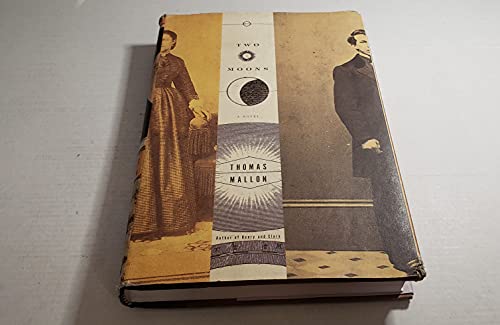
Astronomy, politics, and romance join forces in this novel from the writer John Updike has called "one of the most interesting American novelists at work."
It's the spring of 1877 in Washington, D.C., and at the U.S. Naval Observatory, Hugh Allison has conceived a secret ambition: to project an image through time and space. But his plan takes on urgent life only when the mathematically gifted Cynthia May enters his orbit as one of the observatory's human "computers." A Civil War widow whose beauty has been shadowed by worry and poverty, Cynthia reluctantly falls in love with the younger Hugh, who missed the war that has haunted her life. But the fate of their love affair -- and of Hugh's heavenly vision -- may be out of their hands, decided instead by an astrologer and by the actions of a dangerously magnetic politician who wields his power over a Senate convulsed by Reconstruction and a wildly disputed presidential election.
Masterfully combining historical detail and startling invention, Thomas Mallon gives us a galvanizing story of earthly heartbreak and otherworldly triumph.
Die Inhaltsangabe kann sich auf eine andere Ausgabe dieses Titels beziehen.
Über die Autorin bzw. den Autor
Thomas Mallon's novels include Dewey Defeats Truman, Henry and Clara, and Aurora 7. He is a frequent contributor to the New York Times Magazine and GQ, and is the author of books about plagiarism (Stolen Words) and diaries (A Book of One's Own). In 1998, he received the National Book Critics Circle award for reviewing. He lives in Westport, Connecticut.
Aus dem Klappentext
olitics, and romance join forces in this novel from the writer John Updike has called "one of the most interesting American novelists at work."<br> <br>It's the spring of 1877 in Washington, D.C., and at the U.S. Naval Observatory, Hugh Allison has conceived a secret ambition: to project an image through time and space. But his plan takes on urgent life only when the mathematically gifted Cynthia May enters his orbit as one of the observatory's human "computers." A Civil War widow whose beauty has been shadowed by worry and poverty, Cynthia reluctantly falls in love with the younger Hugh, who missed the war that has haunted her life. But the fate of their love affair -- and of Hugh's heavenly vision -- may be out of their hands, decided instead by an astrologer and by the actions of a dangerously magnetic politician who wields his power over a Senate convulsed by Reconstruction and a wildly disputed presidential election.<br>&
Auszug. © Genehmigter Nachdruck. Alle Rechte vorbehalten.
March 8, 1877
The black ball rose up the flagpole. Spotting it from two blocks east, Cynthia May allowed herself to slow down. The hoisting of the canvas sphere, as big across as a wagon wheel, meant that ten minutes remained until noon, when Potomac ferry captains and fat boardinghouse mistresses all over northwest Washington would watch it drop and reset their clocks, and she would be due inside the Naval Observatory for her appointment.
She crossed E Street at the corner of Virginia, taking off her hat as she went. March 8th, and already so hot that, after twenty blocks of walking, she'd sweated through the skimpy silk lining beneath the straw. With the hat in one hand and her book in the other, she had no hand free to hold her nose against the stink coming up from the water filling half the street. She wondered why the whole swamp that was Foggy Bottom didn't sink, once and for all, into the river; and why the steps of the young man who'd been following her at a constant distance these past few blocks now seemed farther away. Had he been slowed by the smell, or by the thin streak of gray he'd no doubt noticed in her hair as soon as she took off her bonnet?
She turned around to smile, to show him the thirty-five years on the face atop her still-slim frame and, God only knew how, still-fast carriage. The boy looked startled, but appreciative, as if pleased to be fooled by such a handsome woman, however much she might be past eligibility for his serious attention.
She stepped onto the Observatory grounds, this supposed park without a bench to be found. Lifting her skirts and drawing them tight, she hoped to minimize the grass stains they were bound to acquire from the patch of shaded lawn she picked to sit on, a dozen feet from some clerks eating an early lunch. "You filthy thing," she hissed, smacking the mosquito on her bare wrist. "Die." She closed her eyes, determined, before the interview, to compose herself against the unnatural heat of this city; even now, a quarter century after leaving New Hampshire as a ten-year-old girl, she would not accept it. It was winter.
Her eyes still shut, she soundlessly recited five trigonometric formulae. Her numbers were fine; fixed and reliable, as she knew they would be. It was her appearance that was shaking her confidence, the spinsterish agitation her face might betray. Perhaps a bit hysterical, she could picture the examiners noting at the bottom of her paper, until they realized she was not a spinster but a widow, and their amusement turned to something worse, a depressed sort of pity that would make them decide how, all things being equal (or not) among the candidates, they'd really be better off having some bumptious young man about.
Even before noon arrived, she had worked her anticipated resentments into a grudge that felt actual, even long-standing. Rising to her feet, briskly enough to startle the nearby diners, she strode toward the building's east wing and into the Chronometer Room, where in a voice more loud than was necessary she greeted a young man bent over his desk.
"I am Cynthia May," she said. "I have an appointment with Professor Newcomb."
Mrs. John May, she was about to add, in case the fellow mistook what she'd told him for two Christian names, like Mary Jane, as people often did. But he just held up his left hand, like a policeman, indicating she should come no closer and say no more. With his other hand he tapped a telegraph key. A second later, up above, she heard a light thump.
"Time ball," he said, grinning broadly as he beckoned her forward with the same hand he'd used to halt her. "My one tap makes it fall, and gives Western Union their signal. So they can set all their clocks."
Surprised that the boy's keystroke should connect her to people far from the local ferry captains and boardinghouse mistresses, to cities not seething with faction and heat, she let her own face relax into a smile. More quietly than before, she said: "Mrs. John May, for -- "
"If it's Professor Newcomb you want, you don't want me," said the boy. "But the truth is you don't want him either, not just yet. If you're here about the computer's job, you're wanted first in Davis's office." He crooked his finger and drew a path on the air. "He likes to look 'em over."
Who could "he" be? Admiral Charles Davis had died three weeks ago. Cynthia knew so from both the Evening Star and Fanny Christian's most recent gentleman caller, a young ensign whose presence one evening at the boarders' table had been a rare concession from Mrs. O'Toole. Approaching the admiral's office, she could see that she was right: Charles H. Davis was now no more than his portrait, which hung outside the door, draped in black, the late subject's walrus mustache and rectangular flaps of hair quite immobile and unwelcoming.
Inside, she took her place on a bench between the two other applicants. Standing beside a desk, a much younger man, with the same flaps of hair and mustache, looked her up and down quite neutrally, not pausing in his drone of instructions to a slim, balding clerk whose nameplate identifed him as Mr. Harrison. "Tell Professor Baird at the Smithsonian that he may bring his party of ladies here to look through the Great Equatorial if he gives us plenty of advance warning, if the night they pick turns out to be clear, and if they get here early."
"Yes, Commander Davis," said the clerk.
"The son," whispered the job-seeker at Cynthia's right. "A lieutenant commander. Also Charles H. He was attached here when the old man was carried off. They've made him officer-in-charge until the new superintendent comes on."
Cynthia watched the younger Davis brush away a length of hair that hung in limp contrast to the stiff wisp of gold braid sparkling his uniform.
"Professor Newcomb will be along any moment," Mr. Harrison said to Cynthia, repeating the explanation he must already have given the others, his soft tone an apology for the lieutenant commander's preoccupation.
"Then," said Davis, still standing over his clerk, "you can tell Mr. Morrison that the narrative of the polar expedition is not yet ready for issue, and when you're done with that you can write Mr. Watson up in Oswego and tell him that the report he requests of the 1874 Transit of Venus is not yet published. That's right," he said, looking over to the applicants, as if to warn them of the Observatory's chronically short appropriations, "eighteen hundred and seventy-four." And with that he marched back from Mr. Harrison's desk to his own.
The young officer was clearly overwhelmed, whether with mourning or his temporary responsibilities, Cynthia could not tell. Whichever the case, her sympathies lay more naturally with the hard-worked Mr. Harrison, who was already into his ink bottle, turning the lieutenant commander's complaints into correspondence. His labors would go more quickly with a Remington, she thought, though the acquisition of one here anytime soon had to be unlikely, given how everything else seemed behind schedule. The Interior Department, where she worked, had just purchased a half dozen of the machines -- the first cause of her presence here today. When she'd heard that the reward for mastering the Remington's use and listening to its sixfold clatter in the clerks' room would be only fifty cents more a day, she had decided to act upon a piece of information picked up from Fanny Christian's gentleman caller.
"They're hiring another computer to work with the stargazers," he'd said in mocking awe of the scientists whose perimeter he...
„Über diesen Titel“ kann sich auf eine andere Ausgabe dieses Titels beziehen.
Suchergebnisse für Two Moons: A novel

Beispielbild für diese ISBN
Two Moons
Anbieter: World of Books (was SecondSale), Montgomery, IL, USA
Verkäuferbewertung 5 von 5 Sternen

Hardback. Zustand: Very Good. It's the spring of 1877 in Washington, D.C., and at the U.S. Naval Observatory, great changes are afoot: historical, romantic, and scientific. When the brilliant Cynthia May--a Civil War widow whose beauty has been shadowed by worry and poverty--starts work as a human computer at the Observatory, astronomer Hugh Allison has found just the partner he needs for a radiant, half-crazed scheme which will make him live forever in the annals of science and space. But first the two scientists must overcome the very earthly obstacles presented by powerful Senator Roscoe Conkling of New York; and a fraudulent astrologer who just might know their future. Masterfully combining historical detail and startling invention, bringing Reconstruction-era Washington to life along with the ambitions of the burgeoning American nation, acclaimed writer Thomas Mallon gives us a galvanizing story of earthly heartbreak and other-worldly triumph. Artikel-Nr. 00097849956
Gebraucht kaufen
EUR 3,86
Versand gratis
Versand innerhalb von USA
Versand innerhalb von USA
Anzahl: 2 verfügbar
Beispielbild für diese ISBN
Two Moons
Anbieter: World of Books (was SecondSale), Montgomery, IL, USA
Verkäuferbewertung 5 von 5 Sternen
Hardback. Zustand: Good. It's the spring of 1877 in Washington, D.C., and at the U.S. Naval Observatory, great changes are afoot: historical, romantic, and scientific. When the brilliant Cynthia May--a Civil War widow whose beauty has been shadowed by worry and poverty--starts work as a human computer at the Observatory, astronomer Hugh Allison has found just the partner he needs for a radiant, half-crazed scheme which will make him live forever in the annals of science and space. But first the two scientists must overcome the very earthly obstacles presented by powerful Senator Roscoe Conkling of New York; and a fraudulent astrologer who just might know their future. Masterfully combining historical detail and startling invention, bringing Reconstruction-era Washington to life along with the ambitions of the burgeoning American nation, acclaimed writer Thomas Mallon gives us a galvanizing story of earthly heartbreak and other-worldly triumph. Artikel-Nr. 00097231435
Gebraucht kaufen
EUR 3,86
Versand gratis
Versand innerhalb von USA
Versand innerhalb von USA
Anzahl: 1 verfügbar
Beispielbild für diese ISBN
Two Moons: A novel
Anbieter: Wonder Book, Frederick, MD, USA
Verkäuferbewertung 5 von 5 Sternen
Zustand: Good. Good condition. Very Good dust jacket. A copy that has been read but remains intact. May contain markings such as bookplates, stamps, limited notes and highlighting, or a few light stains. Bundled media such as CDs, DVDs, floppy disks or access codes may not be included. Artikel-Nr. M06R-00722
Gebraucht kaufen
EUR 6,40
Versand gratis
Versand innerhalb von USA
Versand innerhalb von USA
Anzahl: 1 verfügbar
Beispielbild für diese ISBN
Two Moons: A novel
Anbieter: Wonder Book, Frederick, MD, USA
Verkäuferbewertung 5 von 5 Sternen
Zustand: Very Good. Very Good condition. Good dust jacket. A copy that may have a few cosmetic defects. May also contain light spine creasing or a few markings such as an owner's name, short gifter's inscription or light stamp. Bundled media such as CDs, DVDs, floppy disks or access codes may not be included. Artikel-Nr. P06B-01609
Gebraucht kaufen
EUR 6,40
Versand gratis
Versand innerhalb von USA
Versand innerhalb von USA
Anzahl: 1 verfügbar
Beispielbild für diese ISBN
Two Moons: A novel
Anbieter: ThriftBooks-Atlanta, AUSTELL, GA, USA
Verkäuferbewertung 5 von 5 Sternen
Paperback. Zustand: Very Good. No Jacket. Former library book; May have limited writing in cover pages. Pages are unmarked. ~ ThriftBooks: Read More, Spend Less. Artikel-Nr. G0375400257I4N10
Gebraucht kaufen
EUR 7,12
Versand gratis
Versand innerhalb von USA
Versand innerhalb von USA
Anzahl: 1 verfügbar
Beispielbild für diese ISBN
Two Moons: A novel
Anbieter: Wonder Book, Frederick, MD, USA
Verkäuferbewertung 5 von 5 Sternen
Zustand: Very Good. Signed Copy . Very Good dust jacket. Signed by author on title page. Artikel-Nr. W09OS-01288
Gebraucht kaufen
EUR 14,05
Versand gratis
Versand innerhalb von USA
Versand innerhalb von USA
Anzahl: 1 verfügbar
Foto des Verkäufers
TWO MOONS.
Verlag:
Pantheon, New York, 2000
ISBN 10: 0375400257
ISBN 13: 9780375400254
Gebraucht
Hardcover
Erstausgabe
Anbieter: Bookfever, IOBA (Volk & Iiams), Ione, CA, USA
Verkäuferbewertung 5 von 5 Sternen
Zustand: NEAR FINE. First printing. The author's fourth novel, set in Washington DC in 1877, in the turbulent Reconstruction years - a novel which blends facts and fiction in this story of Hugh Allison and Cynthia May - and one which combines elements ranging from history to astronomy to love and politics into a seamless and coherent whole. 303 pp. Near fine in near fine dust jacket (remainder dot.). Artikel-Nr. 39143
Gebraucht kaufen
EUR 19,22
EUR 4,40 Versand
Versand innerhalb von USA
Versand innerhalb von USA
Anzahl: 1 verfügbar
Beispielbild für diese ISBN
Two Moons
Anbieter: Dan Pope Books, West Hartford, CT, USA
Verkäuferbewertung 5 von 5 Sternen
Hardcover. Zustand: As New. Zustand des Schutzumschlags: As New. 1st Edition. New York: Pantheon [2000]. First Edition. First Printing. Hardbound. New, in dust jacket, very fine/very fine in all respects. A pristine unread copy. Comes with mylar dust jacket wrapper. 0.0. Artikel-Nr. cat20
Gebraucht kaufen
EUR 22,88
EUR 4,00 Versand
Versand innerhalb von USA
Versand innerhalb von USA
Anzahl: 1 verfügbar
Beispielbild für diese ISBN
Two Moons (First Printing) A Novel
Verlag:
Pantheon, New York, NY, 2000
ISBN 10: 0375400257
ISBN 13: 9780375400254
Gebraucht
Paperback
Erstausgabe
Anbieter: True Oak Books, Highland, NY, USA
Verkäuferbewertung 5 von 5 Sternen
Paperback. Zustand: Very Good. Zustand des Schutzumschlags: Very Good. First Edition; First Printing. 6.25 X 0.75 X 9.5 inches; 303 pages; DJ is not price-clipped. Minimal dust speckles on the top exterior edge of textblock. Minimal shelf wear on the DJ's side edges. Very Good condition otherwise. No other noteworthy defects. No markings. ; Your satisfaction is our priority. We offer free returns and respond promptly to all inquiries. Your item will be carefully cushioned in bubble wrap and securely boxed. All orders ship on the same or next business day. Buy with confidence. Artikel-Nr. HVD-65884-A-0
Gebraucht kaufen
EUR 27,45
Versand gratis
Versand innerhalb von USA
Versand innerhalb von USA
Anzahl: 1 verfügbar
Foto des Verkäufers
Two Moons
Verlag:
Pantheon Books, New York, 2000
ISBN 10: 0375400257
ISBN 13: 9780375400254
Gebraucht
Hardcover
Erstausgabe
Signiert
Anbieter: Between the Covers-Rare Books, Inc. ABAA, Gloucester City, NJ, USA
Verkäuferbewertung 5 von 5 Sternen
Hardcover. Zustand: Fine. Zustand des Schutzumschlags: Fine. First edition. Fine in a fine dustwrapper. Affectionately Inscribed to fellow author Nicholas Delbanco by the author. A novel. Artikel-Nr. 419973
Gebraucht kaufen
EUR 27,46
EUR 4,89 Versand
Versand innerhalb von USA
Versand innerhalb von USA
Anzahl: 1 verfügbar