
Verwandte Artikel zu Fully Alive: Discovering What Matters Most
Inhaltsangabe
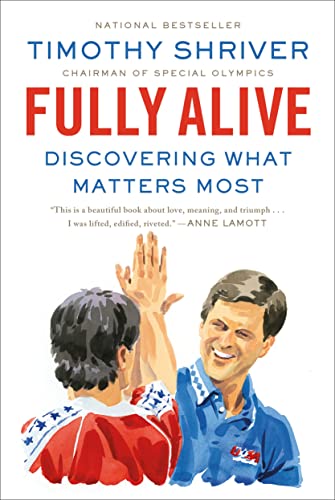
On a quest for what matters most, Timothy Shriver discovers the joy of being fully alive
As chairman of Special Olympics, Timothy Shriver has dedicated his life to the world's most forgotten minority-people with intellectual disabilities. And in a time when we are all more rudderless than ever, when we've lost our sense of what's ultimately important, when we hunger for stability but get only uncertainty, he has looked to them for guidance. Fully Alive chronicles Shriver's discovery of a radically different, and inspiring, way of life. We see straight into the lives of those who seem powerless but who have turned that into a power of their own, and through them learn that we are all totally vulnerable and totally valuable at the same time.
In addition, Shriver offers a new look at his family: his parents, Sargent and Eunice Shriver, and his uncles, John, Robert, and Edward Kennedy, all of whom were resolute advocates for those on the margins. Here, for the first time, Shriver explores the tremendous impact his aunt Rosemary, born with intellectual disabilities, had on his entire family and their legacy.
Die Inhaltsangabe kann sich auf eine andere Ausgabe dieses Titels beziehen.
Über die Autorin bzw. den Autor
Timothy Shriver is an educator, a social activist, a film producer, and an entrepreneur. He is the third child of Eunice Shriver, the founder of Special Olympics. As chairman of Special Olympics, he serves more than four million athletes in 170 countries. He cofounded and currently chairs the Collaborative for Academic, Social, and Emotional Learning (CASEL), the leading research organization in the United States in the field of social and emotional learning. Shriver earned his undergraduate degree from Yale University, a master's degree from Catholic University, and a doctorate in education from the University of Connecticut. He lives in Maryland with his wife. They have five children.
Auszug. © Genehmigter Nachdruck. Alle Rechte vorbehalten.
ONE
Boat Races
When I was about five years old, I fell in love with my first game: “boat races.” My mother and I played it on the little streams that ran through the woods at the edge of the vast field that stretched out behind our house. Those woods were a whole world to me. Looking out from my back door, all I could see was the field, and then the magical woods. On dark nights, beyond the vast expanse of the empty black field and the uneven, inky line of the woods rising above it, I could also see a row of four radio towers blinking red and white like silent sirens.
As a little boy, many nights I’d lie in bed and look out the window and watch those radio towers blinking their secret signals of warning. I knew they were located in the faraway city, but all I knew of the city was that my mother and father went to work there. Sometimes they came home with lots of friends, and sometimes they came home with beaten looks on their faces. Little children remember only moments of heaven or hell. One time when I was four, my mother came home to tell me my uncle had been murdered and I should run along and find something to do. But on other days, she would take me off alone, just the two of us, down through the field and into the woods to play our special game of boat races.
It was not an easy game. The “boats” were actually small sticks, and the race was actually a competition between my stick and my mother’s to see which could go down the stream fastest. So the first challenge was to find a good stick—one that floated well and didn’t have any protrusions that would get stuck on a leaf or a rock. A good boat was small enough to be quick but hefty enough to catch the current.
Once we’d picked our boats, the second challenge was to throw them into the stream at the count of three, hitting the water in just the right place so they would catch the current and go. Then came the breathless part: watching my boat wiggle and wash its way down the stream toward an imaginary finish line, cheering like crazy, encouraging it on its journey toward (I hoped) victory. And then heaven’s most often repeated exclamation: “Let’s play again!”
I loved the ritual of the game—the long walk down the field holding my mother’s hand, the passage from the open grass of the cow pasture into the shade of the huge Maryland oaks, the crunchy path across the leaves and twigs of the forest floor to the edge of the stream, and the furious search for high-quality boats that I could race against my resolute opponent, Mummy. We were all alone in those woods, Mummy and me: quiet, beyond the reach of the hated phone, beyond the city, the cars, and all those people asking Mrs. Shriver what she wanted, when she wanted it, and where she wanted it. All I had to do was pick up a stick and I had the power to make a boat come to life. I could bring the only eyes and ears and heart and mind in the world that I cared about—those of my mother—to focus on my little boat as it navigated mighty rapids, skittered around treacherous leaves and pebbles and occasional whirlpools, and glided toward a win.
They say a child can believe in anything—like Santa Claus with his elves; like leprechauns with their rainbows and pots of gold; like boats made out of sticks and their daring races against the hazards of the elements; like a child being the center of his mother’s life. In those days of boat races, I believed. I believed in things I couldn’t see and in the secret power I had to change the world into a place of love and mystery and eternity. It wasn’t that I didn’t know about the monsters with grotesque faces and devastating strength that could attack. I did, and from an early age. It’s just that the magic of the game was powerful enough to defeat them.
Those are the kinds of things I believed as a child. It took a long time for me to find my way back to them, but I believe in them still.
TWO
Much Is Expected
My understanding of belief goes back to my grandmother Rose Fitzgerald Kennedy. She was a woman of warm elegance, impeccably punctual at family meals, fond of long walks (which we grandchildren were often invited to join), and full of witty stories. She went to mass every day and frequently alluded in conversation to her faith and to the teachings of the Catholic Church. She would sometimes speak of the role faith played in the public events of her life—visits with the Pope in Rome, gifts to the Archdiocese of Boston in support of Catholic causes, the political careers of her sons.
But she also had private lessons for her grandchildren. She was especially fond of paraphrasing Luke 12:48, the parable of the faithful servant: “Of those to whom much is given, much is expected.” “Expected” was a word that had clear implications for her and for everyone in my family. Expectations were serious business, because, as I could easily discern from the large houses and plentiful possessions and ambitious people all around me, we had been given a lot. It was my job to figure out how to fulfill the expectation that I would give back.
Figuring it out, for me, took place in the midst of some rather extraordinary events. My family was immersed in politics—not just any politics, but the politics of the Democratic Party in the second half of the twentieth century. My grandfather became involved in the campaign of Franklin Roosevelt, but his role in that campaign, and his subsequent chairmanship of the fledgling Securities and Exchange Commission, was driven not so much by idealism as by pragmatic ambition. Joseph P. Kennedy was a conservative man in an administration many feared to be too leftist, hired because he spoke the language of Wall Street and could make SEC regulation palatable there. The business world had found Roosevelt’s thundering inaugural words ominous:
The money changers have fled from their high seats in the temple of our civilization. We may now restore that temple to the ancient truths. The measure of the restoration lies in the extent to which we apply social values more noble than mere monetary profit.
My grandfather’s work, often as not, involved sending a more moderate and diplomatic version of this same message: “Don’t worry, he didn’t mean itthat way.” The SEC was about restoring public confidence in the free market, not about shutting it down.
My parents, however, learned the more idealistic version of New Deal politics. They not only supported FDR, but alsobelieved in his message of courage and justice in the face of weakness and greed, and they raised my brothers and sister and me on it. Their Roosevelt was a man who’d proved that government could be a force for fairness in the economy. He was committed to the ideals of artists pursuing their creative passions, to public works, to the great economist John Maynard Keynes. He sided with the poor and against the rich; he envisioned a country where the elderly could be free of the destitution and stigma of old age. He believed, most of all, in action. His protruding jaw and his energy were as powerful as his legislation. I grew up with role models who were eager to forge ahead in the mold of Roosevelt: never fearing anything, least of all fear itself.
Most of the significant adult men in my life served in the armed forces during World War II. My father, Sargent Shriver, saw heavy combat in the Pacific theater and several times escaped with his life only by chance. One of my uncles, Joe Kennedy, Jr., was killed in a high-risk secret mission in the European theater. President Kennedy’s much-heralded heroism in naval warfare was part of my childhood’s...
„Über diesen Titel“ kann sich auf eine andere Ausgabe dieses Titels beziehen.
Suchergebnisse für Fully Alive: Discovering What Matters Most

Beispielbild für diese ISBN
Fully Alive: Discovering What Matters Most
Anbieter: World of Books (was SecondSale), Montgomery, IL, USA
Verkäuferbewertung 5 von 5 Sternen

Paperback. Zustand: Good. On a quest for what matters most, Timothy Shriver discovers the joy of being fully alive As chairman of Special Olympics, Timothy Shriver has dedicated his life to the world's most forgotten minority-people with intellectual disabilities. And in a time when we are all more rudderless than ever, when we've lost our sense of what's ultimately important, when we hunger for stability but get only uncertainty, he has looked to them for guidance. Fully Alive chronicles Shriver's discovery of a radically different, and inspiring, way of life. We see straight into the lives of those who seem powerless but who have turned that into a power of their own, and through them learn that we are all totally vulnerable and totally valuable at the same time. In addition, Shriver offers a new look at his family: his parents, Sargent and Eunice Shriver, and his uncles, John, Robert, and Edward Kennedy, all of whom were resolute advocates for those on the margins. Here, for the first time, Shriver explores the tremendous impact his aunt Rosemary, born with intellectual disabilities, had on his entire family and their legacy. Artikel-Nr. 00055958061
Gebraucht kaufen
EUR 4,83
Versand gratis
Versand innerhalb von USA
Versand innerhalb von USA
Anzahl: 4 verfügbar
Beispielbild für diese ISBN
Fully Alive: Discovering What Matters Most
Anbieter: World of Books (was SecondSale), Montgomery, IL, USA
Verkäuferbewertung 5 von 5 Sternen
Paperback. Zustand: Fair. On a quest for what matters most, Timothy Shriver discovers the joy of being fully alive As chairman of Special Olympics, Timothy Shriver has dedicated his life to the world's most forgotten minority-people with intellectual disabilities. And in a time when we are all more rudderless than ever, when we've lost our sense of what's ultimately important, when we hunger for stability but get only uncertainty, he has looked to them for guidance. Fully Alive chronicles Shriver's discovery of a radically different, and inspiring, way of life. We see straight into the lives of those who seem powerless but who have turned that into a power of their own, and through them learn that we are all totally vulnerable and totally valuable at the same time. In addition, Shriver offers a new look at his family: his parents, Sargent and Eunice Shriver, and his uncles, John, Robert, and Edward Kennedy, all of whom were resolute advocates for those on the margins. Here, for the first time, Shriver explores the tremendous impact his aunt Rosemary, born with intellectual disabilities, had on his entire family and their legacy. Artikel-Nr. 00061211137
Gebraucht kaufen
EUR 4,83
Versand gratis
Versand innerhalb von USA
Versand innerhalb von USA
Anzahl: 1 verfügbar
Beispielbild für diese ISBN
Fully Alive: Discovering What Matters Most
Verlag:
Sarah Crichton Books (edition Reprint), 2015
ISBN 10: 0374535825
ISBN 13: 9780374535827
Gebraucht
Paperback
Anbieter: BooksRun, Philadelphia, PA, USA
Verkäuferbewertung 5 von 5 Sternen
Paperback. Zustand: Very Good. Reprint. It's a well-cared-for item that has seen limited use. The item may show minor signs of wear. All the text is legible, with all pages included. It may have slight markings and/or highlighting. Artikel-Nr. 0374535825-11-18
Gebraucht kaufen
EUR 4,84
Versand gratis
Versand innerhalb von USA
Versand innerhalb von USA
Anzahl: 1 verfügbar
Beispielbild für diese ISBN
Fully Alive: Discovering What Matters Most
Anbieter: ThriftBooks-Phoenix, Phoenix, AZ, USA
Verkäuferbewertung 5 von 5 Sternen
Paperback. Zustand: Very Good. No Jacket. May have limited writing in cover pages. Pages are unmarked. ~ ThriftBooks: Read More, Spend Less. Artikel-Nr. G0374535825I4N00
Gebraucht kaufen
EUR 6,83
Versand gratis
Versand innerhalb von USA
Versand innerhalb von USA
Anzahl: 1 verfügbar
Beispielbild für diese ISBN
Fully Alive: Discovering What Matters Most
Anbieter: ThriftBooks-Atlanta, AUSTELL, GA, USA
Verkäuferbewertung 5 von 5 Sternen
Paperback. Zustand: Very Good. No Jacket. May have limited writing in cover pages. Pages are unmarked. ~ ThriftBooks: Read More, Spend Less. Artikel-Nr. G0374535825I4N00
Gebraucht kaufen
EUR 6,83
Versand gratis
Versand innerhalb von USA
Versand innerhalb von USA
Anzahl: 1 verfügbar
Beispielbild für diese ISBN
Fully Alive: Discovering What Matters Most
Anbieter: ThriftBooks-Dallas, Dallas, TX, USA
Verkäuferbewertung 5 von 5 Sternen
Paperback. Zustand: Very Good. No Jacket. May have limited writing in cover pages. Pages are unmarked. ~ ThriftBooks: Read More, Spend Less. Artikel-Nr. G0374535825I4N00
Gebraucht kaufen
EUR 6,83
Versand gratis
Versand innerhalb von USA
Versand innerhalb von USA
Anzahl: 1 verfügbar
Beispielbild für diese ISBN
Fully Alive : Discovering What Matters Most
Verlag:
Farrar, Straus & Giroux, 2015
ISBN 10: 0374535825
ISBN 13: 9780374535827
Gebraucht
Softcover
Anbieter: Better World Books, Mishawaka, IN, USA
Verkäuferbewertung 5 von 5 Sternen
Zustand: Good. Reprint. Pages intact with minimal writing/highlighting. The binding may be loose and creased. Dust jackets/supplements are not included. Stock photo provided. Product includes identifying sticker. Better World Books: Buy Books. Do Good. Artikel-Nr. GRP102789549
Gebraucht kaufen
EUR 7,19
Versand gratis
Versand innerhalb von USA
Versand innerhalb von USA
Anzahl: 2 verfügbar
Beispielbild für diese ISBN
Fully Alive: Discovering What Matters Most
Anbieter: WorldofBooks, Goring-By-Sea, WS, Vereinigtes Königreich
Verkäuferbewertung 5 von 5 Sternen
Paperback. Zustand: Good. The book has been read but remains in clean condition. All pages are intact and the cover is intact. Some minor wear to the spine. Artikel-Nr. GOR011495118
Gebraucht kaufen
EUR 12,42
EUR 6,68 Versand
Versand von Vereinigtes Königreich nach USA
Versand von Vereinigtes Königreich nach USA
Anzahl: 1 verfügbar
Beispielbild für diese ISBN
Fully Alive: Discovering What Matters Most
Verlag:
Sarah Crichton Books, , New York, 2015
ISBN 10: 0374535825
ISBN 13: 9780374535827
Gebraucht
Paperback
Anbieter: WorldofBooks, Goring-By-Sea, WS, Vereinigtes Königreich
Verkäuferbewertung 5 von 5 Sternen
Paperback. Zustand: Very Good. The book has been read, but is in excellent condition. Pages are intact and not marred by notes or highlighting. The spine remains undamaged. Artikel-Nr. GOR009313758
Gebraucht kaufen
EUR 12,42
EUR 6,68 Versand
Versand von Vereinigtes Königreich nach USA
Versand von Vereinigtes Königreich nach USA
Anzahl: 1 verfügbar
Beispielbild für diese ISBN
Fully Alive
Anbieter: Majestic Books, Hounslow, Vereinigtes Königreich
Verkäuferbewertung 4 von 5 Sternen

Zustand: New. pp. 304 16 Illus. Artikel-Nr. 375210478
Neu kaufen
EUR 20,13
EUR 7,75 Versand
Versand von Vereinigtes Königreich nach USA
Versand von Vereinigtes Königreich nach USA
Anzahl: 1 verfügbar