
Verwandte Artikel zu Improbability Principle: Why Coincidences, Miracles,...
Inhaltsangabe
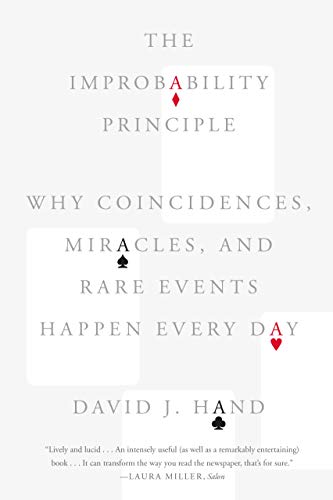
In The Improbability Principle, the renowned statistician David J. Hand argues that extraordinarily rare events are anything but. In fact, they're commonplace. Not only that, we should all expect to experience a miracle roughly once every month.
But Hand is no believer in superstitions, prophecies, or the paranormal. His definition of "miracle" is thoroughly rational. No mystical or supernatural explanation is necessary to understand why someone is lucky enough to win the lottery twice, or is destined to be hit by lightning three times and still survive. All we need, Hand argues, is a firm grounding in a powerful set of laws: the laws of inevitability, of truly large numbers, of selection, of the probability lever, and of near enough.
Together, these constitute Hand's groundbreaking Improbability Principle. And together, they explain why we should not be so surprised to bump into a friend in a foreign country, or to come across the same unfamiliar word four times in one day. Hand wrestles with seemingly less explicable questions as well: what the Bible and Shakespeare have in common, why financial crashes are par for the course, and why lightning does strike the same place (and the same person) twice. Along the way, he teaches us how to use the Improbability Principle in our own lives-including how to cash in at a casino and how to recognize when a medicine is truly effective.
An irresistible adventure into the laws behind "chance" moments and a trusty guide for understanding the world and universe we live in, The Improbability Principle will transform how you think about serendipity and luck, whether it's in the world of business and finance or you're merely sitting in your backyard, tossing a ball into the air and wondering where it will land.
Die Inhaltsangabe kann sich auf eine andere Ausgabe dieses Titels beziehen.
Über die Autorin bzw. den Autor
David J. Hand is an emeritus professor of mathematics and a senior research investigator at Imperial College London. He is the former president of the Royal Statistical Society and the chief scientific adviser to Winton Capital Management, one of Europe's most successful algorithmic-trading hedge funds. He is the author of seven books, including The Information Generation: How Data Rules Our World and Statistics: A Very Short Introduction, and has published more than three hundred scientific papers. Hand lives in London, England.
Auszug. © Genehmigter Nachdruck. Alle Rechte vorbehalten.
Improbability Principle
Why Coincidences, Miracles, and Rare Events Happen Every Day
By David J. HandFarrar, Straus and Giroux
Copyright © 2015 David J. Hand
All rights reserved.
ISBN: 978-0-374-53500-1All rights reserved.
1
THE MYSTERY
Fortune brings in some boats that are not steer’d.
—William Shakespeare
Simply Unbelievable
In the summer of 1972, the actor Anthony Hopkins was signed to play a leading role in a film based on George Feifer’s novel The Girl from Petrovka, so he traveled to London to buy a copy of the book. Unfortunately, none of the main London bookstores had a copy. Then, on his way home, waiting for an underground train at Leicester Square tube station, he saw a discarded book lying on the seat next to him. It was a copy of The Girl from Petrovka.
As if that was not coincidence enough, more was to follow. Later, when he had a chance to meet the author, Hopkins told him about this strange occurrence. Feifer was interested. He said that in November 1971 he had lent a friend a copy of the book—a uniquely annotated copy in which he had made notes on turning the British English into American English (“labour” to “labor,” and so on) for the publication of an American version—but his friend had lost the copy in Bayswater, London. A quick check of the annotations in the copy Hopkins had found showed that it was the very same copy that Feifer’s friend had mislaid.1
You have to ask: What’s the chance of that happening? One in a million? One in a billion? Either way, it begins to stretch the bounds of credibility. It hints at an explanation in terms of forces and influences of which we are unaware, bringing the book back in a circle to Hopkins and then to Feifer.
Here’s another striking incident, this time from the book Synchronicity, by the psychoanalyst Carl Jung. He writes: “The writer Wilhelm von Scholz … tells the story of a mother who took a photograph of her small son in the Black Forest. She left the film to be developed in Strassburg. But, owing to the outbreak of war, she was unable to fetch it and gave it up for lost. In 1916 she bought a film in Frankfurt in order to take a photograph of her daughter, who had been born in the meantime. When the film was developed, it was found to be doubly exposed: the picture underneath was the photograph she had taken of her son in 1914! The old film had not been developed and had somehow got into circulation again among the new films.”2
Most of us will have experienced coincidences rather like these—if not quite so extraordinary. They might be more akin to thinking of someone just before she phones you. Strangely enough, while I was writing part of this book, I had precisely this sort of experience. A colleague at work asked me if I could recommend some publications on a specific aspect of statistical methodology (the so-called “multivariate t-distribution”). The next day, I did a little research and managed to identify a book on exactly that topic by two statisticians, Samuel Kotz and Saralees Nadarajah. I had started to type an e-mail to my colleague, giving him the details of this book, when I was interrupted by a phone call from Canada. During the conversation, the caller happened to mention that Samuel Kotz had just died.
And so it goes on. On September 28, 2005, The Telegraph described how a golfer, Joan Cresswell, scored a hole in one with a fifty-yard shot at the thirteenth hole at the Barrow Golf Club in Cumbria in the UK. Surprising, you may think, but not outlandishly so—after all, holes in one do happen. But what if I tell you that, immediately afterward, a fellow golfer, the novice Margaret Williams, also scored a hole in one?3
There’s no getting away from it: sometimes events occur which seem so improbable, so unexpected, and so unlikely, they hint that there’s something about the universe we don’t understand. They make us wonder if the familiar laws of nature and causality, through which we run our everyday lives, occasionally break down. They certainly make us doubt that they can be explained by the accidental confluence of events, by the random throwing together of people and things. They almost suggest that something is exerting an invisible influence.
Often such occurrences merely startle us, and give us stories to tell. On my first trip to New Zealand, I settled down in a café, and noticed that the notepaper being used by one of the two strangers at the neighboring table was from my own university back in the UK. But at other times, these uncanny events can significantly alter lives—for the better, as with a New Jersey woman who won the lottery twice, or for the worse, as with Major Summerford, who was struck by lightning several times.
Humans are curious animals, so we naturally seek the underlying cause of strange coincidences. What was it that led two strangers from the same university to travel to the far side of the world and end up sitting at neighboring tables in the same café at exactly the same time? What was it that led the woman to pick those two winning sets of lottery numbers? What was it that brought huge electrostatic forces to hit Major Summerford time and time again? And what steered Anthony Hopkins and The Girl from Petrovka through space, and through time, to the same seat in the same underground station at the same moment?
Beyond that, of course, how can we take advantage of the causes underlying such coincidences? How can we manipulate them to our benefit?
So far all my examples have been very small-scale—at the personal level. But there are countless more-profound examples. Some seem to imply that not only the human race, but the very galaxies themselves wouldn’t exist if those very unlikely events hadn’t occurred. Some relate to how sequences of tiny random changes in our genetic constitution could end up producing something as complicated as a human being. Others relate to the distance of the earth from the sun, the existence of Jupiter, and even the values of the fundamental constants of physics. Again the question arises as to whether blind chance is a realistic explanation for these apparently staggeringly unlikely events, or whether there are in fact other influences and forces directing the course of events behind the scenes.
The answers to all these questions hinge on what I call the Improbability Principle. This asserts that extremely improbable events are commonplace. It’s a consequence of a collection of more fundamental laws, which all tie together to lead inevitably and inexorably to the occurrence of such extraordinarily unlikely events. These laws, this principle, tell us that the universe is in fact constructed so that these coincidences are unavoidable: the extraordinarily unlikely must happen; events of vanishingly small probability will occur. The Improbability Principle resolves the apparent contradiction between the sheer unlikeliness of such events, and the fact that they nevertheless keep on happening.
We’ll begin by looking at prescientific explanations. These often go far back into the mists of time. Although many people still hold to them, they predate the Baconian revolution: that is the idea that the way to understand the natural world is to collect data, conduct experiments, take observations, and use these as test beds through which to evaluate proposed explanations for what’s going on. Prescientific notions predate...
THE MYSTERY
Fortune brings in some boats that are not steer’d.
—William Shakespeare
Simply Unbelievable
In the summer of 1972, the actor Anthony Hopkins was signed to play a leading role in a film based on George Feifer’s novel The Girl from Petrovka, so he traveled to London to buy a copy of the book. Unfortunately, none of the main London bookstores had a copy. Then, on his way home, waiting for an underground train at Leicester Square tube station, he saw a discarded book lying on the seat next to him. It was a copy of The Girl from Petrovka.
As if that was not coincidence enough, more was to follow. Later, when he had a chance to meet the author, Hopkins told him about this strange occurrence. Feifer was interested. He said that in November 1971 he had lent a friend a copy of the book—a uniquely annotated copy in which he had made notes on turning the British English into American English (“labour” to “labor,” and so on) for the publication of an American version—but his friend had lost the copy in Bayswater, London. A quick check of the annotations in the copy Hopkins had found showed that it was the very same copy that Feifer’s friend had mislaid.1
You have to ask: What’s the chance of that happening? One in a million? One in a billion? Either way, it begins to stretch the bounds of credibility. It hints at an explanation in terms of forces and influences of which we are unaware, bringing the book back in a circle to Hopkins and then to Feifer.
Here’s another striking incident, this time from the book Synchronicity, by the psychoanalyst Carl Jung. He writes: “The writer Wilhelm von Scholz … tells the story of a mother who took a photograph of her small son in the Black Forest. She left the film to be developed in Strassburg. But, owing to the outbreak of war, she was unable to fetch it and gave it up for lost. In 1916 she bought a film in Frankfurt in order to take a photograph of her daughter, who had been born in the meantime. When the film was developed, it was found to be doubly exposed: the picture underneath was the photograph she had taken of her son in 1914! The old film had not been developed and had somehow got into circulation again among the new films.”2
Most of us will have experienced coincidences rather like these—if not quite so extraordinary. They might be more akin to thinking of someone just before she phones you. Strangely enough, while I was writing part of this book, I had precisely this sort of experience. A colleague at work asked me if I could recommend some publications on a specific aspect of statistical methodology (the so-called “multivariate t-distribution”). The next day, I did a little research and managed to identify a book on exactly that topic by two statisticians, Samuel Kotz and Saralees Nadarajah. I had started to type an e-mail to my colleague, giving him the details of this book, when I was interrupted by a phone call from Canada. During the conversation, the caller happened to mention that Samuel Kotz had just died.
And so it goes on. On September 28, 2005, The Telegraph described how a golfer, Joan Cresswell, scored a hole in one with a fifty-yard shot at the thirteenth hole at the Barrow Golf Club in Cumbria in the UK. Surprising, you may think, but not outlandishly so—after all, holes in one do happen. But what if I tell you that, immediately afterward, a fellow golfer, the novice Margaret Williams, also scored a hole in one?3
There’s no getting away from it: sometimes events occur which seem so improbable, so unexpected, and so unlikely, they hint that there’s something about the universe we don’t understand. They make us wonder if the familiar laws of nature and causality, through which we run our everyday lives, occasionally break down. They certainly make us doubt that they can be explained by the accidental confluence of events, by the random throwing together of people and things. They almost suggest that something is exerting an invisible influence.
Often such occurrences merely startle us, and give us stories to tell. On my first trip to New Zealand, I settled down in a café, and noticed that the notepaper being used by one of the two strangers at the neighboring table was from my own university back in the UK. But at other times, these uncanny events can significantly alter lives—for the better, as with a New Jersey woman who won the lottery twice, or for the worse, as with Major Summerford, who was struck by lightning several times.
Humans are curious animals, so we naturally seek the underlying cause of strange coincidences. What was it that led two strangers from the same university to travel to the far side of the world and end up sitting at neighboring tables in the same café at exactly the same time? What was it that led the woman to pick those two winning sets of lottery numbers? What was it that brought huge electrostatic forces to hit Major Summerford time and time again? And what steered Anthony Hopkins and The Girl from Petrovka through space, and through time, to the same seat in the same underground station at the same moment?
Beyond that, of course, how can we take advantage of the causes underlying such coincidences? How can we manipulate them to our benefit?
So far all my examples have been very small-scale—at the personal level. But there are countless more-profound examples. Some seem to imply that not only the human race, but the very galaxies themselves wouldn’t exist if those very unlikely events hadn’t occurred. Some relate to how sequences of tiny random changes in our genetic constitution could end up producing something as complicated as a human being. Others relate to the distance of the earth from the sun, the existence of Jupiter, and even the values of the fundamental constants of physics. Again the question arises as to whether blind chance is a realistic explanation for these apparently staggeringly unlikely events, or whether there are in fact other influences and forces directing the course of events behind the scenes.
The answers to all these questions hinge on what I call the Improbability Principle. This asserts that extremely improbable events are commonplace. It’s a consequence of a collection of more fundamental laws, which all tie together to lead inevitably and inexorably to the occurrence of such extraordinarily unlikely events. These laws, this principle, tell us that the universe is in fact constructed so that these coincidences are unavoidable: the extraordinarily unlikely must happen; events of vanishingly small probability will occur. The Improbability Principle resolves the apparent contradiction between the sheer unlikeliness of such events, and the fact that they nevertheless keep on happening.
We’ll begin by looking at prescientific explanations. These often go far back into the mists of time. Although many people still hold to them, they predate the Baconian revolution: that is the idea that the way to understand the natural world is to collect data, conduct experiments, take observations, and use these as test beds through which to evaluate proposed explanations for what’s going on. Prescientific notions predate...
„Über diesen Titel“ kann sich auf eine andere Ausgabe dieses Titels beziehen.
Suchergebnisse für Improbability Principle: Why Coincidences, Miracles,...

Foto des Verkäufers
Improbability Principle
Anbieter: Dream Books Co., Denver, CO, USA
Verkäuferbewertung 5 von 5 Sternen

Zustand: good. Gently used with minimal wear on the corners and cover. A few pages may contain light highlighting or writing, but the text remains fully legible. Dust jacket may be missing, and supplemental materials like CDs or codes may not be included. May be ex-library with library markings. Ships promptly! Artikel-Nr. DBV.0374535000.G
Gebraucht kaufen
EUR 3,74
Versand gratis
Versand innerhalb von USA
Versand innerhalb von USA
Anzahl: 2 verfügbar
Beispielbild für diese ISBN
The Improbability Principle: Why Coincidences, Miracles, and Rare Events Happen Every Day
Anbieter: World of Books (was SecondSale), Montgomery, IL, USA
Verkäuferbewertung 5 von 5 Sternen
Paperback. Zustand: Good. In The Improbability Principle, the renowned statistician David J. Hand argues that extraordinarily rare events are anything but. In fact, they're commonplace. Not only that, we should all expect to experience a miracle roughly once every month. But Hand is no believer in superstitions, prophecies, or the paranormal. His definition of "miracle" is thoroughly rational. No mystical or supernatural explanation is necessary to understand why someone is lucky enough to win the lottery twice, or is destined to be hit by lightning three times and still survive. All we need, Hand argues, is a firm grounding in a powerful set of laws: the laws of inevitability, of truly large numbers, of selection, of the probability lever, and of near enough. Together, these constitute Hand's groundbreaking Improbability Principle. And together, they explain why we should not be so surprised to bump into a friend in a foreign country, or to come across the same unfamiliar word four times in one day. Hand wrestles with seemingly less explicable questions as well: what the Bible and Shakespeare have in common, why financial crashes are par for the course, and why lightning does strike the same place (and the same person) twice. Along the way, he teaches us how to use the Improbability Principle in our own lives--including how to cash in at a casino and how to recognize when a medicine is truly effective. An irresistible adventure into the laws behind "chance" moments and a trusty guide for understanding the world and universe we live in, The Improbability Principle will transform how you think about serendipity and luck, whether it's in the world of business and finance or you're merely sitting in your backyard, tossing a ball into the air and wondering where it will land. Artikel-Nr. 00104605163
Gebraucht kaufen
EUR 3,79
Versand gratis
Versand innerhalb von USA
Versand innerhalb von USA
Anzahl: 4 verfügbar
Beispielbild für diese ISBN
Improbability Principle
Anbieter: World of Books (was SecondSale), Montgomery, IL, USA
Verkäuferbewertung 5 von 5 Sternen
Zustand: Very Good. Item in very good condition! Textbooks may not include supplemental items i.e. CDs, access codes etc. Artikel-Nr. 00104501142
Gebraucht kaufen
EUR 3,79
Versand gratis
Versand innerhalb von USA
Versand innerhalb von USA
Anzahl: 4 verfügbar
Beispielbild für diese ISBN
Improbability Principle
Anbieter: World of Books (was SecondSale), Montgomery, IL, USA
Verkäuferbewertung 5 von 5 Sternen
Zustand: Acceptable. Item in acceptable condition! Textbooks may not include supplemental items i.e. CDs, access codes etc. Artikel-Nr. 00105546538
Gebraucht kaufen
EUR 3,79
Versand gratis
Versand innerhalb von USA
Versand innerhalb von USA
Anzahl: 1 verfügbar
Beispielbild für diese ISBN
Improbability Principle
Verlag:
FSG Adult (edition Reprint), 2015
ISBN 10: 0374535000
ISBN 13: 9780374535001
Gebraucht
Paperback
Anbieter: BooksRun, Philadelphia, PA, USA
Verkäuferbewertung 5 von 5 Sternen
Paperback. Zustand: Fair. Reprint. The item might be beaten up but readable. May contain markings or highlighting, as well as stains, bent corners, or any other major defect, but the text is not obscured in any way. Artikel-Nr. 0374535000-7-1-13
Gebraucht kaufen
EUR 4,93
Versand gratis
Versand innerhalb von USA
Versand innerhalb von USA
Anzahl: 1 verfügbar
Beispielbild für diese ISBN
The Improbability Principle: Why Coincidences, Miracles, and Rare Events Happen Every Day
Anbieter: ThriftBooks-Atlanta, AUSTELL, GA, USA
Verkäuferbewertung 5 von 5 Sternen
Paperback. Zustand: Very Good. No Jacket. May have limited writing in cover pages. Pages are unmarked. ~ ThriftBooks: Read More, Spend Less. Artikel-Nr. G0374535000I4N00
Gebraucht kaufen
EUR 5,89
Versand gratis
Versand innerhalb von USA
Versand innerhalb von USA
Anzahl: 1 verfügbar
Beispielbild für diese ISBN
The Improbability Principle: Why Coincidences, Miracles, and Rare Events Happen Every Day
Anbieter: ThriftBooks-Dallas, Dallas, TX, USA
Verkäuferbewertung 5 von 5 Sternen
Paperback. Zustand: Very Good. No Jacket. May have limited writing in cover pages. Pages are unmarked. ~ ThriftBooks: Read More, Spend Less. Artikel-Nr. G0374535000I4N00
Gebraucht kaufen
EUR 5,89
Versand gratis
Versand innerhalb von USA
Versand innerhalb von USA
Anzahl: 1 verfügbar
Beispielbild für diese ISBN
The Improbability Principle: Why Coincidences, Miracles, and Rare Events Happen Every Day
Anbieter: ThriftBooks-Reno, Reno, NV, USA
Verkäuferbewertung 5 von 5 Sternen
Paperback. Zustand: Very Good. No Jacket. May have limited writing in cover pages. Pages are unmarked. ~ ThriftBooks: Read More, Spend Less. Artikel-Nr. G0374535000I4N00
Gebraucht kaufen
EUR 5,89
Versand gratis
Versand innerhalb von USA
Versand innerhalb von USA
Anzahl: 1 verfügbar
Beispielbild für diese ISBN
The Improbability Principle : Why Coincidences, Miracles, and Rare Events Happen Every Day
Verlag:
Farrar, Straus & Giroux, 2015
ISBN 10: 0374535000
ISBN 13: 9780374535001
Gebraucht
Softcover
Anbieter: Better World Books, Mishawaka, IN, USA
Verkäuferbewertung 5 von 5 Sternen
Zustand: Good. Former library copy. Pages intact with minimal writing/highlighting. The binding may be loose and creased. Dust jackets/supplements are not included. Includes library markings. Stock photo provided. Product includes identifying sticker. Better World Books: Buy Books. Do Good. Artikel-Nr. 9079887-6
Gebraucht kaufen
EUR 6,09
Versand gratis
Versand innerhalb von USA
Versand innerhalb von USA
Anzahl: 1 verfügbar
Beispielbild für diese ISBN
The Improbability Principle : Why Coincidences, Miracles, and Rare Events Happen Every Day
Verlag:
Farrar, Straus & Giroux, 2015
ISBN 10: 0374535000
ISBN 13: 9780374535001
Gebraucht
Softcover
Anbieter: Better World Books, Mishawaka, IN, USA
Verkäuferbewertung 5 von 5 Sternen
Zustand: Very Good. Former library copy. Pages intact with possible writing/highlighting. Binding strong with minor wear. Dust jackets/supplements may not be included. Includes library markings. Stock photo provided. Product includes identifying sticker. Better World Books: Buy Books. Do Good. Artikel-Nr. 18144351-6
Gebraucht kaufen
EUR 6,09
Versand gratis
Versand innerhalb von USA
Versand innerhalb von USA
Anzahl: 1 verfügbar