
Verwandte Artikel zu Exit: The Endings That Set Us Free
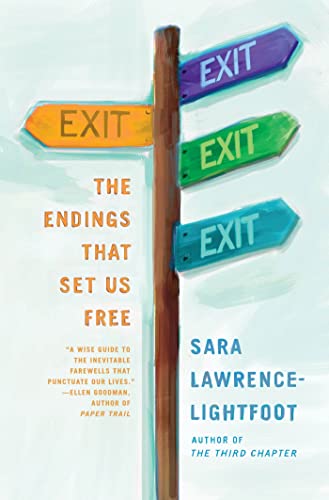
Inhaltsangabe
The wisdom of saying goodbye
In this wise and provocative book, the renowned sociologist Sara Lawrence-Lightfoot trains her lens on the myriad exits we make in our lives: exits big and small, extraordinary and ordinary, quick and protracted, painful and liberating.
Exits are ubiquitous. Part of the historical narrative of our country, they mark the physical landscapes we inhabit; they're braided into the arc of our individual development, laced into our intergenerational relationships, shaped by economic crisis, global mobility, and technological innovations. But we tend to ignore them, often seeing them as signs of failure.
For two years Lawrence-Lightfoot traveled around the country listening to people tell their stories of leaving, witnessing rituals of goodbye, and producing the penetrating portraits that have become her signature. A gay man who finds home and wholeness after coming out of the closet; a sixteen-year-old-boy forced to leave Iran in the midst of a violent civil war; a Catholic priest who leaves the church; an anthropologist who carefully stages her departure from the field after years of research; and many more. Lawrence-Lightfoot shares their stories with sympathy and insight, finding the universal patterns that reframe our exit narratives.
Exit finds wisdom in the possibility of moving on. It marks the start of a new conversation: a chance to discover how to make our exits with dignity and grace.
Die Inhaltsangabe kann sich auf eine andere Ausgabe dieses Titels beziehen.
Über die Autorin bzw. den Autor
Sara Lawrence-Lightfoot, a MacArthur prize-winning sociologist, is the Emily Hargroves Fisher Professor of Education at Harvard University. She is the author of ten books, including The Third Chapter, Respect, The Essential Conversation, and Balm in Gilead, which won the 1988 Christopher Award for "literary merit and humanitarian achievement." She is the recipient of twenty-eight honorary degrees and is the first African American woman in Harvard's history to have an endowed professorship named in her honor.
Auszug. © Genehmigter Nachdruck. Alle Rechte vorbehalten.
Exit
The Endings That Set Us FreeBy Sara Lawrence-LightfootSarah Crichton Books
Copyright © 2013 Sara Lawrence-LightfootAll right reserved.
ISBN: 9780374533908
One
HOME
When most of us think about home, we picture a physical place: the house where we grew up, the address we learned by heart in case we got lost, the room we painted hot pink when we turned eight and our parents allowed us to choose the color, the crack in the third flagstone step leading to the front door, the way no one used the front door anyway, since everyone came in through the back door right off the kitchen. Or our vision of home might be of the house where we now live with our children, where we make the mortgage payments each month and pay the electricity and oil bills, where we have set up a basketball hoop in the driveway for the kids to practice for the big games on Friday night up at the school, where we have barbeques for the neighbors on hot summer evenings, where the traffic and chaos of kids and dogs and busy schedules and homework are both comforting and exhausting. Our vision of home, whether it is the home of our childhood or the home we are creating as adults, has a location, an address, a mark on the map. It is a physical, tangible place. We have photo albums that chronicle our growing family over the years, everyone lined up on the front steps in the same pyramid arrangement—parents on top, kids on the bottom—with smiles that stay the same even as the bodies get bigger and bulkier.
Home is also the place where life is most familiar, where we fall into old patterns, where our roles become scripted and predictable, where there is a fine line between the bonds that bind and constrain. It is also a place where we live by secret codes and allusions that outsiders—even intimate outsiders—don’t understand or appreciate. In her beautiful essay “On Going Home” (1961), Joan Didion speaks about the power and pull of home.
I am home for my daughter’s first birthday. By “home” I do not mean the house in Los Angeles where my husband and I and the baby live, but the place where my family is, in the Central Valley of California. It is a vital though troublesome distinction. My husband likes my family but is uneasy in their house, because once there I fall into their ways which are difficult, oblique, deliberately inarticulate, not my husband’s ways. We live in dusty houses (“D-U-S-T,” he once wrote with his finger on the surfaces all over the house, but no one noticed it) filled with mementos quite without value to him (what could the Canton dessert plates mean to him? How could he have known about the assay scales, why should he care if he did know?) …1
Home, here, is defined as much by those who are outsiders—who have no real clue of what is going on, where signals seem opaque and oblique—as by those who have the inside track, who know the secrets and shadows, the habits and artifacts, the history of the family that lives in this house. Home is made more vivid by the contrasts that get drawn between the outsider’s discomfort and cluelessness and the insider’s ancient and intuitive understandings.
In his biography of the poet Wallace Stevens (1968), Robert Pack echoes Didion’s portrayal of going home, drawing the connection between the intimacy and belonging that home represents and the intimacy with his readers that Stevens achieves through his poetry. Stevens translates the language, rhythm, and cadence from his childhood home into his verse, capturing the themes of family and the feelings of familiarity with which we can all identify. Writes Pack:
Home is the place where one understands the routine, knows the secret rhythms of family activity and communication, and feels the fullness of the presence of the familiar objects. It is this sense of intimacy that Stevens seeks with the world, and it is this sense of order a poet achieves that makes this intimacy possible.2
Here we get a sense of home as the place where we learn to interpret the noises and the silences, the texts and the subtexts of our lives, where the layers and subtleties of our communication are inscribed in our hearts and minds, our bones and bodies, eventually turning up—at least in Stevens’s and Didion’s case—in the form and texture of their art.
The novelist Paule Marshall takes us a step further into the auditory dimensions and cadences of home. In her autobiographical novel, Brown Girl, Brownstones, she offers an evocative and searing portrait of an immigrant family transplanted from Barbados to Brooklyn, and she speaks about home as the sound of the language of the Bajan women as they sit talking in the kitchen.3 It is a language that Marshall herself heard as a child as she sat on the edges of the women’s circle soaking up the gossip, the stories, savoring the rhythms and poetry of their words. In “From the Poets in the Kitchen,” a short essay published in The New York Times, Marshall speaks about the language of home—particularly the talk among the women in the kitchen—that carried with it beauty, wisdom, poetry, and culture, that survived the transplantation from the blue-green sea and open horizons of Barbados to the city streets and brownstones of Brooklyn.
I grew up among poets—whatever that breed is supposed to look like. Nothing about them suggested that poetry was their calling. They were just a group of ordinary housewives and mothers, my mother included, who dressed in a way (shapeless housedresses, dowdy felt hats, dark, solemn coats) that made it impossible for me to imagine they had ever been young.4
So whether we envision home as a place, a physical location on the map that we can now google for directions; whether we feel it in the familiarity, obliqueness, and intimacy of family; or whether we hear it in the language and poetry of our mothers, home is the place we return to. It is the place that forms us, that embraces and inhibits us, that shapes our identity. It is a place where our arrival is awaited.
The tales of exit found in this chapter reframe and transfigure the meaning of home. The two stories—of a teenage Iranian boy escaping the political strife and violence in his war-torn country to come to America, and of a middle-aged gay man reflecting on his long and brave exit from the closet—shape a view of home that is earned and discovered after the protagonists have traveled far away, literally and figuratively, from their family’s place of origin, far away from the cultures and communities that nourished and raised them. The lens of exit in both narratives points to the emotional and spiritual construction of home as a hard-won place of comfort, safety, belonging, and love. Finding home requires leaving and searching, trials and tribulations, and many exits along the way.
HUNGRY FOR HOME
“I’ll go.”
It did not hit him that he was actually leaving—his family, his country, his life—until he arrived at the airport in Tehran, surrounded by his parents and siblings and a huge crowd of aunts and uncles, some of whom had traveled hundreds of miles to say goodbye. He was carrying one small cardboard suitcase, and his mother had sewn a zippered pouch into his underwear to hide the $3,000 he was taking with him. His father had had to sell a plot of land, use all of the family’s savings, and borrow from his uncles in order to come up with the...
„Über diesen Titel“ kann sich auf eine andere Ausgabe dieses Titels beziehen.
Suchergebnisse für Exit: The Endings That Set Us Free

Beispielbild für diese ISBN
Exit
Anbieter: World of Books (was SecondSale), Montgomery, IL, USA
Verkäuferbewertung 5 von 5 Sternen

Paperback. Zustand: Good. The wisdom of saying goodbye In this wise and provocative book, the renowned sociologist Sara Lawrence-Lightfoot trains her lens on the myriad exits we make in our lives: exits big and small, extraordinary and ordinary, quick and protracted, painful and liberating. Exits are ubiquitous. Part of the historical narrative of our country, they mark the physical landscapes we inhabit; they're braided into the arc of our individual development, laced into our intergenerational relationships, shaped by economic crisis, global mobility, and technological innovations. But we tend to ignore them, often seeing them as signs of failure. For two years Lawrence-Lightfoot traveled around the country listening to people tell their stories of leaving, witnessing rituals of goodbye, and producing the penetrating portraits that have become her signature. A gay man who finds home and wholeness after coming out of the closet; a sixteen-year-old-boy forced to leave Iran in the midst of a violent civil war; a Catholic priest who leaves the church; an anthropologist who carefully stages her departure from the field after years of research; and many more. Lawrence-Lightfoot shares their stories with sympathy and insight, finding the universal patterns that reframe our exit narratives. Exit finds wisdom in the possibility of moving on. It marks the start of a new conversation: a chance to discover how to make our exits with dignity and grace. Artikel-Nr. 00104918220
Gebraucht kaufen
EUR 4,45
Versand gratis
Versand innerhalb von USA
Versand innerhalb von USA
Anzahl: 1 verfügbar
Beispielbild für diese ISBN
Exit: The Endings That Set Us Free
Verlag:
Sarah Crichton Books (edition Reprint), 2013
ISBN 10: 0374533903
ISBN 13: 9780374533908
Gebraucht
Paperback
Anbieter: BooksRun, Philadelphia, PA, USA
Verkäuferbewertung 5 von 5 Sternen
Paperback. Zustand: Very Good. Reprint. It's a well-cared-for item that has seen limited use. The item may show minor signs of wear. All the text is legible, with all pages included. It may have slight markings and/or highlighting. Artikel-Nr. 0374533903-11-22
Gebraucht kaufen
EUR 4,93
Versand gratis
Versand innerhalb von USA
Versand innerhalb von USA
Anzahl: 1 verfügbar
Beispielbild für diese ISBN
Exit
Anbieter: ThriftBooks-Dallas, Dallas, TX, USA
Verkäuferbewertung 5 von 5 Sternen
Paperback. Zustand: As New. No Jacket. Pages are clean and are not marred by notes or folds of any kind. ~ ThriftBooks: Read More, Spend Less. Artikel-Nr. G0374533903I2N00
Gebraucht kaufen
EUR 6,34
Versand gratis
Versand innerhalb von USA
Versand innerhalb von USA
Anzahl: 1 verfügbar
Beispielbild für diese ISBN
Exit
Anbieter: ThriftBooks-Atlanta, AUSTELL, GA, USA
Verkäuferbewertung 5 von 5 Sternen
Paperback. Zustand: Very Good. No Jacket. May have limited writing in cover pages. Pages are unmarked. ~ ThriftBooks: Read More, Spend Less. Artikel-Nr. G0374533903I4N00
Gebraucht kaufen
EUR 6,34
Versand gratis
Versand innerhalb von USA
Versand innerhalb von USA
Anzahl: 1 verfügbar
Beispielbild für diese ISBN
Exit
Anbieter: ThriftBooks-Atlanta, AUSTELL, GA, USA
Verkäuferbewertung 5 von 5 Sternen
Paperback. Zustand: Good. No Jacket. Pages can have notes/highlighting. Spine may show signs of wear. ~ ThriftBooks: Read More, Spend Less. Artikel-Nr. G0374533903I3N00
Gebraucht kaufen
EUR 6,34
Versand gratis
Versand innerhalb von USA
Versand innerhalb von USA
Anzahl: 1 verfügbar
Beispielbild für diese ISBN
Exit: The Endings That Set Us Free
Anbieter: BookOutlet, Jefferson City, TN, USA
Verkäuferbewertung 5 von 5 Sternen
Paperback. Zustand: New. Paperback. Publisher overstock, may contain remainder mark on edge. Artikel-Nr. 9780374533908B
Beispielbild für diese ISBN
Exit : The Endings That Set Us Free
Verlag:
Farrar, Straus & Giroux, 2013
ISBN 10: 0374533903
ISBN 13: 9780374533908
Gebraucht
Softcover
Anbieter: Better World Books Ltd, Dunfermline, Vereinigtes Königreich
Verkäuferbewertung 5 von 5 Sternen
Zustand: Good. Pages intact with minimal writing/highlighting. The binding may be loose and creased. Dust jackets/supplements are not included. Stock photo provided. Product includes identifying sticker. Better World Books: Buy Books. Do Good. Artikel-Nr. 5685594-20
Gebraucht kaufen
EUR 5,79
EUR 6,00 Versand
Versand von Vereinigtes Königreich nach USA
Versand von Vereinigtes Königreich nach USA
Anzahl: 1 verfügbar
Foto des Verkäufers
Exit : The Endings That Set Us Free
Anbieter: GreatBookPricesUK, Woodford Green, Vereinigtes Königreich
Verkäuferbewertung 5 von 5 Sternen
Zustand: good. May show signs of wear, highlighting, writing, and previous use. This item may be a former library book with typical markings. No guarantee on products that contain supplements Your satisfaction is 100% guaranteed. Twenty-five year bookseller with shipments to over fifty million happy customers. Artikel-Nr. 19497274-5
Gebraucht kaufen
EUR 15,79
EUR 18,00 Versand
Versand von Vereinigtes Königreich nach USA
Versand von Vereinigtes Königreich nach USA
Anzahl: 4 verfügbar
Beispielbild für diese ISBN
Exit: The Endings That Set Us Free
Anbieter: Revaluation Books, Exeter, Vereinigtes Königreich
Verkäuferbewertung 5 von 5 Sternen
Paperback. Zustand: Brand New. reprint edition. 259 pages. 9.00x6.00x1.00 inches. In Stock. Artikel-Nr. x-0374533903
Neu kaufen
EUR 22,55
EUR 12,00 Versand
Versand von Vereinigtes Königreich nach USA
Versand von Vereinigtes Königreich nach USA
Anzahl: 2 verfügbar
Foto des Verkäufers
Exit : The Endings That Set Us Free
Anbieter: GreatBookPricesUK, Woodford Green, Vereinigtes Königreich
Verkäuferbewertung 5 von 5 Sternen
Zustand: As New. Unread book in perfect condition. Artikel-Nr. 19497274
Gebraucht kaufen
EUR 22,32
EUR 18,00 Versand
Versand von Vereinigtes Königreich nach USA
Versand von Vereinigtes Königreich nach USA
Anzahl: Mehr als 20 verfügbar