
Verwandte Artikel zu Thinking, Fast and Slow
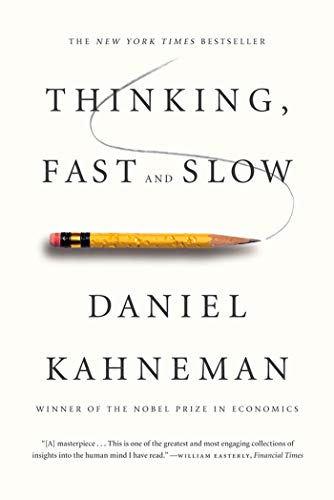
Inhaltsangabe
*Major New York Times Bestseller
*More than 2.6 million copies sold
*One of The New York Times Book Review's ten best books of the year
*Selected by The Wall Street Journal as one of the best nonfiction books of the year
*Presidential Medal of Freedom Recipient
*Daniel Kahneman's work with Amos Tversky is the subject of Michael Lewis's best-selling The Undoing Project: A Friendship That Changed Our Minds
In his mega bestseller, Thinking, Fast and Slow, Daniel Kahneman, world-famous psychologist and winner of the Nobel Prize in Economics, takes us on a groundbreaking tour of the mind and explains the two systems that drive the way we think.
System 1 is fast, intuitive, and emotional; System 2 is slower, more deliberative, and more logical. The impact of overconfidence on corporate strategies, the difficulties of predicting what will make us happy in the future, the profound effect of cognitive biases on everything from playing the stock market to planning our next vacation-each of these can be understood only by knowing how the two systems shape our judgments and decisions.
Engaging the reader in a lively conversation about how we think, Kahneman reveals where we can and cannot trust our intuitions and how we can tap into the benefits of slow thinking. He offers practical and enlightening insights into how choices are made in both our business and our personal lives-and how we can use different techniques to guard against the mental glitches that often get us into trouble. Topping bestseller lists for almost ten years, Thinking, Fast and Slow is a contemporary classic, an essential book that has changed the lives of millions of readers.
Die Inhaltsangabe kann sich auf eine andere Ausgabe dieses Titels beziehen.
Über die Autorin bzw. den Autor
Daniel Kahneman was the Eugene Higgins Professor of Psychology Emeritus at Princeton University and a former professor of public affairs at the Woodrow Wilson School of Public and International Affairs. He received the 2002 Nobel Prize in Economic Sciences for his pioneering work with Amos Tversky on decision-making. He is the author of the international bestseller Thinking, Fast and Slow. He died in 2024.
Auszug. © Genehmigter Nachdruck. Alle Rechte vorbehalten.
Thinking, Fast and Slow
By Daniel KahnemanFarrar, Straus and Giroux
Copyright © 2012 Daniel KahnemanAll right reserved.
ISBN: 9780374533557
THINKING, FAST AND SLOW (Chapter 1)The Characters of the StorySystem 1 operates automatically and quickly, with little or no effort and no sense of voluntary control. System 2 allocates attention to the effortful mental activities that demand it, including complex computations. The operations of System 2 are often associated with the subjective experience of agency, choice, and concentration. Detect that one object is more distant than another. Orient to the source of a sudden sound. Complete the phrase "bread and..." Make a "disgust face" when shown a horrible picture. Detect hostility in a voice. Answer to 2 + 2 = ? Read words on large billboards. Drive a car on an empty road. Find a strong move in chess (if you are a chess master). Understand simple sentences. Recognize that a "meek and tidy soul with a passion for detail" resembles an occupational stereotype. Brace for the starter gun in a race. Focus attention on the clowns in the circus. Focus on the voice of a particular person in a crowded and noisy room. Look for a woman with white hair. Search memory to identify a surprising sound. Maintain a faster walking speed than is natural for you. Monitor the appropriateness of your behavior in a social situation. Count the occurrences of the letter a in a page of text. Tell someone your phone number. Park in a narrow space (for most people except garage attendants). Compare two washing machines for overall value. Fill out a tax form. Check the validity of a complex logical argument.
To observe your mind in automatic mode, glance at the image below.
Figure 1
Your experience as you look at the woman's face seamlessly combines what we normally call seeing and intuitive thinking. As surely and quickly as you saw that the young woman's hair is dark, you knew she is angry. Furthermore, what you saw extended into the future. You sensed that this woman is about to say some very unkind words, probably in a loud and strident voice. A premonition of what she was going to do next came to mind automatically and effortlessly. You did not intend to assess her mood or to anticipate what she might do, and your reaction to the picture did not have the feel of something you did. It just happened to you. It was an instance of fast thinking.
Now look at the following problem:
17 × 24
You knew immediately that this is a multiplication problem, and probably knew that you could solve it, with paper and pencil, if not without. You also had some vague intuitive knowledge of the range of possible results. You would be quick to recognize that both 12,609 and 123 are implausible. Without spending some time on the problem, however, you would not be certain that the answer is not 568. A precise solution did not come to mind, and you felt that you could choose whether or not to engage in the computation. If you have not done so yet, you should attempt the multiplication problem now, completing at least part of it.
You experienced slow thinking as you proceeded through a sequence of steps. You first retrieved from memory the cognitive program for multiplication that you learned in school, then you implemented it. Carrying out the computation was a strain. You felt the burden of holding much material in memory, as you needed to keep track of where you were and of where you were going, while holding on to the intermediate result. The process was mental work: deliberate, effortful, and orderly--a prototype of slow thinking. The computation was not only an event in your mind; your body was also involved. Your muscles tensed up, your blood pressure rose, and your heart rate increased. Someone looking closely at your eyes while you tackled this problem would have seen your pupils dilate. Your pupils contracted back to normal size as soon as you ended your work--when you found the answer (which is 408, by the way) or when you gave up.
Two Systems
Psychologists have been intensely interested for several decades in the two modes of thinking evoked by the picture of the angry woman and by the multiplication problem, and have offered many labels for them. I adopt terms originally proposed by the psychologists Keith Stanovich and Richard West, and will refer to two systems in the mind, System 1 and System 2.
The labels of System 1 and System 2 are widely used in psychology, but I go further than most in this book, which you can read as a psychodrama with two characters.
When we think of ourselves, we identify with System 2, the conscious, reasoning self that has beliefs, makes choices, and decides what to think about and what to do. Although System 2 believes itself to be where the action is, the automatic System 1 is the hero of the book. I describe System 1 as effortlessly originating impressions and feelings that are the main sources of the explicit beliefs and deliberate choices of System 2. The automatic operations of System 1 generate surprisingly complex patterns of ideas, but only the slower System 2 can construct thoughts in an orderly series of steps. I also describe circumstances in which System 2 takes over, overruling the freewheeling impulses and associations of System 1. You will be invited to think of the two systems as agents with their individual abilities, limitations, and functions.
In rough order of complexity, here are some examples of the automatic activities that are attributed to System 1:
All these mental events belong with the angry woman--they occur automatically and require little or no effort. The capabilities of System 1 include innate skills that we share with other animals. We are born prepared to perceive the world around us, recognize objects, orient attention, avoid losses, and fear spiders. Other mental activities become fast and automatic through prolonged practice. System 1 has learned associations between ideas (the capital of France?); it has also learned skills such as reading and understanding nuances of social situations. Some skills, such as finding strong chess moves, are acquired only by specialized experts. Others are widely shared. Detecting the similarity of a personality sketch to an occupational stereotype requires broad knowledge of the language and the culture, which most of us possess. The knowledge is stored in memory and accessed without intention and without effort.
Several of the mental actions in the list are completely involuntary. You cannot refrain from understanding simple sentences in your own language or from orienting to a loud unexpected sound, nor can you prevent yourself from knowing that 2 + 2 = 4 or from thinking of Paris when the capital of France is mentioned. Other activities, such as chewing, are susceptible to voluntary control but normally run on automatic pilot. The control of attention is shared by the two systems. Orienting to a loud sound is normally an involuntary operation of System 1, which immediately mobilizes the voluntary attention of System 2. You may be able to resist turning toward the source of a loud and offensive comment at a crowded party, but even if your head does not move, your attention is initially directed to it, at least for a while. However, attention can be moved away from an unwanted focus, primarily by focusing intently on another target.
The highly diverse operations of System 2 have one feature in common: they require attention and are disrupted when attention is drawn away. Here are some examples:
In all these...
„Über diesen Titel“ kann sich auf eine andere Ausgabe dieses Titels beziehen.
Suchergebnisse für Thinking, Fast and Slow

Foto des Verkäufers
Thinking, Fast and Slow
Verlag:
Farrar, Straus and Giroux, 2013
ISBN 10: 0374533555
ISBN 13: 9780374533557
Gebraucht
Softcover
Anbieter: Dream Books Co., Denver, CO, USA
Verkäuferbewertung 5 von 5 Sternen

Zustand: acceptable. This copy has clearly been enjoyedâ"expect noticeable shelf wear and some minor creases to the cover. Binding is strong, and all pages are legible. May contain previous library markings or stamps. Artikel-Nr. 4EKGY3007XZ3_ns
Gebraucht kaufen
EUR 5,37
Versand gratis
Versand innerhalb von USA
Versand innerhalb von USA
Anzahl: 7 verfügbar
Beispielbild für diese ISBN
Thinking, Fast and Slow
Verlag:
Farrar, Straus and Giroux, 2013
ISBN 10: 0374533555
ISBN 13: 9780374533557
Gebraucht
Paperback
Anbieter: ThriftBooks-Phoenix, Phoenix, AZ, USA
Verkäuferbewertung 5 von 5 Sternen
Paperback. Zustand: Good. No Jacket. Former library book; Pages can have notes/highlighting. Spine may show signs of wear. ~ ThriftBooks: Read More, Spend Less. Artikel-Nr. G0374533555I3N10
Gebraucht kaufen
EUR 6,22
Versand gratis
Versand innerhalb von USA
Versand innerhalb von USA
Anzahl: 1 verfügbar
Beispielbild für diese ISBN
Thinking, Fast and Slow
Verlag:
Farrar, Straus and Giroux, 2013
ISBN 10: 0374533555
ISBN 13: 9780374533557
Gebraucht
Paperback
Anbieter: ThriftBooks-Phoenix, Phoenix, AZ, USA
Verkäuferbewertung 5 von 5 Sternen
Paperback. Zustand: Good. No Jacket. Pages can have notes/highlighting. Spine may show signs of wear. ~ ThriftBooks: Read More, Spend Less. Artikel-Nr. G0374533555I3N00
Gebraucht kaufen
EUR 6,22
Versand gratis
Versand innerhalb von USA
Versand innerhalb von USA
Anzahl: Mehr als 20 verfügbar
Beispielbild für diese ISBN
Thinking, Fast and Slow
Verlag:
Farrar, Straus and Giroux, 2013
ISBN 10: 0374533555
ISBN 13: 9780374533557
Gebraucht
Paperback
Anbieter: ThriftBooks-Reno, Reno, NV, USA
Verkäuferbewertung 5 von 5 Sternen
Paperback. Zustand: Good. No Jacket. Pages can have notes/highlighting. Spine may show signs of wear. ~ ThriftBooks: Read More, Spend Less. Artikel-Nr. G0374533555I3N00
Gebraucht kaufen
EUR 6,22
Versand gratis
Versand innerhalb von USA
Versand innerhalb von USA
Anzahl: Mehr als 20 verfügbar
Beispielbild für diese ISBN
Thinking, Fast and Slow
Verlag:
Farrar, Straus and Giroux, 2013
ISBN 10: 0374533555
ISBN 13: 9780374533557
Gebraucht
Paperback
Anbieter: ThriftBooks-Reno, Reno, NV, USA
Verkäuferbewertung 5 von 5 Sternen
Paperback. Zustand: Good. No Jacket. Former library book; Pages can have notes/highlighting. Spine may show signs of wear. ~ ThriftBooks: Read More, Spend Less. Artikel-Nr. G0374533555I3N10
Gebraucht kaufen
EUR 6,22
Versand gratis
Versand innerhalb von USA
Versand innerhalb von USA
Anzahl: 1 verfügbar
Beispielbild für diese ISBN
Thinking, Fast and Slow
Verlag:
Farrar, Straus and Giroux, 2013
ISBN 10: 0374533555
ISBN 13: 9780374533557
Gebraucht
Paperback
Anbieter: ThriftBooks-Reno, Reno, NV, USA
Verkäuferbewertung 5 von 5 Sternen
Paperback. Zustand: Fair. No Jacket. Readable copy. Pages may have considerable notes/highlighting. ~ ThriftBooks: Read More, Spend Less. Artikel-Nr. G0374533555I5N00
Gebraucht kaufen
EUR 6,22
Versand gratis
Versand innerhalb von USA
Versand innerhalb von USA
Anzahl: 2 verfügbar
Beispielbild für diese ISBN
Thinking, Fast and Slow
Verlag:
Farrar, Straus and Giroux, 2013
ISBN 10: 0374533555
ISBN 13: 9780374533557
Gebraucht
Paperback
Anbieter: ThriftBooks-Phoenix, Phoenix, AZ, USA
Verkäuferbewertung 5 von 5 Sternen
Paperback. Zustand: Fair. No Jacket. Readable copy. Pages may have considerable notes/highlighting. ~ ThriftBooks: Read More, Spend Less. Artikel-Nr. G0374533555I5N00
Gebraucht kaufen
EUR 6,22
Versand gratis
Versand innerhalb von USA
Versand innerhalb von USA
Anzahl: 2 verfügbar
Beispielbild für diese ISBN
Thinking, Fast and Slow
Verlag:
Farrar, Straus and Giroux, 2013
ISBN 10: 0374533555
ISBN 13: 9780374533557
Gebraucht
Paperback
Anbieter: ThriftBooks-Dallas, Dallas, TX, USA
Verkäuferbewertung 5 von 5 Sternen
Paperback. Zustand: Fair. No Jacket. Readable copy. Pages may have considerable notes/highlighting. ~ ThriftBooks: Read More, Spend Less. Artikel-Nr. G0374533555I5N00
Gebraucht kaufen
EUR 6,24
Versand gratis
Versand innerhalb von USA
Versand innerhalb von USA
Anzahl: 3 verfügbar
Beispielbild für diese ISBN
Thinking, Fast and Slow
Verlag:
Farrar, Straus and Giroux, 2013
ISBN 10: 0374533555
ISBN 13: 9780374533557
Gebraucht
Paperback
Anbieter: ThriftBooks-Atlanta, AUSTELL, GA, USA
Verkäuferbewertung 5 von 5 Sternen
Paperback. Zustand: Fair. No Jacket. Readable copy. Pages may have considerable notes/highlighting. ~ ThriftBooks: Read More, Spend Less. Artikel-Nr. G0374533555I5N00
Gebraucht kaufen
EUR 6,24
Versand gratis
Versand innerhalb von USA
Versand innerhalb von USA
Anzahl: 2 verfügbar
Beispielbild für diese ISBN
Thinking, Fast and Slow
Verlag:
Farrar, Straus and Giroux, 2013
ISBN 10: 0374533555
ISBN 13: 9780374533557
Gebraucht
Paperback
Anbieter: ThriftBooks-Atlanta, AUSTELL, GA, USA
Verkäuferbewertung 5 von 5 Sternen
Paperback. Zustand: Good. No Jacket. Former library book; Pages can have notes/highlighting. Spine may show signs of wear. ~ ThriftBooks: Read More, Spend Less. Artikel-Nr. G0374533555I3N10
Gebraucht kaufen
EUR 6,26
Versand gratis
Versand innerhalb von USA
Versand innerhalb von USA
Anzahl: 2 verfügbar