
Verwandte Artikel zu LONG RECESSIONAL: The Imperial Life of Rudyard Kipling
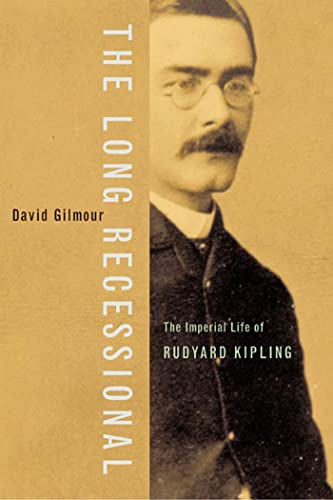
Inhaltsangabe
"Readable and reliable . . . [Gilmour's] assessment of the political background of Kipling's writings is exemplary." —Earl L. Dachslager, Houston Chronicle
David Gilmour's superbly nuanced biography of Rudyard Kipling, now available in paperback, is the first to show how the great writer's life and work mirrored the trajectory of the British Empire, from its zenith to its final decades. His great poem "Recessional" celebrated Queen Victoria's Diamond Jubilee in 1897 and his last poems warned of the dangers of Nazism, while Kipling himself, an icon of the empire, was transformed from an apostle of success to a prophet of national decline. As Gilmour makes clear, Kipling's mysterious and enduring works deeply influenced the way his readers saw both themselves and the British Empire, and they continue to challenge our own generation.
Die Inhaltsangabe kann sich auf eine andere Ausgabe dieses Titels beziehen.
Über die Autorin bzw. den Autor
Sir David Gilmour is one of Britain's most admired and accomplished historical writers and biographers. His books include The Last Leopard, The Long Recessional (FSG, 2002), and The Ruling Caste (FSG, 2006).
Auszug. © Genehmigter Nachdruck. Alle Rechte vorbehalten.
The Long Recessional
The Imperial Life of Rudyard KiplingBy David GilmourFarrar Straus Giroux
Copyright © 2003 David GilmourAll right reserved.
ISBN: 0374528969
Chapter One
Ejections from Paradise
* * *
Rudyard Kipling never wasted time investigating his roots. He as 'not a bit interested' in his ancestry, he reflected in old age, and only wished that a pestering inquirer would desist from hunting down his 'pedigree'.
Rootlessness is in the essence of Kipling's work. He lived in four continents and wrote about six. He crossed the great oceans; he knew the Mediterranean on all its sides; his favourite landscapes were in adverse angles of the Pacific (New Zealand and British Columbia) and in opposite corners of the Atlantic (New England and Cape Colony). At the halfway point of his life he planted laborious roots in Sussex, but it was illness rather than the forests of the Weald that restrained his enthusiasm for travel. In the popular imagination he became ? and remains ? an English jingoist with his heart in India. Yet it would be as accurate to think of him as a citizen of the world in love with France while sometimes still yearning for a previous mistress, South Africa.
Kipling took occasional pride in being a Yorkshireman, a ?tyke? whose family had lived for 200 years in the West Riding. Yet even though he enjoyed hearing 'the good meaty Yorkshire tongue', he was seldom moved to visit the paternal homeland. He believed his ancestors included clock-makers, bell-founders and yeoman farmers, but he knew nothing else about them except that their sons were christened John and Joseph in alternate generations. He was happy in principle to be identified as a Yorkshireman so long as he was not required to assume that identity.
He was not happy, however, to be identified as a Celt. Celtishness suggested affinities with Lloyd George or Irish nationalists, two of Kipling's least favourite organisms. Yet his mother's family were Jacobite Macdonalds who had left the Hebrides after 1745 and settled in Ulster. Inspired by John Wesley, his great-grandfather James joined the Methodist Church and went to England, where his son married Hannah Jones, thereby introducing Welsh blood into the family, a detail about which Rudyard did not boast.
In middle age Kipling became Rector of St Andrews University where he commended the traditional East Coast, non-Celtic Scottish virtues of thrift, common sense and hard work. He could never have been a Calvinist, either in doctrine or in temperament. But he admired the society he believed Presbyterianism had created in Scotland: the system of education, the making of a 'portentous, granite-gutted, self-sufficient community'.
Kipling's innate romanticism, never as submerged as is sometimes thought, surfaced as soon as he saw the heather or read Stevenson and remembered the Jacobites. Although he was incurious about the origins of his Macdonald forebears, he was a partisan of their clan's historic feud with the Campbells. His mother, he told a Highlander during the Boer War, had 'taught [me] never to like a Campbell', and he followed her precept half-seriously ever after: travelling in the ?enemy? territory of Argyllshire in 1919, he found himself ?cursing all Campbells? and admitting that, despite their scenery, he could never love them. If it was strange to dismiss roots yet accept rooted ancestral prejudice, at least he was consistent in the matter. Attempting to explain his highly partisan stance on Ireland in 1911, he wondered half-humorously whether it had anything to do with his ?great-great grandfather buried at Ballynamallard in a grim methody churchyard?.
Methodism flowed into his veins from Yorkshire as well as from the Celtic fringe. Both of Kipling's grandfathers were Methodist ministers. So were his mother's brother and her grandfather: their Macdonald ministry lasted unbroken for three generations and 144 years. Yet these were relaxed strains of Methodism. Kipling's uncle, Frederic Macdonald, may have become President of the Wesleyan Methodist Conference, but his four married sisters all had Anglican weddings. Alice Macdonald, Kipling's mother, is even said to have thrown a lock of John Wesley's hair on to the fire with the cry, ?See! A hair of the dog that bit us!? Kipling's father, Lockwood, was equally disrespectful of his religious heritage, a sceptic who found it ?grievously demoralising? to meet parsons, especially at teatime with their wives. The result was that Rudyard was no more a Methodist than he was a Calvinist. In his adult poems he often invoked a Divinity ? whom he vaguely believed in ? and certainly he respected other people's religions. But he was never, in any real sense, a practising Christian. Whatever bigotries he may have collected in the course of his life, religious ones were absent.
Alice Macdonald was an attractive, vivacious and mildly mischievous girl. She was also a flirt: her youngest sister remarked that she seemed unable ?to go on a visit without becoming engaged to some wild cad of the desert?. Impetuous, musical and tartly humorous, in personality she was very unlike Lockwood, the serene, tolerant, slow-moving man whom she married in March 1865. But as friends pointed out, they had ?congenial tastes and contrasted temperaments?; they shared similar interests, were ?most excellent company? and could ?see persons and events from the humorous side?.
As a matrimonial catch, Lockwood was not in the same league as her sisters' husbands: the painters Edward Burne-Jones and Edward Poynter, and the wealthy ironmaster Alfred Baldwin, the father of Stanley. But this short, bearded and prematurely venerable man had much charm and wisdom. A friend used to refer to him as Socrates because he resembled sculptures of the Athenian philosopher, although she later felt that his ?intense interest in the world of man and nature? made Chaucer a more appropriate comparison. A sculptor and craftsman of skill and diligence, he was dispatched to Bombay soon after his wedding to teach at the School of Art and Industry. As a natural ally of the Arts and Crafts Movement in Britain, he was well suited to a post intended to preserve and rejuvenate the crafts of India.
Rudyard inherited far more from his father than from his mother. Poor Alice had no success in transmitting her musical talent to a boy who admitted near the end of his life that Allah had excluded all music from his ?make-up except the brute instinct for beat, as necessary for the manufacture of verse?. But from Lockwood, Rudyard acquired a love of craft skills and the belief that craftsmanship is the essential basis of all great art. 'He treated me always as a comrade,' Kipling recalled in old age, 'and his severest orders were at most suggestions or invitations.' No doubt it was this approach that made his son so receptive to his ideas: the love of animals and France and India; the dislike of Germans and missionaries; the sceptical views on religion and the conservative opinions on politics. Most of Rudyard's tastes and prejudices were in the blood. After his parents died within a few weeks of each other in the winter of 1910-11, he wrote: 'Dear as my mother was, my father was more to me than most men are to their sons: and now that I have no one to talk or write to I find myself desolate.'...
„Über diesen Titel“ kann sich auf eine andere Ausgabe dieses Titels beziehen.
Suchergebnisse für LONG RECESSIONAL: The Imperial Life of Rudyard Kipling

Beispielbild für diese ISBN
The Long Recessional: The Imperial Life of Rudyard Kipling
Verlag:
Farrar, Straus and Giroux (edition Reprint), 2003
ISBN 10: 0374528969
ISBN 13: 9780374528966
Gebraucht
Paperback
Anbieter: BooksRun, Philadelphia, PA, USA
Verkäuferbewertung 5 von 5 Sternen

Paperback. Zustand: Very Good. Reprint. It's a well-cared-for item that has seen limited use. The item may show minor signs of wear. All the text is legible, with all pages included. It may have slight markings and/or highlighting. Artikel-Nr. 0374528969-11-1
Gebraucht kaufen
EUR 5,49
Versand gratis
Versand innerhalb von USA
Versand innerhalb von USA
Anzahl: 1 verfügbar
Beispielbild für diese ISBN
The Long Recessional : The Imperial Life of Rudyard Kipling
Verlag:
Farrar, Straus & Giroux, 2003
ISBN 10: 0374528969
ISBN 13: 9780374528966
Gebraucht
Softcover
Anbieter: Better World Books, Mishawaka, IN, USA
Verkäuferbewertung 5 von 5 Sternen
Zustand: Good. Reprint. Pages intact with minimal writing/highlighting. The binding may be loose and creased. Dust jackets/supplements are not included. Stock photo provided. Product includes identifying sticker. Better World Books: Buy Books. Do Good. Artikel-Nr. 7913973-6
Gebraucht kaufen
EUR 8,53
Versand gratis
Versand innerhalb von USA
Versand innerhalb von USA
Anzahl: 1 verfügbar
Beispielbild für diese ISBN
The Long Recessional: The Imperial Life of Rudyard Kipling
Verlag:
Farrar, Straus and Giroux, 2003
ISBN 10: 0374528969
ISBN 13: 9780374528966
Gebraucht
paperback
Anbieter: Magers and Quinn Booksellers, Minneapolis, MN, USA
Verkäuferbewertung 5 von 5 Sternen
paperback. Zustand: Very Good. May have light to moderate shelf wear and/or a remainder mark. Complete. Clean pages. Artikel-Nr. 1469018
Gebraucht kaufen
EUR 7,54
EUR 3,55 Versand
Versand innerhalb von USA
Versand innerhalb von USA
Anzahl: 1 verfügbar