
Verwandte Artikel zu Super Stock Rookie (Motor Novels)
Inhaltsangabe
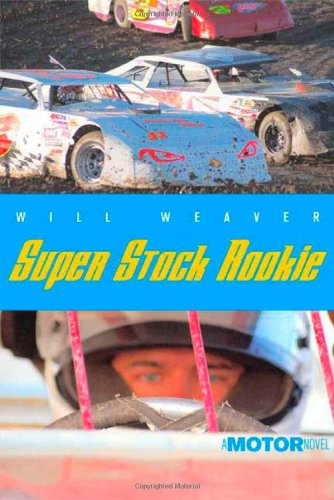
Trace Bonham knows he is fortunate to be offered a chance at being a paid super stock driver while he is still in high school, but regrets that he must leave his friends, including the girl he likes, and hometown speedway.
Die Inhaltsangabe kann sich auf eine andere Ausgabe dieses Titels beziehen.
Über die Autorin bzw. den Autor
WILL WEAVER has written numerous novels, including Defect, winner of the Minnesota Book Award for Young Adult Literature, and Full Service, a YALSA Best Book for Young Adults. Mr. Weaver lives in Bemidji, Minnesota, and is the owner of black No. 16, a Modified race car co-sponsored by Farrar, Straus and Giroux that races in the WISSOTA circuit in the Upper Midwest.
Auszug. © Genehmigter Nachdruck. Alle Rechte vorbehalten.
1
Trace Bonham’s phone beeped in his hand. NERVOUS YET? The text message was from Patrick, who was riding with Mel in her car.
NOT YET, Trace keyed back.
Trace and his dad, Don Bonham, rolled west on U.S. Highway 2 at seventy-plus. Right behind were Mel and friends in her white Toyota. Following Mel was Tyler, Trace’s pit man, alone in his Chevy pickup. Their destination: Trace’s Super Stock tryout at Rivers Speedway in Grand Forks, North Dakota. On both sides of the highway, flat fields shimmered in the July heat.
His phone beeped again. HOW ABOUT NOW?
“I wish you’d put that damn phone away and get your mind right for racing!” Trace’s dad said sharply. His dark brown eyes threw a glare in his son’s direction.
“It’s not like you don’t get a few calls from Linda,” Trace shot back. Linda was his father’s girlfriend; Trace’s mother lived in Wisconsin.
“True,” his dad said. “But I also take care of business. I’m just saying that you don’t get a chance like this every day. You have to be ready.”
“Like I don’t know that?” Trace answered. This Super Stock tryout was a huge deal to his dad. He had been obsessing on it ever since Cal Hopkins, the Late Model points leader and former sprint car driver, had seen Trace win at Headwaters Speedway earlier in the month and invited him to the tryout. Obsessing on that and Linda, a nurse in Detroit Lakes whom Trace had never met.
“For a young driver like you, this is a potentially career-making opportunity—but you have to want it,” his dad said.
“I want it, all right?” Trace said, sudden anger in his voice.
His father fell silent.
HOW ABOUT NOW? read the text message, this time from Mel’s phone.
Trace glanced over his shoulder. Mel—Melody Walters—seventeen, who managed Headwaters Speedway for her dad, was behind the wheel; she smiled and waved with both hands. She wore sunglasses and her usual World of Outlaws cap. Her car appeared to be empty. Mel put her hands behind her head like she was bored with driving, and looked off across the fields. As if on automatic pilot, her Toyota continued straight down the highway.
CUTE, Trace keyed.
A few seconds later, Patrick Fletcher and the other kids in Mel’s car popped up and Mel grabbed back the steering wheel. They all laughed like fools, waving and making faces and obscene gestures at Trace like a carload of patients escaped from the nuthouse. Cute, but annoying. Patrick—whose “gofer” duties at Headwaters included singing the national anthem—got to ride with Mel, while Trace was stuck for two hours with his dad in their big Chevy Tahoe.
“I wish we could have kept this whole thing more under wraps,” his father said, glancing into the rearview mirror.
Trace faked a yawn, certain to annoy his dad, and tipped back his seat. Pulling his cap brim down over his face, Trace closed his eyes. Instead of sleeping, he concentrated on the Super Stock practice laps he had done at Headwaters Speedway . . .
“Start out slow. No rush. First you need to get the feel of the car,” John Sitz shouted above the engine noise of his own yellow No. 29 Super Stock. From the cockpit, Trace nodded. He was strapped in, buckled down, ready to roll. Johnny Walters had opened the Headwaters Speedway track on a Monday morning just for Trace—so he could get ready for his Wednesday tryout in Grand Forks. Local racing people were like that, like family. If you needed something at the track—a tire, an air compressor, a socket wrench, a coil spring—or if you needed help off the track in order to be ready for race night, all you had to do was ask. Or not. As with a family, everybody who raced at Headwaters knew everything about everyone, and when word got around about Trace’s tryout, John Sitz had stepped up to volunteer his Super Stock (he also raced Late Models) without being asked.
Trace feathered the accelerator and checked the gauges: red, blue, and green for oil pressure, water temperature, and fuel pressure.
“All good?” John called, leaning into the cockpit to look at the flat dashboard.
Trace nodded again, impatient to get going.
“Remember, you’ve got a lot more horsepower than that Street Stock of yours,” Sitz shouted, “but don’t be afraid of it. Make it work for you. Trust the car.”
Trace nodded, half listening. He wondered at what rpm his heart was beating.
“Take a few slow laps to get the feel of the steering and the setup, all right?”
Trace looked down pit row. He flexed his left leg. Sitz’s clutch was strung way softer than he was used to. He brought up the rpm for a smooth start—then lurched forward and killed the engine.
John’s laughter filled the suddenly quiet cockpit. “Don’t worry about it. This beast has a hair trigger for a clutch.”
Trace quickly restarted the engine and, with more rpm and a slower pedal release, eased forward down pit row. Idling along at a throaty rumble, Trace felt strange being the only driver, the only car in the pits; everything seemed larger, and farther away. Then again, Trace was glad there weren’t any other spectators. He blipped the throttle—and the Chevy V-8 engine barked like a big dog on a short chain. Steering No. 29 to the entrance at turn 4, he rolled up over the embankment and down onto the track. In this car the dirt was way closer—as if he could reach down and touch it.
Crawling around the track at yellow-flag speed, No. 29 was a Thoroughbred racehorse itching to run. By contrast, Trace’s Street Stock was an old workhorse. He damn well better make the new Super Stock team; it would be tough going back to his old car.
Johnny Walters, Mel’s father and the track owner, sat on his ATV by the exit at turn 3. Trace’s father and John Sitz stood next to him, leaning against the big bumper tires, with their arms crossed. As Trace came by on his first lap, his father did not, he was glad to see, give a thumbs-up or wave.
On the straightaway and then on the banked turn, Trace swerved the car left, right, left, as he tried to get a feel for the steering quickener, for the shock absorbers, for the tires. After Trace’s fifth slow lap, John stepped forward and waggled his right pointer finger: a little faster.
Trace brought the speed up slightly, intermittently punching the accelerator, breaking loose the rear tires. The engine’s throaty grunts echoed in the empty grandstand. The Super Stock wanted to run; it hated being held down. After a couple of laps at this pace, Trace’s back muscles relaxed; his spine began to conform to the seat. He loosened his ten o’clock–two o’clock death grip on the steering wheel.
As Trace approached turn 3, John stepped forward and spun his pointer finger in a quick, tight circle: hot laps!
Trace cranked up the thunder. He took the car into the turn at what he guessed was three-quarters speed. No. 29 hugged the inside bank, then pitched itself out of the apex like a baseball curling out of a pitcher’s hand. His old Street Stock leaned, tipped, and tilted through the turns. Most full-framed race cars were happy to be done with a turn and headed down the straightaway; this Super Stock loved the turns—couldn’t get to them quick enough.
Trace pressed faster around the track. The more he trusted the car and the setup, the smoother—and faster—he felt. After several hot laps, John abruptly waved him into the pits. Trace turned off the track and killed the rumbling engine. He coasted to a stop.
“Okay,” John said. “Looks like you’re getting a feel for the...
Trace Bonham’s phone beeped in his hand. NERVOUS YET? The text message was from Patrick, who was riding with Mel in her car.
NOT YET, Trace keyed back.
Trace and his dad, Don Bonham, rolled west on U.S. Highway 2 at seventy-plus. Right behind were Mel and friends in her white Toyota. Following Mel was Tyler, Trace’s pit man, alone in his Chevy pickup. Their destination: Trace’s Super Stock tryout at Rivers Speedway in Grand Forks, North Dakota. On both sides of the highway, flat fields shimmered in the July heat.
His phone beeped again. HOW ABOUT NOW?
“I wish you’d put that damn phone away and get your mind right for racing!” Trace’s dad said sharply. His dark brown eyes threw a glare in his son’s direction.
“It’s not like you don’t get a few calls from Linda,” Trace shot back. Linda was his father’s girlfriend; Trace’s mother lived in Wisconsin.
“True,” his dad said. “But I also take care of business. I’m just saying that you don’t get a chance like this every day. You have to be ready.”
“Like I don’t know that?” Trace answered. This Super Stock tryout was a huge deal to his dad. He had been obsessing on it ever since Cal Hopkins, the Late Model points leader and former sprint car driver, had seen Trace win at Headwaters Speedway earlier in the month and invited him to the tryout. Obsessing on that and Linda, a nurse in Detroit Lakes whom Trace had never met.
“For a young driver like you, this is a potentially career-making opportunity—but you have to want it,” his dad said.
“I want it, all right?” Trace said, sudden anger in his voice.
His father fell silent.
HOW ABOUT NOW? read the text message, this time from Mel’s phone.
Trace glanced over his shoulder. Mel—Melody Walters—seventeen, who managed Headwaters Speedway for her dad, was behind the wheel; she smiled and waved with both hands. She wore sunglasses and her usual World of Outlaws cap. Her car appeared to be empty. Mel put her hands behind her head like she was bored with driving, and looked off across the fields. As if on automatic pilot, her Toyota continued straight down the highway.
CUTE, Trace keyed.
A few seconds later, Patrick Fletcher and the other kids in Mel’s car popped up and Mel grabbed back the steering wheel. They all laughed like fools, waving and making faces and obscene gestures at Trace like a carload of patients escaped from the nuthouse. Cute, but annoying. Patrick—whose “gofer” duties at Headwaters included singing the national anthem—got to ride with Mel, while Trace was stuck for two hours with his dad in their big Chevy Tahoe.
“I wish we could have kept this whole thing more under wraps,” his father said, glancing into the rearview mirror.
Trace faked a yawn, certain to annoy his dad, and tipped back his seat. Pulling his cap brim down over his face, Trace closed his eyes. Instead of sleeping, he concentrated on the Super Stock practice laps he had done at Headwaters Speedway . . .
“Start out slow. No rush. First you need to get the feel of the car,” John Sitz shouted above the engine noise of his own yellow No. 29 Super Stock. From the cockpit, Trace nodded. He was strapped in, buckled down, ready to roll. Johnny Walters had opened the Headwaters Speedway track on a Monday morning just for Trace—so he could get ready for his Wednesday tryout in Grand Forks. Local racing people were like that, like family. If you needed something at the track—a tire, an air compressor, a socket wrench, a coil spring—or if you needed help off the track in order to be ready for race night, all you had to do was ask. Or not. As with a family, everybody who raced at Headwaters knew everything about everyone, and when word got around about Trace’s tryout, John Sitz had stepped up to volunteer his Super Stock (he also raced Late Models) without being asked.
Trace feathered the accelerator and checked the gauges: red, blue, and green for oil pressure, water temperature, and fuel pressure.
“All good?” John called, leaning into the cockpit to look at the flat dashboard.
Trace nodded again, impatient to get going.
“Remember, you’ve got a lot more horsepower than that Street Stock of yours,” Sitz shouted, “but don’t be afraid of it. Make it work for you. Trust the car.”
Trace nodded, half listening. He wondered at what rpm his heart was beating.
“Take a few slow laps to get the feel of the steering and the setup, all right?”
Trace looked down pit row. He flexed his left leg. Sitz’s clutch was strung way softer than he was used to. He brought up the rpm for a smooth start—then lurched forward and killed the engine.
John’s laughter filled the suddenly quiet cockpit. “Don’t worry about it. This beast has a hair trigger for a clutch.”
Trace quickly restarted the engine and, with more rpm and a slower pedal release, eased forward down pit row. Idling along at a throaty rumble, Trace felt strange being the only driver, the only car in the pits; everything seemed larger, and farther away. Then again, Trace was glad there weren’t any other spectators. He blipped the throttle—and the Chevy V-8 engine barked like a big dog on a short chain. Steering No. 29 to the entrance at turn 4, he rolled up over the embankment and down onto the track. In this car the dirt was way closer—as if he could reach down and touch it.
Crawling around the track at yellow-flag speed, No. 29 was a Thoroughbred racehorse itching to run. By contrast, Trace’s Street Stock was an old workhorse. He damn well better make the new Super Stock team; it would be tough going back to his old car.
Johnny Walters, Mel’s father and the track owner, sat on his ATV by the exit at turn 3. Trace’s father and John Sitz stood next to him, leaning against the big bumper tires, with their arms crossed. As Trace came by on his first lap, his father did not, he was glad to see, give a thumbs-up or wave.
On the straightaway and then on the banked turn, Trace swerved the car left, right, left, as he tried to get a feel for the steering quickener, for the shock absorbers, for the tires. After Trace’s fifth slow lap, John stepped forward and waggled his right pointer finger: a little faster.
Trace brought the speed up slightly, intermittently punching the accelerator, breaking loose the rear tires. The engine’s throaty grunts echoed in the empty grandstand. The Super Stock wanted to run; it hated being held down. After a couple of laps at this pace, Trace’s back muscles relaxed; his spine began to conform to the seat. He loosened his ten o’clock–two o’clock death grip on the steering wheel.
As Trace approached turn 3, John stepped forward and spun his pointer finger in a quick, tight circle: hot laps!
Trace cranked up the thunder. He took the car into the turn at what he guessed was three-quarters speed. No. 29 hugged the inside bank, then pitched itself out of the apex like a baseball curling out of a pitcher’s hand. His old Street Stock leaned, tipped, and tilted through the turns. Most full-framed race cars were happy to be done with a turn and headed down the straightaway; this Super Stock loved the turns—couldn’t get to them quick enough.
Trace pressed faster around the track. The more he trusted the car and the setup, the smoother—and faster—he felt. After several hot laps, John abruptly waved him into the pits. Trace turned off the track and killed the rumbling engine. He coasted to a stop.
“Okay,” John said. “Looks like you’re getting a feel for the...
„Über diesen Titel“ kann sich auf eine andere Ausgabe dieses Titels beziehen.
Suchergebnisse für Super Stock Rookie (Motor Novels)

Beispielbild für diese ISBN
Super Stock Rookie
Anbieter: World of Books (was SecondSale), Montgomery, IL, USA
Verkäuferbewertung 5 von 5 Sternen

Hardback. Zustand: Good. Artikel-Nr. 00110546898
Gebraucht kaufen
EUR 7,01
Versand gratis
Versand innerhalb von USA
Versand innerhalb von USA
Anzahl: 1 verfügbar
Beispielbild für diese ISBN
Super Stock Rookie
Verlag:
Farrar, Straus & Giroux, 2009
ISBN 10: 0374350612
ISBN 13: 9780374350611
Gebraucht
Hardcover
Erstausgabe
Anbieter: Better World Books, Mishawaka, IN, USA
Verkäuferbewertung 5 von 5 Sternen
Zustand: Good. First Edition. Former library copy. Pages intact with minimal writing/highlighting. The binding may be loose and creased. Dust jackets/supplements are not included. Includes library markings. Stock photo provided. Product includes identifying sticker. Better World Books: Buy Books. Do Good. Artikel-Nr. GRP67750451
Gebraucht kaufen
EUR 7,07
Versand gratis
Versand innerhalb von USA
Versand innerhalb von USA
Anzahl: 2 verfügbar