
Verwandte Artikel zu The Money Tree
Inhaltsangabe
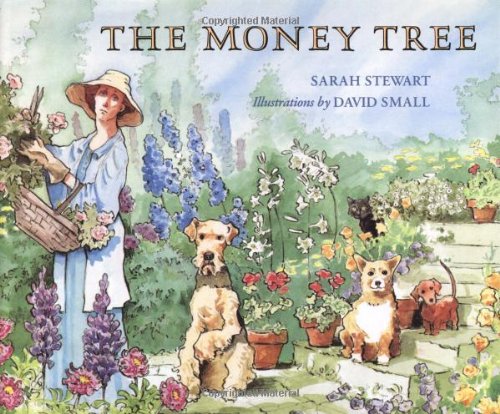
Miss McGillicuddy's simple country routine continues through-out the year in spite of a very unusual tree growing in her yard.
Die Inhaltsangabe kann sich auf eine andere Ausgabe dieses Titels beziehen.
Über die Autorin bzw. den Autor
Husband and wife duo Sarah Stewart and David Small have worked together on several picture books, including The Gardener, a Caldecott Honor book available from Square Fish. Small has also illustrated other books, including the 2001 Caldecott Medal winner So You Want to Be President?, by Judith St. George. Stewart and Small live in a historic home on a bend of the St. Joseph River in Michigan.
Rezensionen
PreSchool-Grade 3-- In January Miss McGillicuddy notices a strange tree in her yard. Month by month, as the seasons change, it grows, faster than any normal plant, into a money tree. Friends, then neighbors, then strangers, then a crowd, ``surging back and forth,'' come to pluck its leaves. Each page recounts, in two sentences of restrained text, Miss McGillicuddy's seasonal activities and her observations of the tree and its changes. The illustrations in pale watercolors show the woman as tall, willowy, and faintly old-fashioned. She's a little out of touch with the times perhaps, but obviously at home with her own life and therefore attractive and pleasing. She is usually placed to the side of the picture, pausing in her activity to observe the tree, which is not always seen by readers. This enhances the sense of Miss McGillicuddy as an observer. The only double-page spread shows the crowds scrambling for the money leaves. It is done with black silhouettes against a dark blue and purple sky, separating it pictorially from the pale orderly pictures of Miss McGillicuddy's world. This quirky little story has charm, but it is perhaps too quiet and the woman too passive an observer for most children. She seems so cool and remote from the tree and the greedy crowds that when she takes action and cuts it up for firewood, the sense of completion and problem solved is diffused. Nevertheless, although not wildly ironic like Heide's Treehorn's Treasure (Holiday, 1981), this book, in a quiet way, makes a definite statement about the foibles of humankind. --Karen James, Louisville Free Public Library, KY
Copyright 1992 Reed Business Information, Inc.
From the window of her cozy farmhouse, Miss McGillicuddy notices "an unusual shape" poking through the snow. By spring it has grown into an oddly configured tree the branches of which are laden not with leaves but with dollar bills. Word of this extravagant foliage spreads fast and far, and all summer long the woman watches quietly as townsfolk and strangers greedily pick money from her tree. After its leaves drop to the ground and winter arrives once again, Miss McGillicuddy decides to chop down the tree, and she is left with something very valuable indeed: wood that will keep her warm during the coldest months. Though its message may be beyond the reach of some readers, Stewart's first book will raise worthwhile questions for both children and adults. Yet more exceptional than the story are Small's ( Paper John ) paintings. Often reminiscent of the art of Carl Larsson, these evocative, pastel-filled watercolors echo the hushed, mysterious tone of the tale. Ages 5-up.
Copyright 1991 Reed Business Information, Inc.
In January, Mrs. McGillicuddy observes an unusual shape out
in the snow. By March it's an extraordinary tree that, in May,
bears a profusion of U.S. currency. She shares it with a few
children, whose parents arrive in June to share the bounty--the
first of what becomes an invasion of people motivated first by
``special projects'' and finally by simple greed. By December,
it's all over: the leaves are gone, and Mrs. McGillicuddy is
preparing to use the tree for her fire. In his mellow,
beautifully drawn illustrations, Small reflects the text's
understated tone by focusing on the continued serenity of the
good lady's house and garden and her pleasure in her dogs, birds,
and flowers--rather than on the not-so-gentle satire implicit in
this offbeat parable. Handsome and thought-provoking. (Picture
book. 5-10) -- Copyright ©1991, Kirkus Associates, LP. All rights reserved.
„Über diesen Titel“ kann sich auf eine andere Ausgabe dieses Titels beziehen.
Suchergebnisse für The Money Tree

Beispielbild für diese ISBN
The Money Tree
Verlag:
Farrar, Straus and Giroux (BYR), 1991
ISBN 10: 0374350140
ISBN 13: 9780374350147
Gebraucht
Hardcover
Anbieter: World of Books (was SecondSale), Montgomery, IL, USA
Verkäuferbewertung 5 von 5 Sternen

Hardback. Zustand: Good. Small, David (illustrator). Artikel-Nr. 00110149280
Gebraucht kaufen
EUR 4,55
Versand gratis
Versand innerhalb von USA
Versand innerhalb von USA
Anzahl: 1 verfügbar
Beispielbild für diese ISBN
The Money Tree
Verlag:
Farrar, Straus and Giroux (BYR), 1991
ISBN 10: 0374350140
ISBN 13: 9780374350147
Gebraucht
Hardcover
Anbieter: World of Books (was SecondSale), Montgomery, IL, USA
Verkäuferbewertung 5 von 5 Sternen
Hardback. Zustand: Fair. Small, David (illustrator). Artikel-Nr. 00099028445
Gebraucht kaufen
EUR 4,55
Versand gratis
Versand innerhalb von USA
Versand innerhalb von USA
Anzahl: 1 verfügbar
Beispielbild für diese ISBN
The Money Tree
Verlag:
Farrar, Straus and Giroux (BYR), 1991
ISBN 10: 0374350140
ISBN 13: 9780374350147
Gebraucht
Hardcover
Anbieter: ThriftBooks-Reno, Reno, NV, USA
Verkäuferbewertung 5 von 5 Sternen
Hardcover. Zustand: Fair. No Jacket. Small, David (illustrator). Readable copy. Pages may have considerable notes/highlighting. ~ ThriftBooks: Read More, Spend Less. Artikel-Nr. G0374350140I5N00
Gebraucht kaufen
EUR 6,01
Versand gratis
Versand innerhalb von USA
Versand innerhalb von USA
Anzahl: 1 verfügbar
Beispielbild für diese ISBN
The Money Tree
Verlag:
Farrar, Straus and Giroux (BYR), 1991
ISBN 10: 0374350140
ISBN 13: 9780374350147
Gebraucht
Hardcover
Anbieter: ThriftBooks-Reno, Reno, NV, USA
Verkäuferbewertung 5 von 5 Sternen
Hardcover. Zustand: Very Good. No Jacket. Small, David (illustrator). Former library book; May have limited writing in cover pages. Pages are unmarked. ~ ThriftBooks: Read More, Spend Less. Artikel-Nr. G0374350140I4N10
Gebraucht kaufen
EUR 6,01
Versand gratis
Versand innerhalb von USA
Versand innerhalb von USA
Anzahl: 1 verfügbar
Beispielbild für diese ISBN
The Money Tree
Verlag:
Farrar, Straus and Giroux (BYR), 1991
ISBN 10: 0374350140
ISBN 13: 9780374350147
Gebraucht
Hardcover
Anbieter: ThriftBooks-Phoenix, Phoenix, AZ, USA
Verkäuferbewertung 5 von 5 Sternen
Hardcover. Zustand: Fair. No Jacket. Small, David (illustrator). Readable copy. Pages may have considerable notes/highlighting. ~ ThriftBooks: Read More, Spend Less. Artikel-Nr. G0374350140I5N00
Gebraucht kaufen
EUR 6,01
Versand gratis
Versand innerhalb von USA
Versand innerhalb von USA
Anzahl: 1 verfügbar
Beispielbild für diese ISBN
The Money Tree
Verlag:
Farrar, Straus and Giroux (BYR), 1991
ISBN 10: 0374350140
ISBN 13: 9780374350147
Gebraucht
Hardcover
Anbieter: ThriftBooks-Atlanta, AUSTELL, GA, USA
Verkäuferbewertung 5 von 5 Sternen
Hardcover. Zustand: Fair. No Jacket. Small, David (illustrator). Missing dust jacket; Readable copy. Pages may have considerable notes/highlighting. ~ ThriftBooks: Read More, Spend Less. Artikel-Nr. G0374350140I5N01
Gebraucht kaufen
EUR 6,03
Versand gratis
Versand innerhalb von USA
Versand innerhalb von USA
Anzahl: 1 verfügbar
Beispielbild für diese ISBN
The Money Tree
Verlag:
Farrar, Straus and Giroux (BYR), 1991
ISBN 10: 0374350140
ISBN 13: 9780374350147
Gebraucht
Hardcover
Anbieter: ThriftBooks-Atlanta, AUSTELL, GA, USA
Verkäuferbewertung 5 von 5 Sternen
Hardcover. Zustand: Fair. No Jacket. Small, David (illustrator). Readable copy. Pages may have considerable notes/highlighting. ~ ThriftBooks: Read More, Spend Less. Artikel-Nr. G0374350140I5N00
Gebraucht kaufen
EUR 6,03
Versand gratis
Versand innerhalb von USA
Versand innerhalb von USA
Anzahl: 1 verfügbar
Beispielbild für diese ISBN
The Money Tree
Verlag:
Farrar, Straus and Giroux (BYR), 1991
ISBN 10: 0374350140
ISBN 13: 9780374350147
Gebraucht
Hardcover
Anbieter: ThriftBooks-Dallas, Dallas, TX, USA
Verkäuferbewertung 5 von 5 Sternen
Hardcover. Zustand: Fair. No Jacket. Small, David (illustrator). Readable copy. Pages may have considerable notes/highlighting. ~ ThriftBooks: Read More, Spend Less. Artikel-Nr. G0374350140I5N00
Gebraucht kaufen
EUR 6,03
Versand gratis
Versand innerhalb von USA
Versand innerhalb von USA
Anzahl: 1 verfügbar
Beispielbild für diese ISBN
The Money Tree
Verlag:
Farrar, Straus and Giroux (BYR), 1991
ISBN 10: 0374350140
ISBN 13: 9780374350147
Gebraucht
Hardcover
Anbieter: ThriftBooks-Dallas, Dallas, TX, USA
Verkäuferbewertung 5 von 5 Sternen
Hardcover. Zustand: Good. No Jacket. Small, David (illustrator). Former library book; Pages can have notes/highlighting. Spine may show signs of wear. ~ ThriftBooks: Read More, Spend Less. Artikel-Nr. G0374350140I3N10
Gebraucht kaufen
EUR 6,03
Versand gratis
Versand innerhalb von USA
Versand innerhalb von USA
Anzahl: 1 verfügbar
Beispielbild für diese ISBN
The Money Tree
Verlag:
Farrar, Straus and Giroux (BYR), 1991
ISBN 10: 0374350140
ISBN 13: 9780374350147
Gebraucht
Hardcover
Anbieter: ThriftBooks-Atlanta, AUSTELL, GA, USA
Verkäuferbewertung 5 von 5 Sternen
Hardcover. Zustand: Fair. No Jacket. Small, David (illustrator). Former library book; Readable copy. Pages may have considerable notes/highlighting. ~ ThriftBooks: Read More, Spend Less. Artikel-Nr. G0374350140I5N10
Gebraucht kaufen
EUR 6,03
Versand gratis
Versand innerhalb von USA
Versand innerhalb von USA
Anzahl: 1 verfügbar