
Verwandte Artikel zu Spooky Action at a Distance: The Phenomenon That Reimagines...
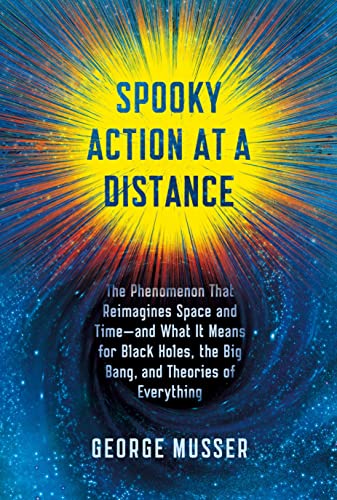
Spooky Action at a Distance: The Phenomenon That Reimagines Space and Time--And What It Means for Black Holes, the Big Bang, and Theories of Everyt: ... the Big Bang, and Theories of Everything - Hardcover
Inhaltsangabe
Long-listed for the 2016 PEN/E. O. Wilson Literary Science Writing Award
Delightfully readable, Spooky Action at a Distance is a mind-bending voyage to the frontiers of modern physics that will change the way we think about reality.
What is space? It isn't a question that most of us normally ask. Space is the venue of physics; it's where things exist, where they move and take shape. Yet over the past few decades, physicists have discovered a phenomenon that operates outside the confines of space and time: nonlocality--the ability of two particles to act in harmony no matter how far apart they may be. It appears to be almost magical.
Einstein grappled with this oddity and couldn't come to terms with it, describing it as "spooky action at a distance." More recently, the mystery has deepened as other forms of nonlocality have been uncovered. This strange occurrence, which has direct connections to black holes, particle collisions, and even the workings of gravity, holds the potential to undermine our most basic understandings of physical reality. If space isn't what we thought it was, then what is it?
In Spooky Action at a Distance, George Musser sets out to answer that question, offering a provocative exploration of nonlocality and a celebration of the scientists who are trying to explain it. Musser guides us on an epic journey into the lives of experimental physicists observing particles acting in tandem, astronomers finding galaxies that look statistically identical, and cosmologists hoping to unravel the paradoxes surrounding the big bang. He traces the often contentious debates over nonlocality through major discoveries and disruptions of the twentieth century and shows how scientists faced with the same undisputed experimental evidence develop wildly different explanations for that evidence. Their conclusions challenge our understanding of not only space and time but also the origins of the universe-and they suggest a new grand unified theory of physics.
“An important book that provides insight into key new developments in our understanding of the nature of space, time and the universe. It will repay careful study.” —John Gribbin, The Wall Street Journal
“An endlessly surprising foray into the current mother of physics' many knotty mysteries, the solving of which may unveil the weirdness of quantum particles, black holes, and the essential unity of nature.” —Kirkus Reviews (starred review)
Die Inhaltsangabe kann sich auf eine andere Ausgabe dieses Titels beziehen.
Über die Autorin bzw. den Autor
George Musser is an award-winning journalist, a contributing editor for Scientific American, and the author of The Complete Idiot's Guide to String Theory. He is the recipient of a Jonathan Eberhart Planetary Sciences Journalism Award from the American Astronomical Society and the 2011 American Institute of Physics Science Communication Award for Science Writing. He was a Knight Science Journalism fellow at MIT from 2014 to 2015. He has appeared on Today, CNN, NPR, the BBC, Al Jazeera, and other outlets. He lives in Glen Ridge, New Jersey, with his wife and daughter.
Auszug. © Genehmigter Nachdruck. Alle Rechte vorbehalten.
Spooky Action at a Distance
The Phenomenon that Reimagines Space and Time–and what It Means for Black Holes, the Big Bang, and Theories of Everything
By George MusserFarrar, Straus and Giroux
Copyright © 2015 George Musser
All rights reserved.
ISBN: 978-0-374-29851-7All rights reserved.
Contents
Title Page,
Copyright Notice,
Dedication,
Introduction: Einstein's Castle in the Air,
1. The Many Varieties of Nonlocality,
2. The Origins of Nonlocality,
3. Einstein's Locality,
4. The Great Debate,
5. Nonlocality and the Unification of Physics,
6. Spacetime Is Doomed,
Conclusion: The Amplituhedron,
Notes,
Bibliography,
Acknowledgments,
Index,
A Note About the Author,
Also by George Musser,
Copyright,
CHAPTER 1
The Many Varieties of Nonlocality
Enrique Galvez's lab at Colgate University is about the size of a two-car garage and, like most people's garages, jammed with stuff. Along the walls are workbenches loaded with toolboxes, electronic gear in various stages of disrepair, and, on the left side as you enter, the most frequently used piece of equipment: the coffee pot. In the middle of the room are a pair of optical benches: industrial-strength steel platforms, each the size of a dining-room table, covered with a pegboard-like grid of holes for attaching mirrors, prisms, lenses, and filters. "It's like playing with Erector sets all over again," says Galvez, a mellow Peruvian who looks remarkably like Al Franken.
If anyone has taken it on himself to show the world what quantum entanglement looks like, it's Galvez. Entanglement is the best known of several types of nonlocality that modern physicists have observed, and the one that spooked Einstein. The word "entanglement" has connotations similar to a romantic entanglement: a special and potentially troublesome relationship. Two particles that are entangled with each other are not literally intertwined, like balls of yarn; rather, they have a peculiar bond that transcends space. You can see this effect by creating, deflecting, and measuring beams of light — not ordinary flashlight beams, but beams of entangled photons. The earliest versions of the experiment, done in the 1970s at Berkeley and Harvard, involved mad-scientist contraptions of broiling-hot ovens, stacks of glass panes, and clattering teletypewriters. Galvez has taken advantage of Blu-ray lasers and optical fibers to miniaturize the setup, so that it now fits on a classroom desk.
Most experimental physicists I've met are tinkerers at heart, as fascinated by cool stuff as by the mysteries of the universe. An experimentalist at the Centre for Quantum Technologies in Singapore told me that, in his lab, incoming students have to pass a test. There's not a single physics question on it. Instead, they have to tell the story of how they took apart some household appliance and managed to get it back together, hopefully before their family found out. Apparently, clothes washers are a popular choice. Galvez, for his part, says his childhood passion was chemistry — of the blowing-up variety. Growing up in a middle-class neighborhood in Lima, he and some friends once tried to make gunpowder. All they got was a smoke bomb, which is perhaps just as well. "It was much more fun than something exploding," Galvez recalls. "It probably wasn't very healthy."
Galvez says he found his calling as a nonlocality crusader almost by accident. In common with the majority of physicists, he didn't give much thought to the phenomenon until the late 1990s, when a colleague stopped by his office with some dramatic news: the Austrian physicist Anton Zeilinger and his lab mates had used entanglement to teleport particles from one place to another. Teleport?! No fan of Star Trek could fail to be impressed. Although Zeilinger's team had beamed only single photons rather than an entire starship landing party, the coolness factor rivaled that of smoke bombs. And the procedure was straightforward. Suppose you want to teleport a photon from the left side of your lab to the right. First, you prime the teleporters by creating a pair of entangled photons and positioning one on each side of the lab. Then, you take the photon you want to beam and let it interact with the left particle. Because the entangled particles have a special bond between them, the interaction is immediately felt on the right, allowing the photon to be reconstituted there. (Some quibble whether the procedure should really be called teleportation; they consider it closer in spirit to identity theft. The experimentalists strip the left particle of its properties and thrust those properties onto the right particle. But a particle is nothing more than the sum of its properties, so these two characterizations amount to the same thing.)
Galvez and his colleague already had all the gear, and before long, they were beaming particles across their lab, too. "We were trying to figure out teleportation just for the fun of it," Galvez says. Another colleague suggested they design an entanglement experiment that even a physics-for-poets class could do. It doesn't do teleportation, but achieves the first and most important step in the process — namely, creating and distributing the entangled photons. As simple as the apparatus looks now, the team sweated over it for two years. Galvez began to run summer workshops for ALPhA, a physics-education group, to show teachers how to do the experiment, and he posted his instruction manuals online so that do-it-yourselfers can entangle particles in their basements. The former president of ALPhA, David Van Baak, exclaims: "We're past the stage where entanglement is a research-university-only affair. It's getting out to the masses."
On the day I visit Galvez's lab, one of his optical benches is given over to the entanglement experiment, the aim of which is not only to demonstrate entanglement, but also to explore what might be causing it. I recognize the setup as basically a high-tech Rube Goldberg coin flipper in which photons assume the role of coins. They are either "heads" or "tails" depending on whether they pass through a filter or not. The system is tuned so they have a 50-50 chance of getting through, like flipping a fair coin. The basic plan is to create a pair of these coins, flip both at the same time, see which sides they land on, create another pair, flip them, and so on. Repeat thousands of times and add up the statistics. It seems like a lot of effort for a predictable result, until you remember that we're talking about quantum coins. Clearly, thinking of particles as coins is a metaphor, but as long as you don't take it too literally, it's completely kosher. Physicists themselves understand phenomena in terms of metaphor.
To set the apparatus into motion, Galvez fires an ultraviolet laser through a series of optical elements that ensure proper alignment of the light. The beam strikes a small crystal of barium borate, a material discovered by Chinese scientists in the early 1980s, which splits the ultraviolet beam into two red beams. The splitting occurs particle by particle: if you could zoom in and view the beam as a stream of photons, you would see some of the ultraviolet photons hit the crystal and divide their energy into identical twin red photons. Voilà, coins. Located just upstream of the crystal is an optical element known as a waveplate, which Galvez uses to control the output of the crystal. Depending on how he sets the waveplate, the red photons are either entangled or...
„Über diesen Titel“ kann sich auf eine andere Ausgabe dieses Titels beziehen.
Suchergebnisse für Spooky Action at a Distance: The Phenomenon That Reimagines...

Beispielbild für diese ISBN
Spooky Action at a Distance
Verlag:
Farrar, Straus & Giroux Inc, 2015
ISBN 10: 0374298513
ISBN 13: 9780374298517
Gebraucht
Hardcover
Anbieter: World of Books (was SecondSale), Montgomery, IL, USA
Verkäuferbewertung 5 von 5 Sternen

Hardback. Zustand: Fair. Physicists have discovered a phenomenon that operates outside the confines of space and time. It is the ability of one particle to affect another instantly across the vastness of space. In Spooky Action at a Distance, George Musser offers a provocative exploration of non locality and a celebration of the scientists who are trying to understand it. Artikel-Nr. 00106687507
Gebraucht kaufen
EUR 5,58
Versand gratis
Versand innerhalb von USA
Versand innerhalb von USA
Anzahl: 1 verfügbar
Beispielbild für diese ISBN
Spooky Action at a Distance
Verlag:
Farrar, Straus & Giroux Inc, 2015
ISBN 10: 0374298513
ISBN 13: 9780374298517
Gebraucht
Hardcover
Anbieter: World of Books (was SecondSale), Montgomery, IL, USA
Verkäuferbewertung 5 von 5 Sternen
Hardback. Zustand: Good. Physicists have discovered a phenomenon that operates outside the confines of space and time. It is the ability of one particle to affect another instantly across the vastness of space. In Spooky Action at a Distance, George Musser offers a provocative exploration of non locality and a celebration of the scientists who are trying to understand it. Artikel-Nr. 00098522564
Gebraucht kaufen
EUR 5,58
Versand gratis
Versand innerhalb von USA
Versand innerhalb von USA
Anzahl: 6 verfügbar
Beispielbild für diese ISBN
Spooky Action at a Distance : The Phenomenon That Reimagines Space and Time--And What It Means for Black Holes, the Big Bang, and Theories of Everything
Verlag:
Farrar, Straus & Giroux, 2015
ISBN 10: 0374298513
ISBN 13: 9780374298517
Gebraucht
Hardcover
Anbieter: Better World Books, Mishawaka, IN, USA
Verkäuferbewertung 5 von 5 Sternen
Zustand: Good. Former library copy. Pages intact with minimal writing/highlighting. The binding may be loose and creased. Dust jackets/supplements are not included. Includes library markings. Stock photo provided. Product includes identifying sticker. Better World Books: Buy Books. Do Good. Artikel-Nr. 11646205-6
Gebraucht kaufen
EUR 6,36
Versand gratis
Versand innerhalb von USA
Versand innerhalb von USA
Anzahl: 3 verfügbar
Beispielbild für diese ISBN
Spooky Action at a Distance : The Phenomenon That Reimagines Space and Time--And What It Means for Black Holes, the Big Bang, and Theories of Everything
Verlag:
Farrar, Straus & Giroux, 2015
ISBN 10: 0374298513
ISBN 13: 9780374298517
Gebraucht
Hardcover
Anbieter: Better World Books, Mishawaka, IN, USA
Verkäuferbewertung 5 von 5 Sternen
Zustand: Good. Pages intact with minimal writing/highlighting. The binding may be loose and creased. Dust jackets/supplements are not included. Stock photo provided. Product includes identifying sticker. Better World Books: Buy Books. Do Good. Artikel-Nr. 6353165-6
Gebraucht kaufen
EUR 6,36
Versand gratis
Versand innerhalb von USA
Versand innerhalb von USA
Anzahl: 1 verfügbar
Beispielbild für diese ISBN
Spooky Action at a Distance : The Phenomenon That Reimagines Space and Time--And What It Means for Black Holes, the Big Bang, and Theories of Everything
Verlag:
Farrar, Straus & Giroux, 2015
ISBN 10: 0374298513
ISBN 13: 9780374298517
Gebraucht
Hardcover
Anbieter: Better World Books, Mishawaka, IN, USA
Verkäuferbewertung 5 von 5 Sternen
Zustand: Very Good. Former library copy. Pages intact with possible writing/highlighting. Binding strong with minor wear. Dust jackets/supplements may not be included. Includes library markings. Stock photo provided. Product includes identifying sticker. Better World Books: Buy Books. Do Good. Artikel-Nr. 9077662-75
Gebraucht kaufen
EUR 6,36
Versand gratis
Versand innerhalb von USA
Versand innerhalb von USA
Anzahl: 1 verfügbar
Beispielbild für diese ISBN
Spooky Action at a Distance: The Phenomenon That Reimagines Space and Time--And What It Means for Black Holes, the Big Bang, and Theories of Everyt
Anbieter: ThriftBooks-Reno, Reno, NV, USA
Verkäuferbewertung 5 von 5 Sternen
Hardcover. Zustand: Good. No Jacket. Former library book; Pages can have notes/highlighting. Spine may show signs of wear. ~ ThriftBooks: Read More, Spend Less. Artikel-Nr. G0374298513I3N10
Gebraucht kaufen
EUR 7,10
Versand gratis
Versand innerhalb von USA
Versand innerhalb von USA
Anzahl: 1 verfügbar
Beispielbild für diese ISBN
Spooky Action at a Distance: The Phenomenon That Reimagines Space and Time--And What It Means for Black Holes, the Big Bang, and Theories of Everyt
Anbieter: ThriftBooks-Atlanta, AUSTELL, GA, USA
Verkäuferbewertung 5 von 5 Sternen
Hardcover. Zustand: Good. No Jacket. Former library book; Pages can have notes/highlighting. Spine may show signs of wear. ~ ThriftBooks: Read More, Spend Less. Artikel-Nr. G0374298513I3N10
Gebraucht kaufen
EUR 7,15
Versand gratis
Versand innerhalb von USA
Versand innerhalb von USA
Anzahl: 1 verfügbar
Beispielbild für diese ISBN
Spooky Action at a Distance: The Phenomenon That Reimagines Space and Time--And What It Means for Black Holes, the Big Bang, and Theories of Everyt
Anbieter: ThriftBooks-Atlanta, AUSTELL, GA, USA
Verkäuferbewertung 5 von 5 Sternen
Hardcover. Zustand: Good. No Jacket. Pages can have notes/highlighting. Spine may show signs of wear. ~ ThriftBooks: Read More, Spend Less. Artikel-Nr. G0374298513I3N00
Gebraucht kaufen
EUR 7,15
Versand gratis
Versand innerhalb von USA
Versand innerhalb von USA
Anzahl: 1 verfügbar
Beispielbild für diese ISBN
Spooky Action at a Distance: The Phenomenon That Reimagines Space and Time--And What It Means for Black Holes, the Big Bang, and Theories of Everyt
Anbieter: ThriftBooks-Dallas, Dallas, TX, USA
Verkäuferbewertung 5 von 5 Sternen
Hardcover. Zustand: Very Good. No Jacket. May have limited writing in cover pages. Pages are unmarked. ~ ThriftBooks: Read More, Spend Less. Artikel-Nr. G0374298513I4N00
Gebraucht kaufen
EUR 7,15
Versand gratis
Versand innerhalb von USA
Versand innerhalb von USA
Anzahl: 1 verfügbar
Beispielbild für diese ISBN
Spooky Action at a Distance: The Phenomenon That Reimagines Space and Time--And What It Means for Black Holes, the Big Bang, and Theories of Everyt
Anbieter: ThriftBooks-Atlanta, AUSTELL, GA, USA
Verkäuferbewertung 5 von 5 Sternen
Hardcover. Zustand: Very Good. No Jacket. May have limited writing in cover pages. Pages are unmarked. ~ ThriftBooks: Read More, Spend Less. Artikel-Nr. G0374298513I4N00
Gebraucht kaufen
EUR 7,15
Versand gratis
Versand innerhalb von USA
Versand innerhalb von USA
Anzahl: 1 verfügbar