
Verwandte Artikel zu The World Is Flat: A Brief History Of The Twenty-First...
Inhaltsangabe
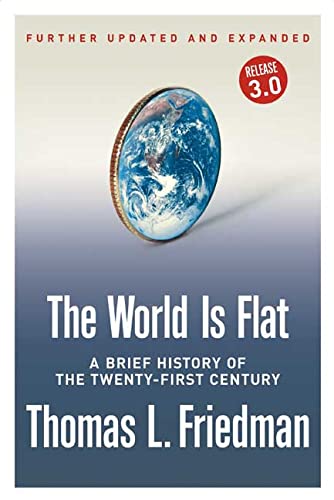
The beginning of the twenty-first century will be remembered, Friedman argues, not for military conflicts or political events, but for a whole new age of globalization - a 'flattening' of the world. The explosion of advanced technologies now means that suddenly knowledge pools and resources have connected all over the planet, levelling the playing field as never before, so that each of us is potentially an equal - and competitor - of the other. The rules of the game have changed forever - but does this 'death of distance', which requires us all to run faster in order to stay in the same place, mean the world has got too small and too flat too fast for us to adjust?
Die Inhaltsangabe kann sich auf eine andere Ausgabe dieses Titels beziehen.
Über die Autorinnen und Autoren
Thomas L. Friedman has won the Pulitzer Prize three times for his work at The New York Times, where he serves as the foriegn affairs columnist. He is the author of three previous books, all of them best-sellers: From Beirut to Jerusalem; winner of the National Book Award for nonfiction; The Lexus and the Olive Tree; and Longitudes and Attitudes. In 2005 The World Is Flat was given the first Financial Times and Golden Sachs Business Book of the Year Award, and Friedman was named one of America's Best Leaders by U.S. News & World Report. He lives in Bethesda, Maryland, with his family.
Thomas L. Friedman is an internationally renowned author, reporter, and columnist—the recipient of three Pulitzer Prizes and the author of five bestselling books, among them From Beirut to Jerusalem and The World Is Flat.
He was born in Minneapolis in 1953, and grew up in the middle-class Minneapolis suburb of St. Louis Park. He graduated from Brandeis University in 1975 with a degree in Mediterranean studies, attended St. Antony's College, Oxford, on a Marshall Scholarship, and received an M.Phil. degree in modern Middle East studies from Oxford.
After three years with United Press International, he joined The New York Times, where he has worked ever since as a reporter, correspondent, bureau chief, and columnist. At the Times, he has won three Pulitzer Prizes: in 1983 for international reporting (from Lebanon), in 1988 for international reporting (from Israel), and in 2002 for his columns after the September 11th attacks.
Friedman’s first book, From Beirut to Jerusalem, won the National Book Award in 1989. His second book, The Lexus and the Olive Tree: Understanding Globalization (1999), won the Overseas Press Club Award for best book on foreign policy in 2000. In 2002 FSG published a collection of his Pulitzer Prize-winning columns, along with a diary he kept after 9/11, as Longitudes and Attitudes: Exploring the World After September 11. His fourth book, The World Is Flat: A Brief History of the Twenty-first Century (2005) became a #1 New York Times bestseller and received the inaugural Financial Times/Goldman Sachs Business Book of the Year Award in November 2005. A revised and expanded edition was published in hardcover in 2006 and in 2007. The World Is Flat has sold more than 4 million copies in thirty-seven languages.
In 2008 he brought out Hot, Flat, and Crowded, which was published in a revised edition a year later. His sixth book, That Used to Be Us: How American Fell Behind in the World We Invented and How We Can Come Back, co-written with Michael Mandelbaum, will be published in September 2011.
Thomas L. Friedman lives in Bethesda, Maryland, with his family.
Von der hinteren Coverseite
"One mark of a great book is that it makes you see things in a new way, and Mr. Friedman certainly succeeds in that goal," the Nobel laureate Joseph E. Stiglitz wrote in The New York Times, reviewing The World Is Flat in 2005. For this updated and expanded edition, Friedman has seen his own book in a new way, bringing fresh stories and insights to help us understand the flattening of the world. New material includes:
The reasons why the flattening of the world "will be seen in time as one of those fundamental shifts or inflection points, like Gutenberg's invention of the printing press, the rise of the nation-state, or the Industrial Revolution"
An explanation of "uploading" as one of the ten forces that are flattening the world, as blogging, open-source software, pooled knowledge projects like Wikipedia, and podcasting enable individuals to bring their experiences and opinions to the whole world
A mapping of the New Middle--the places and spaces in the flat world where
middle-class jobs will be found--and portraits of the character types who will find success as New Middlers
An account of the qualities American parents and teachers need to cultivate in young people so that they will be able to thrive in the flat world
A call for a government-led "geo-green" strategy to preserve the environment and natural resources
An account of the "globalization of the local": how the flattening of the world is actually strengthening local and regional identities rather than homogenizing the world
The reasons why the flattening of the world "will be seen in time as one of those fundamental shifts or inflection points, like Gutenberg's invention of the printing press, the rise of the nation-state, or the Industrial Revolution"
An explanation of "uploading" as one of the ten forces that are flattening the world, as blogging, open-source software, pooled knowledge projects like Wikipedia, and podcasting enable individuals to bring their experiences and opinions to the whole world
A mapping of the New Middle--the places and spaces in the flat world where
middle-class jobs will be found--and portraits of the character types who will find success as New Middlers
An account of the qualities American parents and teachers need to cultivate in young people so that they will be able to thrive in the flat world
A call for a government-led "geo-green" strategy to preserve the environment and natural resources
An account of the "globalization of the local": how the flattening of the world is actually strengthening local and regional identities rather than homogenizing the world
Aus dem Klappentext
THE WORLD IS FLAT is Thomas Friedman's account of the great changes taking place in our time, as lightning-swift advances in technology and communication put people all over the globe in touch as never before-creating an explosion of wealth in India and China, and challenging the rest of us to run even faster just to stay in place. Release 3.0 features two new chapters of fresh reporting and commentary, drawn from Friedman's travels internationally and across the American heartland- from places where the flattening of the world is changing the way we live most dramatically.
Auszug. © Genehmigter Nachdruck. Alle Rechte vorbehalten.
Chapter 1
Your Highnesses, as Catholic Christians, and princes who love and promote the holy Christian faith, and are enemies of the doctrine of Mahomet, and of all idolatry and heresy, determined to send me, Christopher Columbus, to the above-mentioned countries of India, to see the said princes, people, and territories, and to learn their disposition and the proper method of converting them to our holy faith; and furthermore directed that I should not proceed by land to the East, as is customary, but by a Westerly route, in which direction we have hitherto no certain evidence that anyone has gone.
—Entry from the journal of Christopher Columbus on his voyage of 1492
No one ever gave me directions like this on a golf course before: “Aim at either Microsoft or IBM.” I was standing on the first tee at the KGA Golf Club in downtown Bangalore, in southern India, when my playing partner pointed at two shiny glass-and-steel buildings off in the distance, just behind the first green. The Goldman Sachs building wasn’t done yet; otherwise he could have pointed that out as well and made it a threesome. HP and Texas Instruments had their offices on the back nine, along the tenth hole. That wasn’t all. The tee markers were from Epson, the printer company, and one of our caddies was wearing a hat from 3M. Outside, some of the traffic signs were also sponsored by Texas Instruments, and the Pizza Hut billboard on the way over showed a steaming pizza, under the headline “Gigabites of Taste!”
No, this definitely wasn’t Kansas. It didn’t even seem like India. Was this the New World, the Old World, or the Next World?
I had come to Bangalore, India’s Silicon Valley, on my own Columbus-like journey of exploration. Columbus sailed with the Niña, the Pinta, and the Santa María in an effort to discover a shorter, more direct route to India by heading west, across the Atlantic, on what he presumed to be an open sea route to the East Indies—rather than going south and east around Africa, as Portuguese explorers of his day were trying to do. India and the magical Spice Islands of the East were famed at the time for their gold, pearls, gems, and silk—a source of untold riches. Finding this shortcut by sea to India, at a time when the Muslim powers of the day had blocked the overland routes from Europe, was a way for both Columbus and the Spanish monarchy to become wealthy and powerful.
When Columbus set sail, he apparently assumed the earth was round, which was why he was convinced that he could get to India by going west. He miscalculated the distance, though. He thought the earth was a smaller sphere than it is. He also did not anticipate running into a landmass before he reached the East Indies. Nevertheless, he called the aboriginal peoples he encountered in the new world “Indians.” Returning home, though, Columbus was able to tell his patrons, King Ferdinand and Queen Isabella, that although he never did find India, he could confirm that the world was indeed round.
I set out for India by going due east, via Frankfurt. I had Lufthansa business class. I knew exactly which direction I was going thanks to the GPS map displayed on the screen that popped out of the armrest of my airline seat. I landed safely and on schedule. I too encountered people called Indians. I too was searching for India’s riches. Columbus was searching for hardware—precious metals, silk, and spices—the sources of wealth in his day. I was searching for software, brainpower, complex algorithms, knowledge workers, call centers, transmission protocols, breakthroughs in optical engineering—the sources of wealth in our day.
Columbus was happy to make the Indians he met his slaves, a pool of free manual labor. I just wanted to understand why the Indians I met were taking our work, why they had become such an important pool for the outsourcing of service and information technology work from America and other industrialized countries. Columbus had more than one hundred men on his three ships; I had a small crew from the Discovery Times channel that fit comfortably into two banged-up vans, with Indian drivers who drove barefoot. When I set sail, so to speak, I too assumed that the world was round, but what I encountered in the real India profoundly shook my faith in that notion. Columbus accidentally ran into America but thought he had discovered part of India. I actually found India and thought many of the people I met there were Americans. Some had actually taken American names, and others were doing great imitations of American accents at call centers and American business techniques at software labs.
Columbus reported to his king and queen that the world was round, and he went down in history as the man who first made this discovery. I returned home and shared my discovery only with my wife, and only in a whisper.
“Honey,” I confided, “I think the world is flat.”
How did I come to this conclusion? I guess you could say it all started in Nandan Nilekani’s conference room at Infosys Technologies Limited. Infosys is one of the jewels of the Indian information technology world, and Nilekani, the company’s CEO, is one of the most thoughtful and respected captains of Indian industry. I drove with the Discovery Times crew out to the Infosys campus, about forty minutes from the heart of Bangalore, to tour the facility and interview Nilekani. The Infosys campus is reached by a pockmarked road, with sacred cows, horse-drawn carts, and motorized rickshaws all jostling alongside our vans. Once you enter the gates of Infosys, though, you are in a different world. A massive resort-size swimming pool nestles amid boulders and manicured lawns, adjacent to a huge putting green. There are multiple restaurants and a fabulous health club. Glass-and-steel buildings seem to sprout up like weeds each week. In some of those buildings, Infosys employees are writing specific software programs for American or European companies; in others, they are running the back rooms of major American- and European-based multinationals—everything from computer maintenance to specific research projects to answering customer calls routed there from all over the world. Security is tight, cameras monitor the doors, and if you are working for American Express, you cannot get into the building that is managing services and research for General Electric. Young Indian engineers, men and women, walk briskly from building to building, dangling ID badges. One looked like he could do my taxes. Another looked like she could take my computer apart. And a third looked like she designed it!
After sitting for an interview, Nilekani gave our TV crew a tour of Infosys’s global conferencing center—ground zero of the Indian outsourcing industry. It was a cavernous wood-paneled room that looked like a tiered classroom from an Ivy League law school. On one end was a massive wall-size screen and overhead there were cameras in the ceiling for teleconferencing. “So this is our conference room, probably the largest screen in Asia—this is forty digital screens [put together],” Nilekani explained proudly, pointing to the biggest flat-screen TV I had ever seen. Infosys, he said, can hold a virtual meeting of the key players from its entire global supply chain for any project at any time on that supersize screen. So their American designers could be on the screen speaking with their Indian software writers and their Asian manufacturers all at once. “We could be sitting here, somebody from New York,...
„Über diesen Titel“ kann sich auf eine andere Ausgabe dieses Titels beziehen.
Suchergebnisse für The World Is Flat: A Brief History Of The Twenty-First...

Beispielbild für diese ISBN
The World Is Flat: A Brief History of the Twenty-First Century
Anbieter: World of Books (was SecondSale), Montgomery, IL, USA
Verkäuferbewertung 5 von 5 Sternen

Hardback. Zustand: Good. A New Edition of the Phenomenal #1 Bestseller One mark of a great book is that it makes you see things in a new way, and Mr. Friedman certainly succeeds in that goal, the Nobel laureate Joseph E. Stiglitz wrote in The New York Times reviewing The World Is Flat in 2005. In this new edition, Thomas L. Friedman includes fresh stories and insights to help us understand the flattening of the world. Weaving new information into his overall thesis, and answering the questions he has been most frequently asked by parents across the country, this third edition also includes two new chapters--on how to be a political activist and social entrepreneur in a flat world; and on the more troubling question of how to manage our reputations and privacy in a world where we are all becoming publishers and public figures. The World Is Flat 3.0 is an essential update on globalization, its opportunities for individual empowerment, its achievements at lifting millions out of poverty, and its drawbacks--environmental, social, and political, powerfully illuminated by the Pulitzer Prize--winning author of The Lexus and the Olive Tree. Artikel-Nr. 00100377086
Gebraucht kaufen
EUR 4,39
Versand gratis
Versand innerhalb von USA
Versand innerhalb von USA
Anzahl: 4 verfügbar
Beispielbild für diese ISBN
The World Is Flat [Further Updated and Expanded; Release 3.0]: A Brief History of the Twenty-first Century
Verlag:
Farrar, Straus and Giroux (edition 3rd), 2007
ISBN 10: 0374292787
ISBN 13: 9780374292782
Gebraucht
Hardcover
Anbieter: BooksRun, Philadelphia, PA, USA
Verkäuferbewertung 5 von 5 Sternen
Hardcover. Zustand: Very Good. 3rd. With dust jacket. It's a well-cared-for item that has seen limited use. The item may show minor signs of wear. All the text is legible, with all pages included. It may have slight markings and/or highlighting. Artikel-Nr. 0374292787-11-1-29
Gebraucht kaufen
EUR 5,67
Versand gratis
Versand innerhalb von USA
Versand innerhalb von USA
Anzahl: 1 verfügbar
Beispielbild für diese ISBN
The World Is Flat [Further Updated and Expanded; Release 3.0]: A Brief History of the Twenty-first Century
Verlag:
Farrar, Straus and Giroux, 2007
ISBN 10: 0374292787
ISBN 13: 9780374292782
Gebraucht
Hardcover
Anbieter: ThriftBooks-Phoenix, Phoenix, AZ, USA
Verkäuferbewertung 5 von 5 Sternen
Hardcover. Zustand: Very Good. No Jacket. May have limited writing in cover pages. Pages are unmarked. ~ ThriftBooks: Read More, Spend Less. Artikel-Nr. G0374292787I4N00
Gebraucht kaufen
EUR 5,96
Versand gratis
Versand innerhalb von USA
Versand innerhalb von USA
Anzahl: 1 verfügbar
Beispielbild für diese ISBN
The World Is Flat [Further Updated and Expanded; Release 3.0]: A Brief History of the Twenty-first Century
Verlag:
Farrar, Straus and Giroux, 2007
ISBN 10: 0374292787
ISBN 13: 9780374292782
Gebraucht
Hardcover
Anbieter: ThriftBooks-Reno, Reno, NV, USA
Verkäuferbewertung 5 von 5 Sternen
Hardcover. Zustand: Good. No Jacket. Missing dust jacket; Pages can have notes/highlighting. Spine may show signs of wear. ~ ThriftBooks: Read More, Spend Less. Artikel-Nr. G0374292787I3N01
Gebraucht kaufen
EUR 5,96
Versand gratis
Versand innerhalb von USA
Versand innerhalb von USA
Anzahl: 1 verfügbar
Beispielbild für diese ISBN
The World Is Flat [Further Updated and Expanded; Release 3.0]: A Brief History of the Twenty-first Century
Verlag:
Farrar, Straus and Giroux, 2007
ISBN 10: 0374292787
ISBN 13: 9780374292782
Gebraucht
Hardcover
Anbieter: ThriftBooks-Atlanta, AUSTELL, GA, USA
Verkäuferbewertung 5 von 5 Sternen
Hardcover. Zustand: Good. No Jacket. Missing dust jacket; Pages can have notes/highlighting. Spine may show signs of wear. ~ ThriftBooks: Read More, Spend Less. Artikel-Nr. G0374292787I3N01
Gebraucht kaufen
EUR 6,31
Versand gratis
Versand innerhalb von USA
Versand innerhalb von USA
Anzahl: 1 verfügbar
Beispielbild für diese ISBN
The World Is Flat [Further Updated and Expanded; Release 3.0]: A Brief History of the Twenty-first Century
Verlag:
Farrar, Straus and Giroux, 2007
ISBN 10: 0374292787
ISBN 13: 9780374292782
Gebraucht
Hardcover
Anbieter: ThriftBooks-Dallas, Dallas, TX, USA
Verkäuferbewertung 5 von 5 Sternen
Hardcover. Zustand: Very Good. No Jacket. May have limited writing in cover pages. Pages are unmarked. ~ ThriftBooks: Read More, Spend Less. Artikel-Nr. G0374292787I4N00
Gebraucht kaufen
EUR 6,31
Versand gratis
Versand innerhalb von USA
Versand innerhalb von USA
Anzahl: 1 verfügbar
Beispielbild für diese ISBN
The World Is Flat [Further Updated and Expanded; Release 3.0]: A Brief History of the Twenty-first Century
Verlag:
Farrar, Straus and Giroux, 2007
ISBN 10: 0374292787
ISBN 13: 9780374292782
Gebraucht
Hardcover
Anbieter: ThriftBooks-Dallas, Dallas, TX, USA
Verkäuferbewertung 5 von 5 Sternen
Hardcover. Zustand: Good. No Jacket. Former library book; Pages can have notes/highlighting. Spine may show signs of wear. ~ ThriftBooks: Read More, Spend Less. Artikel-Nr. G0374292787I3N10
Gebraucht kaufen
EUR 6,31
Versand gratis
Versand innerhalb von USA
Versand innerhalb von USA
Anzahl: 1 verfügbar
Beispielbild für diese ISBN
The World Is Flat : A Brief History of the Twenty-First Century
Verlag:
Farrar, Straus & Giroux, 2007
ISBN 10: 0374292787
ISBN 13: 9780374292782
Gebraucht
Hardcover
Anbieter: Better World Books: West, Reno, NV, USA
Verkäuferbewertung 5 von 5 Sternen
Zustand: Good. Former library copy. Pages intact with minimal writing/highlighting. The binding may be loose and creased. Dust jackets/supplements are not included. Includes library markings. Stock photo provided. Product includes identifying sticker. Better World Books: Buy Books. Do Good. Artikel-Nr. 4230037-6
Gebraucht kaufen
EUR 6,68
Versand gratis
Versand innerhalb von USA
Versand innerhalb von USA
Anzahl: 1 verfügbar
Beispielbild für diese ISBN
The World Is Flat : A Brief History of the Twenty-First Century
Verlag:
Farrar, Straus & Giroux, 2007
ISBN 10: 0374292787
ISBN 13: 9780374292782
Gebraucht
Hardcover
Anbieter: Better World Books, Mishawaka, IN, USA
Verkäuferbewertung 5 von 5 Sternen
Zustand: Good. Former library copy. Pages intact with minimal writing/highlighting. The binding may be loose and creased. Dust jackets/supplements are not included. Includes library markings. Stock photo provided. Product includes identifying sticker. Better World Books: Buy Books. Do Good. Artikel-Nr. 4230037-6
Gebraucht kaufen
EUR 6,68
Versand gratis
Versand innerhalb von USA
Versand innerhalb von USA
Anzahl: 2 verfügbar
Beispielbild für diese ISBN
The World Is Flat: A Brief History Of The Twenty-First Century. Release 3.0
Verlag:
Farrar, Straus and Giroux, 2007
ISBN 10: 0374292787
ISBN 13: 9780374292782
Gebraucht
Hardcover
Anbieter: medimops, Berlin, Deutschland
Verkäuferbewertung 5 von 5 Sternen
Zustand: good. Befriedigend/Good: Durchschnittlich erhaltenes Buch bzw. Schutzumschlag mit Gebrauchsspuren, aber vollständigen Seiten. / Describes the average WORN book or dust jacket that has all the pages present. Artikel-Nr. M00374292787-G
Gebraucht kaufen
EUR 27,97
EUR 10,00 Versand
Versand von Deutschland nach USA
Versand von Deutschland nach USA
Anzahl: 1 verfügbar