
Verwandte Artikel zu The Third Chapter: Passion, Risk, and Adventure in...
Inhaltsangabe
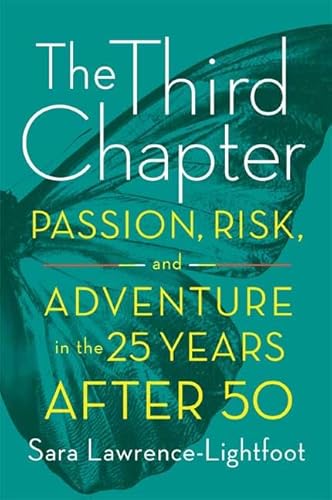
In the twenty-first century, a developmental phase of life is emerging as significant and distinct, capturing our interest, engaging our curiosity, and expanding our understanding of human potential and development. Demographers talk about this new chapter in life as characterized by people—between fifty and seventy-five—who are considered “neither young nor old.” In our “third chapters” we are beginning to redefine our views about the casualties and opportunities of aging; we are challenging cultural definitions of strength, maturity, power, and sexiness. This is a chapter in life when the traditional norms, rules, and rituals of our careers seem less encompassing and restrictive; when many women and men seem to be embracing new challenges and searching for greater meaning in life. In The Third Chapter, the renowned sociologist Dr. Sara Lawrence-Lightfoot offers a strong counterpoint to the murky ambivalence that shrouds our clear view of people in their third chapters. She challenges the still prevailing and anachronistic images of aging by documenting and revealing the ways in which the years between fifty and seventy-five may, in fact, be the most transformative and generative time in our lives, tracing the ways in which wisdom, experience, and new learning inspire individual growth and cultural transformation. The women and men whose voices fill the pages of The Third Chapter tell passionate and poignant stories of risk and vulnerability, failure and resilience, challenge and mastery, experimentation and improvisation, and insight and new learning.
Die Inhaltsangabe kann sich auf eine andere Ausgabe dieses Titels beziehen.
Über die Autorin bzw. den Autor
Sara Lawrence-Lightfoot is the Emily Hargroves Fisher Professor of Education at Harvard and the chair of the board of the MacArthur Foundation. As a sociologist, she examines the culture of schools, the patterns and structures of classroom life, socialization within families and communities, and the relationships between culture and learning styles.
Auszug. © Genehmigter Nachdruck. Alle Rechte vorbehalten.
Introduction: Facing the Mirror
Perhaps it is my age. I am sixty-two, and for the last several years my conversations with friends, colleagues, and even casual acquaintances have often been punctuated by what I have now come to call "confessional moments." Certainly there is the expected chatter and grumbling about minor and major infirmities or unwelcome signs of deterioration—lower-back pain, varicose veins, bald heads, and gray hair—and there is the usual whining about offspring, now finished with college, maybe even married with young children, who return home to live and still need to be provided with health care and spending money. When I refer to confessional moments, however, I do not mean the habitual grumbling about our inevitable decline as we grow older. (One of my friends refers to these gripe sessions as "organ recitals.") Nor am I referring to the odd and troubling sensation of gazing into the mirror and seeing not yourself, but someone decades older than you imagine yourself to be—someone who looks very much like your mother.
I am, instead, talking about moments when we manage to resist the signs of burnout, make peace with the old/new mirror image, and refuse to be preoccupied with our chronic laments about aging or our sadness about our vanishing youth. These are moments when our faces light up, when there is a palpable surge of energy and we begin to reveal stories about learning something new. These are stories told most often by people who are—like me—in the "Third Chapter" of our adult lives, the years between fifty and seventy-five, the generative space that follows young adulthood and middle age. And these stories are recited with intrigue, passion, and self-discovery—stories that reveal themselves like mysterious secrets; tales often striking in their contradictions and paradoxes.
My friend Jacob, an ardent intellectual and a distinguished journalist with a Ph.D. in political science, has a quick mind and a subtle wit. Born in Hoboken, New Jersey, the only son of Jewish immigrant parents, he is a man of expansive warmth, whose greatest pleasures are relational and social and whose currency of discourse has always been language: a rapid-fire delivery blending a New York Bronx dialect with a sprinkling of Yiddish, for emotional effect. Now sixty-two, he tells me of his first experience attending a seven-day silent retreat where—after much resistance, fear, and panic; then resolve and determination— he began to let down his barriers and inhibitions and learn to live in the stillness. This still-raw understanding and practice of meditation has opened a whole new discipline and perspective that seem to "challenge old inhibitions and raise questions" about who he is "becoming," and about his capacity to be alone with himself. He says dramatically, "Meditation is the most counterintuitive thing I could have possibly tried to learn to do."
Roma, a fifty-seven-year-old physicist I met at a dinner party, who has spent all of her professional career in the laboratory enjoying the quiet and order of the space, the exacting, familiar rituals of the scientific process, and the pursuit of the objective, quantitative evidence, recently began to feel—after thirty years—the limits and constraints of her existence. The solitude and discipline of her work, which used to feel safe and generative, started to feel claustrophobic. The rituals began to seem routine. The questions that used to inspire curiosity began to strike her as dull and formulaic. But mostly she sensed the need to "make a difference on our planet" in a more direct and immediate way; she yearned to teach, to serve, to give back. Cutting back on her hours in the lab, Roma signed up for a mentoring program where she teaches middle-school black, brown, and poor students in an after-school program the subject that always fascinated her the most when she was a young adolescent: astronomy. In her first year of teaching, Roma admits that this is the hardest, most challenging work that she has ever done: learning the science now long forgotten and finding a palatable and relevant way to present it; learning to relate to and discipline the children and capture their imaginations; learning to recover from the awkwardness and public failures that come with being a total novice. "I’m so completely uncool," she says with a smile. Like Jacob, she has chosen "the most difficult path," strewn with minefields and misunderstandings, and rare, unexpected successes along the way.
And there is Robert, the seventy-two-year-old retired mechanical engineer whom I meet at an ice-cream joint on the side of the road in rural New Hampshire. He and his wife of fifty years are out on their ritual Sunday drive, and they are looking to pick up an interesting conversation with a stranger. They sit down next to me at the picnic table and begin in a place where we all meet: with family stories. I listen to their proud tales about their grandchildren scattered all over the country and admire the photographs of their smiling faces. But soon, with a bit of gentle prodding from his wife, Abbie, the conversation turns to Robert’s "new passion," and he goes to the car to fetch his drawings, postcard-size pen-and-ink sketches of birds. He has always loved birds: listening to their songs in the morning light, watching them visit the bird feeders outside his kitchen window, observing the "social interactions" among them. And he has always said, "I wish I had an artistic bone in my body, so I could draw the beauty I see in them." A week after his retirement party, as he faced the "surprising emptiness" in front of him, he took the leap of faith and signed up for three drawing courses— "a total immersion"—at the adult-education center. "This has become my life!" he says in confessional tones, as I remark on the steady improvement I see in his portfolio of work, and as he talks about the exhilaration and vulnerability of learning something new.
For women and men in the Third Chapter, the process of learning something new feels both familiar and strange, exciting and terrifying, mature and childlike, both in character and out of body, like returning home and setting out on an adventure to an unknown destination. This is true whether we are talking about learning a new skill, craft, or art form—like learning to speak a foreign language, play jazz piano, or become a play-wright—or whether we are learning to feel and express a broader and deeper emotional repertoire—freeing us from the bondage of the rigid requirements of decorum forged in our childhood— or whether we are learning to grieve after the death of a loved one—learning to make ourselves vulnerable and not retreat from intimacy—or whether we are talking about shifting the focus of our energies and priorities, from solitary, individualistic, and competitive to community-based and collaborative; from making it up the ladder of success to making an imprint on the lives of others.
This book focuses on the creative and purposeful learning that goes on in the Third Chapter of life. I explore the ways in which men and women between the ages of fifty and seventyfive find ways of changing, adapting, exploring, mastering, and channeling their energies, skills, and passions into new domains of learning. I believe that successful aging requires that people continue—across their lifetime—to express a curiosity about their changing world, an ability to adapt to shifts in their developmental and physical capacities, and an eagerness to engage new perspectives, skills, and appetites. This requires the willingness to take risks, experience vulnerability and uncertainty, learn from experimentation and failure, seek guidance and counsel from younger generations, and develop new relationships of...
„Über diesen Titel“ kann sich auf eine andere Ausgabe dieses Titels beziehen.
Suchergebnisse für The Third Chapter: Passion, Risk, and Adventure in...

Beispielbild für diese ISBN
The Third Chapter: Passion, Risk, and Adventure in the 25 Years After 50
Anbieter: World of Books (was SecondSale), Montgomery, IL, USA
Verkäuferbewertung 5 von 5 Sternen

Zustand: Acceptable. Item in acceptable condition! Textbooks may not include supplemental items i.e. CDs, access codes etc. Artikel-Nr. 00103519051
Gebraucht kaufen
EUR 3,53
Versand gratis
Versand innerhalb von USA
Versand innerhalb von USA
Anzahl: 1 verfügbar
Beispielbild für diese ISBN
The Third Chapter: Passion, Risk, and Adventure in the 25 Years After 50
Verlag:
Sarah Crichton Books (edition 1), 2009
ISBN 10: 0374275491
ISBN 13: 9780374275495
Gebraucht
Hardcover
Anbieter: BooksRun, Philadelphia, PA, USA
Verkäuferbewertung 5 von 5 Sternen
Hardcover. Zustand: Very Good. 1. With dust jacket. It's a well-cared-for item that has seen limited use. The item may show minor signs of wear. All the text is legible, with all pages included. It may have slight markings and/or highlighting. Artikel-Nr. 0374275491-8-1-29
Gebraucht kaufen
EUR 6,04
Versand gratis
Versand innerhalb von USA
Versand innerhalb von USA
Anzahl: 1 verfügbar
Beispielbild für diese ISBN
The Third Chapter: Passion, Risk, and Adventure in the 25 Years After 50
Anbieter: ThriftBooks-Atlanta, AUSTELL, GA, USA
Verkäuferbewertung 5 von 5 Sternen
Hardcover. Zustand: Very Good. No Jacket. May have limited writing in cover pages. Pages are unmarked. ~ ThriftBooks: Read More, Spend Less. Artikel-Nr. G0374275491I4N00
Gebraucht kaufen
EUR 6,13
Versand gratis
Versand innerhalb von USA
Versand innerhalb von USA
Anzahl: 1 verfügbar
Beispielbild für diese ISBN
The Third Chapter: Passion, Risk, and Adventure in the 25 Years After 50
Anbieter: ThriftBooks-Dallas, Dallas, TX, USA
Verkäuferbewertung 5 von 5 Sternen
Hardcover. Zustand: As New. No Jacket. Pages are clean and are not marred by notes or folds of any kind. ~ ThriftBooks: Read More, Spend Less. Artikel-Nr. G0374275491I2N00
Gebraucht kaufen
EUR 6,13
Versand gratis
Versand innerhalb von USA
Versand innerhalb von USA
Anzahl: 1 verfügbar
Beispielbild für diese ISBN
The Third Chapter: Passion, Risk, and Adventure in the 25 Years After 50
Anbieter: ThriftBooks-Phoenix, Phoenix, AZ, USA
Verkäuferbewertung 5 von 5 Sternen
Hardcover. Zustand: As New. No Jacket. Pages are clean and are not marred by notes or folds of any kind. ~ ThriftBooks: Read More, Spend Less. Artikel-Nr. G0374275491I2N00
Gebraucht kaufen
EUR 6,13
Versand gratis
Versand innerhalb von USA
Versand innerhalb von USA
Anzahl: 1 verfügbar
Beispielbild für diese ISBN
The Third Chapter : Passion, Risk, and Adventure in the 25 Years after 50
Verlag:
Farrar, Straus & Giroux, 2009
ISBN 10: 0374275491
ISBN 13: 9780374275495
Gebraucht
Hardcover
Erstausgabe
Anbieter: Better World Books, Mishawaka, IN, USA
Verkäuferbewertung 5 von 5 Sternen
Zustand: Very Good. 1st Edition. Pages intact with possible writing/highlighting. Binding strong with minor wear. Dust jackets/supplements may not be included. Stock photo provided. Product includes identifying sticker. Better World Books: Buy Books. Do Good. Artikel-Nr. 9382635-6
Gebraucht kaufen
EUR 6,28
Versand gratis
Versand innerhalb von USA
Versand innerhalb von USA
Anzahl: 2 verfügbar
Beispielbild für diese ISBN
The Third Chapter: Passion, Risk, and Adventure in the 25 Years After 50
Anbieter: Wonder Book, Frederick, MD, USA
Verkäuferbewertung 5 von 5 Sternen
Zustand: Very Good. Very Good condition. Very Good dust jacket. A copy that may have a few cosmetic defects. May also contain light spine creasing or a few markings such as an owner's name, short gifter's inscription or light stamp. Artikel-Nr. I03B-05451
Gebraucht kaufen
EUR 6,35
Versand gratis
Versand innerhalb von USA
Versand innerhalb von USA
Anzahl: 2 verfügbar
Beispielbild für diese ISBN
The Third Chapter: Passion, Risk, and Adventure in the 25 Years After 50
Anbieter: Wonder Book, Frederick, MD, USA
Verkäuferbewertung 5 von 5 Sternen
Zustand: Good. Good condition. Good dust jacket. A copy that has been read but remains intact. May contain markings such as bookplates, stamps, limited notes and highlighting, or a few light stains. Bundled media such as CDs, DVDs, floppy disks or access codes may not be included. Artikel-Nr. T12G-00933
Gebraucht kaufen
EUR 6,35
Versand gratis
Versand innerhalb von USA
Versand innerhalb von USA
Anzahl: 1 verfügbar
Beispielbild für diese ISBN
The Third Chapter: Passion, Risk, and Adventure in the 25 Years After 50
Anbieter: Wonder Book, Frederick, MD, USA
Verkäuferbewertung 5 von 5 Sternen
Zustand: As New. Like New condition. Like New dust jacket. A near perfect copy that may have very minor cosmetic defects. Artikel-Nr. G13A-02983
Gebraucht kaufen
EUR 6,35
Versand gratis
Versand innerhalb von USA
Versand innerhalb von USA
Anzahl: 1 verfügbar
Beispielbild für diese ISBN
The Third Chapter: Passion, Risk, and Adventure in the 25 Years After 50
Anbieter: Books From California, Simi Valley, CA, USA
Verkäuferbewertung 4 von 5 Sternen

hardcover. Zustand: Very Good. Artikel-Nr. mon0003797946
Gebraucht kaufen
EUR 3,62
EUR 4,40 Versand
Versand innerhalb von USA
Versand innerhalb von USA
Anzahl: 1 verfügbar