
Verwandte Artikel zu Einstein: A Biography
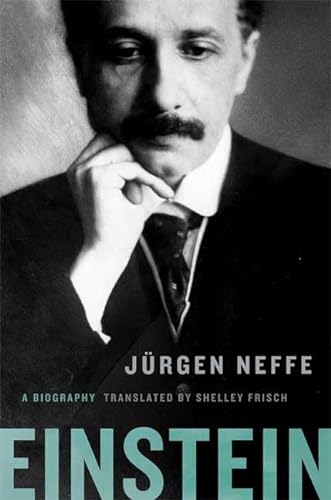
Inhaltsangabe
Albert Einstein is an icon of the twentieth century. Born in Ulm, Germany, in 1879, he is most famous for his theory of relativity. He also made enormous contributions to quantum mechanics and cosmology, and for his work he was awarded the Nobel Prize in 1921. A self-pronounced pacifist, humanist, and, late in his life, democratic socialist, Einstein was also deeply concerned with the social impact of his discoveries.
Much of Einstein’s life is shrouded in legend. From popular images and advertisements to various works of theater and fiction, he has come to signify so many things. In Einstein: A Biography, Jürgen Neffe presents a clear and probing portrait of the man behind the myth. Unearthing new documents, including a series of previously unknown letters from Einstein to his sons, which shed new light on his role as a father, Neffe paints a rich portrait of the tumultuous years in which Einstein lived and worked. And with a background in the sciences, he describes and contextualizes Einstein’s enormous contributions to our scientific legacy.
Einstein, a breakout bestseller in Germany, is sure to be a classic biography of the man and proverbial genius who has been called “the brain of the [twentieth] century.”
Die Inhaltsangabe kann sich auf eine andere Ausgabe dieses Titels beziehen.
Über die Autorin bzw. den Autor
Dr. Jürgen Neffe is a recipient of the Egon Erwin Kisch Award, the most prestigious award for print journalism in Germany. He lives in Berlin, where he is affiliated with the Max Planck Institute for Science History.
Auszug. © Genehmigter Nachdruck. Alle Rechte vorbehalten.
ONE
HIS SECOND BIRTH
THE FATEFUL YEAR 1919
When Albert Einstein woke up on November 7, 1919, a wintry gray Friday morning, in his apartment on Haberlandstrasse 5 in Berlin, his life had been transformed. The forty-year-old had no idea at this point what the next few weeks and months—and the rest of his life—had in store for him. His quest to "sneak a look at God’s cards"1 brought him about as close to the essence of nature as anyone had ever been. Even so, on the day of his "canonization" in the temple of science, he could scarcely envision the direction his life was about to take.
Until this point, Einstein had stayed out of the public eye. Now he learned firsthand that research and technology were not the only two forces that were shaping the twentieth century. The mass media had discovered him and made him the first global pop star of science. It is hard to imagine anyone more fully embodying the notion that fame feeds on itself. Today, Einstein’s popular image—a craggy face encircled by a white mane, with a bulbous nose and a look of wide-eyed innocence—is better known than that of any other human being.
Fame and the mass media go hand in hand. The Times of London set off a chain reaction in the media that morning in November, and Einstein’s fame was immediate. Newspapers and magazines were the voices of the epoch—the age of radio began about a decade later.
The British paper introduced to its readers "one of the most momentous, if not the most momentous, pronouncements of human thought."2 This newspaper normally maintained a tone of genteel detachment and objectivity, but in this case the editors euphorically proclaimed a "revolution in science."
For the originator of the uproar far away in Berlin, the content of the report was no surprise. After all, the "revolution"—the general theory of relativity—had occurred four years earlier. And Einstein was already well aware that an astronomical measurement more than five months earlier had confirmed his "new theory of the universe."
Einstein had made several predictions as touchstones for the correctness of his model. One of them stated that large masses curve or bend space. If this curvature really existed, light would have to follow their forms exactly on its path through the universe. In the proximity of the sun, the closest massive body to the earth, it would have to be deflected by a tiny but quantifiable amount.
This amount can be calculated exactly using Einstein’s formulas: 1.7 seconds of arc in geometric terms. In the cosmos, this is equivalent to a distance of the breadth of a match. The previous prediction on the basis of equations by Isaac Newton, the forerunner of modern physics, had predicted only half of this amount, and had yet to be tested. The moment was arriving to put Einstein’s theory to the test. If his prophecy could be confirmed in practice, his model would triumph over Newton’s, two centuries after the latter’s death.
The requisite measurements are only possible every few years, when the moon covers the sun completely for a few minutes, from the vantage point of people on earth. Only then can stars in the vicinity of the sun even be detected, allowing a possible curvature of the light rays to be measured by the solar mass. Now the readers of The Times were learning that British researchers in the tropics had been successful in conducting this very test during a solar eclipse, on May 29, 1919.
Einstein had learned the results in the early part of the summer. On September 27, he wrote to his mother, who was bedridden with cancer in Switzerland, "Today some happy news. H. A. Lorentz telegraphed me that the English expeditions have locally verified the deflection of light by the Sun."3 The formal announcement was held off, however, until a statement was read at a joint meeting of the Royal Society and the Royal Astronomical Society in London on November 6. This remarkable meeting altered the course of Einstein’s life. The British mathematician and philosopher Alfred North Whitehead, who was present at the meeting, recorded his impressions:
The whole atmosphere of tense interest was exactly that of the Greek drama: we were the chorus commenting on the decree of destiny as disclosed in the development of a supreme incident. There was dramatic quality in the very staging: the traditional ceremonial, and in the background the picture of Newton to remind us that the greatest of scientific generalizations was now, after more than two centuries, to receive its first modification. Nor was the personal interest wanting: a great adventure in thought had at last come safe to shore. . . . The laws of physics are the decrees of fate.4
At this moment, Albert Einstein was reborn as legend and myth, idol and icon of an entire era. The mortal Einstein had just passed his creative zenith, and the rather tragic second half of his life lay before him. An immortal of the same name then stepped onto the international stage—the Einstein that would be embedded in the consciousness of the twentieth century as the archetype of the adventurer of the mind whose philosophical quest embodied a conscience for mankind and put the principle of responsibility on a par with the standard of science and progress. His name became synonymous with genius even during his lifetime.
On November 10, The New York Times picked up the story with the headline, "Lights All Askew in the Heavens" and announced, "Einstein Theory Triumphs."5 The paper reassured its readers that no one need bother trying to grasp the new theory. Only "twelve wise men" would be able to understand it. On November 11, another headline followed on the same topic, and for the rest of the year, additional stories on a nearly daily basis opened the eyes of the readership to the preposterous new world of relativity and its creator. These reports also played a major role in fostering Einstein’s fame to the notoriously curious, sensation-seeking, and enthusiastic American public.
In Berlin, people were oblivious to these developments. They were burdened with other concerns one year after the end of the war. The majority of the population was hungry and cold. Early that month, the winter had set in prematurely, and the first snow had fallen. There was barely anything to eat and almost nothing to burn. The railroad had suspended passenger services for eleven days to transport as many potatoes and as much coal as possible to the city.
Nearly everything was in short supply. Even the small pleasures of life became big problems. Der Abend noted, "You are just as likely to win the lottery or be hit by lightning as you are to buy a bar of chocolate at a normal price."6 Refugees from the East crowded into the congested city. Living quarters were hard to come by, and the homeless camped out in wind-protected corners. Sooner or later, the owners of large apartments were required to take in boarders—including the Einsteins, who had a seven-room apartment on Haberlandstrasse.
Einstein wrote to his mother in September 1919, "We have to relinquish a room (rent it out). Starting tomorrow, the elevator won’t be operating anymore, so each exit will involve a climbing expedition, and in addition to that, much shivering lies ahead of us this winter."7 The following March, he reported to his sons from his first marriage, Hans Albert and Eduard: "One week we had no lights, gas, occasionally even no water."8
Aside from such practical limitations, Einstein saw no reason to alter his daily routine on this morning in November. After waking up in his bedroom right next to the front entrance—the spartan furnishings were limited to a bed, a closet, a chest, a table, and a couple of chairs— he walked through the library and the living room to get...
„Über diesen Titel“ kann sich auf eine andere Ausgabe dieses Titels beziehen.
Suchergebnisse für Einstein: A Biography

Beispielbild für diese ISBN
Einstein: A Biography
Verlag:
Farrar, Straus and Giroux, 2007
ISBN 10: 0374146640
ISBN 13: 9780374146641
Gebraucht
Hardcover
Anbieter: World of Books (was SecondSale), Montgomery, IL, USA
Verkäuferbewertung 5 von 5 Sternen

Zustand: Good. Item in good condition. Textbooks may not include supplemental items i.e. CDs, access codes etc. Artikel-Nr. 00105227519
Gebraucht kaufen
EUR 4,06
Versand gratis
Versand innerhalb von USA
Versand innerhalb von USA
Anzahl: 3 verfügbar
Beispielbild für diese ISBN
Einstein: A Biography
Verlag:
Farrar, Straus and Giroux, 2007
ISBN 10: 0374146640
ISBN 13: 9780374146641
Gebraucht
Hardcover
Anbieter: World of Books (was SecondSale), Montgomery, IL, USA
Verkäuferbewertung 5 von 5 Sternen
Zustand: Good. Good condition ex-library book with usual library markings and stickers. Artikel-Nr. 00108532262
Gebraucht kaufen
EUR 4,44
Versand gratis
Versand innerhalb von USA
Versand innerhalb von USA
Anzahl: 1 verfügbar
Beispielbild für diese ISBN
Einstein: A Biography
Verlag:
Farrar, Straus and Giroux, 2007
ISBN 10: 0374146640
ISBN 13: 9780374146641
Gebraucht
Hardcover
Anbieter: ThriftBooks-Atlanta, AUSTELL, GA, USA
Verkäuferbewertung 5 von 5 Sternen
Hardcover. Zustand: Very Good. No Jacket. Former library book; May have limited writing in cover pages. Pages are unmarked. ~ ThriftBooks: Read More, Spend Less. Artikel-Nr. G0374146640I4N10
Gebraucht kaufen
EUR 7,08
Versand gratis
Versand innerhalb von USA
Versand innerhalb von USA
Anzahl: 1 verfügbar
Beispielbild für diese ISBN
Einstein: A Biography
Verlag:
Farrar, Straus and Giroux, 2007
ISBN 10: 0374146640
ISBN 13: 9780374146641
Gebraucht
Hardcover
Anbieter: ThriftBooks-Reno, Reno, NV, USA
Verkäuferbewertung 5 von 5 Sternen
Hardcover. Zustand: Very Good. No Jacket. Former library book; May have limited writing in cover pages. Pages are unmarked. ~ ThriftBooks: Read More, Spend Less. Artikel-Nr. G0374146640I4N10
Gebraucht kaufen
EUR 7,08
Versand gratis
Versand innerhalb von USA
Versand innerhalb von USA
Anzahl: 1 verfügbar
Beispielbild für diese ISBN
Einstein: A Biography
Verlag:
Farrar, Straus and Giroux, 2007
ISBN 10: 0374146640
ISBN 13: 9780374146641
Gebraucht
Hardcover
Anbieter: ThriftBooks-Atlanta, AUSTELL, GA, USA
Verkäuferbewertung 5 von 5 Sternen
Hardcover. Zustand: Very Good. No Jacket. May have limited writing in cover pages. Pages are unmarked. ~ ThriftBooks: Read More, Spend Less. Artikel-Nr. G0374146640I4N00
Gebraucht kaufen
EUR 7,08
Versand gratis
Versand innerhalb von USA
Versand innerhalb von USA
Anzahl: 1 verfügbar
Beispielbild für diese ISBN
Einstein: A Biography
Verlag:
Farrar, Straus and Giroux, 2007
ISBN 10: 0374146640
ISBN 13: 9780374146641
Gebraucht
Hardcover
Anbieter: ThriftBooks-Dallas, Dallas, TX, USA
Verkäuferbewertung 5 von 5 Sternen
Hardcover. Zustand: Good. No Jacket. Pages can have notes/highlighting. Spine may show signs of wear. ~ ThriftBooks: Read More, Spend Less. Artikel-Nr. G0374146640I3N00
Gebraucht kaufen
EUR 7,08
Versand gratis
Versand innerhalb von USA
Versand innerhalb von USA
Anzahl: 1 verfügbar
Beispielbild für diese ISBN
Einstein: A Biography
Verlag:
Farrar, Straus and Giroux, 2007
ISBN 10: 0374146640
ISBN 13: 9780374146641
Gebraucht
Hardcover
Anbieter: ThriftBooks-Atlanta, AUSTELL, GA, USA
Verkäuferbewertung 5 von 5 Sternen
Hardcover. Zustand: Good. No Jacket. Pages can have notes/highlighting. Spine may show signs of wear. ~ ThriftBooks: Read More, Spend Less. Artikel-Nr. G0374146640I3N00
Gebraucht kaufen
EUR 7,08
Versand gratis
Versand innerhalb von USA
Versand innerhalb von USA
Anzahl: 1 verfügbar
Beispielbild für diese ISBN
Einstein: A Biography
Verlag:
Farrar, Straus and Giroux, 2007
ISBN 10: 0374146640
ISBN 13: 9780374146641
Gebraucht
Hardcover
Anbieter: ThriftBooks-Reno, Reno, NV, USA
Verkäuferbewertung 5 von 5 Sternen
Hardcover. Zustand: Good. No Jacket. Missing dust jacket; Pages can have notes/highlighting. Spine may show signs of wear. ~ ThriftBooks: Read More, Spend Less. Artikel-Nr. G0374146640I3N01
Gebraucht kaufen
EUR 7,08
Versand gratis
Versand innerhalb von USA
Versand innerhalb von USA
Anzahl: 1 verfügbar
Beispielbild für diese ISBN
Einstein: A Biography
Anbieter: AwesomeBooks, Wallingford, Vereinigtes Königreich
Verkäuferbewertung 5 von 5 Sternen
Hardcover. Zustand: Very Good. Einstein: A Biography This book is in very good condition and will be shipped within 24 hours of ordering. The cover may have some limited signs of wear but the pages are clean, intact and the spine remains undamaged. This book has clearly been well maintained and looked after thus far. Money back guarantee if you are not satisfied. See all our books here, order more than 1 book and get discounted shipping. Artikel-Nr. 7719-9780374146641
Gebraucht kaufen
EUR 19,14
EUR 4,81 Versand
Versand von Vereinigtes Königreich nach USA
Versand von Vereinigtes Königreich nach USA
Anzahl: 2 verfügbar
Beispielbild für diese ISBN
Einstein: A Biography
Anbieter: Bahamut Media, Reading, Vereinigtes Königreich
Verkäuferbewertung 5 von 5 Sternen
Hardcover. Zustand: Very Good. This book is in very good condition and will be shipped within 24 hours of ordering. The cover may have some limited signs of wear but the pages are clean, intact and the spine remains undamaged. This book has clearly been well maintained and looked after thus far. Money back guarantee if you are not satisfied. See all our books here, order more than 1 book and get discounted shipping. Artikel-Nr. 6545-9780374146641
Gebraucht kaufen
EUR 18,81
EUR 8,16 Versand
Versand von Vereinigtes Königreich nach USA
Versand von Vereinigtes Königreich nach USA
Anzahl: 2 verfügbar