
Inhaltsangabe
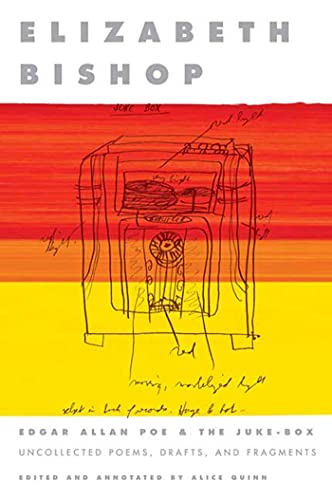
From the mid-1930s to 1978 Elizabeth Bishop published some eighty poems and thirty translations. Yet her notebooks reveal that she embarked upon many more compositions, some existing in only fragmentary form and some embodied in extensive drafts. Edgar Allen Poe & The Juke-Box presents, alongside facsimiles of many notebook pages from which they are drawn, poems Bishop began soon after college, reflecting her passion for Elizabethan verse and surrealist technique; love poems and dream fragments from the 1940s; poems about her Canadian childhood; and many other works that heretofore have been quoted almost exclusively in biographical and critical studies.
This revelatory and moving selection brings us into the poet's laboratory, showing us the initial provocative images that moved her to begin a poem, illustrating terrain unexplored in the work published during her lifetime. Editor Alice Quinn has also mined the Bishop archives for rich tangential material that illuminates the poet's sources and intentions.
Die Inhaltsangabe kann sich auf eine andere Ausgabe dieses Titels beziehen.
Über die Autorinnen und Autoren
The modern American poet Elizabeth Bishop (1911-79) received the Pulitzer Prize in 1956 for her collection Poems: North & South. A Cold Spring, the National Book Award for The Complete Poems (1969), the National Book Critics' Circle Award in 1976, and many other distinctions and accolades for her work. She was born in Worcester, Massachusetts. She traveled widely as an adult, living for years in France and then Brazil, before returning to the United States.
Alice Quinn is poetry editor of The New Yorker and the director of the Poetry Society of America.
Auszug. © Genehmigter Nachdruck. Alle Rechte vorbehalten.
Excerpted from Edgar Allan Poe & The Juke-Box by Elizabeth Bishop Copyright © 2006 by Alice Helen Methfessel. Published in March 2006 by Farrar, Straus and Giroux, LLC. All rights reserved.
Introduction
To visit the Department of Special Collections, Vassar College Libraries, and explore the abundance of Elizabeth Bishop material is to enter a universe of fascinating proportions. In the boxes that preserve more than thirty-five hundred pages of Bishop's writing are brief, indelible character sketches. ("Loved the wrong person all his life / lived in the wrong place / maybe even read the wrong books--"), bits of overheard dialogue she found irresistible, notes for stories, commentary on poetry she revered (by Herbert, Hopkins, Stevens, and Moore, particularly), wholly arresting, distinctly characteristic bits of description ("the bureau trapped in the moon-light, like a creature saying 'oh' "; "Begonias ghostly in a galvanized bucket"), accounts of dreams, drawings, menus, shopping lists, and hosts of fascinating remarks on the art of poetry, as well as the occasional withering comment on a poem, an essay, or a literary attitude or viewpoint she deplored. Of Robert Bridges, Poet Laureate of England and friend to Hopkins, for instance, she writes, "The reasonableness of all his ideas is too much--not a touch of the fanatical. He seems to have made himself into a poet out of wisdom--after deciding, sensibly, it was the best profession life had to offer him." There are also--especially in her notebooks from the 1930s and '40s, when she was often desperately uncertain about the direction of her work and her life--anguishedcris de coeur, indicating how much courage and bedrock stamina her survival entailed.
Many of the titles set down in the notebooks are referred to just once, including early groups with marvelous descriptive tags indicating Bishop's ideas for them. Her post-college journal, which she began on the island of Cuttyhunk off the coast of New Bedford, Massachusetts, in July 1934, lists the following on one page: " 'The Citrus Fruit'--love & friendship, 'The Emblem in the Eye'--6 sonnets, 'Flags and Banners'--motion in dreams, and 'An Individual Island for Everyone' (breakfast foods, etc.--satire)."
And there are innumerable fragments and drafts of poems, work that she did not complete to her satisfaction or considered trifling; drafts with phrases that haunted her, showing up again and again in her notebooks over the course of years; drafts with lines written out in a rush but accompanied by a chosen rhyme scheme; fragments that showcase verbal gestures familiar to Bishop readers from the more successful resolution of those gestures in the poems we know--all of it work that for one reason or another she chose not to publish but did not destroy.
Thinking about poetry in the highest terms was instinctive for Bishop and meeting her own standards was almost impossible, and this may account for the extraordinary quality of her unpublished work. In a letter to Marianne Moore dated December 5, 1936, the twenty-five-year-old Bishop discusses her reaction to the new book by Wallace Stevens,Owl's Clover, making clear how deeply she is pondering what poetry can and ought to do: "What strikes me as so wonderful about the whole book--because I dislike the way he occasionally seems to make blank versemoo--is that it is such a display of ideas at work--making poetry, the poetry making them, etc. That, it seems to me, is the way a poet should think." In another early letter to Moore, she asks, "Can you please forgive me and believe that it is really because I want to do something well that I don't do it at all?"
Early on, editors understood her perfectionism and regularly tried to goad her to let go and send them her poems. She began publishing inThe New Yorker in 1940 at the age of twenty-nine, and on March 9, 1955, Katharine White wrote to her, "As usual, this letter is a plea to let us see some of the Elizabeth Bishop manuscripts that I feel certain are on your desk, all finished if only you could bring yourself to part with them." Many years later, on May 26, 1972, Howard Moss, who had succeeded White as Bishop's editor and who became her friend, wrote exuberantly to her about a poem he had seen in draft years before: " '12 O'Clock News' is marvelous and we're delighted to have it…I was particularly happy to see that 'unicyclist' back. I've been waiting for him for years…Like Beethoven's father, I'd simply put you in a room and make you work all the time if I could. Of course, I wouldn't be that strict. A little gin, a few sandwiches…"
In a talk about poetry prepared but not presented in Rio in the 1960s (and included in full in the appendix), Bishop writes of the challenges as she conceived of them: "Off and on I have written out a poem called 'Grandmother's Glass Eye' which should be about the problem of writing poetry. The situation of my grandmother strikes me as rather like the situation of the poet: the difficulty of combining the real with the decidedly un-real; the natural with the unnatural; the curious effect a poem produces of being as normal as sight and yet as synthetic, as artificial, as a glass eye."
* * *
None of the material here was stamped by Elizabeth Bishop for publication with the notable exception of her villanelle "One Art," which is included here in the appendix along with the sixteen available drafts of the poem as numbered by the Vassar archive. There is disagreement among scholars about the sequence of the drafts--see Elizabeth Bishop: Life and the Memory of It by Brett C. Millier andElizabeth Bishop's Poetics of Intimacy by Victoria Harrison (both noted in the bibliography)--but the set as it is offers a unique opportunity to study a Bishop poem from inception to fulfillment. The poem was written within months as distinct from the sometimes decades-long separation between a poem's beginning and Bishop's satisfaction with it. Bishop kept the drafts together. And it seems the appropriate candidate for inclusion--for the sake of contrast and study--in this book of unfinished work.
The illustrated poem that opens the book, " 'I introduce Penelope Gwin…,' " a portrait of the artist as a young girl, must have pleased Bishop when she wrote it, but where could it have found a home in her oeuvre while she was alive except in an essay on her juvenilia?
In a letter dated January 20, 1938, when she was about to turn twenty-seven, Bishop sent "Money," one of the slighter poems collected here, to Marianne Moore. She referred to the poem as "a sort of joke (made out of a sentence in Dostoevsky'sHouse of the Dead: 'Money comes and goes like a bird.')" Graduating from college during the Depression, though, Bishop had cause to ponder the subject seriously, and her conclusion--that money's "migratory habits" are "stern, both ignorant and wise"--is captivating even if the poem is too tidy and circumscribed to have passed muster with her. The little poem also shows the kind of phrase that could hook Bishop and motivate her to begin a poem.
Bishop's notebooks from the 1940s are full of touching evocation of Mrs. Hannah Almyda, her housekeeper in Key West, whom she described lovingly in letters to friends. But it's at the moment when Bishop seizes upon a powerful metaphor--"the Pelican, self-sacrificing, tearing feathers from its breast to line its nest"--and writes "for a poem?" in the margin that the depth of her regard for her friend and the scale of her own dependence become manifest.
On a draft of "Hannah A." Bishop writes...
Introduction
To visit the Department of Special Collections, Vassar College Libraries, and explore the abundance of Elizabeth Bishop material is to enter a universe of fascinating proportions. In the boxes that preserve more than thirty-five hundred pages of Bishop's writing are brief, indelible character sketches. ("Loved the wrong person all his life / lived in the wrong place / maybe even read the wrong books--"), bits of overheard dialogue she found irresistible, notes for stories, commentary on poetry she revered (by Herbert, Hopkins, Stevens, and Moore, particularly), wholly arresting, distinctly characteristic bits of description ("the bureau trapped in the moon-light, like a creature saying 'oh' "; "Begonias ghostly in a galvanized bucket"), accounts of dreams, drawings, menus, shopping lists, and hosts of fascinating remarks on the art of poetry, as well as the occasional withering comment on a poem, an essay, or a literary attitude or viewpoint she deplored. Of Robert Bridges, Poet Laureate of England and friend to Hopkins, for instance, she writes, "The reasonableness of all his ideas is too much--not a touch of the fanatical. He seems to have made himself into a poet out of wisdom--after deciding, sensibly, it was the best profession life had to offer him." There are also--especially in her notebooks from the 1930s and '40s, when she was often desperately uncertain about the direction of her work and her life--anguishedcris de coeur, indicating how much courage and bedrock stamina her survival entailed.
Many of the titles set down in the notebooks are referred to just once, including early groups with marvelous descriptive tags indicating Bishop's ideas for them. Her post-college journal, which she began on the island of Cuttyhunk off the coast of New Bedford, Massachusetts, in July 1934, lists the following on one page: " 'The Citrus Fruit'--love & friendship, 'The Emblem in the Eye'--6 sonnets, 'Flags and Banners'--motion in dreams, and 'An Individual Island for Everyone' (breakfast foods, etc.--satire)."
And there are innumerable fragments and drafts of poems, work that she did not complete to her satisfaction or considered trifling; drafts with phrases that haunted her, showing up again and again in her notebooks over the course of years; drafts with lines written out in a rush but accompanied by a chosen rhyme scheme; fragments that showcase verbal gestures familiar to Bishop readers from the more successful resolution of those gestures in the poems we know--all of it work that for one reason or another she chose not to publish but did not destroy.
Thinking about poetry in the highest terms was instinctive for Bishop and meeting her own standards was almost impossible, and this may account for the extraordinary quality of her unpublished work. In a letter to Marianne Moore dated December 5, 1936, the twenty-five-year-old Bishop discusses her reaction to the new book by Wallace Stevens,Owl's Clover, making clear how deeply she is pondering what poetry can and ought to do: "What strikes me as so wonderful about the whole book--because I dislike the way he occasionally seems to make blank versemoo--is that it is such a display of ideas at work--making poetry, the poetry making them, etc. That, it seems to me, is the way a poet should think." In another early letter to Moore, she asks, "Can you please forgive me and believe that it is really because I want to do something well that I don't do it at all?"
Early on, editors understood her perfectionism and regularly tried to goad her to let go and send them her poems. She began publishing inThe New Yorker in 1940 at the age of twenty-nine, and on March 9, 1955, Katharine White wrote to her, "As usual, this letter is a plea to let us see some of the Elizabeth Bishop manuscripts that I feel certain are on your desk, all finished if only you could bring yourself to part with them." Many years later, on May 26, 1972, Howard Moss, who had succeeded White as Bishop's editor and who became her friend, wrote exuberantly to her about a poem he had seen in draft years before: " '12 O'Clock News' is marvelous and we're delighted to have it…I was particularly happy to see that 'unicyclist' back. I've been waiting for him for years…Like Beethoven's father, I'd simply put you in a room and make you work all the time if I could. Of course, I wouldn't be that strict. A little gin, a few sandwiches…"
In a talk about poetry prepared but not presented in Rio in the 1960s (and included in full in the appendix), Bishop writes of the challenges as she conceived of them: "Off and on I have written out a poem called 'Grandmother's Glass Eye' which should be about the problem of writing poetry. The situation of my grandmother strikes me as rather like the situation of the poet: the difficulty of combining the real with the decidedly un-real; the natural with the unnatural; the curious effect a poem produces of being as normal as sight and yet as synthetic, as artificial, as a glass eye."
* * *
None of the material here was stamped by Elizabeth Bishop for publication with the notable exception of her villanelle "One Art," which is included here in the appendix along with the sixteen available drafts of the poem as numbered by the Vassar archive. There is disagreement among scholars about the sequence of the drafts--see Elizabeth Bishop: Life and the Memory of It by Brett C. Millier andElizabeth Bishop's Poetics of Intimacy by Victoria Harrison (both noted in the bibliography)--but the set as it is offers a unique opportunity to study a Bishop poem from inception to fulfillment. The poem was written within months as distinct from the sometimes decades-long separation between a poem's beginning and Bishop's satisfaction with it. Bishop kept the drafts together. And it seems the appropriate candidate for inclusion--for the sake of contrast and study--in this book of unfinished work.
The illustrated poem that opens the book, " 'I introduce Penelope Gwin…,' " a portrait of the artist as a young girl, must have pleased Bishop when she wrote it, but where could it have found a home in her oeuvre while she was alive except in an essay on her juvenilia?
In a letter dated January 20, 1938, when she was about to turn twenty-seven, Bishop sent "Money," one of the slighter poems collected here, to Marianne Moore. She referred to the poem as "a sort of joke (made out of a sentence in Dostoevsky'sHouse of the Dead: 'Money comes and goes like a bird.')" Graduating from college during the Depression, though, Bishop had cause to ponder the subject seriously, and her conclusion--that money's "migratory habits" are "stern, both ignorant and wise"--is captivating even if the poem is too tidy and circumscribed to have passed muster with her. The little poem also shows the kind of phrase that could hook Bishop and motivate her to begin a poem.
Bishop's notebooks from the 1940s are full of touching evocation of Mrs. Hannah Almyda, her housekeeper in Key West, whom she described lovingly in letters to friends. But it's at the moment when Bishop seizes upon a powerful metaphor--"the Pelican, self-sacrificing, tearing feathers from its breast to line its nest"--and writes "for a poem?" in the margin that the depth of her regard for her friend and the scale of her own dependence become manifest.
On a draft of "Hannah A." Bishop writes...
„Über diesen Titel“ kann sich auf eine andere Ausgabe dieses Titels beziehen.
Weitere beliebte Ausgaben desselben Titels

Suchergebnisse für Edgar Allan Poe & the Juke-Box: Uncollected Poems,...

Beispielbild für diese ISBN
Edgar Allan Poe & The Juke-Box: Uncollected Poems, Drafts, and Fragments
Verlag:
Farrar, Straus and Giroux, 2006
ISBN 10: 0374146454
ISBN 13: 9780374146450
Gebraucht
Hardcover
Anbieter: World of Books (was SecondSale), Montgomery, IL, USA
Verkäuferbewertung 5 von 5 Sternen

Zustand: Good. Item in good condition. Textbooks may not include supplemental items i.e. CDs, access codes etc. Artikel-Nr. 00105277985
Gebraucht kaufen
EUR 6,66
Versand gratis
Versand innerhalb von USA
Versand innerhalb von USA
Anzahl: 2 verfügbar
Beispielbild für diese ISBN
Edgar Allan Poe & the Juke-Box: Uncollected Poems, Drafts, and Fragments
Verlag:
Farrar, Straus and Giroux, 2006
ISBN 10: 0374146454
ISBN 13: 9780374146450
Gebraucht
Hardcover
Anbieter: ThriftBooks-Dallas, Dallas, TX, USA
Verkäuferbewertung 5 von 5 Sternen
Hardcover. Zustand: Fair. No Jacket. Readable copy. Pages may have considerable notes/highlighting. ~ ThriftBooks: Read More, Spend Less. Artikel-Nr. G0374146454I5N00
Gebraucht kaufen
EUR 8,30
Versand gratis
Versand innerhalb von USA
Versand innerhalb von USA
Anzahl: 1 verfügbar
Beispielbild für diese ISBN
Edgar Allan Poe & the Juke-Box: Uncollected Poems, Drafts, and Fragments
Verlag:
Farrar, Straus and Giroux, 2006
ISBN 10: 0374146454
ISBN 13: 9780374146450
Gebraucht
Hardcover
Anbieter: ThriftBooks-Dallas, Dallas, TX, USA
Verkäuferbewertung 5 von 5 Sternen
Hardcover. Zustand: Good. No Jacket. Former library book; Pages can have notes/highlighting. Spine may show signs of wear. ~ ThriftBooks: Read More, Spend Less. Artikel-Nr. G0374146454I3N10
Gebraucht kaufen
EUR 8,30
Versand gratis
Versand innerhalb von USA
Versand innerhalb von USA
Anzahl: 1 verfügbar
Beispielbild für diese ISBN
Edgar Allan Poe & the Juke-Box: Uncollected Poems, Drafts, and Fragments
Verlag:
Farrar, Straus and Giroux, 2006
ISBN 10: 0374146454
ISBN 13: 9780374146450
Gebraucht
Hardcover
Anbieter: ThriftBooks-Atlanta, AUSTELL, GA, USA
Verkäuferbewertung 5 von 5 Sternen
Hardcover. Zustand: Very Good. No Jacket. May have limited writing in cover pages. Pages are unmarked. ~ ThriftBooks: Read More, Spend Less. Artikel-Nr. G0374146454I4N00
Gebraucht kaufen
EUR 8,30
Versand gratis
Versand innerhalb von USA
Versand innerhalb von USA
Anzahl: 1 verfügbar
Beispielbild für diese ISBN
Edgar Allan Poe and the Juke-Box : Uncollected Poems, Drafts, and Fragments
Verlag:
Farrar, Straus & Giroux, 2006
ISBN 10: 0374146454
ISBN 13: 9780374146450
Gebraucht
Hardcover
Anbieter: Better World Books, Mishawaka, IN, USA
Verkäuferbewertung 5 von 5 Sternen
Zustand: Good. Former library copy. Pages intact with minimal writing/highlighting. The binding may be loose and creased. Dust jackets/supplements are not included. Includes library markings. Stock photo provided. Product includes identifying sticker. Better World Books: Buy Books. Do Good. Artikel-Nr. 3220513-6
Gebraucht kaufen
EUR 10,47
Versand gratis
Versand innerhalb von USA
Versand innerhalb von USA
Anzahl: 1 verfügbar
Beispielbild für diese ISBN
Edgar Allan Poe & The Juke-Box: Uncollected Poems, Drafts, and Fragments
Verlag:
Farrar, Straus and Giroux, 2006
ISBN 10: 0374146454
ISBN 13: 9780374146450
Gebraucht
Hardcover
Anbieter: Roundabout Books, Greenfield, MA, USA
Verkäuferbewertung 4 von 5 Sternen

hardcover. Zustand: Near Fine. Excellent, unmarked copy with little wear and tight binding. We ship in recyclable American-made mailers. 100% money-back guarantee on all orders. Artikel-Nr. 1728341
Gebraucht kaufen
EUR 15,20
Versand gratis
Versand innerhalb von USA
Versand innerhalb von USA
Anzahl: 1 verfügbar
Foto des Verkäufers
Edgar Allan Poe & the Juke-Box (First Printing) Uncollected Poems, Drafts, and Fragments
Verlag:
Farrar, Straus and Giroux, New York, NY, 2006
ISBN 10: 0374146454
ISBN 13: 9780374146450
Gebraucht
Hardcover
Erstausgabe
Anbieter: True Oak Books, Highland, NY, USA
Verkäuferbewertung 5 von 5 Sternen
Hardcover. Zustand: Very Good. Zustand des Schutzumschlags: No Dust Jacket. First Edition; First Printing. 367 pages; very slightly cocked spine. Very Good condition otherwise. No other noteworthy defects. No markings. ; - Your satisfaction is our priority. We offer free returns and respond promptly to all inquiries. Your item will be packaged with care and ship on the same or next business day. Buy with confidence. Artikel-Nr. HVD-68362-A-0
Gebraucht kaufen
EUR 18,07
Versand gratis
Versand innerhalb von USA
Versand innerhalb von USA
Anzahl: 1 verfügbar
Foto des Verkäufers
Edgar Allan Poe & The Juke-Box: Uncollected Poems, Drafts, and Fragments
Verlag:
Farrar, Straus And Giroux, New York, 2006
ISBN 10: 0374146454
ISBN 13: 9780374146450
Gebraucht
Hardcover
Erstausgabe
Anbieter: Andre Strong Bookseller, Blue Hill, ME, USA
Verkäuferbewertung 5 von 5 Sternen
Hardcover. Zustand: Very Good +. Zustand des Schutzumschlags: very good. First printing. 6 1/2 x 9 inches. xx, 367 pages.First printing with 'First Edition' and complete number line on copyright page. Condition of the book is Very Good+; looks new on all points. Dust jacket is very good; very light surface wear. STK. Artikel-Nr. 39259
Gebraucht kaufen
EUR 18,08
EUR 6,14 Versand
Versand innerhalb von USA
Versand innerhalb von USA
Anzahl: 1 verfügbar
Beispielbild für diese ISBN
Edgar Allan Poe & The Juke-Box: Uncollected Poems, Drafts, and Fragments
Verlag:
Farrar, Straus and Giroux, 2006
ISBN 10: 0374146454
ISBN 13: 9780374146450
Gebraucht
Paperback
Anbieter: WorldofBooks, Goring-By-Sea, WS, Vereinigtes Königreich
Verkäuferbewertung 5 von 5 Sternen
Paperback. Zustand: Very Good. The book has been read, but is in excellent condition. Pages are intact and not marred by notes or highlighting. The spine remains undamaged. Artikel-Nr. GOR005261086
Gebraucht kaufen
EUR 19,22
EUR 6,56 Versand
Versand von Vereinigtes Königreich nach USA
Versand von Vereinigtes Königreich nach USA
Anzahl: 2 verfügbar
Foto des Verkäufers
Edgar Allan Poe & The Juke-Box: Uncollected Poems, Drafts, and Fragments
Verlag:
Farrar, Straus and Giroux, 2006
ISBN 10: 0374146454
ISBN 13: 9780374146450
Gebraucht
Hardcover
Anbieter: Chapter 1, Johannesburg, GAU, Südafrika
Verkäuferbewertung 5 von 5 Sternen
Hardcover. Zustand: Fair. Zustand des Schutzumschlags: Fair. jacket is shelf rubbed. edge wear on boards. damp damage on both book and jacket. light markings. fair reading copy.[SK]. Our orders are shipped using tracked courier delivery services. Artikel-Nr. 37iv
Gebraucht kaufen
EUR 7,23
EUR 25,00 Versand
Versand von Südafrika nach USA
Versand von Südafrika nach USA
Anzahl: 1 verfügbar