
Verwandte Artikel zu Pulse: The Coming Age of Systems And Machines Inspired...
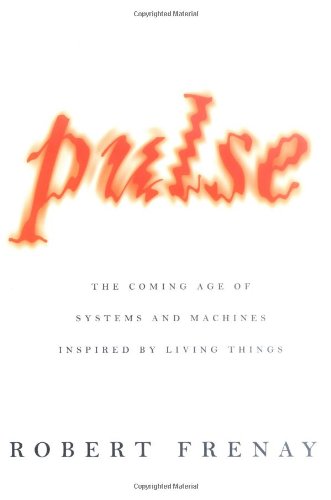
Inhaltsangabe
Explains how technological advances in human systems and machines that work like living things are rapidly transforming life in the twenty-first century, in a layperson's account that discusses such topics as emotion-enabled computers, ships that are designed to move like fish, and rapid evolution.
Die Inhaltsangabe kann sich auf eine andere Ausgabe dieses Titels beziehen.
Über die Autorinnen und Autoren
Robert Frenay was a contributing editor to Audubon Magazine. Pulse is his first book. He divides his time between New York City and Bridgeport, New York.
Robert Frenay is a freelance writer and former contributing editor toAudubon magazine. Pulse is his first book. He divides his time between New York City and upstate New York.
Auszug. © Genehmigter Nachdruck. Alle Rechte vorbehalten.
Excerpted from Pulse by Robert Frenay. Copyright © 2006 by Robert Frenay. Published in April 2006 by Farrar, Straus and Giroux, LLC. All rights reserved.
introduction
Many will see this book as a visitor’s guide to a brave new world of cutting-edge advances and gee-whiz technologies. So I should probably point out that there are no new ideas in the chapters that follow. True, the extraordinary developments outlined here will be mostly unknown to the casual reader, but the ideas that inform them are nearly four billion years old. What we are witnessing, and what this book charts, is a profound shift in the underlying concepts that shape virtually all human endeavors, or at least those in the industrialized world. As new insights into the workings of biology spawn fundamental redesigns of other fields, we can now watch the twin arcs of human culture and technology as they move to conform ever more closely to the underlying profile of living processes.
This is, at the same time, a big step past those reliable old machine age notions that have guided much of the world for centuries. And with that will come changes in the way we live. Many of them are going to be exciting and beneficial; some will be problematic, even dangerous. Either way, there is no question that they are well along. Because biological concepts are transforming so many different and seemingly unconnected fields at once, I believe those transformations are significant, evidence of a larger sea change.
What will be described here as the “new biology” draws from recent discoveries in biology to create machines and other systems that mimic the dynamics of life. Referred to technically by words like “biomimetics,” “ecomimetics,” and “bionics,” those efforts have spawned an ever-growing list of dazzling innovations that even now are moving out of the labs and into our daily lives. I should add that adopting lessons from nature is nothing new. The machine age itself was an early attempt to do just that. Unfortunately, it stopped short in its understanding of nature, basing our industry and eventually much of our culture today on concepts from the physics of the seventeenth and eighteenth centuries. Still, time has shown that getting things even half right was a powerful advance. After some three centuries we see the fruits of its success all around us. The problem is that evidence of its shortcomings is also on the rise. And that problem remains unsolved because the machine age approach—the underlying philosophy—now guiding efforts to correct it is actually its cause. There are good reasons for how this situation came about, the main one being the lack of any broad, viable alternative. But things are set to change. The new biology is that alternative, a more effective and realistic basis for the conventional wisdom that guides our decisions in every area of life.
* * *
This book might be called a current history. After the centuries-long run of machine age outlooks and practices, it describes a brief period of roughly a decade in which a new idea of the world has snapped into focus. The start of that accelerated period of change can be marked approximately by the 1994 founding of the World Wide Web Consortium, also known as W3C, a standards-setting body established by the Web’s inventor, Tim Berners-Lee. That action formalized the connecting of business, science, politics, art, design, philosophy, and a growing base of curious home users through the Internet. At the time there were only a few hundred thousand computers involved, but over the next ten years, through the meandering and ever-multiplying links of the Web, hundreds of millions more would be added. With that spreading network of connections, fields as diverse as genetics, cell biology, brain structure, and ecology would meet and mingle with other fields ranging from materials science, robotics, artificial intelligence, and artificial life to agriculture, town planning, manufacturing, and economic theory.
One result of this unprecedented exchange, among the sweetest fruits it has borne, is the deeper integration of our culture with the natural world. But unlike the romantic feelings that inspired earlier turns to nature, this new esteem for life stems from a sense of wonder at the vibrant dynamics we now see unfolding at its heart. It is those principles—and our dawning awareness of their practical superiority as a guide for human design—that hold out the promise of a new era.
introduction
Many will see this book as a visitor’s guide to a brave new world of cutting-edge advances and gee-whiz technologies. So I should probably point out that there are no new ideas in the chapters that follow. True, the extraordinary developments outlined here will be mostly unknown to the casual reader, but the ideas that inform them are nearly four billion years old. What we are witnessing, and what this book charts, is a profound shift in the underlying concepts that shape virtually all human endeavors, or at least those in the industrialized world. As new insights into the workings of biology spawn fundamental redesigns of other fields, we can now watch the twin arcs of human culture and technology as they move to conform ever more closely to the underlying profile of living processes.
This is, at the same time, a big step past those reliable old machine age notions that have guided much of the world for centuries. And with that will come changes in the way we live. Many of them are going to be exciting and beneficial; some will be problematic, even dangerous. Either way, there is no question that they are well along. Because biological concepts are transforming so many different and seemingly unconnected fields at once, I believe those transformations are significant, evidence of a larger sea change.
What will be described here as the “new biology” draws from recent discoveries in biology to create machines and other systems that mimic the dynamics of life. Referred to technically by words like “biomimetics,” “ecomimetics,” and “bionics,” those efforts have spawned an ever-growing list of dazzling innovations that even now are moving out of the labs and into our daily lives. I should add that adopting lessons from nature is nothing new. The machine age itself was an early attempt to do just that. Unfortunately, it stopped short in its understanding of nature, basing our industry and eventually much of our culture today on concepts from the physics of the seventeenth and eighteenth centuries. Still, time has shown that getting things even half right was a powerful advance. After some three centuries we see the fruits of its success all around us. The problem is that evidence of its shortcomings is also on the rise. And that problem remains unsolved because the machine age approach—the underlying philosophy—now guiding efforts to correct it is actually its cause. There are good reasons for how this situation came about, the main one being the lack of any broad, viable alternative. But things are set to change. The new biology is that alternative, a more effective and realistic basis for the conventional wisdom that guides our decisions in every area of life.
* * *
This book might be called a current history. After the centuries-long run of machine age outlooks and practices, it describes a brief period of roughly a decade in which a new idea of the world has snapped into focus. The start of that accelerated period of change can be marked approximately by the 1994 founding of the World Wide Web Consortium, also known as W3C, a standards-setting body established by the Web’s inventor, Tim Berners-Lee. That action formalized the connecting of business, science, politics, art, design, philosophy, and a growing base of curious home users through the Internet. At the time there were only a few hundred thousand computers involved, but over the next ten years, through the meandering and ever-multiplying links of the Web, hundreds of millions more would be added. With that spreading network of connections, fields as diverse as genetics, cell biology, brain structure, and ecology would meet and mingle with other fields ranging from materials science, robotics, artificial intelligence, and artificial life to agriculture, town planning, manufacturing, and economic theory.
One result of this unprecedented exchange, among the sweetest fruits it has borne, is the deeper integration of our culture with the natural world. But unlike the romantic feelings that inspired earlier turns to nature, this new esteem for life stems from a sense of wonder at the vibrant dynamics we now see unfolding at its heart. It is those principles—and our dawning awareness of their practical superiority as a guide for human design—that hold out the promise of a new era.
* * *
My own love of nature comes from a childhood lived on a dirt road along a rural lakeshore in upstate New York. It was an idyllic beginning, and the careless hours I spent as a boy fishing and wandering through open fields or wondering about the distant stars have remained a touch-stone throughout my life.
The genesis of this book was an ongoing series of conversations with Mike Robbins, my editor at Audubon magazine, where I worked in various capacities from 1991 through 1997. It was a formative experience, not least because of Robbins, then the magazine’s editor in chief. An award-winning journalist, Mike combines intellectual rigor and openness toward new ideas to a degree rare even in top editors. And the energy and ease he brought to his work made it an inspiring time to be there.
I wrote a small column for Audubon during this period, focused on the interface of nature and culture—in particular, on positive developments in technology. A hunch that ecosystems and economic systems might have parallels eventually took me to the Santa Fe Institute. There, Stuart Kauffman and Brian Arthur had been working on that question for some time, using computers as a kind of translation device between their two disciplines. The economics angle ended up as a sidebar to two long stories on the environmental promise of biologically inspired design; they ran in Audubon during the fall of 1995 and winter of 1996. This book has grown from them, and in the process has become a much broader project. To the best of my knowledge it is the first to bring under a single cover the full range of different fields being transformed by the biological approach.
The genesis of this book was an ongoing series of conversations with Mike Robbins, my editor at Audubon magazine, where I worked in various capacities from 1991 through 1997. It was a formative experience, not least because of Robbins, then the magazine’s editor in chief. An award-winning journalist, Mike combines intellectual rigor and openness toward new ideas to a degree rare even in top editors. And the energy and ease he brought to his work made it an inspiring time to be there.
I wrote a small column for Audubon during this period, focused on the interface of nature and culture—in particular, on positive developments in technology. A hunch that ecosystems and economic systems might have parallels eventually took me to the Santa Fe Institute. There, Stuart Kauffman and Brian Arthur had been working on that question for some time, using computers as a kind of translation device between their two disciplines. The economics angle ended up as a sidebar to two long stories on the environmental promise of biologically inspired design; they ran in Audubon during the fall of 1995 and winter of 1996. This book has grown from them, and in the process has become a much broader project. To the best of my knowledge it is the first to bring under a single cover the full range of different fields being transformed by the biological approach.
Someone once said that in order to have “interdisciplinary,” you first have to have the disciplines, and this overview would not have been possible without the more specialized treatments that have preceded it. There are the classics like D’Arcy Thompson’s On Growth and Form, Ian McHarg’s Design with Nature, Gregory Bateson’s Mind and Nature, and Christopher Alexander’s A Pattern Language. Since then there have been a number of books aimed at lay readers. They include Lessons from Nature by Daniel Chiras, Michael Rothschild’s Bionomics, Bruce Mazlish’s The Fourth Discontinuity, and Kevin Kelly’s Out of Control. A more recent wave of titles has included The Sand Dollar and the Slide Rule by Delta Willis; James Hogan’s Mind Matters; John Elkington’s The Chrysalis Economy; and Janine Benyus’ Biomimicry; also Darwin Among the Machines by George Dyson; The Third Culture by John Brockman; Natural Capitalism by Paul Hawken, Amory Lovins, and Hunter Lovins; as well as Douglas Robertson’s Phase Change. And the list continues to grow. As this book was in its final stages, William McDonough and Michael Braungart added to the list with their Cradle to Cradle, as did Christopher Meyer and Stan Davis, with It’s Alive. All these efforts...
„Über diesen Titel“ kann sich auf eine andere Ausgabe dieses Titels beziehen.
Suchergebnisse für Pulse: The Coming Age of Systems And Machines Inspired...

Beispielbild für diese ISBN
Pulse : The Coming Age of Systems and Machines Inspired by Living Things
Verlag:
Farrar, Straus & Giroux, 2006
ISBN 10: 0374113270
ISBN 13: 9780374113278
Gebraucht
Hardcover
Erstausgabe
Anbieter: Better World Books, Mishawaka, IN, USA
Verkäuferbewertung 5 von 5 Sternen

Zustand: Very Good. First Edition. Former library copy. Pages intact with possible writing/highlighting. Binding strong with minor wear. Dust jackets/supplements may not be included. Includes library markings. Stock photo provided. Product includes identifying sticker. Better World Books: Buy Books. Do Good. Artikel-Nr. 15791162-75
Gebraucht kaufen
EUR 6,91
Versand gratis
Versand innerhalb von USA
Versand innerhalb von USA
Anzahl: 1 verfügbar
Beispielbild für diese ISBN
Pulse : The Coming Age of Systems and Machines Inspired by Living Things
Verlag:
Farrar, Straus & Giroux, 2006
ISBN 10: 0374113270
ISBN 13: 9780374113278
Gebraucht
Hardcover
Erstausgabe
Anbieter: Better World Books: West, Reno, NV, USA
Verkäuferbewertung 5 von 5 Sternen
Zustand: Very Good. First Edition. Pages intact with possible writing/highlighting. Binding strong with minor wear. Dust jackets/supplements may not be included. Stock photo provided. Product includes identifying sticker. Better World Books: Buy Books. Do Good. Artikel-Nr. 16829409-20
Gebraucht kaufen
EUR 6,91
Versand gratis
Versand innerhalb von USA
Versand innerhalb von USA
Anzahl: 1 verfügbar
Beispielbild für diese ISBN
Pulse: The Coming Age of Systems and Machines Inspired by Living Things
Verlag:
Farrar, Straus and Giroux, 2006
ISBN 10: 0374113270
ISBN 13: 9780374113278
Gebraucht
Hardcover
Anbieter: ThriftBooks-Atlanta, AUSTELL, GA, USA
Verkäuferbewertung 5 von 5 Sternen
Hardcover. Zustand: Very Good. No Jacket. Missing dust jacket; May have limited writing in cover pages. Pages are unmarked. ~ ThriftBooks: Read More, Spend Less. Artikel-Nr. G0374113270I4N01
Gebraucht kaufen
EUR 7,62
Versand gratis
Versand innerhalb von USA
Versand innerhalb von USA
Anzahl: 1 verfügbar
Beispielbild für diese ISBN
Pulse: The Coming Age of Systems and Machines Inspired by Living Things
Verlag:
Farrar, Straus and Giroux, 2006
ISBN 10: 0374113270
ISBN 13: 9780374113278
Gebraucht
Hardcover
Anbieter: ThriftBooks-Atlanta, AUSTELL, GA, USA
Verkäuferbewertung 5 von 5 Sternen
Hardcover. Zustand: As New. No Jacket. Pages are clean and are not marred by notes or folds of any kind. ~ ThriftBooks: Read More, Spend Less. Artikel-Nr. G0374113270I2N00
Gebraucht kaufen
EUR 7,62
Versand gratis
Versand innerhalb von USA
Versand innerhalb von USA
Anzahl: 1 verfügbar
Beispielbild für diese ISBN
Pulse: The Coming Age of Systems and Machines Inspired by Living Things
Verlag:
Farrar Straus Giroux, New York, 2006
ISBN 10: 0374113270
ISBN 13: 9780374113278
Gebraucht
Hardcover
Erstausgabe
Anbieter: Abacus Bookshop, Pittsford, NY, USA
Verkäuferbewertung 5 von 5 Sternen
hardcover. Zustand: Fine copy in fine dust jacket. 1st. 8vo, 545 pp. Artikel-Nr. 087866
Gebraucht kaufen
EUR 8,98
EUR 3,49 Versand
Versand innerhalb von USA
Versand innerhalb von USA
Anzahl: 1 verfügbar
Foto des Verkäufers
Pulse: The Coming Age of Systems and Machines Inspired by Living Things
Anbieter: Hamelyn, Madrid, M, Spanien
Verkäuferbewertung 5 von 5 Sternen
Zustand: Very Good. : En 'Pulse', Robert Frenay explora la creciente influencia de una 'nueva biología', donde los sistemas y máquinas humanas operan de manera similar a los seres vivos. El libro describe computadoras emocionales, barcos que nadan como peces, vida artificial en diversas formas, granjas que crecen como praderas, ecosistemas tecnológicos y dinero que imita el flujo de energía natural. Frenay examina las promesas y los riesgos de esta transformación hacia la siguiente fase de la evolución cultural humana, ofreciendo una visión original y reflexiva sobre nuestro futuro. EAN: 9780374113278 Tipo: Libros Categoría: Tecnología|Ciencias Título: Pulse: The Coming Age of Systems and Machines Inspired by Living Things Autor: Robert Frenay Editorial: Macmillan Idioma: en Páginas: 576 Formato: tapa dura. Artikel-Nr. Happ-2026-07-28-477bb250
Gebraucht kaufen
EUR 21,05
EUR 12,99 Versand
Versand von Spanien nach USA
Versand von Spanien nach USA
Anzahl: 1 verfügbar
Beispielbild für diese ISBN
Pulse: The Coming Age of Systems And Machines Inspired by Living Things
Anbieter: Buchmarie, Darmstadt, Deutschland
Verkäuferbewertung 4 von 5 Sternen

Zustand: Good. Artikel-Nr. 3509173_ed7_3x
Gebraucht kaufen
EUR 14,17
EUR 105,00 Versand
Versand von Deutschland nach USA
Versand von Deutschland nach USA
Anzahl: 1 verfügbar