
Verwandte Artikel zu 2666
Inhaltsangabe
THE POSTHUMOUS MASTERWORK FROM “ONE OF THE GREATEST AND MOST INFLUENTIAL MODERN WRITERS” (JAMES WOOD,THE NEW YORK TIMES BOOK REVIEW)
Composed in the last years of Roberto Bolaño’s life, 2666 was greeted across Europe and Latin America as his highest achievement, surpassing even his previous work in its strangeness, beauty, and scope. Its throng of unforgettable characters includes academics and convicts, an American sportswriter, an elusive German novelist, and a teenage student and her widowed, mentally unstable father. Their lives intersect in the urban sprawl of SantaTeresa—a fictional Juárez—on the U.S.-Mexico border, where hundreds of young factory workers, in the novel as in life, have disappeared.
Die Inhaltsangabe kann sich auf eine andere Ausgabe dieses Titels beziehen.
Über die Autorin bzw. den Autor
ROBERTO BOLAÑO was born in Santiago, Chile, in 1953. He grew up in Chile and Mexico City, where he was a founder of the infrarealist poetry movement. His first full-length novel,The Savage Detectives, received the Herralde Prize and the Romulo Gallegos Prize when it appeared in 1998. Bolaño died in Blanes, Spain, at the age of fifty.NATASHA WIMMER ’s translation of The Savage Detectives was chosen as one of the ten best books of 2007 byThe Washington Post and The New York Times.
Auszug. © Genehmigter Nachdruck. Alle Rechte vorbehalten.
2666
A NovelBy Roberto BolaoFarrar, Straus and Giroux, LLC
Copyright © 2008 Roberto BolaoAll right reserved.
ISBN: 978-0-374-10014-8
Chapter One
The first time that Jean-Claude Pelletier read Benno von Archimboldi was Christmas 1980, in Paris, when he was nineteen years old and studying German literature. The book in question was D'Arsonval. The young Pelletier didn't realize at the time that the novel was part of a trilogy (made up of the English themed The Garden and the Polish-themed The Leather Mask, together with the clearly French-themed D'Arsonval), but this ignorance or lapse of bibliographical lacuna, attributable only to his extreme youth, did nothing to diminish the wonder and admiration that the novel stirred in him.From that day on (or from the early morning hours when he concluded his maiden reading) he became an enthusiastic Archimboldian and set out on a quest to find more works by the author. This was no easy task. Getting hold of books by Benno von Archimboldi in the 1980s, even in Paris, was an effort not lacking in all kinds of difficulties. Almost no reference to Archimboldi could be found in the university's German department. Pelletier's professors had never heard of him. One said he thought he recognized the name. Ten minutes later, to Pelletier's outrage (and horror), he realized that the person his professor had in mind was the Italian painter, regarding whom he soon revealed himself to be equally ignorant.
Pelletier wrote to the Hamburg publishing house that had published D'Arsonval and received no response. He also scoured the few German bookstores he could find in Paris. The name Archimboldi appeared in a dictionary of German literature and in a Belgian magazine devoted-whether as a joke or seriously, he never knew-to the literature of Prussia. In 1981, he made a trip to Bavaria with three friends from the German department, and there, in a little bookstore in Munich, on Voralmstrasse, he found two other books: the slim volume titled Mitzi's Treasure, less than one hundred pages long, and the aforementioned English novel, The Garden.
Reading these two novels only reinforced the opinion he'd already formed of Archimboldi. In 1983, at the age of twenty-two, he undertook the task of translating D'Arsonval. No one asked him to do it. At the time, there was no French publishing house interested in publishing the German author with the funny name. Essentially Pelletier set out to translate the book because he liked it, and because he enjoyed the work, although it also occurred to him that he could submit the translation, prefaced with a study of the Archimboldian oeuvre, as his thesis, and-why not?-as the foundation of his future dissertation.
He completed the final draft of the translation in 1984, and a Paris publishing house, after some inconclusive and contradictory readings, accepted it and published Archimboldi. Though the novel seemed destined from the start not to sell more than a thousand copies, the first printing of three thousand was exhausted after a coupld of contradictory, positive, even effusive reviews, opening the door for the second, third, and fourth printings.
(Continues...)
Excerpted from 2666 by Roberto Bolao Copyright © 2008 by Roberto Bolao. Excerpted by permission.
All rights reserved. No part of this excerpt may be reproduced or reprinted without permission in writing from the publisher.
Excerpts are provided by Dial-A-Book Inc. solely for the personal use of visitors to this web site.
„Über diesen Titel“ kann sich auf eine andere Ausgabe dieses Titels beziehen.
Suchergebnisse für 2666

Beispielbild für diese ISBN
2666
Verlag:
Farrar, Straus and Giroux, 2008
ISBN 10: 0374100144
ISBN 13: 9780374100148
Gebraucht
Hardcover
Anbieter: World of Books (was SecondSale), Montgomery, IL, USA
Verkäuferbewertung 5 von 5 Sternen

Hardback. Zustand: Good. Composed in the last years of Roberto Bolano's life, 2666 was greeted across Europe and Latin America as his most brilliant achievement, surpassing even his previous work in its strange beauty, daring experimentation, and epic scope. The book's subject matter ranges from the heady heights of literature and love to the gritty realism of violence and death as it explores how humans make sense of senseless events. Its throng of unforgettable characters includes academics and convicts, writers and cops, pursuing their own separate yet interrelated quests for meaning: an enigmatic Prussian novelist who disappears from the public eye after the death of his lover; a group of literary critics who bond through their shared love of the novelist's works; an African American journalist sent to Mexico on a sports beat in the wake of his mother's death; and a Spanish professor and widowed father whose mind is beginning to lose its grip on reality. Their lives intersect in the urban sprawl of Santa Teresa, a fictional Juarez on the US-Mexico border, where the serial killings of hundreds of young working class women remain unsolved. Artikel-Nr. CIN0374100144G
Gebraucht kaufen
EUR 39,77
Versand gratis
Versand innerhalb von USA
Versand innerhalb von USA
Anzahl: 1 verfügbar
Beispielbild für diese ISBN
2666
Anbieter: Revaluation Books, Exeter, Vereinigtes Königreich
Verkäuferbewertung 5 von 5 Sternen
Hardcover. Zustand: Brand New. 912 pages. 9.25x6.25x1.75 inches. In Stock. Artikel-Nr. 0374100144
Neu kaufen
EUR 123,03
EUR 17,70 Versand
Versand von Vereinigtes Königreich nach USA
Versand von Vereinigtes Königreich nach USA
Anzahl: 1 verfügbar
Foto des Verkäufers
2666
Verlag:
Farrar, Straus and Giroux, New York, 2008
ISBN 10: 0374100144
ISBN 13: 9780374100148
Gebraucht
Hardcover
Anbieter: Second Story Books, ABAA, Rockville, MD, USA
Verkäuferbewertung 4 von 5 Sternen

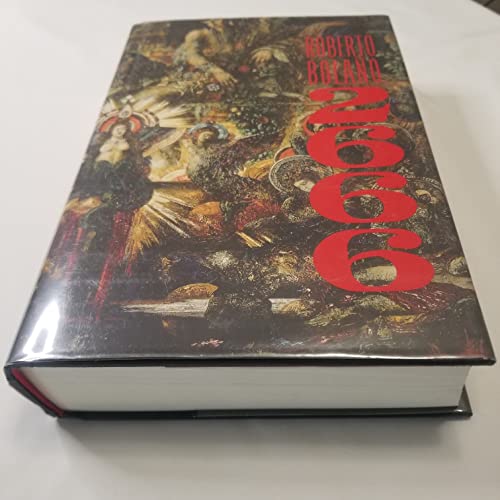
Hardcover. Zustand des Schutzumschlags: dj. First American Edition, First Printing. Octavo, 898 pages. In Very Good condition with a Very Good dust jacket. Dust jacket multicolored with red lettering, protected in mylar covering, price uncut: "$30.00". Mild general shelf wear. Shelved Case 6. Translated from the original Spanish. 1418031. Shelved Dupont Bookstore. Artikel-Nr. 1418031
Gebraucht kaufen
EUR 183,93
EUR 6,25 Versand
Versand innerhalb von USA
Versand innerhalb von USA
Anzahl: 1 verfügbar
Foto des Verkäufers
2666 (Signed First Edition)
Verlag:
Farrar, Straus and Giroux, New York, 2008
ISBN 10: 0374100144
ISBN 13: 9780374100148
Neu
Hardcover
Erstausgabe
Signiert
Anbieter: Dan Pope Books, West Hartford, CT, USA
Verkäuferbewertung 5 von 5 Sternen
Hardcover. Zustand: New. Zustand des Schutzumschlags: New. 1st Edition. FSG, New York, 2008. First edition. First printing, with full number line. A very fine (new) copy in a very fine (new) jacket. A pristine unread copy with price ($30.00) intact on front flap, opened only for translator to sign. Comes with archival-quality jacket protector. SIGNED by translator Natasha Wimmer on title page (name only). Translated from the Spanish. Wimmer won the PEN Translation Prize in 2009. Signed by Author(s). Artikel-Nr. FLAHIVE-1561
Neu kaufen
EUR 689,72
EUR 4,02 Versand
Versand innerhalb von USA
Versand innerhalb von USA
Anzahl: 1 verfügbar