
Verwandte Artikel zu Show Boat: Vintage Movie Classics (A Vintage Movie...
Show Boat: Vintage Movie Classics (A Vintage Movie Classic) - Softcover
Buch 10 von 10: A Vintage Movie Classic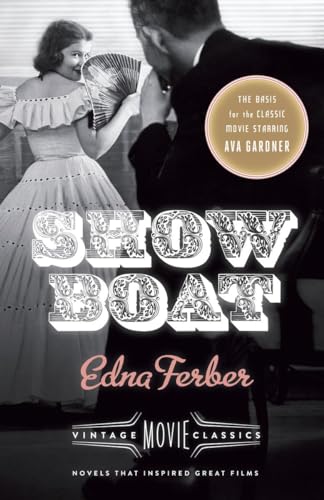
Inhaltsangabe
The classic tale behind MGM’s blockbuster movie directed by George Sidney, starring Ava Gardner, Howard Keel, and Kathryn Grayson.
Bringing to life the adventurous world of Mississippi show boats, the grittiness of turn-of-the-century Chicago, and the majesty of 1920s Broadway, Pulitzer Prize winner Edna Ferber’s Show Boat is a classic. Magnolia Hawks spends her childhood aboard the Cotton Blossom, growing up amid simmering racial tension and struggling to survive life on the Mississippi. When she falls in love with the dashing Gaylord Ravenal and moves with him to Chicago, the joy of giving birth to their beautiful daughter, Kim, is offset by Gaylord’s gambling addiction and distrustful ways. Only when Kim sets off on her own to pursue success on the New York stage does Magnolia return to the Cotton Blossom, reflecting on her own life and all who once called the show boat their home.
Originally published in 1926, adapted for the stage as a musical a year later and filmed three times over three decades, Show Boat brilliantly explores a nation going pivotal change through the lens of its popular culture.
With a new foreword by Foster Hirsch.
Vintage Movie Classics spotlights classic films that have stood the test of time, now rediscovered through the publication of the novels on which they were based.
Die Inhaltsangabe kann sich auf eine andere Ausgabe dieses Titels beziehen.
Über die Autorin bzw. den Autor
Edna Ferber was an American novelist, short story writer and playwright. Her bestselling novels were especially popular and included the Pulitzer Prize-winning So Big, Show Boat, Giant, and Cimarron. She died in 1968.
Auszug. © Genehmigter Nachdruck. Alle Rechte vorbehalten.
Excerpted from the Foreword by Foster Hirsch
FOREWORD
As all connoisseurs of the American musical theater readily acknowledge, Florenz Ziegfeld’s 1927 production of Show Boat, with a score by Jerome Kern and book and lyrics by Oscar Hammerstein II, is America’s first serious musical play—a landmark. The show’s startling opening lines—“Niggers all work on de Mississippi, / Niggers all work while de white folks play”—issued an immediate challenge. Also revolutionary was the level of integration between music and narrative; in unprecedented ways, most of the songs and dances grew out of and complemented the action. Kern’s soaring score and Hammerstein’s big-hearted lyrics for “Ol’ Man River,” “You Are Love,” “Make Believe,” “Can’t Help Lovin’ Dat Man,” and “Bill” (original lyrics by P. G. Wodehouse and revised by Hammerstein) have ensured the work’s enduring appeal. MGM’s 1951 fi lm carried the following description: “based upon the Immortal Musical Play.”
Often overlooked is that Kern and Hammerstein had adapted the 1926 bestselling novel by Edna Ferber, which provided all the characters, the settings, the plot points, and—not least—the song cues. Ferber’s description of the arrival of the show boat, for example, cries out for musical accompaniment: “As they neared the landing, the band, perched atop the , forward, alternated with the calliope. From the town, hurrying down the streets, through the woods, dotting the levee and the landing, came eager figures, black and white.” Wisely, Kern and Hammerstein seized on the scene as the inspiration for their show’s high-stepping opening numbers, “Cotton Blossom” and “Cap’n Andy’s Ballyhoo.”
With its picturesque backdrop, its sweeping-across-the-generations narrative, and its richly evoked Americana, Show Boat is camera-ready, grist for the Broadway and Hollywood mills. But the novel is far more than a template for big-budget theatrical adaptations; it is a work of genuine literary craftsmanship. Ferber had a knack for selecting unusual settings steeped in American history. During a troubled out-of-town tryout for her play Minick (cowritten with George S. Kaufman), theatrical producer Winthrop Ames told Ferber about show boats; she knew at once he had given her the seed for the kind of robust saga of the American past that was already her specialty. Like a vigilant graduate student Ferber embarked on a program of intensive research, supplementing her extensive reading with firsthand experience on an actual show boat, the James Adams Floating Theatre, hosted by producer Charles Hunter and his actress wife, Beulah Adams, who was known as the “Mary Pickford of the Chesapeake.”
Though Ferber had never been on the Mississippi before she wrote the novel, the river becomes her central character, a commanding, mystical presence that guides the denizens of the show boat to their awaiting destinies. In her vivid opening chapter, “the roar and howl and crash of the great river” envelop the action.
Throughout, Ferber paints radiant wide-screen vistas:
When April came, and the dogwood flashed its spectral
white in the woods, the show boat started. It was
the most leisurely and dreamlike of journeys. . . .
Miles—hundreds—thousands of miles of willow-fringed
streams fl owing aquamarine in the sunlight,
olive-green in the shade.
Equally lyrical are the stage-struck novelist’s accounts of the shows performed on the show boat—the hoary melodramas and the minstrelsy-based olios. “To the farmers and villagers of the Midwest; and to the small planters—black and white—of the South, the show boat meant music, romance, gaiety,” she writes with the fervor of a die-hard theater lover.
It penetrated settlements whose backwoods dwellers
had never witnessed a theatrical performance in all
their lives—simple childlike credulous people to whom
the make-believe villainies, heroics, loves, adventures
of the drama were so real as to cause the Cotton Blossom
troupe actual embarrassment.
“Often quality folk came to the show boat,” Ferber adds, and her racing syntax makes it easy to imagine the author herself waiting on the levee in anticipation of showtime.
Ferber’s strength is in her panoramic long shots. Breadth, scope, horizontality are the cinematic qualities that link her work to the swashbuckling style of Hollywood epics. Her detractors claim that in close-ups—in her characterizations and her intimate scenes—she lacks depth.
This may be true enough, often enough to have blocked Ferber from admission to the literary pantheon: her characters can seem drawn to type, lacking dimension and complexity. But in her strongest writing—in Show Boat, Cimarron, and Giant —she outwits her critics and creates characters of size. In Show Boat her three principal female characters—her high-strung, questing heroine Magnolia; Magnolia’s forbidding mother, Parthy; and Magnolia’s nurturing friend, Julie, a mulatto—are more sharply drawn than in Hammerstein’s libretto. Because at heart Edna herself was beyond the reach of piety or sentimentality, she holds her characters to a stricter reckoning than Hammerstein, blessed with a sunnier disposition and angling for a Broadway hit, was able to.
Ferber’s Magnolia, far more than Irene Dunne’s prim interpretation in the 1936 fi lm or Kathryn Grayson’s sugar-coated heroine in the 1951 version, is defiant, a backwoods rebel who identifies with the turbulent Mississippi rather than its placid tributaries. Repeatedly, Magnolia stands up to her tyrannical, frostbitten mother. Against her mother’s orders, she marries an untrustworthy buccaneer, riverboat gambler Gaylord Ravenal; when he abandons her and their daughter, Kim, she has the strength to survive on her own, first as an entertainer and then as the proprietress of the Cotton Blossom . “There stood Magnolia Ravenal on the upper deck of the Cotton Blossom Floating Palace Theatre, silhouetted against sunset sky and water—tall, erect, indomitable,” Ferber writes about her heroine in the book’s final scene. Surviving without a man by her side, the fearsomely independent Magnolia has become a proto-feminist, and as enduring as the river.
It’s tempting to see the strong-willed Magnolia as a projection of the novelist herself, a lifelong spinster “married” to her work, a woman without a man, who husbanded her zest for life, her great curiosity, and her equally great ambition, into her writing. Ferber slyly places her endorsement of Magnolia against her disapproval of Magnolia’s convent-educated daughter, Kim, who has an orderly marriage and a career as “almost the first of this new crop of intelligent, successful, deft, workmanlike, intuitive, vigorous, adaptable young women of the theater. There was about her—about them—nothing of genius, of greatness, of the divine fire.”
Ferber’s Parthy is a darker—fiercer—character than Hammerstein’s sentimental libretto could sustain. Like the Mississippi, she is omnipresent and implacable. And perhaps reflecting Ferber’s tortured relationship with her own unyielding mother, she is unlovable. Typically, however, as in both the 1936 and 1951 films, Parthy is played as a comic character—a domestic scold. But Ferber has higher intentions: “There...
„Über diesen Titel“ kann sich auf eine andere Ausgabe dieses Titels beziehen.
Suchergebnisse für Show Boat: Vintage Movie Classics (A Vintage Movie...

Beispielbild für diese ISBN
Show Boat: Vintage Movie Classics
Anbieter: World of Books (was SecondSale), Montgomery, IL, USA
Verkäuferbewertung 5 von 5 Sternen

Paperback. Zustand: Good. The classic tale behind MGM's blockbuster movie directed by George Sidney, starring Ava Gardner, Howard Keel, and Kathryn Grayson. Bringing to life the adventurous world of Mississippi show boats, the grittiness of turn-of-the-century Chicago, and the majesty of 1920s Broadway, Pulitzer Prize winner Edna Ferber's Show Boat is a classic. Magnolia Hawks spends her childhood aboard the Cotton Blossom, growing up amid simmering racial tension and struggling to survive life on the Mississippi. When she falls in love with the dashing Gaylord Ravenal and moves with him to Chicago, the joy of giving birth to their beautiful daughter, Kim, is offset by Gaylord's gambling addiction and distrustful ways. Only when Kim sets off on her own to pursue success on the New York stage does Magnolia return to the Cotton Blossom, reflecting on her own life and all who once called the show boat their home. Originally published in 1926, adapted for the stage as a musical a year later and filmed three times over three decades, Show Boat brilliantly explores a nation going pivotal change through the lens of its popular culture. With a new foreword by Foster Hirsch. Vintage Movie Classics spotlights classic films that have stood the test of time, now rediscovered through the publication of the novels on which they were based. Artikel-Nr. 00103209384
Gebraucht kaufen
EUR 6,55
Versand gratis
Versand innerhalb von USA
Versand innerhalb von USA
Anzahl: 1 verfügbar
Beispielbild für diese ISBN
Show Boat : Vintage Movie Classics
Verlag:
Knopf Doubleday Publishing Group, 2014
ISBN 10: 0345805739
ISBN 13: 9780345805737
Gebraucht
Softcover
Anbieter: Better World Books, Mishawaka, IN, USA
Verkäuferbewertung 5 von 5 Sternen
Zustand: Good. Former library copy. Pages intact with minimal writing/highlighting. The binding may be loose and creased. Dust jackets/supplements are not included. Includes library markings. Stock photo provided. Product includes identifying sticker. Better World Books: Buy Books. Do Good. Artikel-Nr. 14563733-6
Gebraucht kaufen
EUR 6,56
Versand gratis
Versand innerhalb von USA
Versand innerhalb von USA
Anzahl: 1 verfügbar
Beispielbild für diese ISBN
Show Boat : Vintage Movie Classics
Verlag:
Knopf Doubleday Publishing Group, 2014
ISBN 10: 0345805739
ISBN 13: 9780345805737
Gebraucht
Softcover
Anbieter: Better World Books, Mishawaka, IN, USA
Verkäuferbewertung 5 von 5 Sternen
Zustand: Good. Pages intact with minimal writing/highlighting. The binding may be loose and creased. Dust jackets/supplements are not included. Stock photo provided. Product includes identifying sticker. Better World Books: Buy Books. Do Good. Artikel-Nr. 10870263-6
Gebraucht kaufen
EUR 6,56
Versand gratis
Versand innerhalb von USA
Versand innerhalb von USA
Anzahl: 2 verfügbar
Beispielbild für diese ISBN
Show Boat
Anbieter: ThriftBooks-Dallas, Dallas, TX, USA
Verkäuferbewertung 5 von 5 Sternen
Paperback. Zustand: Fair. No Jacket. Readable copy. Pages may have considerable notes/highlighting. ~ ThriftBooks: Read More, Spend Less. Artikel-Nr. G0345805739I5N00
Gebraucht kaufen
EUR 8,25
Versand gratis
Versand innerhalb von USA
Versand innerhalb von USA
Anzahl: 1 verfügbar
Beispielbild für diese ISBN
Show Boat
Anbieter: ThriftBooks-Dallas, Dallas, TX, USA
Verkäuferbewertung 5 von 5 Sternen
Paperback. Zustand: Fair. No Jacket. Former library book; Readable copy. Pages may have considerable notes/highlighting. ~ ThriftBooks: Read More, Spend Less. Artikel-Nr. G0345805739I5N10
Gebraucht kaufen
EUR 8,25
Versand gratis
Versand innerhalb von USA
Versand innerhalb von USA
Anzahl: 1 verfügbar
Beispielbild für diese ISBN
Show Boat
Anbieter: ThriftBooks-Atlanta, AUSTELL, GA, USA
Verkäuferbewertung 5 von 5 Sternen
Paperback. Zustand: Good. No Jacket. Pages can have notes/highlighting. Spine may show signs of wear. ~ ThriftBooks: Read More, Spend Less. Artikel-Nr. G0345805739I3N00
Gebraucht kaufen
EUR 8,25
Versand gratis
Versand innerhalb von USA
Versand innerhalb von USA
Anzahl: 1 verfügbar
Beispielbild für diese ISBN
Show Boat: Vintage Movie Classics
Verlag:
Knopf Doubleday Publishing Group, 2014
ISBN 10: 0345805739
ISBN 13: 9780345805737
Gebraucht
paperback
Anbieter: Books From California, Simi Valley, CA, USA
Verkäuferbewertung 4 von 5 Sternen

paperback. Zustand: Very Good. Artikel-Nr. mon0003882359
Gebraucht kaufen
EUR 9,10
EUR 4,45 Versand
Versand innerhalb von USA
Versand innerhalb von USA
Anzahl: 1 verfügbar
Beispielbild für diese ISBN
Show Boat: Vintage Movie Classics
Anbieter: Powell's Bookstores Chicago, ABAA, Chicago, IL, USA
Verkäuferbewertung 5 von 5 Sternen
Paperback. Zustand: Used-Very Good. Minimal shelf wear, clean internals. May have remainder mark. Artikel-Nr. 2034337
Gebraucht kaufen
EUR 9,65
EUR 4,46 Versand
Versand innerhalb von USA
Versand innerhalb von USA
Anzahl: 3 verfügbar
Beispielbild für diese ISBN
Show Boat: Vintage Movie Classics
Anbieter: Powell's Bookstores Chicago, ABAA, Chicago, IL, USA
Verkäuferbewertung 5 von 5 Sternen
Paperback. Zustand: Very Good. Minimal shelf wear, clean internals. Remainder mark. Artikel-Nr. 2046438
Gebraucht kaufen
EUR 9,65
EUR 4,46 Versand
Versand innerhalb von USA
Versand innerhalb von USA
Anzahl: 5 verfügbar
Beispielbild für diese ISBN
Show Boat: Vintage Movie Classics
Anbieter: Eagle Eye Books, Decatur, GA, USA
Verkäuferbewertung 4 von 5 Sternen
Paper Back. Zustand: New. Artikel-Nr. 864418
Neu kaufen
EUR 17,45
EUR 3,56 Versand
Versand innerhalb von USA
Versand innerhalb von USA
Anzahl: 2 verfügbar