
Instructions for a Heatwave (Vintage Contemporaries) - Softcover
Buch 176 von 248: Vintage Contemporaries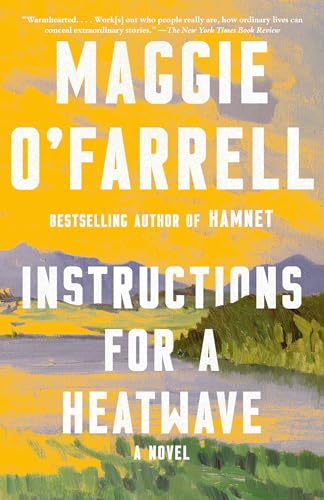
Inhaltsangabe
An unforgettable narrative—from the New York Times bestselling author of The Marriage Portrait and Hamnet—of a family falling apart and coming together with hard-won, life-changing truths about who they really are.
“Strange weather brings out strange behavior.” London, 1976. In the thick of a record-breaking heatwave, Gretta Riordan’s newly retired husband has cleaned out his bank account and vanished. Now, for the first time in years, Gretta calls her children home: Michael Francis, a history teacher whose marriage is failing; Monica, whose blighted past has driven a wedge between her and her younger sister; and Aoife, the youngest, whose new life in Manhattan is elaborately arranged to conceal a devastating secret.
In a story that stretches from the Upper West Side to a village on the coast of Ireland, Maggie O’Farrell explores the mysteries that inhere within families, and reveals the fault lines over which we build our lives.
Die Inhaltsangabe kann sich auf eine andere Ausgabe dieses Titels beziehen.
Über die Autorin bzw. den Autor
MAGGIE O'FARRELL was born in Northern Ireland in 1972. Her novels include Hamnet (winner of the National Book Critics Circle Award), After You’d Gone, The Vanishing Act of Esme Lennox, The Hand That First Held Mine (winner of the Costa Novel Award), and Instructions for a Heatwave. She has also written a memoir, I Am, I Am, I Am: Seventeen Brushes with Death. She lives in Edinburgh.
Auszug. © Genehmigter Nachdruck. Alle Rechte vorbehalten.
Highbury, London
The heat, the heat. It wakes Gretta just after dawn, propelling her from the bed and down the stairs. It inhabits the house like a guest who has outstayed his welcome: it lies along corridors, it circles around curtains, it lolls heavily on sofas and chairs. The air in the kitchen is like a solid entity filling the space, pushing Gretta down into the floor, against the side of the table.
Only she would choose to bake bread in such weather.
Consider her now, yanking open the oven and grimacing in its scorching blast as she pulls out the bread tin. She is in her nightdress, hair still wound onto curlers. She takes two steps backwards and tips the steaming loaf into the sink, the weight of it reminding her, as it always does, of a baby, a newborn, the packed, damp warmth of it.
She has made soda bread three times a week for her entire married life. She is not about to let a little thing like a heatwave get in the way of that. Of course, living in London, it is impossible to get buttermilk; she has to make do with a mixture of half milk and half yogurt. A woman at Mass told her it worked and it does, up to a point, but it is never quite the same.
At a clacking sound on the lino behind her, she says, “Is that you? Bread’s ready.”
“It’s going to be—” he begins, then stops.
Gretta waits for a moment before turning around. Robert is standing between the sink and the table, his large hands upturned, as if he’s holding a tea tray. He is staring at some-thing. The tarnished chrome of the tap, perhaps, the runnels of the draining board, that rusting enamel pan. Everything around them is so familiar, it’s impossible sometimes to tell what your eye has been trained upon, the way a person can no longer hear the individual notes of a known piece of music.
“It’s going to be a what?” she demands. He doesn’t reply. She moves towards him and places a palm on his shoulder. “You all right?” She has, of late, been finding herself reminded of his age, the sudden stoop of his back, the look of mild confusion on his face.
“What?” He swings his head around to look at her, as if startled by her touch. “Yes.” He nods. “Of course. I was just saying it’s going to be another hot one today.”
He shuffles sideways, just as she’d known he would, towards the thermometer, which clings, by a spit-moistened sucker, to the outside of the window.
It is the third month of the drought. For ten days now the heat has passed 90ºF. There has been no rain—not for days, not for weeks, not for months. No clouds pass, slow and stately as ships, over the roofs of these houses.
With a metallic click, like that of a hammer tapping a nail, a black spot lands on the window, as if pulled there by magnetic force. Robert, still peering at the thermometer, flinches. The insect has a striated underside, six legs splaying outwards. Another appears, at the other end of the window, then another, then another.
“Those buggers are back,” he murmurs.
Gretta comes to see, jamming on her glasses. Together, they peer at them, transfixed.
Swarms of red-backed aphids have, in the past week, been passing over the city. They mass in trees, on car windscreens. They catch in the hair of children coming home from school, they find their way into the mouths of those crazy enough to cycle in this heat, their feet adhere to the sun-creamed limbs of people lying in their back gardens.
The aphids fling themselves from the window, their feet detaching at the same moment, as if alerted by some secret signal, and they disappear into the azure sky.
Gretta and Robert straighten up, in unison, relieved.
“That’s them gone,” he says.
She sees him glance at the clock on the wall—a quarter to seven. At precisely this time, for more than thirty years, he would leave the house. He would take his coat off the peg by the door, pick up his bag, call goodbye to them all, shouting and squawking in the kitchen, and slam the door behind him. He always left at six forty-five, on the proverbial dot, no matter what was happening, whether Michael Francis was refusing to get out of bed, whether Aoife was kicking up a stink about Godknowswhat, whether Monica was trying to take over the cooking of the bacon. Not his department, all that, never was. Six forty-five, and he was out the door, gone.
He seems to feel a twitching in his limbs, she’s noticed, a kind of vestigial urge to set off, to get going, to be out in the world. Any minute now, she knows, he’ll be off to the newsagent’s.
With a hand on her bad hip, she pushes the chair out from the table with her foot, and Robert says, “I’ll just go round the corner and get the paper.
“Right you are,” she says, without looking up. “See you in a bit.”
Gretta sits herself down at the table. Robert has arranged everything she needs: a plate, a knife, a bowl with a spoon, a pat of butter, a jar of marmalade. It is in such small acts of kindness that people know they are loved. Which is, she reflects as she moves the sugar bowl to one side, surprisingly rare at their age. So many friends of hers feel overlooked or outgrown or unseen by their husbands, like furniture kept too long. But not her. Robert likes to know where she is at all times, he frets if she leaves the house without telling him, gets edgy if she slips away with-out him seeing, and starts ringing the children to question them on her whereabouts. It used to drive her crazy when they were first married—she used to long for a bit of invisibility, a bit of liberty—but she’s used to it now. Gretta saws a hunk from the end of the loaf and slathers it with butter. She gets a terrible weakness in her limbs if she doesn’t eat regularly. She told a doctor, years ago, that she thought she had hypoglycemia, after reading about it in a Sunday newspaper. Which would have explained her need to eat quite so often, wouldn’t it? But the doctor hadn’t even looked up from his prescription pad. “No such luck, I’m afraid, Mrs. Riordan,” he’d said, the cheeky so-and-so, and handed her a diet sheet.
The children all love this bread. She makes an extra loaf if she’s going to visit any of them and takes it, wrapped in a tea towel. She’s always done her best to keep Ireland alive in her London-born children. The girls both went to Irish-dancing classes. They had to catch the bus all the way to a place in Cam-den Town. Gretta used to take a cake tin of brack or gingerbread with her to pass around to the other mothers—exiled like her from Cork, from Dublin, from Donegal—and they would watch their daughters dip up and dip down, tap their feet in time to the fiddle. Monica, the teacher had said after only three lessons, had talent, had the potential to be a champion. She always knew, the teacher had said, she could always spot them. But Monica hadn’t wanted to become a champion or to enter the competitions. I hate it, she’d whisper, I hate it when everyone looks at you, when the judges write things down. She’d always been so fearful, so cautious, so backwards in coming forwards. Was it Gretta’s fault, or were children born like that? Hard to know. Either way, she’d had to allow Monica to give up the dancing, which was a crying shame.
Gretta had insisted on...
„Über diesen Titel“ kann sich auf eine andere Ausgabe dieses Titels beziehen.
Weitere beliebte Ausgaben desselben Titels

Suchergebnisse für Instructions for a Heatwave (Vintage Contemporaries)

Beispielbild für diese ISBN
Instructions for a Heatwave Vi
Anbieter: World of Books (was SecondSale), Montgomery, IL, USA
Verkäuferbewertung 5 von 5 Sternen

Zustand: Very Good. Item in very good condition! Textbooks may not include supplemental items i.e. CDs, access codes etc. Artikel-Nr. 00103927306
Gebraucht kaufen
EUR 8,09
Versand gratis
Versand innerhalb von USA
Versand innerhalb von USA
Anzahl: 3 verfügbar
Beispielbild für diese ISBN
Instructions for a Heatwave Vi
Anbieter: World of Books (was SecondSale), Montgomery, IL, USA
Verkäuferbewertung 5 von 5 Sternen
Zustand: Good. Item in good condition. Textbooks may not include supplemental items i.e. CDs, access codes etc. Artikel-Nr. 00103909907
Gebraucht kaufen
EUR 8,09
Versand gratis
Versand innerhalb von USA
Versand innerhalb von USA
Anzahl: 2 verfügbar
Beispielbild für diese ISBN
Instructions for a Heatwave : A Novel
Verlag:
Knopf Doubleday Publishing Group, 2014
ISBN 10: 0345804716
ISBN 13: 9780345804716
Gebraucht
Softcover
Anbieter: Better World Books, Mishawaka, IN, USA
Verkäuferbewertung 5 von 5 Sternen
Zustand: Good. Former library copy. Pages intact with minimal writing/highlighting. The binding may be loose and creased. Dust jackets/supplements are not included. Includes library markings. Stock photo provided. Product includes identifying sticker. Better World Books: Buy Books. Do Good. Artikel-Nr. 10292292-6
Gebraucht kaufen
EUR 13,90
Versand gratis
Versand innerhalb von USA
Versand innerhalb von USA
Anzahl: 1 verfügbar
Beispielbild für diese ISBN
Instructions for a Heatwave : A Novel
Verlag:
Knopf Doubleday Publishing Group, 2014
ISBN 10: 0345804716
ISBN 13: 9780345804716
Gebraucht
Softcover
Anbieter: Better World Books: West, Reno, NV, USA
Verkäuferbewertung 5 von 5 Sternen
Zustand: Good. Former library copy. Pages intact with minimal writing/highlighting. The binding may be loose and creased. Dust jackets/supplements are not included. Includes library markings. Stock photo provided. Product includes identifying sticker. Better World Books: Buy Books. Do Good. Artikel-Nr. 10292292-6
Gebraucht kaufen
EUR 13,90
Versand gratis
Versand innerhalb von USA
Versand innerhalb von USA
Anzahl: 1 verfügbar
Beispielbild für diese ISBN
Instructions for a Heatwave : A Novel
Verlag:
Knopf Doubleday Publishing Group, 2014
ISBN 10: 0345804716
ISBN 13: 9780345804716
Gebraucht
Softcover
Anbieter: Better World Books, Mishawaka, IN, USA
Verkäuferbewertung 5 von 5 Sternen
Zustand: Good. Pages intact with minimal writing/highlighting. The binding may be loose and creased. Dust jackets/supplements are not included. Stock photo provided. Product includes identifying sticker. Better World Books: Buy Books. Do Good. Artikel-Nr. 4056531-6
Gebraucht kaufen
EUR 13,90
Versand gratis
Versand innerhalb von USA
Versand innerhalb von USA
Anzahl: 1 verfügbar
Beispielbild für diese ISBN
Instructions for a Heatwave: A novel
Anbieter: Kennys Bookstore, Olney, MD, USA
Verkäuferbewertung 5 von 5 Sternen
Zustand: New. 2014. Reprint. Paperback. . . . . . Books ship from the US and Ireland. Artikel-Nr. V9780345804716
Neu kaufen
EUR 23,79
EUR 9,19 Versand
Versand innerhalb von USA
Versand innerhalb von USA
Anzahl: 1 verfügbar
Beispielbild für diese ISBN
Instructions for a Heatwave
Anbieter: Revaluation Books, Exeter, Vereinigtes Königreich
Verkäuferbewertung 5 von 5 Sternen
Paperback. Zustand: Brand New. reprint edition. 319 pages. 8.00x5.25x0.75 inches. In Stock. Artikel-Nr. 0345804716
Neu kaufen
EUR 30,72
EUR 17,65 Versand
Versand von Vereinigtes Königreich nach USA
Versand von Vereinigtes Königreich nach USA
Anzahl: 1 verfügbar
Foto des Verkäufers
Instructions for a Heatwave
Anbieter: moluna, Greven, Deutschland
Verkäuferbewertung 5 von 5 Sternen
Kartoniert / Broschiert. Zustand: New. KlappentextAn unforgettable narrative--from the New York Times bestselling author of The Marriage Portrait and Hamnet--of a family falling apart and coming together with hard-won, life-changing . Artikel-Nr. 897814719
Neu kaufen
EUR 27,01
EUR 48,99 Versand
Versand von Deutschland nach USA
Versand von Deutschland nach USA
Anzahl: 5 verfügbar