
Verwandte Artikel zu In Spite of Myself: A Memoir
Inhaltsangabe
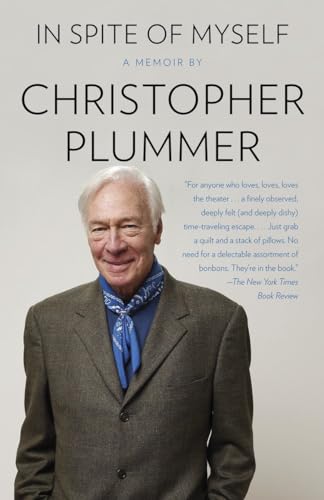
A collection of delicious anecdotes of a life spent on stages and film sets across the world—from Peter Hall’s Royal Shakespeare Theatre to The Sound of Music—from one of our greatest actors.
Christopher Plummer’s magnificent book recounts the wild adventure that was his life, stretching from a privileged childhood in Canada to the glorious, star-studded New York of the fifties to a sensational career in film appearing in some of our most beloved classics. Here are his late nights out with Carson McCullers, Tennessee Williams, Paddy Chayefsky, and Arthur Miller; his affairs and marriages; his collaborations with famed producers; and his memorable roles alongside fellow young and talented actors, each also destined for stardom: Judi Dench, Vanessa Redgrave, Peter O’Toole, Natalie Wood, and countless others.
Die Inhaltsangabe kann sich auf eine andere Ausgabe dieses Titels beziehen.
Über die Autorin bzw. den Autor
Christopher Plummer was born in Toronto, Ontario. He acted in more than 100 feature films, including The Man Who Would Be King, The Sound of Music, Stage Struck, and The Insider, and he starred in three of the world's most important theatre companies: Great Britain's National Theatre, The Royal Shakespeare Company, and the Stratford Festival of Canada. He received two Tony Awards for Best Actor (Barrymore; Cyrano), and he was nominated for the award seven other times. He also received a London Evening Standard Award for Best Actor for Becket. He received Emmys, the John Gielgud Quill Award, the Edwin Booth Award (Barrymore), The Jason Robards Award for Excellence, and was inducted into the Theatre Hall of Fame. He received an Academy Award for Best Supporting Actor for his role in Beginners. He was nominated for an Oscar for his role in All the Money in the World. He died in 2021.
Auszug. © Genehmigter Nachdruck. Alle Rechte vorbehalten.
CHAPTER ONE
I was brought up by an Airedale. I won’t deny it, ’tis the truth and nothing but, Your Honour—a bumbling, oversized shaggy great Airedale. The earliest memory I have of anything resembling a pater familia, bouncer, male-nurse or God is that dear slobbering old Airedale. My sword, my lance, my shield, he never failed to stand at the ready to rescue me from all my early Moriarties! Wherever I happened to be—on the floor, in my bath or on the potty, there— looming above me, panting heavily, one large, drooling Airedale reporting for duty, sir! If I went for a ride in my little cart, I would look away and pretend there was no one there at all and then when I did look back, of course he was there. He was always there padding along beside me—how could I miss him? He was my only horizon— he filled the sky. Like Romulus or Remus, I was his cub and he was my Wolf of Rome. His name was Byng.
He was christened after another shaggy old Airedale, Field Marshal Lord Byng of Vimy, whom my grandparents had known when he was governor general; and also for the very good reason that if any of our household showed guts enough to sit down to tea or play a hand at bridge, the day’s calm would invariably become a stormy séance as tables, taking on a life of their own, began to shake violently and with one quick loud explosion, Bing! they would catapult themselves ceiling-ward as teapots, cups, toast, crumpets, cards and markers flew madly across the room! My canine patron had, quite simply, decided to rise.
But I like Byng, my dog, because
He doesn’t know how to behave
So Byng’s the same as the First Friend was
And I am the Man in the Cave
(Apologies to Kipling)
Nothing ever came between us—Your Honour—nothing—he was my world; I knew no other. Until one day, one sobering day, the spell was broken when a meddling family friend pointed out to me that the nice tall lady pushing my pram was my mother.
Mummies and dogs! You can beat ’em, kick ’em, treat ’em as shabbily as you like—they will eternally forgive you and still come back for more. Such degree of devotion is as hard to grasp as it is unshakable. Being a child, I had no comprehension of it. It embarrassed me. I regularly ran away from it; in fact, I still do.
I didn’t throw myself into the struggle for life—
I threw my mother into it.
—g. b. shaw
I came into the world that monster of infant monsters, who can clear a room more swiftly than a Sherman tank; that very monster which causes fear, dread, revulsion to seal the lips of those that dare to speak its name—The Only Child! And being an only child I was more than frequently left on my own. Can you blame ’em?! A little boy’s mind can play some pretty macabre tricks on itself. I was so damned terrified of the dark that Mother had to sing me to sleep, snatches of old French songs she particularly loved.
Chante, rossignol, chante,
Toi qui as le coeur gai
Il y a longtemps que je t’aime,
Jamais, je ne t’oublierai.
But the terror never left. It stayed through all the early years. Because of books, which Mother insisted I read, my imagination began to take over, and the long winters gave one so much time to dream up horrors. My grandparents’ tall, forbidding house in the city could be pretty ominous, full of dark corners to jump out of and scare yourself to death. Every time I tried to rob my grandfather’s overcoat pocket of change so I could sneak downtown to Ben’s delicatessen for a smoked-meat sandwich and a Coke, some sudden sound would force me to drop everything and run like hell. My room was on the very top floor and in the middle of the night I would steal from my bed and sit shivering on the uppermost step, clinging tight to old Byng, staring down into the center of the long circular staircase, down into that black hole, that bottomless pit, and wait—wait for “them,” whoever “they” were, to climb up and get us.
Every spring we moved to the country. Lingering in the city after school, I generally took one of the late-night trains. As they never knew when I’d arrive, there was no family car to meet me and I was obliged to walk the long way home. When finally I reached our gate, I was tired and hungry but there was still some distance to go. Our driveway from the gate to the house was at least a half-mile long—it was always dark—no streetlamps lit the way. The first portion of the drive was long and straight but suddenly it dipped precipitously and turned a sharp corner. It was next to impossible to see. I could only feel my way and would invariably slip and fall on the loose gravel.
The drive resumed, snaking along by a deep swamp to my left near the edge of the lake. The dense woods which made the darkness even more impenetrable gave out a dank fenlike smell. I kept glancing behind as I hurried along but there was never anyone following me. To gain confidence I tried singing, but the sound of my voice was more sinister than the darkness itself, so I quickly gave up. A faint light glowed from the fields to my right and more than once I was sure that I saw, lit by a young moon, a still, solitary figure standing there. I bolted the rest of the way up the hill and it wasn’t till I reached the top and could see, through the eight tall poplars the lights from the house beyond, that my heart stopped pounding.
Very softly down the glade runs a waiting, watching shade,
And the whisper spreads and widens far and near;
And the sweat is on thy brow, for he passes even now—
He is Fear, O Little Hunter, he is Fear.
—RUDYARD KIPLING
More than once in the mountains north of the city, snowshoeing in the woods, I would lose my way. Night fell and I’d stop and stand dead still listening to the wind. The ice-bound trees cracked and rattled like the bones of skeletons. I was sure I would freeze to death. I started to cry and the tears froze against my face—little icicles hanging from my eyelids. The wind was stronger now and began to moan and howl through the tops of the pines, a sad and terrifying sound. I was certain at any moment I would be snatched up by that Spirit that hovers high above the trees the half-breeds talk of—that carries you away into the sky at such frightening speed that you burn alive. And so the energy that imagination generates warmed me, and at last, I could concentrate and find my bearings.
In the snow-covered city, I would ski from the top of Mount Royal down its winding trails past the great stone wall surrounding an estate called Raven’scrag and onto our street, Pine Avenue. Often Mother would join me on her skis, but she also loved taking walks up those same trails. Frequently alone, as her selfish wayward son had less and less time for Mummy, she very seldom wore an overcoat even on the most frigid day, just a heavy tweed suit, thick brogues and flowing scarf. Very thirties, very smart, very brave! One late afternoon as I whirled down the hill full speed along by Raven’scrag’s wall, I saw her coming up toward me on foot. I waved at her as I whisked past and out of the corner of my eye I saw her wave back. When I reached the bottom I looked around, but to my...
„Über diesen Titel“ kann sich auf eine andere Ausgabe dieses Titels beziehen.
Suchergebnisse für In Spite of Myself: A Memoir

Beispielbild für diese ISBN
In Spite of Myself
Anbieter: World of Books (was SecondSale), Montgomery, IL, USA
Verkäuferbewertung 5 von 5 Sternen

Paperback. Zustand: Good. A rollicking, rich portrait of a life. And what a life By one of our greatest actors. Plummer tells how this young bilingual wastrel, incurably romantic, spoiled rotten, tore himself away from the ski slopes to break into the big bad world of theatre, not from the streets up but from an Edwardian living room down, and writes of his early acting days as an eighteen-year-old playing the lead in Shakespeare's Cymbeline. We see his glorious New York of the fifties, where life began at midnight, with the likes of Arthur Miller, Carson McCullers, Tennessee Williams, and Paddy Chayefsky, and how Plummer's own Broadway world developed and swept him along through the last Golden Age the American Theatre would ever remember . . . how the sublime Ruth Chatterton (she might have been created by F. Scott Fitzgerald and Sinclair Lewis) introduced him to the right people in New York . . . how Miss Eva Le Gallienne gave Plummer his Broadway debut at twenty-five in The Starcross Story (It opened and closed in one night One solitary night But what a night ). He writes about his film career: The Sound of Music (affectionately dubbed S&M) . . . Inside Daisy Clover, which brought him together with the beautiful Natalie Wood . . . John Huston's The Man Who Would Be King (Plummer was Rudyard Kipling). He tells the story of accepting Sir Laurence Olivier's invitation to join the National Theatre Company, playing in Amphytron directed by Olivier himself (a great actor but lousy director), and writes about falling deeply in love with and eventually marrying a young actress and dancer, Elaine Taylor--to this day, his one true strength. Seamlessly written, with stories that make us laugh out loud and that make real the fascinating, complex, exuberant adventure that is the actor's (at least this actor's) life. Artikel-Nr. 00092978766
Gebraucht kaufen
EUR 4,56
Versand gratis
Versand innerhalb von USA
Versand innerhalb von USA
Anzahl: 3 verfügbar
Beispielbild für diese ISBN
In Spite of Myself
Verlag:
Vintage (edition Illustrated), 2012
ISBN 10: 0345803221
ISBN 13: 9780345803221
Gebraucht
Paperback
Anbieter: BooksRun, Philadelphia, PA, USA
Verkäuferbewertung 5 von 5 Sternen
Paperback. Zustand: Fair. Illustrated. The item might be beaten up but readable. May contain markings or highlighting, as well as stains, bent corners, or any other major defect, but the text is not obscured in any way. Artikel-Nr. 0345803221-7-1-13
Gebraucht kaufen
EUR 5,38
Versand gratis
Versand innerhalb von USA
Versand innerhalb von USA
Anzahl: 1 verfügbar
Beispielbild für diese ISBN
In Spite of Myself
Anbieter: Wonder Book, Frederick, MD, USA
Verkäuferbewertung 5 von 5 Sternen
Zustand: Good. Good condition. A copy that has been read but remains intact. May contain markings such as bookplates, stamps, limited notes and highlighting, or a few light stains. Artikel-Nr. L16B-03716
Gebraucht kaufen
EUR 6,70
Versand gratis
Versand innerhalb von USA
Versand innerhalb von USA
Anzahl: 1 verfügbar
Beispielbild für diese ISBN
In Spite of Myself
Verlag:
Knopf Doubleday Publishing Group, 2012
ISBN 10: 0345803221
ISBN 13: 9780345803221
Gebraucht
Softcover
Anbieter: Better World Books, Mishawaka, IN, USA
Verkäuferbewertung 5 von 5 Sternen
Zustand: Very Good. Pages intact with possible writing/highlighting. Binding strong with minor wear. Dust jackets/supplements may not be included. Stock photo provided. Product includes identifying sticker. Better World Books: Buy Books. Do Good. Artikel-Nr. 10168193-6
Gebraucht kaufen
EUR 7,19
Versand gratis
Versand innerhalb von USA
Versand innerhalb von USA
Anzahl: 1 verfügbar
Beispielbild für diese ISBN
In Spite of Myself
Verlag:
Knopf Doubleday Publishing Group, 2012
ISBN 10: 0345803221
ISBN 13: 9780345803221
Gebraucht
Softcover
Anbieter: Better World Books, Mishawaka, IN, USA
Verkäuferbewertung 5 von 5 Sternen
Zustand: Good. Pages intact with minimal writing/highlighting. The binding may be loose and creased. Dust jackets/supplements are not included. Stock photo provided. Product includes identifying sticker. Better World Books: Buy Books. Do Good. Artikel-Nr. 4258810-6
Gebraucht kaufen
EUR 7,19
Versand gratis
Versand innerhalb von USA
Versand innerhalb von USA
Anzahl: 1 verfügbar
Beispielbild für diese ISBN
In Spite of Myself
Verlag:
Knopf Doubleday Publishing Group, 2012
ISBN 10: 0345803221
ISBN 13: 9780345803221
Gebraucht
Softcover
Anbieter: Better World Books, Mishawaka, IN, USA
Verkäuferbewertung 5 von 5 Sternen
Zustand: Very Good. Former library copy. Pages intact with possible writing/highlighting. Binding strong with minor wear. Dust jackets/supplements may not be included. Includes library markings. Stock photo provided. Product includes identifying sticker. Better World Books: Buy Books. Do Good. Artikel-Nr. 39103120-6
Gebraucht kaufen
EUR 7,19
Versand gratis
Versand innerhalb von USA
Versand innerhalb von USA
Anzahl: 1 verfügbar
Beispielbild für diese ISBN
In Spite of Myself: A Memoir
Verlag:
Vintage Books, New York, 2012
ISBN 10: 0345803221
ISBN 13: 9780345803221
Gebraucht
softcover
Erstausgabe
Anbieter: Abacus Bookshop, Pittsford, NY, USA
Verkäuferbewertung 5 von 5 Sternen
softcover. Zustand: Fine copy. Illus. with photos (illustrator). 1st. 8vo, 648 pp. Artikel-Nr. 100818
Gebraucht kaufen
EUR 6,89
EUR 3,57 Versand
Versand innerhalb von USA
Versand innerhalb von USA
Anzahl: 1 verfügbar
Beispielbild für diese ISBN
In Spite of Myself
Anbieter: Hollywood Canteen Inc., Toronto, ON, Kanada
Verkäuferbewertung 5 von 5 Sternen
paperback. Zustand: Very Good. 23 jamremainder mark. Artikel-Nr. 230111002
Gebraucht kaufen
EUR 13,77
EUR 5,79 Versand
Versand von Kanada nach USA
Versand von Kanada nach USA
Anzahl: 1 verfügbar
Beispielbild für diese ISBN
In Spite of Myself
Anbieter: WorldofBooks, Goring-By-Sea, WS, Vereinigtes Königreich
Verkäuferbewertung 5 von 5 Sternen
Paperback. Zustand: Very Good. The book has been read, but is in excellent condition. Pages are intact and not marred by notes or highlighting. The spine remains undamaged. Artikel-Nr. GOR006112373
Gebraucht kaufen
EUR 19,56
EUR 6,68 Versand
Versand von Vereinigtes Königreich nach USA
Versand von Vereinigtes Königreich nach USA
Anzahl: 9 verfügbar
Beispielbild für diese ISBN
In Spite of Myself: A Memoir
Anbieter: Kennys Bookstore, Olney, MD, USA
Verkäuferbewertung 5 von 5 Sternen
Zustand: New. 2012. Illustrated. Paperback. . . . . . Books ship from the US and Ireland. Artikel-Nr. V9780345803221
Neu kaufen
EUR 26,18
EUR 9,36 Versand
Versand innerhalb von USA
Versand innerhalb von USA
Anzahl: 1 verfügbar