
Inhaltsangabe
A Shelf Awareness Best Book of the Year
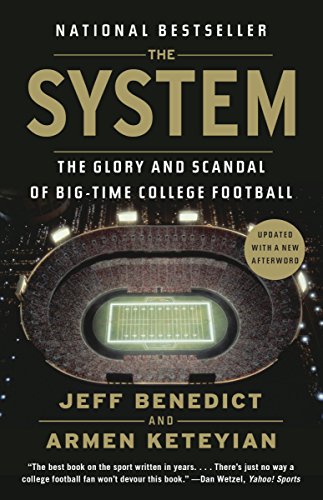
NCAA football is big business. Every Saturday millions of people file into massive stadiums or tune in on television as "athlete-students" give everything they've got to make their team a success. Billions of dollars now flow into the game. But what is the true cost? The players have no share in the oceans of money. And once the lights go down, the glitter doesn't shine so brightly. Filled with mind-blowing details of major NCAA football scandals, with stops at Ohio State, Tennessee, Texas Tech, Missouri, BYU, LSU, Texas A&M and many more, The System explores and exposes the complex, and perhaps broken, machine that churns behind the glamour of college football.
With a New Afterword.
Die Inhaltsangabe kann sich auf eine andere Ausgabe dieses Titels beziehen.
Über die Autorin bzw. den Autor
JEFF BENEDICT is one of the country’s top investigative reporters. He is a special features contributor for Sports Illustrated and the author of eleven critically acclaimed books, including Pros and Cons and Out of Bounds. His essays and articles have appeared in the New York Times, Newsweek and the Los Angeles Times, among other publications.
ARMEN KETEYIAN is a CBS News correspondent based in New York and the lead correspondent for 60 Minutes Sports on Showtime. An eleven-time Emmy Award winner, he is widely regarded as one of the finest investigative journalists in the country. He is also the author or coauthor of nine previous books, including Money Players and Raw Recruits.
Auszug. © Genehmigter Nachdruck. Alle Rechte vorbehalten.
THE COACH
Part I, Mike Leach after midnight
On Saturday afternoons in the fall of 1981 the roar of the crowd would echo across campus every time BYU scored a touchdown. It happened a lot that year. BYU led the nation in offense, scoring more than five hundred points, thanks to the arm of two-time all-American quarterback Jim McMahon. On his way to setting seventy NCAA passing records, McMahon had put Provo, Utah, on the college football map.
Twenty-year-old Sharon Smith hardly noticed. But one evening that fall she was outside her apartment when a rugged-looking guy with wavy, shoulder-length hair approached. He introduced himself as Mike Leach, a twenty-year-old junior from Cody, Wyoming. He lived in the apartment complex next door. They even used the same laundry room. Turned out they had been neighbors for months.
Smith was surprised they had never crossed paths. But Leach traveled a fair amount. He was a member of BYU’s rugby team.
She was intrigued. Leach didn’t look like a BYU student. For one thing, his hair was too long. It should have been above his collar, according to BYU’s honor code. But Leach ignored the rule. That got him repeatedly summoned to the dean’s office. Still, Leach didn’t cut his hair. He didn’t talk like a BYU student either. His vocabulary was a little more colorful. So was his upbringing. He grew up in Wyoming with boys who spent Friday nights popping beers and getting in fistfights. Ranchers wearing sidearms would come into town for lunch at the local diner. Gunsmoke reruns were all the rage. Marshal Dillon was Leach’s boyhood hero.
Smith had met lots of guys at BYU. None was as authentic—or as funny—as Leach. They ended up talking until after midnight, and she accepted his invitation to go out the following night.
Their first date was a meal at an A&W restaurant in Provo. That’s when college football entered the picture. Over hot dogs and a couple cold root beers, Leach started talking about coaching. His idol was BYU’s head coach, LaVell Edwards. During Leach’s freshman year he had entered his name in a drawing and won season tickets on the forty-yard line. From that perch he began studying BYU’s offensive scheme: a controlled passing game with somebody always in motion before the snap; lots of receivers running a combination of vertical routes and crossing patterns; throwing to the backs in the flat. Edwards’s innovative system was a forerunner of the West Coast Offense ultimately popularized by Bill Walsh in the NFL. But at the college level in the early 1980s, no defensive coordinator in the country had figured out how to stop it.
To the casual fan BYU’s system looked pretty complicated. And to a certain extent, it was. But Leach had figured out that the genius of Edwards was the way he packaged his plays. He used an endless number of formations to disguise about fifty basic plays. That made it easy for the offense to memorize and difficult for defenses to recognize.
Smith had no idea what Leach was talking about. But one thing was obvious to her: the guy sitting across from her sipping root beer through a straw was no casual fan of the game. He wasn’t some armchair quarterback either. In high school Leach had started a “coaching” file, filling it with newspaper clippings from the sports pages and schematic ideas he scribbled on loose sheets of paper. By the time he got to Provo and could watch LaVell Edwards up close, he was mapping out his future. “BYU had a state-of-the-art offense,” Leach said. “The best in the country. I started studying it very closely. LaVell Edwards had a major impact on me.”
After one date with Leach, Smith never saw anyone else. “Of all the people I dated at BYU, he was the only guy who knew exactly what he wanted to do,” Smith said. “He told me right away that he knew he was going to be a lawyer or a college football coach. I found it very attractive that he had a plan and was very confident about achieving it.”
Never mind that Leach had never played college football and his only coaching experience was as a Little League baseball coach back in Wyoming. Smith wasn’t worried. “He could analyze the game and the way coaches were coaching, and he had it in his mind that he could do it better at a young age,” she said. “Confidence is a very attractive feature.”
In June 1982, Mike and Sharon were married in St. George, Utah. After BYU, they moved to Southern California, and Mike attended law school at Pepperdine. But just before he got his law degree, he posed a practical question to Sharon: “Do you want me to come home miserable and making a lot of money or come home happy and not earning as much money?”
She told him that being happy was more important than making a lot of money.
Leach didn’t bother taking the bar exam. Instead, he and Sharon headed to Alabama so Mike could attend the U.S. Sports Academy. After he obtained his master’s, they returned to California, and Mike talked his way into a part-time assistant’s position with the football team at Cal Poly San Luis Obispo, then a Division II school. The fact that Leach had a law degree intrigued the head coach enough to offer him a job helping out for $3,000. Sharon figured that was a monthly salary. But it was $3,000 for the season.
With a one-year-old baby, the Leaches moved into campus housing. Their bed was a floor mattress. They didn’t own a television. Their motto was “Opportunity trumps money.”
After one season, the head coach at Cal Poly San Luis Obispo predicted that Leach would develop into a big-time college football coach. Over the next decade Mike and Sharon crisscrossed the country, taking coaching jobs at College of the Desert in California, Iowa Wesleyan and Valdosta State. Leach even spent a year coaching football in Finland. He held every position from offensive line coach to linebacker coach to quarterback coach. He even served as sports information director and equipment manager at one school. And when all the other coaches left at the end of the day, Leach stayed behind to watch film—always alone, sometimes until dawn—night after night.
For the first fifteen years of marriage, Sharon made more money doing clerical work and miscellaneous jobs than Mike made coaching. They were happy but broke. Plus, they were up to three kids with a fourth on the way. Then things changed in 1997. Kentucky’s head coach, Hal Mumme, hired Leach as his offensive coordinator. Suddenly Leach jumped from small schools in the middle of nowhere to the SEC, the best conference in college football. His offensive scheme—referred to as “the spread”—would be tested against Florida, Alabama, Georgia, LSU, Tennessee and Auburn.
Working under Mumme and drawing from the BYU offense he’d studied in the early 1980s, Leach added new wrinkles that opened up the field even more, making it easier for his quarterback to throw into open passing lanes. “I spend more time trying to make my offense easy for the quarterback to memorize than anything,” Leach said. “I want to make it as simple as possible because I want guys to trigger as quick as possible. The key isn’t finding good plays. The key is packaging.”
One of the most revolutionary aspects of Leach’s system was spacing the offensive linemen three feet apart. At first glance, it appears to give pass rushers a clear shot at the quarterback. But the result was fewer sacks and cleaner passing lanes for the quarterback. The SEC had never...
„Über diesen Titel“ kann sich auf eine andere Ausgabe dieses Titels beziehen.
Weitere beliebte Ausgaben desselben Titels

Suchergebnisse für The System: The Glory and Scandal of Big-Time College...

Beispielbild für diese ISBN
The System: The Glory and Scandal of Big-Time College Football
Anbieter: World of Books (was SecondSale), Montgomery, IL, USA
Verkäuferbewertung 5 von 5 Sternen

Zustand: Acceptable. Item in acceptable condition! Textbooks may not include supplemental items i.e. CDs, access codes etc. Artikel-Nr. 00084577595
Gebraucht kaufen
EUR 3,37
Versand gratis
Versand innerhalb von USA
Versand innerhalb von USA
Anzahl: 3 verfügbar
Beispielbild für diese ISBN
The System: The Glory and Scandal of Big-Time College Football
Anbieter: World of Books (was SecondSale), Montgomery, IL, USA
Verkäuferbewertung 5 von 5 Sternen
Zustand: Good. Item in good condition. Textbooks may not include supplemental items i.e. CDs, access codes etc. Artikel-Nr. 00084197347
Gebraucht kaufen
EUR 3,37
Versand gratis
Versand innerhalb von USA
Versand innerhalb von USA
Anzahl: 14 verfügbar
Beispielbild für diese ISBN
The System: The Glory and Scandal of Big-Time College Football
Verlag:
Anchor (edition Updated), 2014
ISBN 10: 0345803035
ISBN 13: 9780345803030
Gebraucht
Paperback
Anbieter: BooksRun, Philadelphia, PA, USA
Verkäuferbewertung 5 von 5 Sternen
Paperback. Zustand: Fair. Updated. The item might be beaten up but readable. May contain markings or highlighting, as well as stains, bent corners, or any other major defect, but the text is not obscured in any way. Artikel-Nr. 0345803035-7-1
Gebraucht kaufen
EUR 5,29
Versand gratis
Versand innerhalb von USA
Versand innerhalb von USA
Anzahl: 1 verfügbar
Beispielbild für diese ISBN
The System : The Glory and Scandal of Big-Time College Football
Verlag:
Knopf Doubleday Publishing Group, 2014
ISBN 10: 0345803035
ISBN 13: 9780345803030
Gebraucht
Softcover
Anbieter: Better World Books, Mishawaka, IN, USA
Verkäuferbewertung 5 von 5 Sternen
Zustand: Good. Former library copy. Pages intact with minimal writing/highlighting. The binding may be loose and creased. Dust jackets/supplements are not included. Includes library markings. Stock photo provided. Product includes identifying sticker. Better World Books: Buy Books. Do Good. Artikel-Nr. 10572638-6
Gebraucht kaufen
EUR 5,78
Versand gratis
Versand innerhalb von USA
Versand innerhalb von USA
Anzahl: 1 verfügbar
Beispielbild für diese ISBN
The System : The Glory and Scandal of Big-Time College Football
Verlag:
Knopf Doubleday Publishing Group, 2014
ISBN 10: 0345803035
ISBN 13: 9780345803030
Gebraucht
Softcover
Anbieter: Better World Books, Mishawaka, IN, USA
Verkäuferbewertung 5 von 5 Sternen
Zustand: Good. Pages intact with minimal writing/highlighting. The binding may be loose and creased. Dust jackets/supplements are not included. Stock photo provided. Product includes identifying sticker. Better World Books: Buy Books. Do Good. Artikel-Nr. 6493690-6
Gebraucht kaufen
EUR 5,84
Versand gratis
Versand innerhalb von USA
Versand innerhalb von USA
Anzahl: 4 verfügbar
Beispielbild für diese ISBN
The System: The Glory and Scandal of Big-Time College Football
Anbieter: ThriftBooks-Atlanta, AUSTELL, GA, USA
Verkäuferbewertung 5 von 5 Sternen
Paperback. Zustand: Very Good. No Jacket. May have limited writing in cover pages. Pages are unmarked. ~ ThriftBooks: Read More, Spend Less. Artikel-Nr. G0345803035I4N00
Gebraucht kaufen
EUR 6,05
Versand gratis
Versand innerhalb von USA
Versand innerhalb von USA
Anzahl: 1 verfügbar
Beispielbild für diese ISBN
The System: The Glory and Scandal of Big-Time College Football
Anbieter: ThriftBooks-Dallas, Dallas, TX, USA
Verkäuferbewertung 5 von 5 Sternen
Paperback. Zustand: Very Good. No Jacket. May have limited writing in cover pages. Pages are unmarked. ~ ThriftBooks: Read More, Spend Less. Artikel-Nr. G0345803035I4N00
Gebraucht kaufen
EUR 6,05
Versand gratis
Versand innerhalb von USA
Versand innerhalb von USA
Anzahl: 1 verfügbar
Beispielbild für diese ISBN
The System: The Glory and Scandal of Big-Time College Football
Anbieter: ThriftBooks-Reno, Reno, NV, USA
Verkäuferbewertung 5 von 5 Sternen
Paperback. Zustand: Very Good. No Jacket. May have limited writing in cover pages. Pages are unmarked. ~ ThriftBooks: Read More, Spend Less. Artikel-Nr. G0345803035I4N00
Gebraucht kaufen
EUR 6,05
Versand gratis
Versand innerhalb von USA
Versand innerhalb von USA
Anzahl: 1 verfügbar
Beispielbild für diese ISBN
The System: The Glory and Scandal of Big-Time College Football
Anbieter: WorldofBooks, Goring-By-Sea, WS, Vereinigtes Königreich
Verkäuferbewertung 5 von 5 Sternen
Paperback. Zustand: Fair. A readable copy of the book which may include some defects such as highlighting and notes. Cover and pages may be creased and show discolouration. Artikel-Nr. GOR011380202
Gebraucht kaufen
EUR 0,97
EUR 6,48 Versand
Versand von Vereinigtes Königreich nach USA
Versand von Vereinigtes Königreich nach USA
Anzahl: 2 verfügbar
Beispielbild für diese ISBN
The System: The Glory and Scandal of Big-Time College Football
Anbieter: WorldofBooks, Goring-By-Sea, WS, Vereinigtes Königreich
Verkäuferbewertung 5 von 5 Sternen
Paperback. Zustand: Very Good. The book has been read, but is in excellent condition. Pages are intact and not marred by notes or highlighting. The spine remains undamaged. Artikel-Nr. GOR006476864
Gebraucht kaufen
EUR 0,97
EUR 6,48 Versand
Versand von Vereinigtes Königreich nach USA
Versand von Vereinigtes Königreich nach USA
Anzahl: 2 verfügbar