
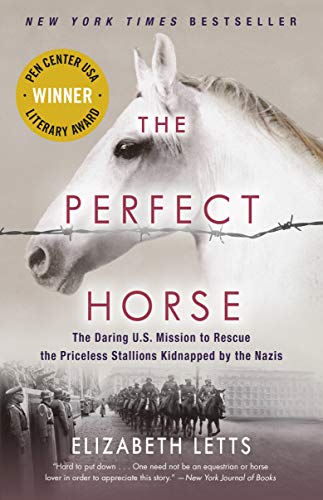
The Perfect Horse: The Daring U.S. Mission to Rescue the Priceless Stallions Kidnapped by the Nazis - Softcover
Inhaltsangabe
NEW YORK TIMES BESTSELLER • From the author of The Eighty-Dollar Champion, the remarkable story of the heroic rescue of priceless horses in the closing days of World War II
WINNER OF THE PEN AWARD FOR RESEARCH NONFICTION
In the chaotic last days of the war, a small troop of battle-weary American soldiers captures a German spy and makes an astonishing find—his briefcase is empty but for photos of beautiful white horses that have been stolen and kept on a secret farm behind enemy lines. Hitler has stockpiled the world’s finest purebreds in order to breed the perfect military machine—an equine master race. But with the starving Russian army closing in, the animals are in imminent danger of being slaughtered for food.
With only hours to spare, one of the U.S. Army’s last great cavalrymen, Colonel Hank Reed, makes a bold decision—with General George Patton’s blessing—to mount a covert rescue operation. Racing against time, Reed’s small but determined force of soldiers, aided by several turncoat Germans, steals across enemy lines in a last-ditch effort to save the horses.
Pulling together this multistranded story, Elizabeth Letts introduces us to an unforgettable cast of characters: Alois Podhajsky, director of the famed Spanish Riding School of Vienna, a former Olympic medalist who is forced to flee the bomb-ravaged Austrian capital with his entire stable in tow; Gustav Rau, Hitler’s imperious chief of horse breeding, a proponent of eugenics who dreams of genetically engineering the perfect warhorse for Germany; and Tom Stewart, a senator’s son who makes a daring moonlight ride on a white stallion to secure the farm’s surrender.
A compelling account for animal lovers and World War II buffs alike, The Perfect Horse tells for the first time the full story of these events. Elizabeth Letts’s exhilarating tale of behind-enemy-lines adventure, courage, and sacrifice brings to life one of the most inspiring chapters in the annals of human valor.
Praise for The Perfect Horse
“Winningly readable . . . Letts captures both the personalities and the stakes of this daring mission with such a sharp ear for drama that the whole second half of the book reads like a WWII thriller dreamed up by Alan Furst or Len Deighton. . . . The right director could make a Hollywood classic out of this fairy tale.”—The Christian Science Monitor
“Letts, a lifelong equestrienne, eloquently brings together the many facets of this unlikely, poignant story underscoring the love and respect of man for horses.”—Kirkus Reviews
Die Inhaltsangabe kann sich auf eine andere Ausgabe dieses Titels beziehen.
Über die Autorin bzw. den Autor
Elizabeth Letts is the #1 New York Times bestselling author of The Eighty-Dollar Champion as well as two novels, Quality of Care and Family Planning. A competitive equestrian in her youth, Letts rode for California in the North American Junior Three-Day Eventing Championships. She currently lives in Southern California.
Auszug. © Genehmigter Nachdruck. Alle Rechte vorbehalten.
Eight Years Earlier
1.
An Unlikely Olympian
Berlin, Germany, 1936
Alois Podhajsky wore the cares of the world on his narrow, melancholy face. His gaze was like a poet’s, directed inward. His oeuvre was the art of classical dressage. His verses danced on four legs. Podhajsky looked as if he’d been born to sit astride a horse. His long straight torso had no awkward angles, no rounded curves, nothing to detract from its elegant lines. But to look at the Austrian officer’s forlorn expression was to understand that within, he carried a shadow. In 1918, after being severely wounded in the neck while serving in the trenches in Flanders, he had suffered from shell shock. His love for horses had brought him slowly back, but the deep stillness of a defeated warrior never left him.
On June 12, 1936, Alois Podhajsky sat astride his mount, Nero, ready to enter the rectangular dressage arena that had been set out with meticulous precision on May Field, a twenty-eight-acre lawn just to the east of the Olympic stadium; it was the site of the Olympic competition in equestrian dressage. The fact that this pair was competing here, in the eleventh Olympic Games, against the top equestrian contenders from around the world, was unlikely indeed. Nero, a gangly brown Thoroughbred, had been bred to race, but having proven slow, he had been cast off for use as an army cavalry mount. The gelding had shown equally little talent as a soldier’s charger, and the army had nearly sold him off before Podhajsky decided that the horse showed potential and saved him from the auction block. Podhajsky too was an almost-reject, kicked out of Austria’s prestigious cavalry officer training school after a back injury made him unable to bend at the waist, forcing him to abandon his first love—jumping. Unwilling to give up his passion, he kept riding even though he had to be lifted onto his horse. He would never forget the day in 1928, during a cavalry school lesson, when his riding instructor scrutinized Podhajsky’s stiff form in the saddle and said, “You’re finished.” But Podhajsky had pressed on, working with his reject mount, dedicating his energy to the art of dressage. Just three years later, Podhajsky had received the Austrian cavalry’s highest honor: In 1931, he was sent to study for two years at the world’s oldest academy of classical riding, the Spanish Riding School. The instruction he received in the classical art of horsemanship was as much a spiritual education as a physical one. Students neither entered their horses in competitions nor vied for any medals. They pursued perfection as an end unto itself. Podhajsky’s love for horses, for riding, for life, had been restored. Five years after being expelled from the cavalry school, Podhajsky was representing his country at the Olympics. While Nero was neither flashy nor handsome, the gelding was willing and cooperative, and after several years of training, they had risen to the top of the sport: Today, they entered the arena as favorites.
Although Podhajsky believed that the Austrian tradition of riding was without peer, he knew that many found his country’s traditions backward-looking. One of Podhajsky’s teammates was the oldest competitor at the entire Games, born way back in 1864. Podhajsky’s own love of Austria’s equestrian traditions had started during his boyhood, and at eighteen, he’d joined the cavalry. Posing for a portrait in 1916, wearing the uniform of his regiment, he looked younger than his eighteen years. His ornate uniform—fur-muffed, spike-helmeted, brass-buttoned—could be mistaken for a costume. In his right hand, he held white gloves; at his left hip, a sword and scabbard. He resembled a boy playing dress-up in his father’s clothes. But Austria lost both the Great War and its empire, and the pomp and traditions to which he had sworn boyhood allegiance were mostly gone. What remained of the great Austrian empire was its tradition of horsemanship, which Podhajsky still believed was the best in the world. Now was his chance to prove it with the eyes of the world upon him.
Nero’s turnout was impeccable, each of his braids carefully wrapped in snow-white adhesive tape, setting off the arched carriage of his neck. Podhajsky looked resplendent in the olive uniform of the Austrian Republic. The failed racehorse and his reject rider were preparing to compete in one of the most complex and demanding sports. Of all equestrian sports, dressage requires the most discipline. Descended from intricate military maneuvers developed in ancient times, dressage asks horse and rider to execute a series of carefully prescribed movements. Just as ballroom dancing and pair skating command partners to work together seamlessly, in the sport of dressage, the rider performs an intricate pas de deux with his partner—a twelve-hundred-pound four-footed beast. Great dressage demands more than skill; it engages a rider’s inner wisdom and his ability to communicate with a mount in the silent language of horsemanship.
The arena was laid out with geometrical precision on the clipped lawn of May Field. Large pots of flowers were set up at intervals around the perimeter, adding vibrant splashes of color. In the distance, the impressive hulk of Olympia Stadium filled the horizon, festooned with the flags of many nations. Evenly spaced scarlet Nazi swastika banners stained its perimeter. Inside, a hundred thousand seats were filled to capacity for the track and field events. The crowd assembled to watch the dressage competition, though a quarter that size, was no less fervent. Men in white fedoras and women in colorful summer dresses speckled the field’s stands like rainbow sprinkles on ice cream. Podhajsky had committed to memory the complex series of movements that he would need to execute perfectly in the seventeen minutes allotted to him. If his horse stepped out of the low barriers that marked the boundaries of the twenty-by-sixty-meter ring, he would be eliminated. Surrounding the arena were points marked by letters of the alphabet: If the program specified that a movement be completed as he passed that mark, the horse needed to begin or end the movement just as the rider’s boot passed the marker.
In the sport of dressage, the rider spends years teaching a horse to perform movements on command that come naturally to horses in the wild. The horse has four ordinary paces: walk, trot, canter, and gallop, each with a different cadence. But in each of these paces, a wild horse will perform the gaits with a variety of nuances. For example, when a horse trots, it moves its legs in diagonal pairs with a two-beat cadence. A wild stallion, showing off, sometimes elevates the simple trot to an art form—he coils his powerful haunches underneath him, slows down the tempo, and elevates each step, transforming the workaday gait into a balletic art. These exaggerated movements are innate in certain circumstances, but to coax a horse to perform them on command takes the utmost tact, sympathy, and meticulous training from a rider. In an advanced dressage test, a rider may ask a horse to perform a pirouette, whereby the horse’s hindquarters remain almost in place while his forelegs canter a full circle around them, or a half-pass, where a horse moves both forward and sideways, his body slightly bent around his rider’s leg, his legs crossing each other. Each of these movements has been inculcated slowly, painstakingly, in a step-by-step process that takes...
„Über diesen Titel“ kann sich auf eine andere Ausgabe dieses Titels beziehen.
Weitere beliebte Ausgaben desselben Titels

Suchergebnisse für The Perfect Horse: The Daring U.S. Mission to Rescue...

Foto des Verkäufers
The Perfect Horse: The Daring U.S. Mission to Rescue the Priceless Stallions Kidnapped by the Nazis
Anbieter: Dream Books Co., Denver, CO, USA
Verkäuferbewertung 5 von 5 Sternen

Zustand: acceptable. This copy has clearly been enjoyedâ"expect noticeable shelf wear and some minor creases to the cover. Binding is strong, and all pages are legible. May contain previous library markings or stamps. Artikel-Nr. 4EKGLF0088XX_ns
Gebraucht kaufen
EUR 3,72
Versand gratis
Versand innerhalb von USA
Versand innerhalb von USA
Anzahl: 2 verfügbar
Foto des Verkäufers
The Perfect Horse: The Daring U.S. Mission to Rescue the Priceless Stallions Kidnapped by the Nazis
Anbieter: Dream Books Co., Denver, CO, USA
Verkäuferbewertung 5 von 5 Sternen
Zustand: good. Gently used with minimal wear on the corners and cover. A few pages may contain light highlighting or writing, but the text remains fully legible. Dust jacket may be missing, and supplemental materials like CDs or codes may not be included. May be ex-library with library markings. Ships promptly! Artikel-Nr. DBV.034554482X.G
Gebraucht kaufen
EUR 3,91
Versand gratis
Versand innerhalb von USA
Versand innerhalb von USA
Anzahl: 2 verfügbar
Beispielbild für diese ISBN
The Perfect Horse: The Daring U.S. Mission to Rescue the Priceless Stallions Kidnapped by the Nazis
Verlag:
Ballantine Books (edition Reprint), 2017
ISBN 10: 034554482X
ISBN 13: 9780345544827
Gebraucht
Paperback
Anbieter: BooksRun, Philadelphia, PA, USA
Verkäuferbewertung 5 von 5 Sternen
Paperback. Zustand: Fair. Reprint. The item might be beaten up but readable. May contain markings or highlighting, as well as stains, bent corners, or any other major defect, but the text is not obscured in any way. Artikel-Nr. 034554482X-7-1
Gebraucht kaufen
EUR 4,84
Versand gratis
Versand innerhalb von USA
Versand innerhalb von USA
Anzahl: 1 verfügbar
Beispielbild für diese ISBN
The Perfect Horse: The Daring U.S. Mission to Rescue the Priceless Stallions Kidnapped by the Nazis
Verlag:
Ballantine Books (edition Reprint), 2017
ISBN 10: 034554482X
ISBN 13: 9780345544827
Gebraucht
Paperback
Anbieter: BooksRun, Philadelphia, PA, USA
Verkäuferbewertung 5 von 5 Sternen
Paperback. Zustand: Fair. Reprint. The item might be beaten up but readable. May contain markings or highlighting, as well as stains, bent corners, or any other major defect, but the text is not obscured in any way. Artikel-Nr. 034554482X-7-22-13
Gebraucht kaufen
EUR 5,23
Versand gratis
Versand innerhalb von USA
Versand innerhalb von USA
Anzahl: 1 verfügbar
Beispielbild für diese ISBN
The Perfect Horse: The Daring U.S. Mission to Rescue the Priceless Stallions Kidnapped by the Nazis
Verlag:
Ballantine Books (edition Reprint), 2017
ISBN 10: 034554482X
ISBN 13: 9780345544827
Gebraucht
Paperback
Anbieter: BooksRun, Philadelphia, PA, USA
Verkäuferbewertung 5 von 5 Sternen
Paperback. Zustand: Very Good. Reprint. It's a well-cared-for item that has seen limited use. The item may show minor signs of wear. All the text is legible, with all pages included. It may have slight markings and/or highlighting. Artikel-Nr. 034554482X-11-22
Gebraucht kaufen
EUR 5,28
Versand gratis
Versand innerhalb von USA
Versand innerhalb von USA
Anzahl: 1 verfügbar
Beispielbild für diese ISBN
The Perfect Horse: The Daring U.S. Mission to Rescue the Priceless Stallions Kidnapped by the Nazis
Anbieter: ThriftBooks-Dallas, Dallas, TX, USA
Verkäuferbewertung 5 von 5 Sternen
Paperback. Zustand: Good. No Jacket. Pages can have notes/highlighting. Spine may show signs of wear. ~ ThriftBooks: Read More, Spend Less. Artikel-Nr. G034554482XI3N00
Gebraucht kaufen
EUR 5,84
Versand gratis
Versand innerhalb von USA
Versand innerhalb von USA
Anzahl: 3 verfügbar
Beispielbild für diese ISBN
The Perfect Horse: The Daring U.S. Mission to Rescue the Priceless Stallions Kidnapped by the Nazis
Anbieter: ThriftBooks-Atlanta, AUSTELL, GA, USA
Verkäuferbewertung 5 von 5 Sternen
Paperback. Zustand: Very Good. No Jacket. Missing dust jacket; May have limited writing in cover pages. Pages are unmarked. ~ ThriftBooks: Read More, Spend Less. Artikel-Nr. G034554482XI4N01
Gebraucht kaufen
EUR 5,84
Versand gratis
Versand innerhalb von USA
Versand innerhalb von USA
Anzahl: 1 verfügbar
Beispielbild für diese ISBN
The Perfect Horse: The Daring U.S. Mission to Rescue the Priceless Stallions Kidnapped by the Nazis
Anbieter: ThriftBooks-Atlanta, AUSTELL, GA, USA
Verkäuferbewertung 5 von 5 Sternen
Paperback. Zustand: Good. No Jacket. Pages can have notes/highlighting. Spine may show signs of wear. ~ ThriftBooks: Read More, Spend Less. Artikel-Nr. G034554482XI3N00
Gebraucht kaufen
EUR 5,84
Versand gratis
Versand innerhalb von USA
Versand innerhalb von USA
Anzahl: 3 verfügbar
Beispielbild für diese ISBN
The Perfect Horse: The Daring U.S. Mission to Rescue the Priceless Stallions Kidnapped by the Nazis
Anbieter: ThriftBooks-Reno, Reno, NV, USA
Verkäuferbewertung 5 von 5 Sternen
Paperback. Zustand: Good. No Jacket. Pages can have notes/highlighting. Spine may show signs of wear. ~ ThriftBooks: Read More, Spend Less. Artikel-Nr. G034554482XI3N00
Gebraucht kaufen
EUR 5,84
Versand gratis
Versand innerhalb von USA
Versand innerhalb von USA
Anzahl: 3 verfügbar
Beispielbild für diese ISBN
The Perfect Horse: The Daring U.S. Mission to Rescue the Priceless Stallions Kidnapped by the Nazis
Anbieter: ThriftBooks-Phoenix, Phoenix, AZ, USA
Verkäuferbewertung 5 von 5 Sternen
Paperback. Zustand: Very Good. No Jacket. May have limited writing in cover pages. Pages are unmarked. ~ ThriftBooks: Read More, Spend Less. Artikel-Nr. G034554482XI4N00
Gebraucht kaufen
EUR 5,84
Versand gratis
Versand innerhalb von USA
Versand innerhalb von USA
Anzahl: 1 verfügbar