
Verwandte Artikel zu Old Venus: A Collection of Stories
Inhaltsangabe
Sixteen all-new stories by science fiction’s top talents, collected by bestselling author George R. R. Martin and multiple-award-winning editor Gardner Dozois
From pulp adventures such as Edgar Rice Burroughs’s Carson of Venus to classic short stories such as Ray Bradbury’s “The Long Rain” to visionary novels such as C. S. Lewis’s Perelandra, the planet Venus has loomed almost as large in the imaginations of science fiction writers as Earth’s next-nearest neighbor, Mars. But while the Red Planet conjured up in Golden Age science fiction stories was a place of vast deserts and ruined cities, bright blue Venus was its polar opposite: a steamy, swampy jungle world with strange creatures lurking amidst the dripping vegetation. Alas, just as the last century’s space probes exploded our dreams of Mars, so, too, did they shatter our romantic visions of Venus, revealing, instead of a lush paradise, a hellish world inimical to all life.
But don’t despair! This new anthology of sixteen original stories by some of science fiction’s best writers—edited by #1 New York Times bestselling author George R. R. Martin and award-winning editor Gardner Dozois—turns back the clock to that more innocent time, before the hard-won knowledge of science vanquished the infinite possibilities of the imagination.
Join our cast of award-winning contributors—including Elizabeth Bear, David Brin, Joe Haldeman, Gwyneth Jones, Mike Resnick, Eleanor Arnason, Allen M. Steele, and more—as we travel back in time to a planet that never was but should have been: a young, rain-drenched world of fabulous monsters and seductive mysteries.
FEATURING ALL-NEW STORIES BY
Eleanor Arnason • Elizabeth Bear • David Brin • Tobias S. Buckell • Michael Cassutt • Joe Haldeman • Matthew Hughes • Gwyneth Jones • Joe R. Lansdale • Stephen Leigh • Paul McAuley • Ian McDonald • Garth Nix • Mike Resnick • Allen M. Steele • Lavie Tidhar
And an Introduction by Gardner Dozois
Die Inhaltsangabe kann sich auf eine andere Ausgabe dieses Titels beziehen.
Über die Autorin bzw. den Autor
George R. R. Martin is the #1 New York Times bestselling author of many novels, including the acclaimed series A Song of Ice and Fire—A Game of Thrones, A Clash of Kings, A Storm of Swords, A Feast for Crows, and A Dance with Dragons—as well as Tuf Voyaging, Fevre Dream, The Armageddon Rag, Dying of the Light, Windhaven (with Lisa Tuttle), and Dreamsongs Volumes I and II. He is also the creator of The Lands of Ice and Fire, a collection of maps from A Song of Ice and Fire featuring original artwork from illustrator and cartographer Jonathan Roberts, and The World of Ice & Fire (with Elio M. García, Jr., and Linda Antonsson). As a writer-producer, Martin has worked on The Twilight Zone, Beauty and the Beast, and various feature films and pilots that were never made. He lives with the lovely Parris in Santa Fe, New Mexico.
Gardner Dozois was the author or editor of more than a hundred books. He won fifteen Hugo Awards, a World Fantasy Award, and thirty-four Locus Awards for his editing work, as well as two Nebula Awards and a Sidewise Award for his own writing. He was the editor of the leading science fiction magazine, Asimov’s Science Fiction, for twenty years, and the editor of the anthology series The Year’s Best Science Fiction for thirty-five years. A member of the Science Fiction Hall of Fame, Gardner Dozois died in 2018.
Auszug. © Genehmigter Nachdruck. Alle Rechte vorbehalten.
Allen M. Steele
In the suspenseful story that follows, we accompany a tough PI to Venus on a risky mission that takes him down some very Mean Streets indeed—even if, on Venus, there aren’t any streets.
Allen Steele made his first sale to Asimov’s Science Fiction magazine in 1988, soon following it up with a long string of other sales to Asimov’s, as well as to markets such as Analog, The Magazine of Fantasy & Science Fiction, and Science Fiction Age. In 1989, he published his critically acclaimed first novel, Orbital Decay, which subsequently won the Locus Poll as Best First Novel of the year, and soon Steele was being compared to Golden Age Heinlein by no less an authority than Gregory Benford. His other books include the novels Clarke County, Space, Lunar Descent, Labyrinth of Night, The Weight, The Tranquillity Alternative, A King of Infinite Space, Oceanspace, Chronospace, Coyote, Coyote Rising, Spindrift, Galaxy Blues, Coyote Horizon, and Coyote Destiny. His short work has been gathered in three collections, Rude Astronauts, Sex and Violence in Zero-G, and The Last Science Fiction Writer. His most recent books are a new novel in the Coyote sequence, Hex, a YA novel, Apollo’s Outcasts, an alternate history, V-S Day, and the collection Sex and Violence in Zero-G: The Complete “Near Space” Stories: Expanded Edition. He has won three Hugo Awards, in 1996 for his novella “The Death of Captain Future,” in 1998 for his novella “. . . Where Angels Fear to Tread,” and, most recently, in 2011 for his novelette “The Emperor of Mars.” Born in Nashville, Tennessee, he has worked for a variety of newspapers and magazines, covering science and business assignments, and is now a full-time writer living in Whately, Massachusetts, with his wife, Linda.
Frogheads
Allen M. Steele
The shuttle fell through the clouds—clouds as dense as grey wool, separating purple sky and sun above from perpetual rain below—for what seemed like a very long time until the windows finally cleared and Venus’s global ocean lay revealed: dark blue, storm-lashed, endless.
Engines along the spacecraft’s boatlike underbelly fired, forming a concentric circle of white-peaked wavelets that spread outward upon the ocean surface. Gradually the shuttle made its final descent until its hull settled upon the water. As careful as the pilots were, though, the splashdown was rough. A swift, violent jolt passed through the passenger compartment, shaking everyone in their seats, causing an overhead storage compartment to snap open and spill a couple of carry-on bags into the center aisle. Through the compartment, people cursed—mainly in Russian although a few American obscenities were heard as well—and someone in the back noisily threw up, an involuntary act that was greeted by more foul language.
Ronson wasn’t happy about the landing either. This wasn’t the first time he’d traveled off-world, but landing on Mars was mild compared to this. He couldn’t blame the guy a few rows back for getting sick. Although the shuttle was no longer airborne, it still remained in motion, slowly bobbing up and down as it was rocked by the ocean. He’d been warned to take Dramamine before boarding, and he was glad he’d heeded the advice.
Clutching the armrests, Ronson gazed through the oval porthole beside his seat. Rain spattered the outer pane, but he could still see where he was. Not that there was much to look at: ocean for as far as the eye could see—the Venusian horizon was about three miles away, nearly the same as Earth’s at sea level—beneath a slate-colored sky bloated by clouds that had never parted and never would. The shuttle was supposed to make planetfall at Veneragrad, but the floating colony must be on the other side of the spacecraft. Unless, of course, the pilots had miscalculated the colony’s current position and had come down—landed wasn’t the proper word, was it?—in the wrong place.
That was a possibility. Ronson had spent the last four months in hibernation, but his waking hours aboard the Tsiolkovsky had shown him that Cosmoflot’s reputation for ineptitude was well deserved. He’d just begun to consider the possibility that the shuttle was lost at sea when a tugboat came into view. Smoke belching from its funnel, the rust-flecked craft circled the shuttle until it passed out of sight once again. Several minutes went by, then there was a thump as its crew attached a towline to the shuttle’s prow. The shuttle began to move forward again, the tug hauling it toward its final destination.
Everyone on his side of the passenger compartment peered through the windows as the shuttle pulled into Veneragrad, including the middle-aged Russian in the aisle seat who unapologetically leaned over Ronson as he craned his head for a look at the man-made island. Veneragrad was as utilitarian as only a Soviet-era artifact could be: a tiered hemisphere a kilometer in diameter, a shade darker than the ocean it floated upon, the long, wooden piers jutting out from its sides giving it the appearance of an enormous, bloated water spider. Rickety-looking platforms, also constructed of native timber, rose as irregularly spaced towers from the outside balconies; they supported the open-top steel tanks that caught the rain and distilled it as the colony’s drinking water. Radio masts and dish antennae jutted out at odd angles from near the top of the dome; a helicopter lifted off from a landing pad on its roof. An ugly, unwelcoming place.
“Looks bad, yes?” The man seated beside him stared past him. “Better than nothing . . . it’s dry.”
Ronson had already learned that his traveling companion spoke English, albeit not very well. His breath reeked of the vodka he swilled from a bag-wrapped bottle on the way down from orbit; he’d opened it as soon as the shuttle entered the atmosphere. “Is this where you live?” he asked, if only for the sake of being polite. “Is this your home, I mean?”
The other man barked sullen laughter. “This hellhole? No! My home, St. Petersburg. Come here to make money. Sell . . . um . . . ah”—he searched for the right word—“computers, yes? Computers for office.”
Ronson nodded. He wasn’t much interested in making friends with the businessman, but it appeared that conversation was unavoidable. “Whole colony, built in space above Earth, sent here by rockets,” the businessman continued, telling Ronson something he already knew. “Dropped from orbit by para . . . para . . .”
“Parachutes.”
“Parachutes, yes. Come down”—he lifted his hands—“sploosh! in water.” He waved the bag toward the window. “People then build onto it. Wood from floating . . . um, forests, yes? Floating forests on moss islands.”
“Yes, I see.” Again, the businessman wasn’t telling him anything new.
“Yes, you see.” The Russian took another swig from his bottle, then offered it to Ronson. “So why you come here?”
Ronson shook his head at the bottle. There were several ways he could get out of this unwanted conversation. He opted for the easiest approach. “I’m a detective,” he said, and when the businessman gave an uncomprehending look, he rephrased his answer in simpler, if inaccurate, terms. “A cop.”
“A cop....
„Über diesen Titel“ kann sich auf eine andere Ausgabe dieses Titels beziehen.
Suchergebnisse für Old Venus: A Collection of Stories

Foto des Verkäufers
Old Venus: A Collection of Stories
Anbieter: Dream Books Co., Denver, CO, USA
Verkäuferbewertung 5 von 5 Sternen

Zustand: good. Gently used with minimal wear on the corners and cover. A few pages may contain light highlighting or writing, but the text remains fully legible. Dust jacket may be missing, and supplemental materials like CDs or codes may not be included. May be ex-library with library markings. Ships promptly! Artikel-Nr. DBV.0345537289.G
Gebraucht kaufen
EUR 5,00
Versand gratis
Versand innerhalb von USA
Versand innerhalb von USA
Anzahl: 1 verfügbar
Beispielbild für diese ISBN
Old Venus: A Collection of Stories
Anbieter: ThriftBooks-Atlanta, AUSTELL, GA, USA
Verkäuferbewertung 5 von 5 Sternen
Hardcover. Zustand: Good. No Jacket. Former library book; Pages can have notes/highlighting. Spine may show signs of wear. ~ ThriftBooks: Read More, Spend Less. Artikel-Nr. G0345537289I3N10
Gebraucht kaufen
EUR 6,22
Versand gratis
Versand innerhalb von USA
Versand innerhalb von USA
Anzahl: 1 verfügbar
Beispielbild für diese ISBN
Old Venus: A Collection of Stories
Anbieter: ThriftBooks-Atlanta, AUSTELL, GA, USA
Verkäuferbewertung 5 von 5 Sternen
Hardcover. Zustand: Very Good. No Jacket. Former library book; May have limited writing in cover pages. Pages are unmarked. ~ ThriftBooks: Read More, Spend Less. Artikel-Nr. G0345537289I4N10
Gebraucht kaufen
EUR 6,22
Versand gratis
Versand innerhalb von USA
Versand innerhalb von USA
Anzahl: 1 verfügbar
Beispielbild für diese ISBN
Old Venus: A Collection of Stories
Anbieter: ThriftBooks-Dallas, Dallas, TX, USA
Verkäuferbewertung 5 von 5 Sternen
Hardcover. Zustand: Good. No Jacket. Pages can have notes/highlighting. Spine may show signs of wear. ~ ThriftBooks: Read More, Spend Less. Artikel-Nr. G0345537289I3N00
Gebraucht kaufen
EUR 6,22
Versand gratis
Versand innerhalb von USA
Versand innerhalb von USA
Anzahl: 1 verfügbar
Beispielbild für diese ISBN
Old Venus: A Collection of Stories
Anbieter: ThriftBooks-Dallas, Dallas, TX, USA
Verkäuferbewertung 5 von 5 Sternen
Hardcover. Zustand: Very Good. No Jacket. Missing dust jacket; May have limited writing in cover pages. Pages are unmarked. ~ ThriftBooks: Read More, Spend Less. Artikel-Nr. G0345537289I4N01
Gebraucht kaufen
EUR 6,22
Versand gratis
Versand innerhalb von USA
Versand innerhalb von USA
Anzahl: 1 verfügbar
Beispielbild für diese ISBN
Old Venus: A Collection of Stories
Anbieter: ThriftBooks-Atlanta, AUSTELL, GA, USA
Verkäuferbewertung 5 von 5 Sternen
Hardcover. Zustand: Fair. No Jacket. Readable copy. Pages may have considerable notes/highlighting. ~ ThriftBooks: Read More, Spend Less. Artikel-Nr. G0345537289I5N00
Gebraucht kaufen
EUR 6,22
Versand gratis
Versand innerhalb von USA
Versand innerhalb von USA
Anzahl: 1 verfügbar
Beispielbild für diese ISBN
Old Venus : A Collection of Stories
Verlag:
Random House Worlds, 2015
ISBN 10: 0345537289
ISBN 13: 9780345537287
Gebraucht
Hardcover
Erstausgabe
Anbieter: Better World Books, Mishawaka, IN, USA
Verkäuferbewertung 5 von 5 Sternen
Zustand: Good. 1St Edition. Former library copy. Pages intact with minimal writing/highlighting. The binding may be loose and creased. Dust jackets/supplements are not included. Includes library markings. Stock photo provided. Product includes identifying sticker. Better World Books: Buy Books. Do Good. Artikel-Nr. 5373700-6
Gebraucht kaufen
EUR 6,70
Versand gratis
Versand innerhalb von USA
Versand innerhalb von USA
Anzahl: 3 verfügbar
Beispielbild für diese ISBN
Old Venus: A Collection of Stories
Verlag:
Random House Worlds (edition First Ed), 2015
ISBN 10: 0345537289
ISBN 13: 9780345537287
Gebraucht
Hardcover
Erstausgabe
Anbieter: BooksRun, Philadelphia, PA, USA
Verkäuferbewertung 5 von 5 Sternen
Hardcover. Zustand: Very Good. First Ed. With dust jacket. It's a well-cared-for item that has seen limited use. The item may show minor signs of wear. All the text is legible, with all pages included. It may have slight markings and/or highlighting. Artikel-Nr. 0345537289-8-1-29
Gebraucht kaufen
EUR 6,91
Versand gratis
Versand innerhalb von USA
Versand innerhalb von USA
Anzahl: 1 verfügbar
Beispielbild für diese ISBN
Old Venus
Verlag:
Bantam, New York, 2015
ISBN 10: 0345537289
ISBN 13: 9780345537287
Gebraucht
Hardcover
Erstausgabe
Anbieter: Basically SF Books, Salem, OR, USA
Verkäuferbewertung 4 von 5 Sternen

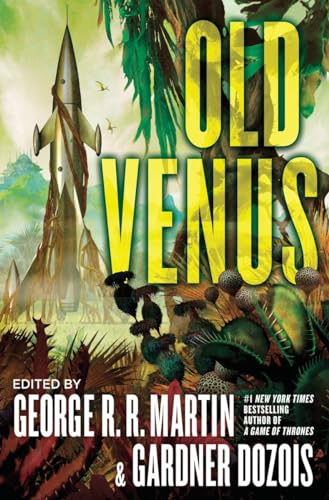
hardcover. Zustand: Very Good. Zustand des Schutzumschlags: very Good. Stephen Youll (illustrator). first edition. First edition. Dust jacket is in excellent condition, with a small closed tear on back but no other tears or chips; now in new removable protective cover. Green boards with gold print on brown spine. Pages are clean and unmarked. Bantam hard cover with dust jacket, First edition (stated), first printing March 2015, complete number line. ISBN: 9780345537287, 586 pages, cover art by Stephen Youll. 8vo (6.5" x 9.5") Winner, 2016 Locus Award for Best Anthology. Introduction: Return to Venusport, by Gardner Dozois. Stories: Frogheads, by Allen M. Steele; The Drowned Celestial, by Lavie Tidhar; Planet of Fear, by Paul McAuley (16th place, 2016 Locus Award); Greeves and the Evening Star, by Matthew Hughes; A Planet Called Desire, by Gwyneth Jones; Living Hell, by Joe Haldeman; Bones of Air, Bones of Stone, by Stephen Leigh; Ruins, by Eleanor Arnason (10th place, 2016 Locus Award); The Tumbledowns of Cleopatra Abyss, by David Brin (13th place, 2016 Locus Award); By Frogsled and Lizardback to Outcast Venusian Lepers, by Garth Nix (winner, 2015 Aurealis Award); The Sunset of Time, by Michael Cassutt; Pale Blue Memories, by Tobias S. Buckell; The Heart's Filthy Lesson, by Elizabeth Bear (5th place, 2016 Locus Award); The Wizard of the Trees, by Joe R. Lansdale; The Godstone of Venus, by Mike Resnick; Botanica Veneris: Thirteen Papercuts by Ida Countess Rathangan, by Ian McDonald (6th place, 2016 Locus Award; Nominated, 2016 Sturgeon Award). Artikel-Nr. 031717039780345537287cvr
Gebraucht kaufen
EUR 20,62
EUR 4,75 Versand
Versand innerhalb von USA
Versand innerhalb von USA
Anzahl: 1 verfügbar
Beispielbild für diese ISBN
Old Venus: A Collection of Stories
Anbieter: Kennys Bookstore, Olney, MD, USA
Verkäuferbewertung 5 von 5 Sternen
Zustand: New. 2015. Hardcover. . . . . . Books ship from the US and Ireland. Artikel-Nr. V9780345537287
Neu kaufen
EUR 39,33
EUR 9,06 Versand
Versand innerhalb von USA
Versand innerhalb von USA
Anzahl: 15 verfügbar