
Verwandte Artikel zu The Prime Minister's Secret Agent: A Maggie Hope...
Inhaltsangabe
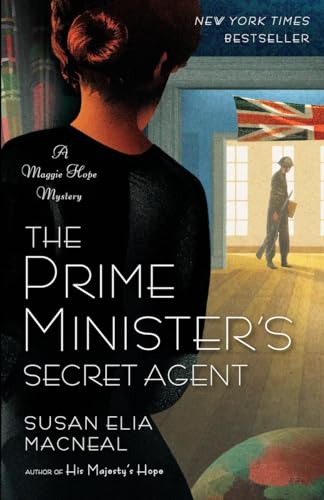
NEW YORK TIMES BESTSELLER • For fans of Jacqueline Winspear, Charles Todd, and Anne Perry comes a gripping mystery featuring intrepid spy and code breaker Maggie Hope. This time, the fallout of a deadly plot comes straight to her own front door.
World War II rages on across Europe, but Maggie Hope has finally found a moment of rest on the pastoral coast of western Scotland. Home from an undercover mission in Berlin, she settles down to teach at her old spy training camp, and to heal from scars on both her body and heart. Yet instead of enjoying the quieter pace of life, Maggie is quickly drawn into another web of danger and intrigue. When three ballerinas fall strangely ill in Glasgow—including one of Maggie’s dearest friends—Maggie partners with MI-5 to uncover the truth behind their unusual symptoms. What she finds points to a series of poisonings that may expose shocking government secrets and put countless British lives at stake. But it’s the fight brewing in the Pacific that will forever change the course of the war—and indelibly shape Maggie’s fate.
Praise for The Prime Minister’s Secret Agent
“[A] stellar series . . . [Susan Elia] MacNeal has written an impeccably researched, wonderfully engaging story.”—Minneapolis Star Tribune
“A treat for WWII buffs and mystery lovers alike.”—Booklist
“[MacNeal] seamlessly mixes fact and fiction.”—Publishers Weekly
“Splendid . . . riveting . . . The research is complete and fascinating. . . . The scenes are so detailed that readers will feel as if they are next to the characters and listening to them speaking.”—RT Book Reviews (Top Pick)
“Fans of Jacqueline Winspear and Charles Todd will feast on this riveting series chronicling Britain’s own ‘Greatest Generation.’ MacNeal’s research and gift for dialogue shine through on every page, transporting the reader to Churchill’s inner circle. The Prime Minister’s Secret Agent is both top-drawer historical fiction and mystery in its finest hour.”—Julia Spencer-Fleming, New York Times bestselling author of Through the Evil Days
Praise for Susan Elia MacNeal’s Maggie Hope mysteries
“You’ll be [Maggie Hope’s] loyal subject, ready to follow her wherever she goes.”—O: The Oprah Magazine
“A heart-pounding novel peopled with fully drawn real and fictional characters . . . provides the thrills that readers have come to expect from MacNeal.”—Richmond Times-Dispatch, on His Majesty’s Hope
“With false starts, double agents, and red herrings . . . MacNeal provides a vivid view of life both above and below stairs at Windsor Castle.”—Publishers Weekly, on Princess Elizabeth’s Spy
Die Inhaltsangabe kann sich auf eine andere Ausgabe dieses Titels beziehen.
Über die Autorin bzw. den Autor
Susan Elia MacNeal is the New York Times bestselling author of the Maggie Hope mysteries and Mother Daughter Traitor Spy. MacNeal won the Barry Award and an AudioFile Earphones award and has been nominated for the Edgar, Macavity, Agatha, Left Coast Crime, Dilys, ITW Thriller, and Nero awards. She lives in Brooklyn, New York, with her husband and son.
Auszug. © Genehmigter Nachdruck. Alle Rechte vorbehalten.
Chapter One
Maggie Hope had thought that summer in Berlin was hell, but it was nothing compared to the inferno of darkness that now raged in her own head, even as she was “safe as houses” in Arisaig on the western coast of Scotland.
A mixture of shame, anger, guilt, and grief had become a miasma of depression, which followed her everywhere, not at all helped by the lack of daylight in Scotland in November. She’d once heard Winston Churchill describe his own melancholy as his “Black Dog,” but didn’t understand it. She’d pictured a large black dog with long silky fur and dark, sad eyes, silently padding after his master.
But now she knew the truth: The Black Dog of depression was dirty and scarred, feral and rabid. He lurked in the night, yellow eyes gleaming, waiting for a chink in the armor, a weakness, a vulnerability, a memory. And then, jaws wide and fangs sharp, he would leap. She had trouble sleeping, and when she did finally fall unconscious, she had nightmares.
Sometimes, just sometimes, Maggie had a few moments in the morning, when she first woke up, when she didn’t remember her nightmares, or any of what had happened. Those were blessed moments, innocent and sweet. Until her mind started working again, and the sharp ache returned to her heart. She remembered what had transpired in Berlin. Remembered that her contact, Gottlieb Lehrer, was dead—a devout Catholic who’d shot himself rather than be taken by the Gestapo for questioning. Remembered that she herself had killed a man.
“It was self-defense,” the analyst she’d been ordered to see by Peter Frain had told her. “It’s war. You don’t need to torture yourself.” And yet, even though he’d shot first, and she’d killed in self-defense, the man’s eyes—sad and reproachful—haunted her.
As did the high-pitched voice of the little Jewish girl being pushed into a cattle car in Berlin, destined for Poland. “I’m thirsty, Mama,” she’d cried, “so thirsty.” What happened to her? Maggie often wondered. Did she die on the train? Or later in the camp? Could she still be alive? Because now that Maggie—and most of the rest of the world—knew that the Nazis were capable of killing their own children, calling it “Operation Compassionate Death,” she didn’t hold any hope at all for the children of Jews.
And as if that weren’t enough burden, her mother, Clara Hess, a Nazi Abwehr agent, was imprisoned in the Tower of London—and asking to talk with her. She was also scheduled to be executed soon, if she didn’t share some of the top-secret information she possessed.
And then there was John Sterling, with whom she’d worked at Number 10 for Mr. Churchill during the Battle of Britain. And had almost been engaged to marry. And who’d become a RAF pilot and been shot down near Berlin. And even though she’d managed to rescue them both and get them safe passage from Berlin to Switzerland, their return to London had been, well, less than romantic. More of a romantic disaster, really.
Maggie turned over beneath the scratchy gray wool blankets, reflexively reaching for the hard outline of the German bullet, which had just managed to miss her heart. Dumb luck was what had saved her—and allowed her to kill her attacker, instead. The doctors in Switzerland, and then in London—even one of her best friends, Chuck, a nurse—had wanted her to have the bullet removed, but she refused. She called it her “Berlin souvenir.”
I’m dead inside, she thought, not for the first time since she’d made it to Arisaig. Worse than dead—if I were dead at least I wouldn’t have to remember everything anymore.
On her nightstand, the black Bakelite clock ticked, and she reached over to turn it off before the alarm rang. Maggie concentrated on breathing—in and out, in and out. Even that caused pain, as though she had a shard of ice in her heart.
Maggie had heard the expression heartache before, of course, but never thought it would be so literal. So much pain, physical pain in her heart. But the heart was just a muscle, an organ, made to pump blood—not to feel things. So was it stress? Adrenaline? What made it hurt so much? Of course, the brain wasn’t much better—the brain could be a hellish prison of despair and pain and emptiness. Who knew that the brain could be such a traitor?
It didn’t help that it was coming up on Thanksgiving—and even though she’d lived in Britain since 1938, Maggie still missed her Aunt Edith, a chemistry professor at Wellesley College. She missed the United States sometimes too, truth be told. She missed its innocence—or was it ignorance?—of war, its clear skies and untouched cities. Not to mention unlimited hot water and unrationed food. Although she was British by birth, she’d been raised in the U.S., and even though she’d made a choice to throw her lot in with the Brits when war started, she missed her aunt and her friends and their broad, flat, nasal accents. She missed Thanksgiving. She missed turkey and cranberry sauce and pumpkin pie. She missed Boston and Cambridge. She missed America.
Maggie sighed and then rose, washed her face and brushed her teeth in the rust-tinged water in the enamel sink, and changed into her clothes, the brown twill jumpsuit all the instructors wore over layers of thermal underwear and wool socks, plus standard-issue thick-soled boots. She twisted and then pinned up her long red hair with her tortoiseshell clip. If she’d been doing office work, as she had been doing at Number 10 Downing Street, she would have put on the pearl earrings that her Aunt Edith had given to her when she’d graduated from Wellesley in ’37—but not only were they inappropriate for her job as an instructor at an SOE camp, she’d lost them somewhere in London after returning from Berlin. Not that anyone cares about anything as frivolous as earrings anymore. But they were another symbol of everything she’d lost.
Sallow and pinched, with shadows under her eyes and a chafed red nose, Maggie shrugged into her thick wool coat and pulled on a scarf and stocking cap. She left the upstairs flat of the gardener’s cottage, where she’d been assigned to live, and headed to Arisaig House, the large home that loomed above.
Although her body ached and felt as if it were made from spun glass, she jogged to warm her muscles before breaking into a run up the path of the rockery, taking the steep lichen-covered flagstone steps to the manor house at a brisk jog in the darkness. It was November and so it was light only from eight thirty in the morning to four thirty in the afternoon. But to Maggie it always seemed dark, not Henry Vaughan’s “deep but dazzling darkness” but a sinister absence of light.
Arisaig House was the administrative heart of the War Office for Special Operations Executive—or SOE, as it was better known—in Scotland. SOE was neither MI-5 nor MI-6, but a black ops operation, training agents to be dropped into places such as France and Germany, and helping local resistance groups “set Europe ablaze,” as Winston Churchill had admonished. The SOE used great houses all over Britain to train their would-be spies, sparking the joke that SOE really stood for “Stately ’omes of England.” While training camps were preliminary schools, or specifically dedicated to parachute jumping or radio transmission, Arisaig...
„Über diesen Titel“ kann sich auf eine andere Ausgabe dieses Titels beziehen.
Suchergebnisse für The Prime Minister's Secret Agent: A Maggie Hope...

Beispielbild für diese ISBN
The Prime Minister's Secret Ag
Anbieter: World of Books (was SecondSale), Montgomery, IL, USA
Verkäuferbewertung 5 von 5 Sternen

Zustand: Acceptable. Item in acceptable condition! Textbooks may not include supplemental items i.e. CDs, access codes etc. Artikel-Nr. 00110582441
Gebraucht kaufen
EUR 3,72
Versand gratis
Versand innerhalb von USA
Versand innerhalb von USA
Anzahl: 1 verfügbar
Beispielbild für diese ISBN
The Prime Minister's Secret Ag
Anbieter: World of Books (was SecondSale), Montgomery, IL, USA
Verkäuferbewertung 5 von 5 Sternen
Zustand: Good. Item in good condition. Textbooks may not include supplemental items i.e. CDs, access codes etc. Artikel-Nr. 00091467030
Gebraucht kaufen
EUR 3,72
Versand gratis
Versand innerhalb von USA
Versand innerhalb von USA
Anzahl: Mehr als 20 verfügbar
Beispielbild für diese ISBN
The Prime Minister's Secret Agent
Anbieter: ThriftBooks-Dallas, Dallas, TX, USA
Verkäuferbewertung 5 von 5 Sternen
Paperback. Zustand: Good. No Jacket. Former library book; Pages can have notes/highlighting. Spine may show signs of wear. ~ ThriftBooks: Read More, Spend Less. Artikel-Nr. G0345536746I3N10
Gebraucht kaufen
EUR 5,96
Versand gratis
Versand innerhalb von USA
Versand innerhalb von USA
Anzahl: 1 verfügbar
Beispielbild für diese ISBN
The Prime Minister's Secret Agent
Anbieter: ThriftBooks-Dallas, Dallas, TX, USA
Verkäuferbewertung 5 von 5 Sternen
Paperback. Zustand: Good. No Jacket. Missing dust jacket; Pages can have notes/highlighting. Spine may show signs of wear. ~ ThriftBooks: Read More, Spend Less. Artikel-Nr. G0345536746I3N01
Gebraucht kaufen
EUR 5,96
Versand gratis
Versand innerhalb von USA
Versand innerhalb von USA
Anzahl: 1 verfügbar
Beispielbild für diese ISBN
The Prime Minister's Secret Agent
Anbieter: ThriftBooks-Atlanta, AUSTELL, GA, USA
Verkäuferbewertung 5 von 5 Sternen
Paperback. Zustand: Good. No Jacket. Former library book; Pages can have notes/highlighting. Spine may show signs of wear. ~ ThriftBooks: Read More, Spend Less. Artikel-Nr. G0345536746I3N10
Gebraucht kaufen
EUR 5,96
Versand gratis
Versand innerhalb von USA
Versand innerhalb von USA
Anzahl: 1 verfügbar
Beispielbild für diese ISBN
The Prime Minister's Secret Agent
Anbieter: ThriftBooks-Phoenix, Phoenix, AZ, USA
Verkäuferbewertung 5 von 5 Sternen
Paperback. Zustand: Good. No Jacket. Pages can have notes/highlighting. Spine may show signs of wear. ~ ThriftBooks: Read More, Spend Less. Artikel-Nr. G0345536746I3N00
Gebraucht kaufen
EUR 5,96
Versand gratis
Versand innerhalb von USA
Versand innerhalb von USA
Anzahl: 2 verfügbar
Beispielbild für diese ISBN
The Prime Minister's Secret Agent
Anbieter: ThriftBooks-Atlanta, AUSTELL, GA, USA
Verkäuferbewertung 5 von 5 Sternen
Paperback. Zustand: Good. No Jacket. Pages can have notes/highlighting. Spine may show signs of wear. ~ ThriftBooks: Read More, Spend Less. Artikel-Nr. G0345536746I3N00
Gebraucht kaufen
EUR 5,96
Versand gratis
Versand innerhalb von USA
Versand innerhalb von USA
Anzahl: 3 verfügbar
Beispielbild für diese ISBN
The Prime Minister's Secret Agent
Anbieter: ThriftBooks-Reno, Reno, NV, USA
Verkäuferbewertung 5 von 5 Sternen
Paperback. Zustand: Good. No Jacket. Pages can have notes/highlighting. Spine may show signs of wear. ~ ThriftBooks: Read More, Spend Less. Artikel-Nr. G0345536746I3N00
Gebraucht kaufen
EUR 5,96
Versand gratis
Versand innerhalb von USA
Versand innerhalb von USA
Anzahl: 2 verfügbar
Beispielbild für diese ISBN
The Prime Minister's Secret Agent
Anbieter: ThriftBooks-Phoenix, Phoenix, AZ, USA
Verkäuferbewertung 5 von 5 Sternen
Paperback. Zustand: Good. No Jacket. Former library book; Pages can have notes/highlighting. Spine may show signs of wear. ~ ThriftBooks: Read More, Spend Less. Artikel-Nr. G0345536746I3N10
Gebraucht kaufen
EUR 5,96
Versand gratis
Versand innerhalb von USA
Versand innerhalb von USA
Anzahl: 1 verfügbar
Beispielbild für diese ISBN
The Prime Minister's Secret Agent
Anbieter: ThriftBooks-Reno, Reno, NV, USA
Verkäuferbewertung 5 von 5 Sternen
Paperback. Zustand: Good. No Jacket. Former library book; Pages can have notes/highlighting. Spine may show signs of wear. ~ ThriftBooks: Read More, Spend Less. Artikel-Nr. G0345536746I3N10
Gebraucht kaufen
EUR 5,96
Versand gratis
Versand innerhalb von USA
Versand innerhalb von USA
Anzahl: 1 verfügbar