
Verwandte Artikel zu The Games That Changed the Game: The Evolution of the...
Inhaltsangabe
From the advent of the vertical passing game to the development of ever-more-sophisticated blitzing schemes on defense, professional football in the last half century has been a sport marked by relentless innovation. For fans determined to keep up with the changes that have transformed the game, close examination of the coaching footage is a must. In the words of Hall of Fame linebacker Mike Singletary, “The film does not lie.”
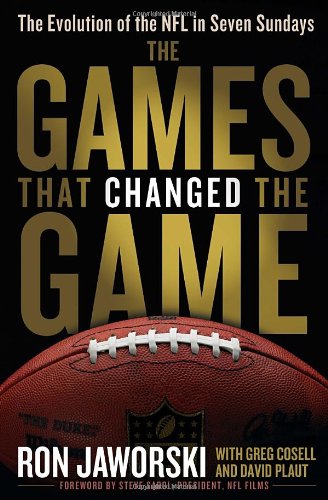
In The Games That Changed the Game, Ron Jaworski, a one-time NFL MVP turned Monday Night Football analyst and pro football’s #1 game-tape guru, breaks down the film from seven of the most momentous contests of the last fifty years. With an eye toward the brilliant game plans and seminal strategic breakthroughs that revolutionized play on both sides of the ball, Jaworski offers readers a drive-by-drive, play-by-play guide to the evolutionary leaps that now define the modern NFL, as well as portraits of the seven men who exhibited both creativity and courage in bucking established strategies. From Sid Gillman’s development of the Vertical Stretch, which culminated in the San Diego Chargers’ victory in the 1963 AFL Championship Game and launched the era of wide-open passing offenses, to Bill Belichick’s daring defensive game plan in Super Bowl XXXVI, which enabled his outgunned squad to upset the heavily favored St. Louis Rams and usher in the New England Patriots dynasty, the most cutting-edge concepts come alive again through the recollections of nearly seventy coaches and players interviewed for this book.
Writing with the same vivid, passionate, and accessible style that has made him television’s go-to X’s and O’s maven, Jaworski fills in the blanks for fans who aren’t satisfied with merely dropping the terms “West Coast offense” or “46 defense” into conversation, but want to understand them fully, in context, as they were experienced by the men who played the game. You’ll never watch the NFL the same way again.
Foreword by Steve Sabol, president, NFL Films
Die Inhaltsangabe kann sich auf eine andere Ausgabe dieses Titels beziehen.
Über die Autorin bzw. den Autor
Ron Jaworski is one of the broadcasters of Monday Night Football, and one of the most popular analysts covering the NFL today. He appears regularly on a number of ESPN shows and specials. Jaworski attended Youngstown State University, then played seventeen NFL seasons. In 1980, he led the Philadelphia Eagles to Super Bowl XV and was named NFL MVP. Jaworski then became a sports commentator and TV show host. The president of Philadelphia’s famed Maxwell Club, Jaworski is involved in charitable activities and a variety of business ventures.
Greg Cosell and David Plaut are senior producers with NFL Films. Cosell is the creator and supervising producer of the NFL Matchup program, as well as a frequent guest on national sports radio programs. He lives in Mount Laurel, New Jersey. Plaut is a multi–Emmy Award–winning producer with NFL Films, former book critic for USA Today, Sports Weekly, and the author of four previous books. He lives in Moorestown, New Jersey.
Auszug. © Genehmigter Nachdruck. Alle Rechte vorbehalten.
Sunday No. 1
Sid Gillman’s Vertical Stretch
1963 AFL ChampIonship Boston Patriots vs. San Diego Chargers
Balboa Stadium, San Diego, California — January 5, 1964
Dick Vermeil was my coach with the Philadelphia Eagles for six years. He is the most influential person in my football life. Dick believed in me when others did not. He taught me how to be a leader, how to do things right, how to be tough enough to survive in the brutal world of the NFL.
Dick also gave me the greatest gift any quarterback could ever ask for. At a critical point in my career, he brought in Sid Gillman to be my position coach. If there were a Mount Rushmore for pioneering football geniuses, Sid Gillman’s likeness would be on it. Sid, quite simply, is the father of the modern passing game. Every passing guru—from Al Davis and Don Coryell to Bill Walsh and Mike Holmgren—owes him a debt of gratitude. Every fan who loves “the bomb” should be grateful to Gillman. I know I was. For two years, I was the lucky recipient of Sid’s incredible knowledge, and I’d equate my experience with him to be the same as a physics student getting daily one-on-one tutoring from Albert Einstein.
Sound far-fetched? Not really. More than any other coach of his day, Gillman understood the geometry of the game. Sid designed his receivers’ routes to look different, while the distance of the quarterback’s throw remained the same. In Sid’s scheme, receivers positioned themselves by using the hash marks. How much space those receivers left between their own tackle or tight end was critical. It insured that a quarterback’s throw on specific routes would never vary in distance. Sid achieved this by emphasizing alignment and formation. Specific details were drilled over and over until they became second nature to his players. This is an expected element of pro football now, but it wasn’t back when Sid coached the Rams and Chargers during the 1950s and 60s. He reinforced the legitimacy of these concepts by sending assistant coach Tom Bass to consult with a mathematics professor at San Diego State University in the early 1960s. Their mission: to figure out geometrically where players needed to be on every passing route so that the ball would be in the air the same length of time.
Every passing game concept today stems from Gillman’s understanding of timing, rhythm, and anticipation. It’s keyed by a three-five- or seven-step drop by the quarterback, drops whose distances are directly linked to the route depths of his receivers. It may be Sid’s most lasting and critical contribution to pro football: He took this seemingly simple concept and made it a science. Joe Collier, who coached against Gillman with the Patriots, Bills, and Denver Broncos in the American Football League, readily admits, “Everybody had to work like hell to keep up with him. We were forced to be more creative on defense because of Sid.”
Sid’s passing attack was among the first to use the entire field vertically and horizontally. He divided the field into sections, based on favorable passing angles. He had his split end and flanker (what wide receivers were referred to before 1970, when NFL publicists discarded those terms for the sake of uniformity) line up outside the numbers—the better to stretch the field from sideline to sideline. Sid’s credo was “The field is one hundred yards long and fifty-three yards wide. We’re going to use every damn inch of it and force the other guy to defend all of it.” He advanced a critical concept that all quarterbacks abide by today: the “best-located-safety” principle. By that, he meant a passer should throw the ball to the receiver who is located the farthest from either safety on the field. The principle worked for his Chargers quarterbacks, it worked for me throughout my pro career, and it’s still a cardinal rule for today’s NFL passers.
It helped that Sid landed in the perfect environment in which to develop these bold concepts. After he was fired by the Rams in the late 1950s, his coaching days appeared to be over. “I was looking at starting a career in stocks and bonds—a new profession that didn’t quite appeal to me,” Sid confessed. But then, beginning in 1960, a group of businessmen formed a rival league to compete with the NFL, and Sid was one of the first coaches hired. The new American Football League was a blank slate, with no precedent, no tradition, no history. Its coaches were handed lumps of wet clay and told to create something exciting. That was all a guy like Sid needed to hear. The NFL was a ground-oriented league in 1960, so the AFL decided that it could attract fans by passing—a lot. As Sid told me on more than one occasion, “People wanted to see us throw the ball. They didn’t give a damn who caught it, but they wanted that ball in the air.” The AFL became a 100-yard laboratory for this pigskin Ph.D. to conduct his football experiments.
In an era when the prevailing wisdom was “Three things can happen when you pass—and two of them are bad,” Sid ignored that mind-set and passed more often so he could set up his running game. He put backs in motion, threw to backs in the flat—even sent them on “go” routes up the field and down the middle. Sid asked himself, “Why do we always need our backs and tight end to block, then release? Hell, just let ’em go right away.” That gave Sid’s teams more receivers downfield than defenses of that era could cover, but it also left fewer pass blockers. Gillman compensated for reduced protection by putting the responsibility on his quarterbacks to throw quickly when pressured (known today as making a “hot read”) to the backs and to the tight end. This concept was pivotal to his philosophy—and unique.
Few tight ends regularly ran vertical routes before Sid Gillman came along. Gillman believed that the success of any passing game depended on how well it dominated the hash mark areas with a pass-catching tight end. Time and again Sid preached, “You put a real tough tight end with good hands in the hash area, and there won’t be anyone who can cover him. Then you really control the passing game.” This forced defenses to respect the interior of the field, which opened up passing lanes for the other receivers. Sid’s first tight end with the Chargers was Dave Kocourek, a guy who averaged between 16 to 19 yards per catch every year. He was often shadowed by Mike Stratton, a six-time AFL all-star linebacker who played for the Buffalo Bills. “Kocourek was a tall, rangy guy—very good size for a tight end at that time,” said Stratton. “Because the Chargers’ other receivers were so talented, opponents abandoned man-to-man and were forced to play more zone coverage, leaving Kocourek open to run plays down the seam in between everybody. He was almost impossible to stop.”
The Chargers were also innovative off the field, as they were the first pro team to hire a weight trainer. “We really got the jump on the rest of football back then,” said Ron Mix, the Chargers’ Hall of Fame offensive tackle. “Most coaches discouraged weight lifting because they thought you’d get ‘muscle bound’ and tied up, interfering with your flexibility. Not many players worked out year-round, but, because of Sid, many of the Chargers did, and it gave us a huge strength advantage in games.” More than a few of Gillman’s peers viewed this type of training—and many of his passing schemes—as too radical and irresponsible. As Bill Walsh so accurately noted, “Sid was so far ahead of his time, people...
„Über diesen Titel“ kann sich auf eine andere Ausgabe dieses Titels beziehen.
Suchergebnisse für The Games That Changed the Game: The Evolution of the...

Beispielbild für diese ISBN
The Games That Changed the Game: The Evolution of the NFL in Seven Sundays
Anbieter: World of Books (was SecondSale), Montgomery, IL, USA
Verkäuferbewertung 5 von 5 Sternen

Zustand: Good. Item in good condition. Textbooks may not include supplemental items i.e. CDs, access codes etc. Artikel-Nr. 00093013738
Gebraucht kaufen
EUR 3,78
Versand gratis
Versand innerhalb von USA
Versand innerhalb von USA
Anzahl: 4 verfügbar
Beispielbild für diese ISBN
The Games That Changed the Game: The Evolution of the NFL in Seven Sundays
Verlag:
ESPN (edition First Edition), 2010
ISBN 10: 0345517954
ISBN 13: 9780345517951
Gebraucht
Hardcover
Erstausgabe
Anbieter: BooksRun, Philadelphia, PA, USA
Verkäuferbewertung 5 von 5 Sternen
Hardcover. Zustand: Very Good. First Edition. It's a well-cared-for item that has seen limited use. The item may show minor signs of wear. All the text is legible, with all pages included. It may have slight markings and/or highlighting. Artikel-Nr. 0345517954-11-1
Gebraucht kaufen
EUR 4,96
Versand gratis
Versand innerhalb von USA
Versand innerhalb von USA
Anzahl: 1 verfügbar
Beispielbild für diese ISBN
The Games That Changed the Game: The Evolution of the NFL in Seven Sundays
Verlag:
ESPN (edition First Edition), 2010
ISBN 10: 0345517954
ISBN 13: 9780345517951
Gebraucht
Hardcover
Erstausgabe
Anbieter: BooksRun, Philadelphia, PA, USA
Verkäuferbewertung 5 von 5 Sternen
Hardcover. Zustand: Very Good. First Edition. With dust jacket. It's a well-cared-for item that has seen limited use. The item may show minor signs of wear. All the text is legible, with all pages included. It may have slight markings and/or highlighting. Artikel-Nr. 0345517954-11-6-29
Gebraucht kaufen
EUR 6,10
Versand gratis
Versand innerhalb von USA
Versand innerhalb von USA
Anzahl: 1 verfügbar
Beispielbild für diese ISBN
The Games That Changed the Game : The Evolution of the NFL in Seven Sundays
Verlag:
Random House Publishing Group, 2010
ISBN 10: 0345517954
ISBN 13: 9780345517951
Gebraucht
Hardcover
Erstausgabe
Anbieter: Better World Books, Mishawaka, IN, USA
Verkäuferbewertung 5 von 5 Sternen
Zustand: Good. 1St Edition. Former library copy. Pages intact with minimal writing/highlighting. The binding may be loose and creased. Dust jackets/supplements are not included. Includes library markings. Stock photo provided. Product includes identifying sticker. Better World Books: Buy Books. Do Good. Artikel-Nr. GRP76447263
Gebraucht kaufen
EUR 6,17
Versand gratis
Versand innerhalb von USA
Versand innerhalb von USA
Anzahl: 1 verfügbar
Beispielbild für diese ISBN
The Games That Changed the Game : The Evolution of the NFL in Seven Sundays
Verlag:
Random House Publishing Group, 2010
ISBN 10: 0345517954
ISBN 13: 9780345517951
Gebraucht
Hardcover
Erstausgabe
Anbieter: Better World Books, Mishawaka, IN, USA
Verkäuferbewertung 5 von 5 Sternen
Zustand: Good. 1St Edition. Pages intact with minimal writing/highlighting. The binding may be loose and creased. Dust jackets/supplements are not included. Stock photo provided. Product includes identifying sticker. Better World Books: Buy Books. Do Good. Artikel-Nr. 4756925-6
Gebraucht kaufen
EUR 6,17
Versand gratis
Versand innerhalb von USA
Versand innerhalb von USA
Anzahl: 2 verfügbar
Beispielbild für diese ISBN
The Games That Changed the Game: The Evolution of the NFL in Seven Sundays
Anbieter: Wonder Book, Frederick, MD, USA
Verkäuferbewertung 5 von 5 Sternen
Zustand: Very Good. Very Good condition. Very Good dust jacket. A copy that may have a few cosmetic defects. May also contain light spine creasing or a few markings such as an owner's name, short gifter's inscription or light stamp. Artikel-Nr. Y05J-00651
Gebraucht kaufen
EUR 6,23
Versand gratis
Versand innerhalb von USA
Versand innerhalb von USA
Anzahl: 2 verfügbar
Beispielbild für diese ISBN
The Games That Changed the Game: The Evolution of the NFL in Seven Sundays
Anbieter: Wonder Book, Frederick, MD, USA
Verkäuferbewertung 5 von 5 Sternen
Zustand: As New. Like New condition. Very Good dust jacket. A near perfect copy that may have very minor cosmetic defects. Artikel-Nr. S09D-01092
Gebraucht kaufen
EUR 6,23
Versand gratis
Versand innerhalb von USA
Versand innerhalb von USA
Anzahl: 1 verfügbar
Beispielbild für diese ISBN
The Games That Changed the Game: The Evolution of the NFL in Seven Sundays
Anbieter: ThriftBooks-Phoenix, Phoenix, AZ, USA
Verkäuferbewertung 5 von 5 Sternen
Hardcover. Zustand: Very Good. No Jacket. May have limited writing in cover pages. Pages are unmarked. ~ ThriftBooks: Read More, Spend Less. Artikel-Nr. G0345517954I4N00
Gebraucht kaufen
EUR 6,51
Versand gratis
Versand innerhalb von USA
Versand innerhalb von USA
Anzahl: 1 verfügbar
Beispielbild für diese ISBN
The Games That Changed the Game: The Evolution of the NFL in Seven Sundays
Anbieter: ThriftBooks-Dallas, Dallas, TX, USA
Verkäuferbewertung 5 von 5 Sternen
Hardcover. Zustand: Very Good. No Jacket. May have limited writing in cover pages. Pages are unmarked. ~ ThriftBooks: Read More, Spend Less. Artikel-Nr. G0345517954I4N00
Gebraucht kaufen
EUR 6,53
Versand gratis
Versand innerhalb von USA
Versand innerhalb von USA
Anzahl: 1 verfügbar
Foto des Verkäufers
The Games That Changed the Game: The Evolution of the NFL in Seven Sundays
Anbieter: WeBuyBooks, Rossendale, LANCS, Vereinigtes Königreich
Verkäuferbewertung 5 von 5 Sternen
hardcover. Zustand: Good. Most items will be dispatched the same or the next working day. A copy that has been read but remains in clean condition. All of the pages are intact and the cover is intact and the spine may show signs of wear. The book may have minor markings which are not specifically mentioned. Ex library copy with usual stamps & stickers. Artikel-Nr. rev1862237634
Gebraucht kaufen
EUR 3,55
EUR 8,89 Versand
Versand von Vereinigtes Königreich nach USA
Versand von Vereinigtes Königreich nach USA
Anzahl: 1 verfügbar