
Verwandte Artikel zu Stan Musial: An American Life
Inhaltsangabe
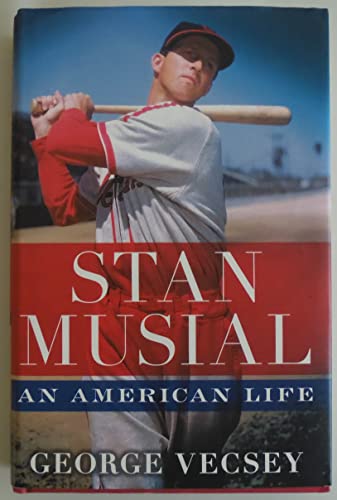
When baseball fans voted on the top twenty-five players of the twentieth century in 1999, Stan Musial didn’t make the cut. This glaring omission—later rectified by a panel of experts—raised an important question: How could a first-ballot Hall of Famer, widely considered one of the greatest hitters in baseball history, still rank as the most underrated athlete of all time?
In Stan Musial, veteran sports journalist George Vecsey finally gives this twenty-time All-Star and St. Louis Cardinals icon the kind of prestigious biographical treatment previously afforded to his more celebrated contemporaries Ted Williams and Joe DiMaggio. More than just a chronological recounting of the events of Musial’s life, this is the definitive portrait of one of the game’s best-loved but most unappreciated legends, told through the remembrances of those who played beside, worked with, and covered “Stan the Man” over the course of his nearly seventy years in the national spotlight.
Stan Musial never married a starlet. He didn’t die young, live too hard, or squander his talent. There were no legendary displays of temper or moodiness. He was merely the most consistent superstar of his era, a scarily gifted batsman who compiled 3,630 career hits (1,815 at home and 1,815 on the road), won three World Series titles, and retired in 1963 in possession of seventeen major-league records. Away from the diamond, he proved a savvy businessman and a model of humility and graciousness toward his many fans in St. Louis and around the world. From Keith Hernandez’s boyhood memories of Musial leaving tickets for him when the Cardinals were in San Francisco to the little-known story of Musial’s friendship with novelist James Michener—and their mutual association with Pope John Paul II—Vecsey weaves an intimate oral history around one of the great gentlemen of baseball’s Greatest Generation.
There may never be another Stan the Man, a fact that future Hall of Famer Albert Pujols—reluctantly nicknamed “El Hombre” in Musial’s honor—is quick to acknowledge. But thanks to this long-overdue reappraisal, even those who took his greatness for granted will learn to appreciate him all over again.
Die Inhaltsangabe kann sich auf eine andere Ausgabe dieses Titels beziehen.
Über die Autorin bzw. den Autor
George Vecsey, a sports columnist for The New York Times, has written about such events as the FIFA World Cup and the Olympics but considers baseball, the sport he’s covered since 1960, his favorite game. He is the author of more than a dozen books, including Baseball: A History of America’s Favorite Game and Loretta Lynn: Coal Miner’s Daughter (with Loretta Lynn), which was made into an Academy Award–winning film. He has also served as a national and religion reporter for The New York Times, interviewing the Dalai Lama, Tony Blair, Billy Graham, and a host of other noteworthy figures. He lives in New York with his wife, Marianne, an artist.
Auszug. © Genehmigter Nachdruck. Alle Rechte vorbehalten.
1
THE DO-OVER
Bud selig could see it coming. He did not know exactly which great player was going to be overlooked by the capricious impulses of baseball fans, but he was certain it was going to be somebody he loved.
The commissioner had brought this agony on himself by approving a commercial gimmick he suspected might backfire. A credit card company, a major sponsor, would arrange for fans to select the top twenty-five players of the twentieth century, using computerized punch cards. The winners would be announced during the World Series of 1999.
The drawback, and Selig knew it right away, was that this election could produce an injustice for some great players who had concluded their careers before the current generation of fans, before cable television began displaying endless loops of home runs by sluggers who were mysteriously growing burlier by the hour.
In addition to being the commissioner, with all the crass business decisions that post entails, Selig is a legitimate fan who grew up in Milwaukee, whose mother took him to Chicago and New York, giving him a lifelong appreciation for the game.
Knowing, just knowing, that some great players would be left out by mathematical inevitability, Selig did the prudent, fretting, consensual, quintessential Bud Selig thing: he arranged for an oversight committee that would add five players, making it a top-thirty team. He just knew.
Selig’s premonition came true when voting closed on September 10, 1999. Pete Rose, who had been banned from baseball after blatantly denying he had gambled on games, was among the top nine outfielders on the all-century team; Stan Musial, with his perfect image, who ranked among the top ten hitters who ever played, was mired at eleventh. Stan the Man, an also-ran.
“Ughhhh,” Selig groaned, a decade later, from deep in his innards. “How could they vote Pete Rose on that team before the great Stan Musial? You look at Musial’s stats, oh, oh, I can’t emphasize enough to you my regard for him, not only as a player, but when I got to know him in later years, when he came to Cooperstown. I can’t begin to tell you what a wonderful human being he is.”
His voice rising to an aggrieved squeal, Selig continued: “Did he deserve to be there? Are you kidding me? That to me was the biggest shock of the whole thing. I felt an incredible sadness. I said, ‘This is impossible.’
“I love Stan Musial,” Selig added. “He was just awesome. I watched him eleven, twelve times a year. I saw him in Ebbets Field, where they called him Stan the Man, because that’s what he was.”
“I’m seventy-four years old and I still say, in a kidlike way, wow!” Selig said, gaining steam. “And if you were trying to win a game in the eighth or ninth inning, you didn’t want to see him up. In old Sportsman’s Park, with that screen, he would pepper it. He was the man in every way.”
It would have been easy enough for voters to look up Musial’s statistics. Even in 1999, everybody had access to instant electronic information. And this is what Stan Musial accomplished: twenty-two seasons, a career batting average of .331, with 725 doubles, 177 triples, 1,951 runs batted in. Three times the National League’s Most Valuable Player. Seven batting championships. He led the league in total bases and slugging percentage six times each, and he led the league in doubles eight times and triples five times.
Musial also hit 475 home runs and struck out only 696 times in his entire career, twenty-two seasons—an astounding ratio in contrast to the chemically enhanced worthies of recent vintage, who strike out 696 times per season, or so it seems.
Oh, yes, and Musial was also the most beloved great player of his time, was never thrown out of a game—and yet the fans of the Internet age, with all that information available to them, did not see fit to include him among the top twenty-five.
“He has not gotten the recognition he deserves,” Selig said. “He is truly one of the great hitters. And believe me, I have great admiration for Ted Williams, but if you look at the stats, Stan Musial is right there. As far as I’m concerned, he’s got to be on the all-time team. He’s that great.”
In the top twenty-five, the fans included not only Rose but four players active in 1999—Cal Ripken Jr., Ken Griffey Jr., Roger Clemens, and Mark McGwire.
Knowing what they know now—McGwire’s extremely belated admission that he indeed used steroids that were illegal under the law of the land, though he still maintained he used them only for physical healing and never to gain extra power—fans of today might not vote for him.
But in 1999, given the choice, the fans voted for Bluto and stiffed Popeye the Sailor Man.
On further review, fans might not vote for the two Juniors a decade down the line, while Clemens’s seedy image and rumors of his using illegal body-enhancing chemicals probably would keep him out of the top twenty-five just on general principle. But that was the way things looked to fans with a punch-out computer card in the summer of 1999, listening to the incessant now-now-now babble of the tube and the blare of the public-address system.
Fortunately, Bud Selig’s oversight committee kicked in—the same panel that had come up with the original computer-card list of one hundred: Paul Beeston and Richard Levin from Major League Baseball, Gene Orza from the Players Association, Bob Costas and Jaime Jarrin, two experienced broadcasters, and four respected writers, Jerome Holtzman, Larry Whiteside, John Thorn, and Claire Smith. They did their work via conference call.
“The first thing we said was, ‘We start here, we start with Musial,’ ” recalled Costas, the baseball buff who had lived much of his adult life in St. Louis. Costas loved Musial. Everybody in St. Louis loved Musial. Now it was time for Costas to do the right thing.
“We had to scurry to improvise a nudnik-cancelling measure,” Thorn recalled. As Orza remembered it, the committee first added Musial and Christy Mathewson, then swiftly went to Warren Spahn, Honus Wagner, and Lefty Grove.
Even at that, to Selig’s chagrin, Frank Robinson, one of the great clutch hitters of all time, was left off the top thirty, along with Roberto Clemente, the great right fielder who died in a humanitarian airlift mission. The top-thirty team did not include a single Latino star or Negro League star, not Satchel Paige, not Josh Gibson, which rendered the venture still something of a gimmick.
When you think about it, all lists are gimmicks. Top ten movies. Top hundred books. Five worst presidents. I once wrote a column saying I could pick a team of players who are not in the Hall of Fame and on any given day “my guys”—just off the top of my head, Roger Maris, Gil Hodges, Tony Oliva, Ron Santo, Maury Wills, Thurman Munson, Dick Allen, Jack Morris, Tommy John, Jim Kaat, Lee Smith (sure, I’d take Pete Rose the ballplayer on that team; I covered him from the day he was nicknamed Charlie Hustle, and I believe he was clean as a player)—could give the Cooperstown guys a heckuva game. Somebody is always left off every list.
“It broke my heart to leave them off,” Costas said of players like Robinson and Clemente. And he added, “There would have been hell to pay if Musial had been left off.”
other tomfoolery was taking place in the closing months of 1999. People were obsessing that the world was going to fly out of orbit as computers spun from one digital millennium to...
„Über diesen Titel“ kann sich auf eine andere Ausgabe dieses Titels beziehen.
Suchergebnisse für Stan Musial: An American Life

Beispielbild für diese ISBN
Stan Musial: An American Life
Anbieter: World of Books (was SecondSale), Montgomery, IL, USA
Verkäuferbewertung 5 von 5 Sternen

Hardback. Zustand: Fair. NATIONAL BESTSELER Veteran sports journalist George Vecsey finally gives this twenty-time All-Star and St. Louis Cardinals icon the biographical treatment he deserves. Stan Musial is the definitive portrait of one of the game s best-loved but most unappreciated legends told through the remembrances of those who played beside, worked with, and covered Stan the Man over the course of his nearly seventy years in the national spotlight. Away from the diamond, Musial proved a savvy businessman and a model of humility and graciousness toward his many fans in St. Louis and around the world. From Keith Hernandez s boyhood memories of Musial leaving tickets for him when the Cardinals were in San Francisco to the little-known story of Musial s friendship with novelist James Michener, Vecsey weaves an intimate oral history around one of the great gentlemen of baseball s Greatest Generation. Artikel-Nr. 00103545271
Gebraucht kaufen
EUR 3,94
Versand gratis
Versand innerhalb von USA
Versand innerhalb von USA
Anzahl: 3 verfügbar
Beispielbild für diese ISBN
Stan Musial: An American Life
Anbieter: World of Books (was SecondSale), Montgomery, IL, USA
Verkäuferbewertung 5 von 5 Sternen
Hardback. Zustand: Good. NATIONAL BESTSELER Veteran sports journalist George Vecsey finally gives this twenty-time All-Star and St. Louis Cardinals icon the biographical treatment he deserves. Stan Musial is the definitive portrait of one of the game s best-loved but most unappreciated legends told through the remembrances of those who played beside, worked with, and covered Stan the Man over the course of his nearly seventy years in the national spotlight. Away from the diamond, Musial proved a savvy businessman and a model of humility and graciousness toward his many fans in St. Louis and around the world. From Keith Hernandez s boyhood memories of Musial leaving tickets for him when the Cardinals were in San Francisco to the little-known story of Musial s friendship with novelist James Michener, Vecsey weaves an intimate oral history around one of the great gentlemen of baseball s Greatest Generation. Artikel-Nr. 00105524722
Gebraucht kaufen
EUR 3,94
Versand gratis
Versand innerhalb von USA
Versand innerhalb von USA
Anzahl: 5 verfügbar
Foto des Verkäufers
Stan Musial: An American Life
Anbieter: Dream Books Co., Denver, CO, USA
Verkäuferbewertung 5 von 5 Sternen
Zustand: acceptable. This copy has clearly been enjoyedâ"expect noticeable shelf wear and some minor creases to the cover. Binding is strong, and all pages are legible. May contain previous library markings or stamps. Artikel-Nr. DBV.0345517067.A
Gebraucht kaufen
EUR 3,95
Versand gratis
Versand innerhalb von USA
Versand innerhalb von USA
Anzahl: 1 verfügbar
Beispielbild für diese ISBN
Stan Musial: An American Life
Verlag:
ESPN (edition First Edition), 2011
ISBN 10: 0345517067
ISBN 13: 9780345517067
Gebraucht
Hardcover
Erstausgabe
Anbieter: BooksRun, Philadelphia, PA, USA
Verkäuferbewertung 5 von 5 Sternen
Hardcover. Zustand: Very Good. First Edition. With dust jacket. It's a well-cared-for item that has seen limited use. The item may show minor signs of wear. All the text is legible, with all pages included. It may have slight markings and/or highlighting. Artikel-Nr. 0345517067-8-1-29
Gebraucht kaufen
EUR 5,46
Versand gratis
Versand innerhalb von USA
Versand innerhalb von USA
Anzahl: 1 verfügbar
Foto des Verkäufers
Stan Musial: An American Life
Anbieter: Dream Books Co., Denver, CO, USA
Verkäuferbewertung 5 von 5 Sternen
Zustand: good. Gently used with minimal wear on the corners and cover. A few pages may contain light highlighting or writing, but the text remains fully legible. Dust jacket may be missing, and supplemental materials like CDs or codes may not be included. May be ex-library with library markings. Ships promptly! Artikel-Nr. DBV.0345517067.G
Gebraucht kaufen
EUR 5,76
Versand gratis
Versand innerhalb von USA
Versand innerhalb von USA
Anzahl: 1 verfügbar
Beispielbild für diese ISBN
Stan Musial: An American Life
Anbieter: ThriftBooks-Atlanta, AUSTELL, GA, USA
Verkäuferbewertung 5 von 5 Sternen
Hardcover. Zustand: Fair. No Jacket. Readable copy. Pages may have considerable notes/highlighting. ~ ThriftBooks: Read More, Spend Less. Artikel-Nr. G0345517067I5N00
Gebraucht kaufen
EUR 5,87
Versand gratis
Versand innerhalb von USA
Versand innerhalb von USA
Anzahl: 1 verfügbar
Beispielbild für diese ISBN
Stan Musial: An American Life
Anbieter: ThriftBooks-Atlanta, AUSTELL, GA, USA
Verkäuferbewertung 5 von 5 Sternen
Hardcover. Zustand: Good. No Jacket. Pages can have notes/highlighting. Spine may show signs of wear. ~ ThriftBooks: Read More, Spend Less. Artikel-Nr. G0345517067I3N00
Gebraucht kaufen
EUR 5,87
Versand gratis
Versand innerhalb von USA
Versand innerhalb von USA
Anzahl: 1 verfügbar
Beispielbild für diese ISBN
Stan Musial: An American Life
Anbieter: ThriftBooks-Atlanta, AUSTELL, GA, USA
Verkäuferbewertung 5 von 5 Sternen
Hardcover. Zustand: Fair. No Jacket. Former library book; Readable copy. Pages may have considerable notes/highlighting. ~ ThriftBooks: Read More, Spend Less. Artikel-Nr. G0345517067I5N10
Gebraucht kaufen
EUR 5,87
Versand gratis
Versand innerhalb von USA
Versand innerhalb von USA
Anzahl: 1 verfügbar
Beispielbild für diese ISBN
Stan Musial: An American Life
Anbieter: ThriftBooks-Reno, Reno, NV, USA
Verkäuferbewertung 5 von 5 Sternen
Hardcover. Zustand: Good. No Jacket. Pages can have notes/highlighting. Spine may show signs of wear. ~ ThriftBooks: Read More, Spend Less. Artikel-Nr. G0345517067I3N00
Gebraucht kaufen
EUR 5,87
Versand gratis
Versand innerhalb von USA
Versand innerhalb von USA
Anzahl: 1 verfügbar
Beispielbild für diese ISBN
Stan Musial: An American Life
Anbieter: ThriftBooks-Reno, Reno, NV, USA
Verkäuferbewertung 5 von 5 Sternen
Hardcover. Zustand: Very Good. No Jacket. Former library book; May have limited writing in cover pages. Pages are unmarked. ~ ThriftBooks: Read More, Spend Less. Artikel-Nr. G0345517067I4N10
Gebraucht kaufen
EUR 5,87
Versand gratis
Versand innerhalb von USA
Versand innerhalb von USA
Anzahl: 1 verfügbar