
Verwandte Artikel zu Counterclockwise: Mindful Health and the Power of Possibilit...
Inhaltsangabe
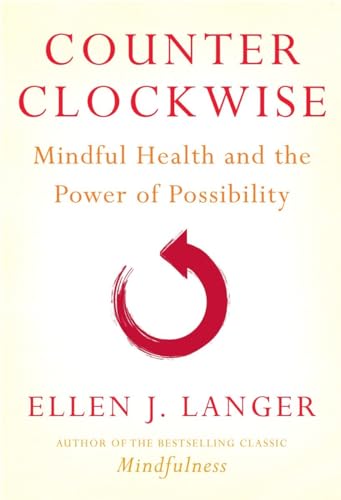
If we could turn back the clock psychologically, could we also turn it back physically? For more than thirty years, award-winning social psychologist Ellen Langer has studied this provocative question, and now, in Counterclockwise, she presents the answer: Opening our minds to what’s possible, instead of presuming impossibility, can lead to better health–at any age.
Drawing on landmark work in the field and her own body of colorful and highly original experiments–including the first detailed discussion of her “counterclockwise” study, in which elderly men lived for a week as though it was 1959 and showed dramatic improvements in their hearing, memory, dexterity, appetite, and general well-being–Langer shows that the magic of rejuvenation and ongoing good health lies in being aware of the ways we mindlessly react to social and cultural cues. Examining the hidden decisions and vocabulary that shape the medical world (“chronic” versus “acute,” “cure” versus “remission”), the powerful physical effects of placebos, and the intricate but often defeatist ways we define our physical health, Langer challenges the idea that the limits we assume and impose on ourselves are real. With only subtle shifts in our thinking, in our language, and in our expectations, she tells us, we can begin to change the ingrained behaviors that sap health, optimism, and vitality from our lives. Improved vision, younger appearance, weight loss, and increased longevity are just four of the results that Langer has demonstrated.
Immensely readable and riveting, Counterclockwise offers a transformative and bold new paradigm: the psychology of possibility. A hopeful and groundbreaking book by an author who has changed how people all over the world think and feel, Counterclockwise is sure to join Mindfulness as a standard source on new-century science and healing.
Die Inhaltsangabe kann sich auf eine andere Ausgabe dieses Titels beziehen.
Über die Autorin bzw. den Autor
Ellen J. Langer is the author of eleven books, including the international bestseller Mindfulness, which has been translated into fifteen languages, and more than two hundred research articles. She is the recipient of, among other numerous awards and honors, a Guggenheim Fellowship, the Award for Distinguished Contributions to Psychology in the Public Interest from the American Psychological Association, the Award for Distinguished Contributions of Basic Science to the Application of Psychology from the American Association of Applied and Preventive Psychology, and the Adult Development and Aging Distinguished Research Achievement Award from the American Psychological Association. Langer’s trailblazing experiments in social psychology have earned her inclusion in The New York Times Magazine’s “Year in Ideas” issue and will soon be the subject of a major motion picture. A member of the psychology department at Harvard University and a painter, she lives in Cambridge, Massachusetts.
Auszug. © Genehmigter Nachdruck. Alle Rechte vorbehalten.
Chapter One
What we need is not the will to believe, but the wish to find out. –William Wordsworth
There’s no way to turn back the clock or to fight the inevitable. We age and the vigor of youth becomes only a memory as we are ravaged by time. Chronic illnesses take their toll, our health and strength diminish accordingly, and the best we can do is graciously accept our fate. Once sickness is upon us, we give ourselves over to modern medicine and hope for the best. We can’t intervene as time marches on. Or can we?
In the 1970s my colleague Judith Rodin and I conducted an experiment with nursing home residents.1 We encouraged one group of participants to find ways to make more decisions for themselves. For example, they were allowed to choose where to receive visitors, and if and when to watch the movies that were shown at the home. Each also chose a houseplant to care for, and they were to decide where to place the plant in their room, as well as when and how much to water it. Our intent was to make the nursing home residents more mindful, to help them engage with the world and live their lives more fully.
A second, control group received no such instructions to make their own decisions; they were given houseplants but told that the nursing staff would care for them. A year and a half later, we found that members of the first group were more cheerful, active, and alert, based on a variety of tests we had administered both before and after the experiment. Allowing for the fact that they were all elderly and quite frail at the start, we were pleased that they were also much healthier: we were surprised, however, that less than half as many of the more engaged group had died than had those in the control group.
Over the next several years, I spent a lot of time thinking about what had happened. Our explanation was that the results were due to the power of making choices and the increased personal control it affords. Although we couldn’t make an airtight case, subsequent research would bear out our original understanding. Our research had taken place at the beginning of what was later termed the “New Age” movement and well before mind/body studies were conducted in laboratories around the country. It raised a nagging question: “What is the nature of the link from the nonmaterial mind to the material body?” Examples of this connection are all around us. We see a rat and show signs of fear as our pulse races and sweat breaks out on our skin; we think about losing a significant other and our blood pressure increases; we watch someone vomit and we feel nauseous ourselves. While we easily see evidence of the connection, it’s not well understood. Even we had been surprised: it seemed odd that simply asking people to make choices would result in the powerful consequences that our study showed. Subsequently, I realized that making choices results in mindfulness, and perhaps our surprise was because of the mindlessness we shared with most of the culture. I began to realize that ideas about mind/body dualism were just that, ideas, and a different, nondualist view of the mind and the body could be more useful. If we put the mind and the body back together so that we are just one person again, then wherever we put the mind, we would also put the body. If the mind is in a truly healthy place, the body would be as well–and so we could change our physical health by changing our minds.
The next question for me was one of limits. To what extent can the mind influence the body? If I smelled a fresh donut and imagined eating it, would my blood sugar rise? Would people fully convinced that their teeth are in excellent condition have healthier- looking X-rays at their annual checkups? Do men who become bald at a young age and thus see themselves as prematurely old test as older physiologically than men their age with a full head of hair? Do women who undergo cosmetic surgery and see a more youthful self in the mirror age more slowly? The questions may seem a bit “out there,” but they were worth asking.
In 1979, several years after that initial investigation with plants and nursing home residents, it seemed natural to continue testing the question of limits with an elderly population. My students and I devised a study–which we would later come to call the “counterclockwise study”–to look at what effects turning back the clock psychologically would have on people’s physiological state.2 We would re-create the world of 1959 and ask subjects to live as though it were twenty years earlier. If we put the mind back twenty years, would the body reflect this change?
As with many ideas, at first it seemed extreme, but the more we thought about it, the more possible it became. We finally decided it was worth the effort. My students weren’t quite as confident as I was because it wasn’t your usual study, but they quickly got caught up in my excitement.
To start, we consulted leading geriatricians to find the definitive biological markers of age to measure our results. Astonishingly, we were told there were (and still are) none. Without knowing someone’s chronological age, science cannot pinpoint how old someone is. To do our research, however, we needed ways to measure how old people were both before and after the retreat, so we determined which psychological and physical measures were the best bets to use. In addition to weight, dexterity, and flexibility, we planned to measure vision with and without eyeglasses, for each eye separately and together, as well as sensitivity to taste. We would give potential participants intelligence tests, to assess how quickly and accurately they could complete a series of paper- and- pencil mazes, and we would test their visual memory. We would also take photographs that we could later evaluate for the appearance of changes. Finally, they would each be asked to fill out a psychological self- evaluation test. All of these tests would help us select participants and give us a way to measure potential improvements at the end of the study.
We advertised the study in local newspapers and circulars, describing the research as a study on reminiscing, where people in their late seventies or early eighties would spend a week at a country retreat and talk about the past. To keep the study simple, we decided to use only one gender in order to make room assignments and other logistics easier. We chose to use men. We wanted men who were not ill and who would be reasonably able to participate in the activities and discussions we had planned for them. Word got out. Many younger people wanted to learn more about the study and how it might benefit their elderly parents. Those selected based on their telephone interviews came to the office to take the baseline physical and psychological tests. The interviews were memorable. At our first meeting, I asked a man named Arnold to tell me about himself and especially how he felt about his health and physical condition. Unlike other adult children who brought their parents in, Arnold’s daughter sat back and let him talk without...
„Über diesen Titel“ kann sich auf eine andere Ausgabe dieses Titels beziehen.
Suchergebnisse für Counterclockwise: Mindful Health and the Power of Possibilit...

Beispielbild für diese ISBN
Counterclockwise: Mindful Health and the Power of Possibility
Anbieter: World of Books (was SecondSale), Montgomery, IL, USA
Verkäuferbewertung 5 von 5 Sternen

Hardback. Zustand: Good. If we could turn back the clock psychologically, could we also turn it back physically? For more than thirty years, award-winning social psychologist Ellen Langer has studied this provocative question, and now, in Counterclockwise, she presents a conclusive answer: Opening our minds to what's possible, instead of presuming impossibility, can lead to better health--at any age. Drawing on landmark work in the field and her own body of highly original experiments--including her counterclockwise study, in which elderly men lived for a week as though it was 1959 and showed dramatic improvements in their hearing, memory, dexterity, appetite, and general well-being--Langer shows that the magic of rejuvenation and ongoing good health lies in being aware of the ways we mindlessly react to social and cultural cues. Examining the intricate but often defeatist ways we define our physical health, Langer challenges the idea that the limits we assume and impose on ourselves are real. With only subtle shifts in our thinking, in our language, and in our expectations, she tells us, we can begin to change the ingrained behaviors that sap health, optimism, and vitality from our lives. Improved vision, weight loss, and increased longevity are just three of the results that Langer has demonstrated. Provocative and riveting, Counterclockwise offers a transformative and bold new paradigm: the psychology of possibility. A hopeful and groundbreaking work by an author who has changed how people all over the world think and feel, Counterclockwise is sure to join Mindfulness as a standard source on new-century science and healing. Artikel-Nr. 00106917344
Gebraucht kaufen
EUR 6,46
Versand gratis
Versand innerhalb von USA
Versand innerhalb von USA
Anzahl: 5 verfügbar
Beispielbild für diese ISBN
Counterclockwise: Mindful Health and the Power of Possibility
Anbieter: World of Books (was SecondSale), Montgomery, IL, USA
Verkäuferbewertung 5 von 5 Sternen
Hardback. Zustand: Fair. If we could turn back the clock psychologically, could we also turn it back physically? For more than thirty years, award-winning social psychologist Ellen Langer has studied this provocative question, and now, in Counterclockwise, she presents a conclusive answer: Opening our minds to what's possible, instead of presuming impossibility, can lead to better health--at any age. Drawing on landmark work in the field and her own body of highly original experiments--including her counterclockwise study, in which elderly men lived for a week as though it was 1959 and showed dramatic improvements in their hearing, memory, dexterity, appetite, and general well-being--Langer shows that the magic of rejuvenation and ongoing good health lies in being aware of the ways we mindlessly react to social and cultural cues. Examining the intricate but often defeatist ways we define our physical health, Langer challenges the idea that the limits we assume and impose on ourselves are real. With only subtle shifts in our thinking, in our language, and in our expectations, she tells us, we can begin to change the ingrained behaviors that sap health, optimism, and vitality from our lives. Improved vision, weight loss, and increased longevity are just three of the results that Langer has demonstrated. Provocative and riveting, Counterclockwise offers a transformative and bold new paradigm: the psychology of possibility. A hopeful and groundbreaking work by an author who has changed how people all over the world think and feel, Counterclockwise is sure to join Mindfulness as a standard source on new-century science and healing. Artikel-Nr. 00110588591
Gebraucht kaufen
EUR 6,46
Versand gratis
Versand innerhalb von USA
Versand innerhalb von USA
Anzahl: 3 verfügbar
Foto des Verkäufers
Counterclockwise: Mindful Health and the Power of Possibility
Anbieter: Dream Books Co., Denver, CO, USA
Verkäuferbewertung 5 von 5 Sternen
Zustand: acceptable. This copy has clearly been enjoyedâ"expect noticeable shelf wear and some minor creases to the cover. Binding is strong, and all pages are legible. May contain previous library markings or stamps. Artikel-Nr. DBV.0345502043.A
Gebraucht kaufen
EUR 6,47
Versand gratis
Versand innerhalb von USA
Versand innerhalb von USA
Anzahl: 1 verfügbar
Beispielbild für diese ISBN
Counter Clockwise: Mindful Health and the Power of Possibility
Anbieter: ThriftBooks-Atlanta, AUSTELL, GA, USA
Verkäuferbewertung 5 von 5 Sternen
Hardcover. Zustand: Fair. No Jacket. Missing dust jacket; Readable copy. Pages may have considerable notes/highlighting. ~ ThriftBooks: Read More, Spend Less. Artikel-Nr. G0345502043I5N01
Gebraucht kaufen
EUR 6,86
Versand gratis
Versand innerhalb von USA
Versand innerhalb von USA
Anzahl: 1 verfügbar
Beispielbild für diese ISBN
Counter Clockwise: Mindful Health and the Power of Possibility
Anbieter: ThriftBooks-Dallas, Dallas, TX, USA
Verkäuferbewertung 5 von 5 Sternen
Hardcover. Zustand: Very Good. No Jacket. May have limited writing in cover pages. Pages are unmarked. ~ ThriftBooks: Read More, Spend Less. Artikel-Nr. G0345502043I4N00
Gebraucht kaufen
EUR 6,86
Versand gratis
Versand innerhalb von USA
Versand innerhalb von USA
Anzahl: 1 verfügbar
Beispielbild für diese ISBN
Counter Clockwise: Mindful Health and the Power of Possibility
Anbieter: ThriftBooks-Atlanta, AUSTELL, GA, USA
Verkäuferbewertung 5 von 5 Sternen
Hardcover. Zustand: Very Good. No Jacket. May have limited writing in cover pages. Pages are unmarked. ~ ThriftBooks: Read More, Spend Less. Artikel-Nr. G0345502043I4N00
Gebraucht kaufen
EUR 6,86
Versand gratis
Versand innerhalb von USA
Versand innerhalb von USA
Anzahl: 1 verfügbar
Beispielbild für diese ISBN
Counter Clockwise: Mindful Health and the Power of Possibility
Anbieter: ThriftBooks-Atlanta, AUSTELL, GA, USA
Verkäuferbewertung 5 von 5 Sternen
Hardcover. Zustand: Very Good. No Jacket. Missing dust jacket; May have limited writing in cover pages. Pages are unmarked. ~ ThriftBooks: Read More, Spend Less. Artikel-Nr. G0345502043I4N01
Gebraucht kaufen
EUR 6,86
Versand gratis
Versand innerhalb von USA
Versand innerhalb von USA
Anzahl: 1 verfügbar
Beispielbild für diese ISBN
Counter Clockwise: Mindful Health and the Power of Possibility
Anbieter: ThriftBooks-Dallas, Dallas, TX, USA
Verkäuferbewertung 5 von 5 Sternen
Hardcover. Zustand: Fair. No Jacket. Missing dust jacket; Readable copy. Pages may have considerable notes/highlighting. ~ ThriftBooks: Read More, Spend Less. Artikel-Nr. G0345502043I5N01
Gebraucht kaufen
EUR 6,86
Versand gratis
Versand innerhalb von USA
Versand innerhalb von USA
Anzahl: 1 verfügbar
Beispielbild für diese ISBN
Counter Clockwise: Mindful Health and the Power of Possibility
Anbieter: ThriftBooks-Dallas, Dallas, TX, USA
Verkäuferbewertung 5 von 5 Sternen
Hardcover. Zustand: Good. No Jacket. Missing dust jacket; Pages can have notes/highlighting. Spine may show signs of wear. ~ ThriftBooks: Read More, Spend Less. Artikel-Nr. G0345502043I3N01
Gebraucht kaufen
EUR 6,87
Versand gratis
Versand innerhalb von USA
Versand innerhalb von USA
Anzahl: 1 verfügbar
Beispielbild für diese ISBN
Counterclockwise: Mindful Health and the Power of Possibility
Anbieter: Wonder Book, Frederick, MD, USA
Verkäuferbewertung 5 von 5 Sternen
Zustand: Good. Good condition. Like New dust jacket. A copy that has been read but remains intact. May contain markings such as bookplates, stamps, limited notes and highlighting, or a few light stains. Artikel-Nr. K08U-01668
Gebraucht kaufen
EUR 7,35
Versand gratis
Versand innerhalb von USA
Versand innerhalb von USA
Anzahl: 1 verfügbar