
Verwandte Artikel zu A Memory, a Monologue, a Rant, and a Prayer: Writings...
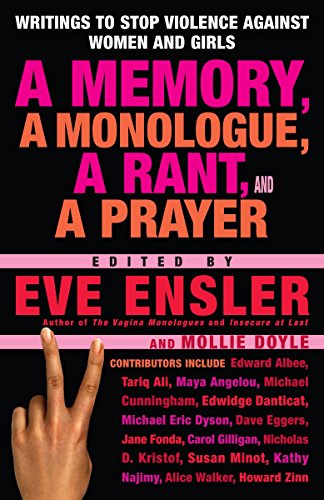
A Memory, a Monologue, a Rant, and a Prayer: Writings to Stop Violence Against Women and Girls - Softcover
Inhaltsangabe
Selections from the “Until the Violence Stops” Festival
Featuring writings by Abiola Abrams • Edward Albee • Tariq Ali • Maya Angelou • Periel Aschenbrand • Patricia Bosworth • Nicole Burdette • Kate Clinton • Kimberle Crenshaw • Michael Cunningham • Edwidge Danticat • Ariel Dorfman • Mollie Doyle • Slavenka Drakulic • Michael Eric Dyson • Dave Eggers • Kathy Engel • Eve Ensler • Jane Fonda • Carol Gilligan • Jyllian Gunther • Suheir Hammad • Christine House • Marie Howe • Carol Michèle Kaplan • Moisés Kaufman • Michael Klein • Nicholas Kristof • James Lecesne • Elizabeth Lesser • Mark Matousek • Deena Metzger • Susan Miller • Winter Miller • Susan Minot • Robin Morgan • Kathy Najimy • Lynn Nottage • Sharmeen Obaid-Chinoy • Sharon Olds • Hanan al-Shaykh • Anna Deavere Smith • Diana Son • Monica Szlekovics • Robert Thurman • Betty Gale Tyson • Alice Walker • Jody Williams • Erin Cressida Wilson • Howard Zinn
This groundbreaking collection, edited by author and playwright Eve Ensler, features pieces from “Until the Violence Stops,” the international tour that brings the issue of violence against women and girls to the forefront of our consciousness. These diverse voices rise up in a collective roar to break open, expose, and examine the insidiousness of brutality, neglect, a punch, or a put-down. Here is Edward Albee on S&M; Maya Angelou on women’s work; Michael Cunningham on self-mutilation; Dave Eggers on a Sudanese
abduction; Carol Gilligan on a daughter witnessing her mother being hit; Susan Miller on raising a son as a single mother; and Sharon Olds on a bra.
These writings are inspired, funny, angry, heartfelt, tragic, and beautiful. But above all, together they create a true and profound portrait of this issue’s effect on every one of us. With information on how to organize an “Until the Violence Stops” event in your community, A Memory, a Monologue, a Rant, and a Prayer is a call to the world to demand an end to violence against women.
“In the current era, it takes some brain racking to think of anyone else doing anything quite like Ensler. She’s a countercultural consciousness-raiser, an empowering figure, a truth-teller.”
–Chicago Tribune
Die Inhaltsangabe kann sich auf eine andere Ausgabe dieses Titels beziehen.
Über die Autorin bzw. den Autor
Eve Ensler is an internationally bestselling author and an acclaimed playwright whose works for the stage include The Vagina Monologues, Necessary Targets, and The Good Body. She is the author of Insecure at Last, a political memoir. Ensler is the founder of V-Day, the global movement to end violence against women and girls. In the last decade, V-Day has raised more than $70 million for grassroots groups that work to end violence against women and girls around the world. Eve Ensler lives in Paris and New York City.
Auszug. © Genehmigter Nachdruck. Alle Rechte vorbehalten.
Looking for the Body Music
Michael Klein
My friend Frank calls it looking for the body music—the music my mother heard.
At the end of looking for the body music, one stumbles upon a woman’s body
with the whole world taken out of her—but before that scene,
a foreshadow: my mother at the boarding school.
She’s twelve, child of two alcoholics, vaudevillians, shadows on a stage.
She’s overweight and sees beyond herself even then, so the girls
are mean in their pressed dresses and routinely hang my mother out
the window by her feet for a long time waiting for the exactly right cadence of please before they pull her back into her life.
That was in 1940-something—the year my mother began
the book her mind was writing called this is what happened to me—
the book she read to us—pill-language to cushion the abyss of two marriages—
one husband beat her up, one husband took her money and broke her off
with the world until she got written as the failed suicide after hanging by a thread
by a hair, by her feet, borne of her fierce suspension
over something called a youth.
7 Variations on Margarita Weinberg
Moisés Kaufman
Dedicated to the memory of Rebeca Clisci Akerman
1.
My grandmother was born in the Ukraine but immigrated to Venezuela before the Second World War. She told me this story:
A young Jewish woman was kidnapped by a group of Cossacks during a pogrom. They brought her into a room and held her down, deciding who would have her first.
“If you touch me I will put a curse on you,” the woman said. “I am a witch.” The Cossacks laughed. “I can prove it!” she shouted. “I can prove to you that I’m a witch.”
Their leader smiled and said, “Very well. Prove it, then.”
“I am immortal,” she said, “and you cannot kill me.” They laughed some more. “You cannot kill me. Not even if you shoot me. Try it.”
They stopped laughing and looked at her.
“Here. Try it.” She pointed to her chest. “Shoot me right here. You will see that I’m immortal.” The Cossacks looked at one another but didn’t move.
“Shoot me in the heart. You will see I won’t die. And then you’ll have your proof that I’m a witch.” The leader thought for a moment, then quickly took out his pistol and shot her in the heart. The young woman fell to the floor bleeding, looked at the man who had shot her, and said, “Thank you, you imbecile.”
My grandmother liked stories of heroic suicides.
2.
My grandmother wanted to be a doctor when she was young. But in the Ukraine in 1935, there were only a few seats at the university allotted to Jews, and all of them went to men. So she became a nurse.
When she told her family in 1937 that she wanted to go to Venezuela, everyone was against it. They hardly knew where Venezuela was on the map.
But her fiancé, Boris (my grandfather), had moved here two years earlier to make his fortune, and he wanted her to come join him; business was going well for him and he was worried about rumors of a war in Europe.
I don’t know if it was the imminent war or the invitation of a lover in the tropics, or both, but she came here. She was twenty-two years old.
The story goes that when she arrived in Caracas, she was a woman of such delicate beauty, every immigrant wanted to marry her. (I’ve seen pictures, and she was stunning.) And my grandfather said, “Although I brought you here, you have no obligation to marry me. We’ve been apart for two years, and your feelings might have changed. You can have your pick of any man in our community.”
My grandmother cried, moved by his words, and told him that yes, it was her decision. And her decision was to marry him. (Another version of the story is that their marriage had been arranged by their parents in the Ukraine, and that his asking her to choose to marry him was a testament to his liberal views, so she married him.)
3.
When their first child was born, my grandmother named her Margarita, which is the name of Venezuela’s national flower. Margarita Weinberg. (Her Jewish name, Miriam, came from my grandmother’s mother, who had died when my grandmother was two.)
My grandmother was the storyteller in the family.
In some arrangement made long before I was born, she had inherited the responsibility of keeping our narratives and our history alive for us.
“My brother was a Communist who left our village in the Ukraine and went to Paris to join the Resistance fighters against the Nazis,” she said. “He became one of their best spies. A street in Paris is named after him.” Two years after he joined the Resistance, he was surprised on a mission inside a German arsenal in a suburb of Paris. “When the Nazis surrounded the arsenal, he used all the weapons in it to defend himself. He killed many Nazis that day,” she told us. “He saved the last bullet for himself.”
Heroic suicides . . .
I grew up with these narratives.
4.
At nineteen my mother, Margarita, met a young man named Simon, who’d arrived in Venezuela after the war, from Romania. He’d survived the war by sewing and selling the yellow Stars of David that the Jews were made to wear. He spent most of the war alternately hiding in a small room and selling Stars of David. He was eleven.
My mother’s childhood in Venezuela was idyllic. The country was blessed with warm weather and kind inhabitants who were welcoming to the immigrants. The war was an ocean away, and my mother heard about it only when my grandparents would talk in hushed tones about relatives who had stayed behind and were now either in concentration camps or dead.
Simon was brought to Venezuela by his aunt, who had a successful clock shop in the center of town. She brought him to my grandmother’s house to meet my mother. They went out on a few dates, and then he asked her to marry him.
She liked him, but her intuition told her she shouldn’t marry him—he came from such a different life. She had never known hunger or war, except in the heroic and suicidal stories of her mother.
But my grandfather Boris said, “Do you think there’s a line of men waiting for you? We are a small Jewish community here. He’s a good man. You should marry him.”
My grandmother heard this but said nothing. And my mother married him.
Her strongest memory of her wedding day is standing under the canopy in the synagogue thinking, “What am I doing here? This feels like suicide.”
5.
Their marriage was a disaster. My mother’s intuition about Simon, my father, was absolutely correct. They were from two different worlds.
My father’s Eastern European upbringing, already stern and strict, had then been further hardened by the war. He loved Spi- noza, Schopenhauer, and other severe European philosophers. He was despotic and had little patience for things other than survival. His main interests were making a living, having children, and attending synagogue.
My mother loved American movies and Venezuelan balladeers and porcelain dolls. He was punctual and Germanic in his daily habits. She had the punctuality of people in the tropics and their laid-back attitude. He perceived her as spoiled and lazy. And his inability to understand her quickly turned to fury.
For her part, she often thought herself superior to him. The war had left deep scars: His manners were lacking or nonexistent; he laughed...
„Über diesen Titel“ kann sich auf eine andere Ausgabe dieses Titels beziehen.
Suchergebnisse für A Memory, a Monologue, a Rant, and a Prayer: Writings...

Beispielbild für diese ISBN
A Memory, a Monologue, a Rant, and a Prayer: Writings to Stop Violence Against Women and Girls
Verlag:
Random House Publishing Group, 2007
ISBN 10: 0345497910
ISBN 13: 9780345497918
Gebraucht
Softcover
Anbieter: World of Books (was SecondSale), Montgomery, IL, USA
Verkäuferbewertung 5 von 5 Sternen

Zustand: Good. Item in good condition. Textbooks may not include supplemental items i.e. CDs, access codes etc. Artikel-Nr. 00081812119
Gebraucht kaufen
EUR 4,05
Versand gratis
Versand innerhalb von USA
Versand innerhalb von USA
Anzahl: 5 verfügbar
Beispielbild für diese ISBN
A Memory, a Monologue, a Rant, and a Prayer: Writings to Stop Violence Against Women and Girls
Verlag:
Random House Publishing Group (edition 1), 2007
ISBN 10: 0345497910
ISBN 13: 9780345497918
Gebraucht
Paperback
Anbieter: BooksRun, Philadelphia, PA, USA
Verkäuferbewertung 5 von 5 Sternen
Paperback. Zustand: Fair. 1. The item might be beaten up but readable. May contain markings or highlighting, as well as stains, bent corners, or any other major defect, but the text is not obscured in any way. Artikel-Nr. 0345497910-7-1
Gebraucht kaufen
EUR 4,46
Versand gratis
Versand innerhalb von USA
Versand innerhalb von USA
Anzahl: 1 verfügbar
Beispielbild für diese ISBN
A Memory, a Monologue, a Rant, and a Prayer: Writings to Stop Violence Against Women and Girls
Anbieter: ThriftBooks-Atlanta, AUSTELL, GA, USA
Verkäuferbewertung 5 von 5 Sternen
Paperback. Zustand: Very Good. No Jacket. May have limited writing in cover pages. Pages are unmarked. ~ ThriftBooks: Read More, Spend Less. Artikel-Nr. G0345497910I4N00
Gebraucht kaufen
EUR 6,37
Versand gratis
Versand innerhalb von USA
Versand innerhalb von USA
Anzahl: 1 verfügbar
Beispielbild für diese ISBN
A Memory, a Monologue, a Rant, and a Prayer: Writings to Stop Violence Against Women and Girls
Anbieter: ThriftBooks-Dallas, Dallas, TX, USA
Verkäuferbewertung 5 von 5 Sternen
Paperback. Zustand: As New. No Jacket. Pages are clean and are not marred by notes or folds of any kind. ~ ThriftBooks: Read More, Spend Less. Artikel-Nr. G0345497910I2N00
Gebraucht kaufen
EUR 6,37
Versand gratis
Versand innerhalb von USA
Versand innerhalb von USA
Anzahl: 1 verfügbar
Beispielbild für diese ISBN
A Memory, a Monologue, a Rant, and a Prayer: Writings to Stop Violence Against Women and Girls
Anbieter: Wonder Book, Frederick, MD, USA
Verkäuferbewertung 5 von 5 Sternen
Zustand: Good. Good condition. A copy that has been read but remains intact. May contain markings such as bookplates, stamps, limited notes and highlighting, or a few light stains. Artikel-Nr. K14N-00046
Gebraucht kaufen
EUR 6,43
Versand gratis
Versand innerhalb von USA
Versand innerhalb von USA
Anzahl: 1 verfügbar
Beispielbild für diese ISBN
A Memory, a Monologue, a Rant, and a Prayer : Writings to Stop Violence Against Women and Girls
Verlag:
Random House Publishing Group, 2007
ISBN 10: 0345497910
ISBN 13: 9780345497918
Gebraucht
Softcover
Erstausgabe
Anbieter: Better World Books, Mishawaka, IN, USA
Verkäuferbewertung 5 von 5 Sternen
Zustand: Good. 1st Edition. Pages intact with minimal writing/highlighting. The binding may be loose and creased. Dust jackets/supplements are not included. Stock photo provided. Product includes identifying sticker. Better World Books: Buy Books. Do Good. Artikel-Nr. 4025095-6
Gebraucht kaufen
EUR 6,57
Versand gratis
Versand innerhalb von USA
Versand innerhalb von USA
Anzahl: 1 verfügbar
Beispielbild für diese ISBN
A Memory, a Monologue, a Rant, and a Prayer : Writings to Stop Violence Against Women and Girls
Verlag:
Random House Publishing Group, 2007
ISBN 10: 0345497910
ISBN 13: 9780345497918
Gebraucht
Softcover
Erstausgabe
Anbieter: Better World Books: West, Reno, NV, USA
Verkäuferbewertung 5 von 5 Sternen
Zustand: Fine. 1st Edition. Used book that is in almost brand-new condition. May contain a remainder mark. Better World Books: Buy Books. Do Good. Artikel-Nr. 17853054-75
Gebraucht kaufen
EUR 6,57
Versand gratis
Versand innerhalb von USA
Versand innerhalb von USA
Anzahl: 1 verfügbar
Beispielbild für diese ISBN
A Memory, a Monologue, a Rant, and a Prayer: Writings to Stop Violence Against Women and Girls
Verlag:
Random House Publishing Group, 2007
ISBN 10: 0345497910
ISBN 13: 9780345497918
Gebraucht
Paperback
Anbieter: WorldofBooks, Goring-By-Sea, WS, Vereinigtes Königreich
Verkäuferbewertung 5 von 5 Sternen
Paperback. Zustand: Very Good. The book has been read, but is in excellent condition. Pages are intact and not marred by notes or highlighting. The spine remains undamaged. Artikel-Nr. GOR003845848
Gebraucht kaufen
EUR 12,70
EUR 6,63 Versand
Versand von Vereinigtes Königreich nach USA
Versand von Vereinigtes Königreich nach USA
Anzahl: 3 verfügbar
Beispielbild für diese ISBN
A Memory, a Monologue, a Rant, and a Prayer: Writings to Stop Violence Against Women and Girls
Verlag:
Random House Publishing Group, 2007
ISBN 10: 0345497910
ISBN 13: 9780345497918
Neu
Softcover
Anbieter: Ria Christie Collections, Uxbridge, Vereinigtes Königreich
Verkäuferbewertung 5 von 5 Sternen
Zustand: New. In English. Artikel-Nr. ria9780345497918_new
Neu kaufen
EUR 21,60
EUR 11,09 Versand
Versand von Vereinigtes Königreich nach USA
Versand von Vereinigtes Königreich nach USA
Anzahl: Mehr als 20 verfügbar
Beispielbild für diese ISBN
A Memory, a Monologue, a Rant, and a Prayer
Anbieter: Revaluation Books, Exeter, Vereinigtes Königreich
Verkäuferbewertung 5 von 5 Sternen
Paperback. Zustand: Brand New. 1st edition. 223 pages. 8.00x5.25x0.75 inches. In Stock. Artikel-Nr. x-0345497910
Neu kaufen
EUR 21,52
EUR 11,84 Versand
Versand von Vereinigtes Königreich nach USA
Versand von Vereinigtes Königreich nach USA
Anzahl: 2 verfügbar