
Verwandte Artikel zu The Taste of Conquest: The Rise and Fall of the Three...
Inhaltsangabe
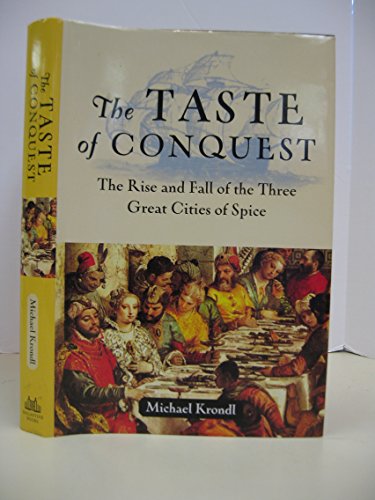
Ranging from the medieval period to the present day, a history of the international spice trade focuses on the involvement of three important European cities--Venice, Lisbon, and Amsterdam--charting the growth of the spice trade in relation to the successive rise--and fall--of the three urban centers. 30,000 first printing.
Die Inhaltsangabe kann sich auf eine andere Ausgabe dieses Titels beziehen.
Über die Autorin bzw. den Autor
Michael Krondl is a chef, food writer, and author of Around the American Table: Treasured Recipes and Food Traditions from the American Cookery Collections of the New York Public Library and The Great Little Pumpkin Cookbook. He has published articles in Good Food, Family Circle, Pleasures of Cooking, and Chocolatier, and has contributed entries to The Oxford Encyclopedia of Food and Drink in America. He lives in New York City.
Auszug. © Genehmigter Nachdruck. Alle Rechte vorbehalten.
I Antichi
What I remember best from that dinner on Campo San Maurizio are the canoce, a tangle of milky pink sea creatures spilling across a great silver platter. And Luca, looming in the low kitchen doorway, in an outfit of leather pants, royal blue velvet blouse, and Day-Glo orange boots, a huge grin splitting his satyr’s face as he paused dramatically to hold up the dish so that we might admire his succulent prize. Canoce are about the size of a fat man’s index finger and belong to the same family of tasty exoskeletal sea life as shrimp and saltwater crayfish; however, they are distinctly more buglike in appearance, lacking the bright color and exuberant claws of other crustaceans. In flavor, though, they are far more delicate, infused with sweetness and brininess in exquisite balance. When they arrive at the table, I give up on my knife and fork so that I can methodically rip each luscious beast apart to extract its sweet belly and slurp on my fingers to secure each salty drip. I try to remember the instructions from a pamphlet on etiquette published in 1483, when everyone ate with their hands: “Eat with the three fingers, do not take morsels of excessive size and do not stuff your mouth with both hands.” Success is elusive.
Like most Italian cooking today, the canoce recipe is simple: the crustaceans are bathed in a little olive oil and seasoned with salt and pepper. It is Venetian food at its most elemental, a dish that comes from the bounty of the lagoon that fed local fishermen long before Venice became Europe’s pepper dealer and continued to do so long after the city was washed up in the spice trade. The pepper is still there, but there’s not even a trace of the other seasonings—the ginger, the cinnamon, the nutmeg, the cloves—that once filled the city’s great galleys and suffused her suppers with Oriental scents. It’s as if the ancient town can no longer recall yesterday’s spiced debauch and instead, as the old often do, has retreated to the memories of her youth, before the parvenu aristocrats began to dress her up with baubles from abroad. Luca explains that this method of cooking canoce is more popolare, of the people, the way the old ladies make them, the only ones who can still make Venetian food. The recollection of feasts gone by fades the rake’s smile to melancholy.
I had come to Venice to try to pry off her mask, to uncover some of the antique flavors, to sniff out her ancient peppery smells. I figured Luca could make the introductions. After all, he has spent his forty-something years consorting with the old dowager on the lagoon. Along the way, he has reproduced Renaissance feasts complete with trained bears, swordfights, and period trumpet serenades, where the gilded pheasants and cinnamon-scented ravioli were served from ornate platters and golden bowls. Although he is more a jack-of-all- trades than a Renaissance man, he has often dressed the part of the latter. Imagine Paul Bunyan in silk tights topped by an exquisite doublet of pink and gold. In other towns, Luca Colferai might have been a punk rocker in his youth, but here, his rebellion took the form of organizing erotic poetry festivals and resurrecting Casanova. So you can understand that when his grandiloquent dinner invitation arrived, I could hardly refuse.
One of Luca’s many roles is to play a guiding spirit to I Antichi, a confraternity of like-minded families known as a compagnia de calza (literally, “society of the stocking”). “Our compagnia is made up of a small lunatic fringe who just want to have fun during Carnevale” is how Luca describes his companions. In fact, the society’s mandate, to organize celebrations during Carnival, is fully approved and authorized by the Venetian municipal government. Given that this is Venice, the idea goes back to the sixteenth century, when groups of elite young men formed these associations to throw parties during Carnival. This was a time when the city’s commercial prowess, and the spice trade in particular, was under siege. To the sons of privilege, drinking and whoring till dawn seemed much more sensible than risking their lives in the increasingly precarious pepper business.
The original I Antichi was founded by a group of Venetian nobles in 1541 with the motto Divertire divertendosi, which might be roughly translated as “Throw parties so you can party.” The group was reinvented by a Venetian lawyer and antiquarian named Paolo Zancopè in the late 1970s and subsequently passed into Luca’s hands upon the founder’s death. Zancopè’s residence, where our canoce feast was held, has become a kind of clubhouse for I Antichi, presided over by the effervescent presence of his Brazilian widow, Jurubeba.
Emptying yet another bottle of fizzy Prosecco, Luca recounts a golden past of grand regattas and mask-filled balls. The membership of I Antichi ranges from street sweepers to multimillionaires, from butchers to poets. They come together for the many official festivals that mark the Venetian calendar: for the Festa della Salute, which commemorates the end of the plague of 1631, when a third of Venice perished; for the Festa di Redentore, another party in memory of an epidemic; for the Festa della Sensa, when Venice recalls a time when the doge, the elected Venetian leader, would symbolically marry the sea; and, of course, for Carnevale, the pre-Lenten festival that overruns Venice and can seem as execrable as a plague when the narrow alleys swarm with the tourist hordes. The menu for every holiday follows age-old traditions: cured, spiced mutton, for the Salute; artichokes for the Sensa; bigoli for the Redentore.
Jurubeba interrupts Luca’s reminiscences to consult on the state of our bigoli. (The canoce were only one course among many.) He breaks off midsentence to attend to the important matter at hand. Bigoli are a kind of thick whole wheat spaghetti that are typically served entangled in a sauce of caramelized onions and anchovies, the saltiness of the fish and sweetness of the onion providing the perfect, if unsubtle, condiment for the rough pasta. They are very traditional, especially to the Jews of the Ghetto Nuovo, the original “ghetto.” (The Jewish variant uses garlic instead of onions.) But today, it seems, all that’s left of the Ghetto’s ancient community are Hassidic Jews from Brooklyn—and they know about as much about bigoli as they do about prosciutto. These days, there is little traditional food to be found in Venice. When I invite Luca to a restaurant, he grimaces, insisting that there are no more “honest” restaurants left, that they’re all for the tourists now.
All the same, Venetian food hasn’t entirely disappeared (yet), and if you dig hard enough, you can still unearth hints and clues of what food might have tasted like two hundred, five hundred, even a thousand years ago. Many restaurants still serve sarde in saor, a dish of fried sardines mounded with onions and raisins, seasoned with vinegar, sugar, and occasionally even cinnamon. Its combination of sweet and sour is typical of the Middle Ages; there’s even a fourteenth-century recipe for much the same dish. You can also taste the past in the confections called peverini, sold in every Venetian pasticceria. They are barely sweet with molasses but distinctly seasoned with pepper, the pungency a faint echo of the city’s past renown as spice supplier to the Western world.
Still, most of the food that Venetians call their own, the cooking of their grandmothers, is of much more recent vintage. In Marco Polo’s day, our canoce would have been showered with a medieval blend of spices on top of today’s salt and pepper; even as late as the seventeen hundreds,...
„Über diesen Titel“ kann sich auf eine andere Ausgabe dieses Titels beziehen.
Suchergebnisse für The Taste of Conquest: The Rise and Fall of the Three...

Beispielbild für diese ISBN
The Taste of Conquest: The Rise and Fall of the Three Great Cities of Spice
Anbieter: Wonder Book, Frederick, MD, USA
Verkäuferbewertung 5 von 5 Sternen

Zustand: Very Good. Very Good condition. Very Good dust jacket. A copy that may have a few cosmetic defects. May also contain light spine creasing or a few markings such as an owner's name, short gifter's inscription or light stamp. Artikel-Nr. P09R-00434
Gebraucht kaufen
EUR 6,44
Versand gratis
Versand innerhalb von USA
Versand innerhalb von USA
Anzahl: 1 verfügbar
Beispielbild für diese ISBN
The Taste of Conquest: The Rise and Fall of the Three Great Cities of Spice
Anbieter: ThriftBooks-Atlanta, AUSTELL, GA, USA
Verkäuferbewertung 5 von 5 Sternen
Hardcover. Zustand: Very Good. No Jacket. May have limited writing in cover pages. Pages are unmarked. ~ ThriftBooks: Read More, Spend Less. Artikel-Nr. G034548083XI4N00
Gebraucht kaufen
EUR 7,02
Versand gratis
Versand innerhalb von USA
Versand innerhalb von USA
Anzahl: 1 verfügbar
Beispielbild für diese ISBN
The Taste of Conquest: The Rise and Fall of the Three Great Cities of Spice
Anbieter: ThriftBooks-Atlanta, AUSTELL, GA, USA
Verkäuferbewertung 5 von 5 Sternen
Hardcover. Zustand: Fair. No Jacket. Readable copy. Pages may have considerable notes/highlighting. ~ ThriftBooks: Read More, Spend Less. Artikel-Nr. G034548083XI5N00
Gebraucht kaufen
EUR 7,02
Versand gratis
Versand innerhalb von USA
Versand innerhalb von USA
Anzahl: 1 verfügbar
Beispielbild für diese ISBN
The Taste of Conquest: The Rise and Fall of the Three Great Cities of Spice
Anbieter: ThriftBooks-Dallas, Dallas, TX, USA
Verkäuferbewertung 5 von 5 Sternen
Hardcover. Zustand: Very Good. No Jacket. May have limited writing in cover pages. Pages are unmarked. ~ ThriftBooks: Read More, Spend Less. Artikel-Nr. G034548083XI4N00
Gebraucht kaufen
EUR 7,02
Versand gratis
Versand innerhalb von USA
Versand innerhalb von USA
Anzahl: 1 verfügbar
Beispielbild für diese ISBN
The Taste of Conquest : The Rise and Fall of the Three Great Cities of Spice
Verlag:
Random House Publishing Group, 2007
ISBN 10: 034548083X
ISBN 13: 9780345480835
Gebraucht
Hardcover
Anbieter: Better World Books: West, Reno, NV, USA
Verkäuferbewertung 5 von 5 Sternen
Zustand: Very Good. 1st American. Pages intact with possible writing/highlighting. Binding strong with minor wear. Dust jackets/supplements may not be included. Stock photo provided. Product includes identifying sticker. Better World Books: Buy Books. Do Good. Artikel-Nr. 4338277-6
Gebraucht kaufen
EUR 7,39
Versand gratis
Versand innerhalb von USA
Versand innerhalb von USA
Anzahl: 1 verfügbar
Beispielbild für diese ISBN
The Taste of Conquest : The Rise and Fall of the Three Great Cities of Spice
Verlag:
Random House Publishing Group, 2007
ISBN 10: 034548083X
ISBN 13: 9780345480835
Gebraucht
Hardcover
Anbieter: Better World Books, Mishawaka, IN, USA
Verkäuferbewertung 5 von 5 Sternen
Zustand: Good. 1st American. Pages intact with minimal writing/highlighting. The binding may be loose and creased. Dust jackets/supplements are not included. Stock photo provided. Product includes identifying sticker. Better World Books: Buy Books. Do Good. Artikel-Nr. 6372546-6
Gebraucht kaufen
EUR 7,39
Versand gratis
Versand innerhalb von USA
Versand innerhalb von USA
Anzahl: 2 verfügbar
Beispielbild für diese ISBN
The Taste of Conquest: The Rise and Fall of the Three Great Cities of Spice
Verlag:
Ballantine Books November 2007, 2007
ISBN 10: 034548083X
ISBN 13: 9780345480835
Gebraucht
Hardcover
Anbieter: Eagle Eye Books, Decatur, GA, USA
Verkäuferbewertung 4 von 5 Sternen

Hardcover. Zustand: Used. Artikel-Nr. 903037
Gebraucht kaufen
EUR 5,51
EUR 3,56 Versand
Versand innerhalb von USA
Versand innerhalb von USA
Anzahl: 1 verfügbar
Beispielbild für diese ISBN
The Taste of Conquest: The Rise and Fall of the Three Great Cities of Spice
Anbieter: WorldofBooks, Goring-By-Sea, WS, Vereinigtes Königreich
Verkäuferbewertung 5 von 5 Sternen
Paperback. Zustand: Very Good. The book has been read, but is in excellent condition. Pages are intact and not marred by notes or highlighting. The spine remains undamaged. Artikel-Nr. GOR006466510
Gebraucht kaufen
EUR 29,21
EUR 6,62 Versand
Versand von Vereinigtes Königreich nach USA
Versand von Vereinigtes Königreich nach USA
Anzahl: 1 verfügbar
Beispielbild für diese ISBN
The Taste of Conquest: The Rise and Fall of the Three Great Cities of Spice
Anbieter: Revaluation Books, Exeter, Vereinigtes Königreich
Verkäuferbewertung 5 von 5 Sternen
Hardcover. Zustand: Brand New. 320 pages. 9.50x6.50x1.00 inches. In Stock. Artikel-Nr. 034548083X
Neu kaufen
EUR 29,36
EUR 14,77 Versand
Versand von Vereinigtes Königreich nach USA
Versand von Vereinigtes Königreich nach USA
Anzahl: 1 verfügbar
Beispielbild für diese ISBN
The Taste of Conquest
Anbieter: Mooney's bookstore, Den Helder, Niederlande
Verkäuferbewertung 4 von 5 Sternen
Zustand: Very Good. Artikel-Nr. 1F0194A92F1CD14
Gebraucht kaufen
EUR 45,88
EUR 14,95 Versand
Versand von Niederlande nach USA
Versand von Niederlande nach USA
Anzahl: 1 verfügbar