
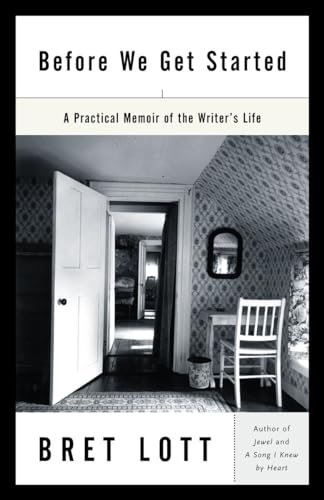
Verwandte Artikel zu Before We Get Started: A Practical Memoir of the Writer'...
Inhaltsangabe
This marvelous guide begins where other books on writing and the writing life leave off. Delving deep into the creative process, Bret Lott reveals truths we scarcely realized we needed to know but without which we as writers will soon lose our way. In ten intimate essays based on his own experiences and on the seasoned wisdom of writers including Eudora Welty, E. B. White, Henry David Thoreau, Henry James, and John Gardner, Lott explores such topics as
• why write? why keep writing?
• the importance of simple words
• the finer points of character detail
• narrative and the passage of time
• the pitfalls of technique
• making a plan–and letting it go
• risking failure–and reaping the benefits
• Accepting rejection
Writers travel alone, but Bret Lott’s book makes the journey less lonely and infinitely more rewarding. Before We Get Started will help you make your work as good as it can be: “Pay attention recklessly. Strain to see through the window of your own artistic consciousness in the exhilarating knowledge that there is no path to the waterfall, and there are a million paths to the waterfall, and there is, too, only one path: yours.”
Die Inhaltsangabe kann sich auf eine andere Ausgabe dieses Titels beziehen.
Über die Autorin bzw. den Autor
BRET LOTT is the author of the novels A Song I Knew by Heart, Jewel (an Oprah’s Book Club Selection in 1999), Reed’s Beach, A Stranger’s House, The Man Who Owned Vermont, and The Hunt Club; the story collections How to Get Home and A Dream of Old Leaves; and the memoir Fathers, Sons, and Brothers. He lives with his wife in Baton Rouge, Louisiana, and was recently named editor of The Southern Review.
Von der hinteren Coverseite
This marvelous guide begins where other books on writing and the writing life leave off. Delving deep into the creative process, Bret Lott reveals truths we scarcely realized we needed to know but without which we as writers will soon lose our way. In ten intimate essays based on his own experiences and on the seasoned wisdom of writers including Eudora Welty, E. B. White, Henry David Thoreau, Henry James, and John Gardner, Lott explores such topics as
- why write? why keep writing?
- the importance of simple words
- the finer points of character detail
- narrative and the passage of time
- the pitfalls of technique
- making a plan-and letting it go
- risking failure-and reaping the benefits
- Accepting rejection
Writers travel alone, but Bret Lott's book makes the journey less lonely and infinitely more rewarding. Before We Get Started will help you make your work as good as it can be: "Pay attention recklessly. Strain to see through the window of your own artistic consciousness in the exhilarating knowledge that there is no path to the waterfall, and there are a million paths to the waterfall, and there is, too, only one path: yours."
Auszug. © Genehmigter Nachdruck. Alle Rechte vorbehalten.
Genesis
I am sitting in the sanctuary, a few rows from the front, to my left my mom and dad, my little brother, Timmy, in Mom’s lap and sleeping, to my right my older brother, Brad. Brad and I have just received these thin blue books, every kid in the service passed a brand-new copy by men in gray or black suits standing at either end of the pews, stacks of these books in hand.
The blue paper cover is bordered with green grapevines, tendrils working up and down either side with bunches of grapes here and there; at the top and bottom of the cover those tendrils meet sheaves of wheat in the same green ink.
The pastor says it is the book of somms, and I wonder what that is, look at the words in black ink centered a little high on the cover. I sound out the words to myself, The . . . Book . . . of, and stop.
P-S-A-L-M-S. How does that, I wonder, spell out Somms?
But even if I don’t understand, this is the ?rst Bible—or piece of it—I have ever gotten, and I don’t want to lose this book. I want to keep it.
So I take one of the nubby pencils from the back of the pew in front of me, nestled in its tiny wooden hole beside the wooden shelf where attendance forms are kept, and beside the larger holes where the tiny glass cups are placed once we’ve emptied them of grape juice.
And I begin, for the first time in my life, to write my name by myself.
I start at the upper-left-hand corner, just below the border, but the first word trails off, falls toward that centered title in black as though that title is a magnet, the letters I make iron filings. They fall that way because there are no lines for me to balance them upon, as I am able to do with the paper given me by my kindergarten teacher, Mrs. Pasley.
I finish that first word, feel in my hand the cramp of so much strenuous, focused work, and hold the book away from me, look at it while the pastor rolls on.
There is no place for the second word, I see, the last letter of my first name too near the first of the title.
This is a problem. I know the second word must follow the first on the same line, a little space needed between them. Mrs. Pasley would not approve. This is a problem.
But there is space above my name due to its falling away, a wedge of blue field that might, if I am careful enough, be able to hold that second word, and I write, work out the riddle of letters without lines, letters that will line up to mark this book as mine, and mine only.
Then I am finished, and here is my name. Me.
The first time I have ever written my name myself, alone.
Later, on the way home, my older brother, Brad, will look at the book, say, “Lott Bret. Who’s that?” and laugh at my ill-spaced effort. Later still I will write my name again on the cover, this time with a blue pen and holding the book upside down. The words will be a little more jaunty, full of themselves and the confidence of a kid who knows how to write his name, no problem at all. Beneath this second round, though, will be the lone letter B, a practice swing at making that capital letter as good as I can make it.
Later, I will be baptized into the church at age fourteen, a ritual it will seem to me is the right thing to do.
Later still, in college, I will be born again, as Christ instructed Nicodemus.
And later even still, I will have written entire books of my own, created lives out of the whole cloth of the imagination. I will have created, and created in my name.
But on this Sunday, the pastor still rolling on, these two words themselves are enough.
Only a kid’s scrawl. My own small imitation of God.
Before We Get Started
Let me begin this book on the nature and aim of words by saying that I won’t be talking about those glamour words we all get to use now and again, the ones that set our pride spinning at our actually using in a sentence. Abrogate was one of those words I used that, once I’d actually employed it correctly in a sentence, made me lean back and put my hands behind my head, kick my feet up on the desk, and beam at my intelligence. Another one I love is the word limn, which I’ve used a number of times for what I hope was good effect. Once, in a review of a perfectly dreadful novel that centered on hidden incestuous relationships, I had the great good fortune of putting together the phrase “the most Byzantine jamboree of family flesh possible.” That was a glorious occasion, I remember, and I remember, too, me smiling at the monitor for a good five minutes about that. Byzantine jamboree. That was fun.
But I won’t be talking about those words here. The kind of words I’m talking about are those trench-warfare words, those grunt-work words we oftentimes don’t give a second thought because we traffic in them day in and day out, truck them in and offload them like they were so many yards of gravel being used to rough-pave the road for the brilliant parade of paper floats our ideas and ambitions and intellect will be once this story is done.
Byzantine jamboree. Man, that was fun.
No. I’ll be talking about a, the, and this. Those few small words we couldn’t care less about because they are, like the poor, always with us.
But before I begin holding forth on even that much—those three numbingly nondescript syllables that together only use up three vowels and three consonants—I need to tell you about how I used to live behind a guy who used the term no-brainer way too often. He was a doctor—a gastroenterologist—and because doctors know everything precisely because they are doctors, it was never any surprise to me that everything he encountered was a “no-brainer.”
And because he used it so often in our everyday exchanges—from the “no-brainer” it was for him to buy a two-year-old Lexus instead of a new one, to the “no-brainer” it was deciding to scope a patient complaining of blood in his phlegm—slowly the term crept into my own lexicon, until for a while I was walking around saying it just as much as he was. It’s a fun term, I found out, infectious for its sharp little shorthand expressing your own acumen and eloquence at once.
“Can I get a transverse Mohawk?” my older son, Zeb, once asked me. Really.
“That’s a no-brainer,” I told him. Meaning, I hoped he understood, no.
“That’s a no-brainer,” I said when Jacob asked if he could ride his bike alone to Wendy’s for lunch one Saturday back when he was in the third or fourth grade. He’d have to cross Highway 17 where Mathis Ferry Road intersected it, six lanes without a crosswalk.
But I’ve since kicked the habit—or almost. Because, finally, I hate that term. There’s something about it that smacks of condescension, something in it that implies everyone else is an idiot who can’t assess and discuss things as quickly and accurately as you.
Which leads to how I’d like to begin this book: with a moment a few semesters ago when I almost blurted out, “That’s a no-brainer,” to a student in class.
This was toward the beginning of things, during the critique of one of the first student stories, all of us doing the old workshop shuffle: what you like, what you don’t, what works, what doesn’t, what’s at stake, what’s missing, blah blah blah, all in the hopes not just to put a Band-Aid on the story at hand but to try to speak of the larger notion of writing ?ction. There was a particular point I wanted to make about the way the student used a noun and its synonyms, and how its usage called into question the verisimilitude of the entire story, because...
„Über diesen Titel“ kann sich auf eine andere Ausgabe dieses Titels beziehen.
Suchergebnisse für Before We Get Started: A Practical Memoir of the Writer'...

Beispielbild für diese ISBN
Before We Get Started A Practi
Verlag:
Random House Publishing Group, 2005
ISBN 10: 0345478177
ISBN 13: 9780345478177
Gebraucht
Softcover
Anbieter: World of Books (was SecondSale), Montgomery, IL, USA
Verkäuferbewertung 5 von 5 Sternen

Zustand: Good. Item in good condition. Textbooks may not include supplemental items i.e. CDs, access codes etc. Artikel-Nr. 00087698369
Gebraucht kaufen
EUR 5,73
Versand gratis
Versand innerhalb von USA
Versand innerhalb von USA
Anzahl: 3 verfügbar
Beispielbild für diese ISBN
Before We Get Started: A Practical Memoir of the Writer's Life
Anbieter: Wonder Book, Frederick, MD, USA
Verkäuferbewertung 5 von 5 Sternen
Zustand: Good. Good condition. A copy that has been read but remains intact. May contain markings such as bookplates, stamps, limited notes and highlighting, or a few light stains. Bundled media such as CDs, DVDs, floppy disks or access codes may not be included. Artikel-Nr. X10B-01187
Gebraucht kaufen
EUR 6,33
Versand gratis
Versand innerhalb von USA
Versand innerhalb von USA
Anzahl: 1 verfügbar
Beispielbild für diese ISBN
Before We Get Started : A Practical Memoir of the Writer's Life
Verlag:
Random House Publishing Group, 2005
ISBN 10: 0345478177
ISBN 13: 9780345478177
Gebraucht
Softcover
Anbieter: Better World Books, Mishawaka, IN, USA
Verkäuferbewertung 5 von 5 Sternen
Zustand: Good. Pages intact with minimal writing/highlighting. The binding may be loose and creased. Dust jackets/supplements are not included. Stock photo provided. Product includes identifying sticker. Better World Books: Buy Books. Do Good. Artikel-Nr. 4386681-6
Gebraucht kaufen
EUR 6,47
Versand gratis
Versand innerhalb von USA
Versand innerhalb von USA
Anzahl: 2 verfügbar
Beispielbild für diese ISBN
Before We Get Started: A Practical Memoir of the Writer's Life
Verlag:
Random House Publishing Group, 2005
ISBN 10: 0345478177
ISBN 13: 9780345478177
Gebraucht
Paperback
Anbieter: ThriftBooks-Dallas, Dallas, TX, USA
Verkäuferbewertung 5 von 5 Sternen
Paperback. Zustand: Good. No Jacket. Pages can have notes/highlighting. Spine may show signs of wear. ~ ThriftBooks: Read More, Spend Less. Artikel-Nr. G0345478177I3N00
Gebraucht kaufen
EUR 7,01
Versand gratis
Versand innerhalb von USA
Versand innerhalb von USA
Anzahl: 1 verfügbar
Beispielbild für diese ISBN
Before We Get Started: A Practical Memoir of the Writer's Life
Verlag:
Random House Publishing Group, 2005
ISBN 10: 0345478177
ISBN 13: 9780345478177
Gebraucht
Paperback
Anbieter: ThriftBooks-Atlanta, AUSTELL, GA, USA
Verkäuferbewertung 5 von 5 Sternen
Paperback. Zustand: Very Good. No Jacket. May have limited writing in cover pages. Pages are unmarked. ~ ThriftBooks: Read More, Spend Less. Artikel-Nr. G0345478177I4N00
Gebraucht kaufen
EUR 7,01
Versand gratis
Versand innerhalb von USA
Versand innerhalb von USA
Anzahl: 1 verfügbar
Beispielbild für diese ISBN
Before We Get Started: A Practical Memoir of the Writer's Life
Anbieter: Revaluation Books, Exeter, Vereinigtes Königreich
Verkäuferbewertung 5 von 5 Sternen
Paperback. Zustand: Brand New. 224 pages. 8.00x5.00x0.50 inches. In Stock. Artikel-Nr. x-0345478177
Neu kaufen
EUR 20,30
EUR 11,63 Versand
Versand von Vereinigtes Königreich nach USA
Versand von Vereinigtes Königreich nach USA
Anzahl: 2 verfügbar
Beispielbild für diese ISBN
Before We Get Started: A Practical Memoir of the Writer's Life
Verlag:
Random House Publishing Group, 2005
ISBN 10: 0345478177
ISBN 13: 9780345478177
Neu
Softcover
Anbieter: Kennys Bookstore, Olney, MD, USA
Verkäuferbewertung 5 von 5 Sternen
Zustand: New. Artikel-Nr. V9780345478177
Neu kaufen
EUR 25,99
EUR 9,23 Versand
Versand innerhalb von USA
Versand innerhalb von USA
Anzahl: Mehr als 20 verfügbar