
Verwandte Artikel zu Killer Colt: Murder, Disgrace, and the Making of an...
Inhaltsangabe
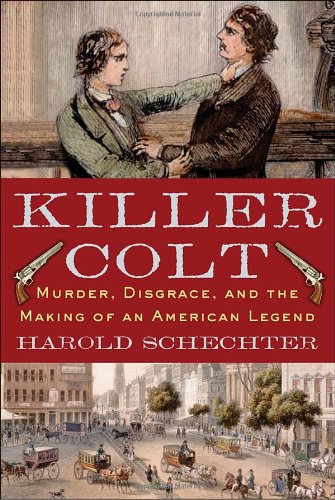
Recounts an electrifying 19th-century New York trial that saw John Colt--the brother of Sam Colt, the inventor of the revolver--accused a grisly murder that left a putrefying corpse onboard a ship, a trial that failed to unearth an astounding secret that went undiscovered for years and was only known by the two brothers and an illiterate Scottish woman of ill repute.
Die Inhaltsangabe kann sich auf eine andere Ausgabe dieses Titels beziehen.
Über die Autorinnen und Autoren
Harold Schechter is a professor of American literature and culture at Queens College, the City University of New York. He is widely celebrated for both fiction and true-crime writing, including The Devil's Gentleman and The Serial Killer Files. He lives in Brooklyn and Mattituck, Long Island, with his wife, the poet Kimiko Hahn.
Harold Schechter is a professor of American literature and culture at Queens College, the City University of New York. He is widely celebrated for both fiction and true-crime writing, including The Devil's Gentleman, The Tell-Tale Corpse, and The Serial Killer Files. He lives in Brooklyn and Mattituck, Long Island, with his wife, the poet Kimiko Hahn.
Auszug. © Genehmigter Nachdruck. Alle Rechte vorbehalten.
Chapter One
The neighborhood of his birth would later become known as Asylum Hill, after the Connecticut Asylum for the Education and Instruction ofDeaf and Dumb Persons, the nation's first institution of its kind. In 1814,however, it was still called Lord's Hill, an apt name for a place so steeped inPuritan tradition-though, in fact, it derived from the original owners of theland: the descendants of Captain Richard Lord, one of the early heroes of thecolony. In succeeding decades, various luminaries-among them Mark Twain andHarriet Beecher Stowe-would make their home on Lord's Hill, drawn by thetranquil charm of this rural district of Hartford. The infant born in afarmhouse there on July 19, 1814, would himself grow up to be one of thecentury's most eminent figures, a man whose name would become synonymous withthe nation's burgeoning industrial might: Samuel Colt.
He came by his enterprising spirit honestly. His maternalgrandfather, Major John Caldwell, was one of Hartford's leading citizens: firstpresident of its bank, first commander of its volunteer horse guard, a founderof the deaf asylum, and one of the commissioners responsible for building thestatehouse in 1796. He was also the richest man in town, a shipbuilder andcanny businessman who-like many another God-fearing New England merchant-made afortune in the West Indies trade, shipping produce, livestock, and lumber tothe Caribbean slave plantations in exchange for molasses, tobacco, and rum.
To his other grandfather, Lieutenant Benjamin Colt, Samuelowed some of the mechanical aptitude that would make him one of the world'sgreat inventors. Admired throughout the Connecticut Valley for his handiwork,Benjamin had been a blacksmith of unusual skill and ingenuity who owned a widervariety of tools than any metalworker in the region. History would credit himas manufacturer of the first scythe in America.
The children of these two worthies, Christopher Colt andSarah Caldwell ("Sally" to her family and friends), had met inHartford in 1803, when-according to one possibly apocryphal account-thestrapping six-footer had stopped the runaway buggy in which the young woman wastrapped. An attraction immediately developed between the pair, both in theirearly twenties at the time. Despite his many virtues, however-his manlybearing, indefatigable energy, and striving ambition-Christopher Colt did notappear to be a particularly suitable candidate for the hand of Sarah Caldwell,patrician daughter of Hartford's leading citizen.
To be sure, Christopher claimed an illustrious backgroundof his own, tracing his lineage to Sir John Coult, an English peer in OliverCromwell's day who gained everlasting renown in his country's civil wars.During one ferocious battle-so the story goes-he had three horses killed underhim, shattered his sword, and still led his troops to victory. Knighted for hisheroism, Coult adopted a coat of arms emblematic of his exploits: a shield withthree charging steeds above the family motto, Vincit qui patitur-"Heconquers who endures."
At the time of his meeting with Sarah, however,Christopher-a recent arrival from his native Massachusetts who had left home toseek his fortune in Hartford-was in dire financial straits. Indeed, the membersof the city council, wary of indigent newcomers who relied on the public dole,had resolved to expel him from town.6 Impressed, however, with young Colt'spersonal qualities, Major Caldwell took the youth under his wing. Before long,thanks to his strict adherence to the Franklin-esque values of industry,frugality, and perseverance-coupled with a zeal for commercialspeculation-Christopher Colt had accumulated a sizable fortune of his own. InApril 1805, with the blessing of his mentor in Hartford's booming mercantiletrade, he and Sarah were wed.
Their first child, Margaret, was born a year later. Sevenmore followed at regular intervals. Of this substantial brood, two would die inchildhood, two others in the bloom of their youth. The survivors would comprisea judge, a textile pioneer, the legendary Colonel Colt, and a brilliantaccountant responsible-in the language of nineteenth-centurysensationmongers-for the most "horrid and atrocious" murder of hisday.
Chapter Two
Of his three brothers, Sam was closest to the eldest,John Caldwell Colt, four years his senior.
Much later, at the height of John's notoriety,commentators would offer radically different views of his boyhood character.According to his harshest critics, he was a "willful, cunning, andrevengeful youth," ruled by "violent passions" over which he had"no great control." Bridling at parental authority, he displayed rank"insubordination from childhood upwards," refusing to submit to"the common restraints of the family, the school room, and the law ofGod."
Other people, whose loyalty to John never wavered,described him in far more flattering terms as a rambunctious but fundamentally good-heartedboy, who reveled "in air and freedom" and would "do anything fora frolic." "His juvenile characteristics," insisted oneacquaintance, "were a fondness for boyish sports, extreme bravery, andgreat generosity of character . . . His daring was remarkable." Thoughgiven to all sorts of juvenile pranks, "there was nothing vicious abouthis sportfulness."
In his own published statements, John recalled himself asa headstrong youth-"rash and foolishly venturesome"-whose boldnessoften bordered on sheer recklessness and whose penchant for risk takingfrequently put his life in danger. Besides numerous hunting and ridingaccidents, there were at least five separate occasions when his fearlessnessnearly got him killed.
At the age of five, for example, while playing near acider press, he lost his footing and "plunged head foremost" into thevat full of juice. Only the quick actions of a playmate, "a stout younggirl" who saw him go under, saved him from drowning.
Several winters later, he nearly drowned again, this timewhile playing on a frozen river. He was "jumping up and down on theice" when it gave way beneath his feet. "Swept by the current somesixty feet under a sheet of ice," he was carried into open water, where hemanaged to catch the limb of a fallen tree and drag himself onto the bank.
Another time, he was "playing tricks with" hisfavorite horse, which retaliated by throwing him from the saddle and deliveringa near-crippling kick to his hip. And then there was his "awfulencounter" with an enraged buffalo, part of "a caravan ofanimals" that arrived in Hartford with a traveling show. Sneaking into thecreature's pen, young John found himself face-to-face with the"shaggy-throated beast" that "forthwith plunged at me, nailingme fast against the wall between his horns." He was rescued by thekeeper's assistants, who immediately leapt at the buffalo and began to"belabor him with their clubs."
The most memorable of all John's juvenile mishaps,however, occurred when he was eight. His favorite pastime at that age wasplaying soldier. His doting mother-whose father had fought with distinction inthe Continental army-was happy to encourage her little boy's "militarymania" and supplied him with the means to "rig out a little troop ofboys" with outfits and toy rifles. The centerpiece of their company was aminiature brass cannon. One day, John, with the help of a companion, loaded thelittle weapon with an excessive charge of powder. When John put a light to thefuse, the cannon exploded.
Somewhat miraculously, neither John nor his playmatesuffered serious injury, though their eyesight was temporarily impaired."How we escaped with our lives," John later recalled, "is awonder."
Whether Samuel Colt was present when his older brotherdetonated the toy is unclear. Some biographers speculate that the four-year-oldboy did, in fact, witness the event, which had a powerful...
„Über diesen Titel“ kann sich auf eine andere Ausgabe dieses Titels beziehen.
Suchergebnisse für Killer Colt: Murder, Disgrace, and the Making of an...

Beispielbild für diese ISBN
Killer Colt: Murder, Disgrace, and the Making of an American Legend
Anbieter: World of Books (was SecondSale), Montgomery, IL, USA
Verkäuferbewertung 5 von 5 Sternen

Zustand: Good. Item in good condition. Textbooks may not include supplemental items i.e. CDs, access codes etc. Artikel-Nr. 00097416993
Gebraucht kaufen
EUR 5,74
Versand gratis
Versand innerhalb von USA
Versand innerhalb von USA
Anzahl: 1 verfügbar
Beispielbild für diese ISBN
Killer Colt: Murder, Disgrace, and the Making of an American Legend
Anbieter: ThriftBooks-Atlanta, AUSTELL, GA, USA
Verkäuferbewertung 5 von 5 Sternen
Hardcover. Zustand: Good. No Jacket. Former library book; Pages can have notes/highlighting. Spine may show signs of wear. ~ ThriftBooks: Read More, Spend Less. Artikel-Nr. G0345476816I3N10
Gebraucht kaufen
EUR 5,75
Versand gratis
Versand innerhalb von USA
Versand innerhalb von USA
Anzahl: 1 verfügbar
Beispielbild für diese ISBN
Killer Colt: Murder, Disgrace, and the Making of an American Legend
Anbieter: ThriftBooks-Dallas, Dallas, TX, USA
Verkäuferbewertung 5 von 5 Sternen
Hardcover. Zustand: Very Good. No Jacket. May have limited writing in cover pages. Pages are unmarked. ~ ThriftBooks: Read More, Spend Less. Artikel-Nr. G0345476816I4N00
Gebraucht kaufen
EUR 5,75
Versand gratis
Versand innerhalb von USA
Versand innerhalb von USA
Anzahl: 1 verfügbar
Beispielbild für diese ISBN
Killer Colt: Murder, Disgrace, and the Making of an American Legend
Anbieter: ThriftBooks-Atlanta, AUSTELL, GA, USA
Verkäuferbewertung 5 von 5 Sternen
Hardcover. Zustand: Very Good. No Jacket. Former library book; May have limited writing in cover pages. Pages are unmarked. ~ ThriftBooks: Read More, Spend Less. Artikel-Nr. G0345476816I4N10
Gebraucht kaufen
EUR 5,75
Versand gratis
Versand innerhalb von USA
Versand innerhalb von USA
Anzahl: 1 verfügbar
Beispielbild für diese ISBN
Killer Colt: Murder, Disgrace, and the Making of an American Legend
Anbieter: ThriftBooks-Phoenix, Phoenix, AZ, USA
Verkäuferbewertung 5 von 5 Sternen
Hardcover. Zustand: Very Good. No Jacket. May have limited writing in cover pages. Pages are unmarked. ~ ThriftBooks: Read More, Spend Less. Artikel-Nr. G0345476816I4N00
Gebraucht kaufen
EUR 5,75
Versand gratis
Versand innerhalb von USA
Versand innerhalb von USA
Anzahl: 1 verfügbar
Beispielbild für diese ISBN
Killer Colt: Murder, Disgrace, and the Making of an American Legend
Anbieter: ThriftBooks-Dallas, Dallas, TX, USA
Verkäuferbewertung 5 von 5 Sternen
Hardcover. Zustand: Good. No Jacket. Missing dust jacket; Pages can have notes/highlighting. Spine may show signs of wear. ~ ThriftBooks: Read More, Spend Less. Artikel-Nr. G0345476816I3N01
Gebraucht kaufen
EUR 5,75
Versand gratis
Versand innerhalb von USA
Versand innerhalb von USA
Anzahl: 1 verfügbar
Beispielbild für diese ISBN
Killer Colt: Murder, Disgrace, and the Making of an American Legend
Anbieter: ThriftBooks-Atlanta, AUSTELL, GA, USA
Verkäuferbewertung 5 von 5 Sternen
Hardcover. Zustand: Very Good. No Jacket. May have limited writing in cover pages. Pages are unmarked. ~ ThriftBooks: Read More, Spend Less. Artikel-Nr. G0345476816I4N00
Gebraucht kaufen
EUR 5,75
Versand gratis
Versand innerhalb von USA
Versand innerhalb von USA
Anzahl: 1 verfügbar
Beispielbild für diese ISBN
Killer Colt: Murder, Disgrace, and the Making of an American Legend
Anbieter: ThriftBooks-Reno, Reno, NV, USA
Verkäuferbewertung 5 von 5 Sternen
Hardcover. Zustand: Very Good. No Jacket. Former library book; May have limited writing in cover pages. Pages are unmarked. ~ ThriftBooks: Read More, Spend Less. Artikel-Nr. G0345476816I4N10
Gebraucht kaufen
EUR 5,75
Versand gratis
Versand innerhalb von USA
Versand innerhalb von USA
Anzahl: 1 verfügbar
Beispielbild für diese ISBN
Killer Colt: Murder, Disgrace, and the Making of an American Legend
Anbieter: ThriftBooks-Reno, Reno, NV, USA
Verkäuferbewertung 5 von 5 Sternen
Hardcover. Zustand: Very Good. No Jacket. May have limited writing in cover pages. Pages are unmarked. ~ ThriftBooks: Read More, Spend Less. Artikel-Nr. G0345476816I4N00
Gebraucht kaufen
EUR 5,75
Versand gratis
Versand innerhalb von USA
Versand innerhalb von USA
Anzahl: 1 verfügbar
Beispielbild für diese ISBN
Killer Colt: Murder, Disgrace, and the Making of an American Legend
Anbieter: ThriftBooks-Phoenix, Phoenix, AZ, USA
Verkäuferbewertung 5 von 5 Sternen
Hardcover. Zustand: Very Good. No Jacket. Former library book; May have limited writing in cover pages. Pages are unmarked. ~ ThriftBooks: Read More, Spend Less. Artikel-Nr. G0345476816I4N10
Gebraucht kaufen
EUR 5,75
Versand gratis
Versand innerhalb von USA
Versand innerhalb von USA
Anzahl: 1 verfügbar