
Verwandte Artikel zu At All Costs: How a Crippled Ship and Two American...
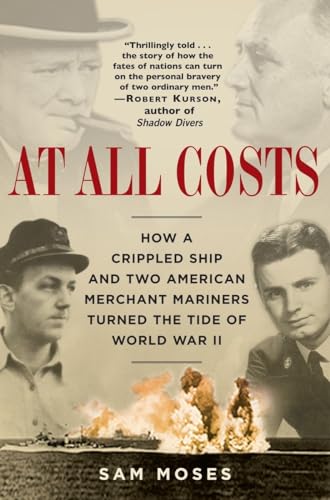
At All Costs: How a Crippled Ship and Two American Merchant Mariners Turned the Tide of World War II - Softcover
Inhaltsangabe
In this gripping, page-turning account, Sam Moses has told a story in the tradition of Sebastian Junger’s A Perfect Storm, Robert Kurson’s Shadow Divers, and Hampton Sides’s Ghost Soldiers. It’s a story about the heroism of two men in battle at sea during World War II, and one woman fleeing Nazi Norway with her child. It’s about how courage can change the course of history.
AT ALL COSTS: How a Crippled Ship and Two American Merchant Marines Turned the Tide of World War II is the astonishing untold account, with original historical reporting, of how two men faced unfathomable danger to help save the island of Malta, Churchill’s crux of the war.
In 1942, the tiny island of Malta was the most heavily bombed place on earth. Hitler needed Malta as a stepping-stone to get to the oil in Iraq and Iran (Persia at the time). Blockaded by sea, Malta was running on empty, in food, fuel and ammunition. Axis U-boats and dive-bombers made supply convoys to Malta more like suicide missions. In this last-hope convoy, 50 warships escorted 13 freighters carrying aviation fuel, and a single critical tanker, the SS Ohio, with 107,000 barrels of oil from Texas. Winston Churchill had traveled to Washington and asked FDR for the tanker–his prime ministership was at stake over this mission to Malta.
Relentlessly dive-bombed and repeatedly torpedoed, the Ohio suffered huge hits and was abandoned. Two young American merchant mariners–pulled from the sea after their own ship went down in flames–boarded the ravaged tanker, repaired her guns and fought off German and Italian dive-bombers, as the sinking Ohio was towed at 4 knots toward Malta with a tiny crew of volunteers.
Sam Moses’ AT ALL COSTS is a triumphant story of human bravery: fearless, selfless acts by men determined to save a ship and win a war; profound communal courage from an island under brutal siege; and leaders who understood the cause of freedom.
Kirkus (starred review)
A historical footnote provides a riveting tale of true American grit during World War II.
In 1942, the island of Malta was the primary launching point in the Mediterranean for Allied
aircraft and submarine attacks against Axis supply convoys. At the height of the North African
campaign, Rommel’s tanks prepared to sweep into Egypt, Iran and Iraq. The only thing they lacked was
the fuel to get there, and the shortage was equally desperate on Malta. The Allies launched Operation
Pedestal, a last-ditch effort to re-supply the base by sending a convoy from Britain through the Gibraltar
Strait to the beleaguered island. The convoy, which included the American tanker Ohio and the U.S.
freighter Santa Elisa, was anything but a milk run. Vietnam vet Moses (Fast Guys, Rich Guys and
Idiots, not reviewed) crafts a thrilling adventure on the high seas, though it takes a while to get started.
The book’s first third juxtaposes Malta’s plight against the stories of two American merchant seamen
on the Santa Elisa: Lonnie Dales and Fred Larsen, through whose eyes the battle will be viewed in bluecollar
detail. Once Operation Pedestal begins, the narrative is all action. The convoy comes under
repeated attack, lives are lost, the Santa Elisa is sunk. Dales and Larsen find themselves aboard the
wounded Ohio, full to the brim with Texas crude. If they can hold off Nazi attacks and keep their new
ship afloat long enough to reach Malta, the operation will be a success. Moses takes readers directly
into the heat of battle, demonstrating a strong command of historical detail.
Highly recommended for fans of naval adventure. (Agent: Peter Riva/International Transactions, Inc.)
"At All Costs is an extraordinary work of research and an exciting read that pays tribute to a crucial enterprise taken against incredible odds. Sam Moses has brought the ghastliness of war and the beauty of heroism together, in jarring union." –Frank Deford
“This book tells a great story. But Sam Moses is not just sharing a gripping tale. He is sharing an important and oft neglected story about a battle that played a decisive role in shaping the outcome of WW II. You will meet people who will linger in memory for their bravery, foolishness, or wisdom.” –Ken Auletta, author of Backstory
“Thrillingly told and beautifully researched, At All Costs is not just the against-all-odds story of the saving of Malta, but also of how the fate of nations can turn on the personal bravery of two ordinary men.”
–Robert Kurson, author of Shadow Divers
“Sam Moses has skillfully blended the vivid recollections of many eyewitnesses with a wealth of original documentary research to produce an immensely readable and authoritative account of this crucial operation.” –Mark Whitmore, Director of Collections, Imperial War Museum, London, England
Die Inhaltsangabe kann sich auf eine andere Ausgabe dieses Titels beziehen.
Über die Autorin bzw. den Autor
Sam Moses is the author of the acclaimed race-driving memoir, Fast Guys, Rich Guys, and Idiots, and a former senior writer for Sports Illustrated. He began writing as a U.S. Navy Seaman on a heavy cruiser in action off Vietnam. He lives with his two sons in White Salmon, Washington.
Auszug. © Genehmigter Nachdruck. Alle Rechte vorbehalten.
CHAPTER 3 • • • FIRE DOWN BELOW
At twenty-eight, Lieutenant Reinhard Hardegen, a German U-boat captain, was a loose cannon. He carried unchecked ambition and relentless intensity along with his war wounds–a short leg and bleeding stomach– from the aviation crash that had ended his previous career as a naval pilot. He had concealed the injuries in order to qualify for command of U-123, and had begun an impatient rampage of sinkings with the neutral Portuguese freighter Ganda.The 4,300-ton ship didn’t go down after two torpedo hits, so Hardegen surfaced U-123 and sank her with its four-inch gun. When the attack became an international incident, Admiral Karl Dönitz, commander of Germany’s U-boat fleet, claimed it was a British sub that had sunk Ganda.
Dönitz chose U-123 to be among the first five U-boats with orders to attack the eastern seaboard of the United States. He had begun planning the attack four days after Pearl Harbor, on instructions from Hitler to destroy merchant ships from New York to Cape Hatteras. Five 1,050-ton Type 9B U-boats, with a range of 12,000 nautical miles cruising at 10 knots on the surface, left their pens at the port of Lorient in France on separate dates around Christmas 1941. Dönitz called the operation “Drumbeat,” for the effect he expected it to have.
The Submarine Tracking Room at the Operational Intelligence Centre of the British Admiralty in London, Royal Navy headquarters, had located the U-boats crossing the surface of the ocean, and their positions were passed on to the U.S. Navy and charted on the wall in the headquarters of the Eastern Sea Frontier in New York City. But a vicious winter hurricane hit the Atlantic with winds of 100 mph, tossing the subs like surfboards off the lips of big waves, and enabling them to lose the Americans tracking them.
The Eastern Sea Frontier, commanded by Admiral Adolphus “Dolly” Andrews, didn’t have much of a fleet. It consisted of Coast Guard cutters with wooden hulls, turn-of-the-century gunboats, and converted yachts with a machine gun and maybe a few depth charges on deck. The boats were often broken down in port. The day before the first U-boat left France, Admiral Andrews complained in a memo to Admiral Ernest King, commander in chief of the U.S. Navy: “It is submitted that should enemy submarines operate off this coast, this command has no forces available to take adequate action against them, either offensive or defensive.”
Early on the morning of January 12, 1942, off the coast of Nova Scotia, U-123 sank the 9,100-ton British freighter Cyclops. Ninety-eight men died, almost all of them freezing in lifeboats. Operation Drumbeat was supposed to be a sneak attack off New York, coordinated with the other U-boats, and by attacking the Cyclops, Hardegen had disobeyed Dönitz’s orders and blew the element of surprise, not that it mattered, because the Eastern Sea Frontier was so unprepared.
The New York Times ran a two-paragraph story, picked up from a boast by Radio Berlin, but the story didn’t attract much attention. The U.S. Navy issued a lying press release claiming to have “liquidated” U-boats off the coast, adding that national security prevented the disclosure of more information. “This is a phase of the game of war secrecy into which every American should enter enthusiastically,” said the navy’s statement, printed by the Times. The release added that the media and civilians could make the same “great, patriotic contribution” by not mentioning what they might see with their own eyes.
The next day, U-123 traveled south from Nova Scotia, steaming at 18 knots in broad daylight. It submerged a couple of times when aircraft flew over, but the ESF’s Fleet Air Arm was no more of a threat to U-boats than its bathtub navy. U-123 had traveled more than 3,300 nautical miles from France, only 55 of them submerged, without being challenged. The big U-boat passed south of Nantucket late in the afternoon, and that night was beckoned down the coast by Montauk Point Lighthouse.
Kapitan Hardegen was excited by the glow from the lights on shore, exposing his targets. “Don’t they know there’s a war on?” he asked his chief mate. The U.S. Navy had urged cities and towns along the coast to black themselves out, but merchants declined because business would suffer.
After midnight, Hardegen spotted the Norness, a 9,600-ton Norwegian tanker, and split her apart with three torpedoes. He continued to New York and submerged at sunrise in the harbor. U-123 spent the day on the bottom, ninety feet down in the mud. The New York Times was still on the street with a headline now shouting “tanker torpedoed 60 miles off long island,” when Hardegen surfaced after dark, awed by the dome of white light rising almost religiously into the black sky above Manhattan. He knew the moment was profound. “We were the first to be here, and for the first time in this war a German soldier looked out upon the coast of the U.S.A.,” he said.
Later that night, during an icy nor’easter, he torpedoed the 6,800-ton British tanker Coimbra, whose 80,000 barrels of oil exploded in a giant fireball, killing thirty-six. Witnesses saw flames from the beach at Southampton. Admiral Andrews told the press that the navy knew nothing about it, which was almost the truth. His feeble fleet was grasping at the wisps and ghosts of ocean spray in its lame attempt to find U-123.
****
Fred Larsen’s Irish grandfather, the woodcarver Christopher Melia, and William Russell Grace, who founded Grace Line after emigrating from Ireland, were about the same age and had the same eye for beauty. Had they lived long enough to see the Santa Elisa, Melia might have carved a model of her, and Grace would have been proud of her. A flurry of shipbuilding was triggered by the Merchant Marine Act of 1936, passed in order to increase the size of the U.S. merchant fleet. As President Franklin D. Roosevelt prepared for the growing possibility of war, the pace increased. The Santa Elisa was one of 173 freighters built between 1940 and 1945, to Maritime Commission designs for the class called C2. She was 459 feet from bow to stern, 63 feet at beam, and 40 feet between main deck and keel bottom, with a loaded draft of 26 feet and freeboard of 14. Her five holds gave her a gross weight of 8,380 tons, with the ability to stow 8,620 tons of cargo. Because she was specially built for Grace Line, she had some custom touches shared by only her sister ship, the Santa Rita. Her bridge was enclosed, keeping the helmsman out of the weather and providing protection against shrapnel from bombs. Powered by a double reduction General Electric turbine making 6,000 horsepower and driving a single screw, she could run all day and night at 17 knots.
Larsen was junior third officer on the Santa Elisa, in charge of the lifeboats and lifesaving equipment, but the chief officer also assigned him to supervise the fire equipment. He did much more than the manual described for a third mate, because he could. At 27, he had done it all. He’d been a teenage prodigy in the engine room of his first ship, the Attila, working with diesel, steam, and hydraulic systems. He could navigate and operate radios. He'd been a quartermaster, purser, bosun, and cargo mate; he was certified in firefighting and lifeboats, and liked guns. He'd even been a stevedore on the San Pedro wharf in California. He could speak English, Norwegian, Danish, Swedish, and Spanish, and was beginning to study German, although he despised it.
He acted with a natural sense of authority based on experience, and carried himself with conspicuous self-discipline....
„Über diesen Titel“ kann sich auf eine andere Ausgabe dieses Titels beziehen.
Suchergebnisse für At All Costs: How a Crippled Ship and Two American...

Beispielbild für diese ISBN
At All Costs: How a Crippled Ship and Two American Merchant Mariners Turned the Tide of World War II
Verlag:
Random House Publishing Group, 2007
ISBN 10: 0345476743
ISBN 13: 9780345476746
Gebraucht
Softcover
Anbieter: World of Books (was SecondSale), Montgomery, IL, USA
Verkäuferbewertung 5 von 5 Sternen

Zustand: Good. Item in good condition. Textbooks may not include supplemental items i.e. CDs, access codes etc. Artikel-Nr. 00096385132
Gebraucht kaufen
EUR 4,96
Versand gratis
Versand innerhalb von USA
Versand innerhalb von USA
Anzahl: 4 verfügbar
Beispielbild für diese ISBN
At All Costs: How a Crippled Ship and Two American Merchant Mariners Turned the Tide of World War II
Verlag:
Random House Publishing Group, 2007
ISBN 10: 0345476743
ISBN 13: 9780345476746
Gebraucht
Softcover
Anbieter: World of Books (was SecondSale), Montgomery, IL, USA
Verkäuferbewertung 5 von 5 Sternen
Zustand: Acceptable. Item in acceptable condition! Textbooks may not include supplemental items i.e. CDs, access codes etc. Artikel-Nr. 00100317453
Gebraucht kaufen
EUR 4,96
Versand gratis
Versand innerhalb von USA
Versand innerhalb von USA
Anzahl: 1 verfügbar
Beispielbild für diese ISBN
At All Costs: How a Crippled Ship and Two American Merchant Mariners Turned the Tide of World War II
Verlag:
Random House Publishing Group (edition Reprint), 2007
ISBN 10: 0345476743
ISBN 13: 9780345476746
Gebraucht
Paperback
Anbieter: BooksRun, Philadelphia, PA, USA
Verkäuferbewertung 5 von 5 Sternen
Paperback. Zustand: Very Good. Reprint. It's a well-cared-for item that has seen limited use. The item may show minor signs of wear. All the text is legible, with all pages included. It may have slight markings and/or highlighting. Artikel-Nr. 0345476743-11-6
Gebraucht kaufen
EUR 4,97
Versand gratis
Versand innerhalb von USA
Versand innerhalb von USA
Anzahl: 1 verfügbar
Beispielbild für diese ISBN
At All Costs: How a Crippled Ship and Two American Merchant Mariners Turned the Tide of World War II
Verlag:
Random House Publishing Group, 2007
ISBN 10: 0345476743
ISBN 13: 9780345476746
Gebraucht
Softcover
Anbieter: Wonder Book, Frederick, MD, USA
Verkäuferbewertung 5 von 5 Sternen
Zustand: Good. Good condition. A copy that has been read but remains intact. May contain markings such as bookplates, stamps, limited notes and highlighting, or a few light stains. Artikel-Nr. I04D-01450
Gebraucht kaufen
EUR 6,20
Versand gratis
Versand innerhalb von USA
Versand innerhalb von USA
Anzahl: 1 verfügbar
Beispielbild für diese ISBN
At All Costs: How a Crippled Ship and Two American Merchant Mariners Turned the Tide of World War II
Verlag:
Random House Publishing Group, 2007
ISBN 10: 0345476743
ISBN 13: 9780345476746
Gebraucht
Softcover
Anbieter: Wonder Book, Frederick, MD, USA
Verkäuferbewertung 5 von 5 Sternen
Zustand: Very Good. Very Good condition. A copy that may have a few cosmetic defects. May also contain light spine creasing or a few markings such as an owner's name, short gifter's inscription or light stamp. Artikel-Nr. D11M-01178
Gebraucht kaufen
EUR 6,20
Versand gratis
Versand innerhalb von USA
Versand innerhalb von USA
Anzahl: 1 verfügbar
Beispielbild für diese ISBN
At All Costs: How a Crippled Ship and Two American Merchant Mariners Turned the Tide of World War II
Verlag:
Random House Publishing Group, 2007
ISBN 10: 0345476743
ISBN 13: 9780345476746
Gebraucht
Paperback
Anbieter: ThriftBooks-Reno, Reno, NV, USA
Verkäuferbewertung 5 von 5 Sternen
Paperback. Zustand: Good. No Jacket. Pages can have notes/highlighting. Spine may show signs of wear. ~ ThriftBooks: Read More, Spend Less. Artikel-Nr. G0345476743I3N00
Gebraucht kaufen
EUR 6,55
Versand gratis
Versand innerhalb von USA
Versand innerhalb von USA
Anzahl: 1 verfügbar
Beispielbild für diese ISBN
At All Costs: How a Crippled Ship and Two American Merchant Mariners Turned the Tide of World War II
Verlag:
Random House Publishing Group, 2007
ISBN 10: 0345476743
ISBN 13: 9780345476746
Gebraucht
Paperback
Anbieter: ThriftBooks-Phoenix, Phoenix, AZ, USA
Verkäuferbewertung 5 von 5 Sternen
Paperback. Zustand: Good. No Jacket. Pages can have notes/highlighting. Spine may show signs of wear. ~ ThriftBooks: Read More, Spend Less. Artikel-Nr. G0345476743I3N00
Gebraucht kaufen
EUR 6,55
Versand gratis
Versand innerhalb von USA
Versand innerhalb von USA
Anzahl: 1 verfügbar
Beispielbild für diese ISBN
At All Costs: How a Crippled Ship and Two American Merchant Mariners Turned the Tide of World War II
Verlag:
Random House Publishing Group, 2007
ISBN 10: 0345476743
ISBN 13: 9780345476746
Gebraucht
Paperback
Anbieter: ThriftBooks-Reno, Reno, NV, USA
Verkäuferbewertung 5 von 5 Sternen
Paperback. Zustand: Fair. No Jacket. Readable copy. Pages may have considerable notes/highlighting. ~ ThriftBooks: Read More, Spend Less. Artikel-Nr. G0345476743I5N00
Gebraucht kaufen
EUR 6,55
Versand gratis
Versand innerhalb von USA
Versand innerhalb von USA
Anzahl: 1 verfügbar
Beispielbild für diese ISBN
At All Costs: How a Crippled Ship and Two American Merchant Mariners Turned the Tide of World War II
Verlag:
Random House Publishing Group, 2007
ISBN 10: 0345476743
ISBN 13: 9780345476746
Gebraucht
Paperback
Anbieter: ThriftBooks-Atlanta, AUSTELL, GA, USA
Verkäuferbewertung 5 von 5 Sternen
Paperback. Zustand: Good. No Jacket. Pages can have notes/highlighting. Spine may show signs of wear. ~ ThriftBooks: Read More, Spend Less. Artikel-Nr. G0345476743I3N00
Gebraucht kaufen
EUR 6,56
Versand gratis
Versand innerhalb von USA
Versand innerhalb von USA
Anzahl: 2 verfügbar
Beispielbild für diese ISBN
At All Costs: How a Crippled Ship and Two American Merchant Mariners Turned the Tide of World War II
Verlag:
Random House Publishing Group, 2007
ISBN 10: 0345476743
ISBN 13: 9780345476746
Gebraucht
Paperback
Anbieter: ThriftBooks-Dallas, Dallas, TX, USA
Verkäuferbewertung 5 von 5 Sternen
Paperback. Zustand: Fair. No Jacket. Readable copy. Pages may have considerable notes/highlighting. ~ ThriftBooks: Read More, Spend Less. Artikel-Nr. G0345476743I5N00
Gebraucht kaufen
EUR 6,56
Versand gratis
Versand innerhalb von USA
Versand innerhalb von USA
Anzahl: 1 verfügbar