
Verwandte Artikel zu The Main Enemy: The Inside Story of the CIA's Final...
Inhaltsangabe
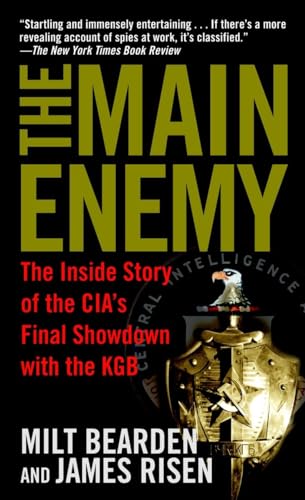
A landmark collaboration between a thirty-year veteran of the CIA and a Pulitzer Prize–winning journalist, The Main Enemy is the dramatic inside story of the CIA-KGB spy wars, told through the actions of the men who fought them.
Based on hundreds of interviews with operatives from both sides, The Main Enemy puts us inside the heads of CIA officers as they dodge surveillance and walk into violent ambushes in Moscow. This is the story of the generation of spies who came of age in the shadow of the Cuban missile crisis and rose through the ranks to run the CIA and KGB in the last days of the Cold War. The clandestine operations they masterminded took them from the sewers of Moscow to the back streets of Baghdad, from Cairo and Havana to Prague and Berlin, but the action centers on Washington, starting in the infamous "Year of the Spy"—when, one by one, the CIA’s agents in Moscow began to be killed, up through to the very last man.
Behind the scenes with the CIA's covert operations in Afghanistan, Milt Bearden led America to victory in the secret war against the Soviets, and for the first time he reveals here what he did and whom America backed, and why. Bearden was called back to Washington after the Soviets withdrew from Afghanistan and was made chief of the Soviet/East Euro-pean Division—just in time to witness the fall of the Berlin Wall, the revolutions that swept across Eastern Europe, and the implosion of the Soviet Union.
Laced with startling revelations—about fail-safe top-secret back channels between the CIA and KGB, double and triple agents, covert operations in Berlin and Prague, and the fateful autumn of 1989—The Main Enemy is history at its action-packed best.
Die Inhaltsangabe kann sich auf eine andere Ausgabe dieses Titels beziehen.
Über die Autorin bzw. den Autor
A thirty-year veteran of the CIA’s clandestine services, Milt Bearden was chief of the Soviet/East European Division at the time of the collapse of the Soviet Union. As CIA chief in Pakistan, he supplied the Afghan freedom fighters who overthrew the Soviets. He received the Donovan Award and the Distinguished Intelligence Medal, the CIA's highest honor. He is featured in the Discovery Channel's Secret Warriors and the BBC's Covert Action. He was born in Oklahoma and spent his childhood in Washington State, where his father worked on the Manhattan Project. He served in the Air Force before joining the CIA in 1964 and currently lives outside Washington, D.C., with his French-born wife.
James Risen covers national security for The New York Times. He was a member of the team that won the Pulitzer Prize for explanatory reporting in 2002 for coverage of September 11 and terrorism, and he is coauthor of Wrath of Angels. He lives outside Washington, D.C., with his wife and three sons.
Von der hinteren Coverseite
A landmark collaboration between a thirty-year veteran of the CIA and a Pulitzer Prize-winning journalist, The Main Enemy is the dramatic inside story of the CIA-KGB spy wars, told through the actions of the men who fought them.
Based on hundreds of interviews with operatives from both sides, The Main Enemy puts us inside the heads of CIA officers as they dodge surveillance and walk into violent ambushes in Moscow. This is the story of the generation of spies who came of age in the shadow of the Cuban missile crisis and rose through the ranks to run the CIA and KGB in the last days of the Cold War. The clandestine operations they masterminded took them from the sewers of Moscow to the back streets of Baghdad, from Cairo and Havana to Prague and Berlin, but the action centers on Washington, starting in the infamous "Year of the Spy"--when, one by one, the CIA's agents in Moscow began to be killed, up through to the very last man.
Behind the scenes with the CIA's covert operations in Afghanistan, Milt Bearden led America to victory in the secret war against the Soviets, and for the first time he reveals here what he did and whom America backed, and why. Bearden was called back to Washington after the Soviets withdrew from Afghanistan and was made chief of the Soviet/East Euro-pean Division--just in time to witness the fall of the Berlin Wall, the revolutions that swept across Eastern Europe, and the implosion of the Soviet Union.
Laced with startling revelations--about fail-safe top-secret back channels between the CIA and KGB, double and triple agents, covert operations in Berlin and Prague, and the fateful autumn of 1989--The Main Enemy is history at its action-packed best.
"From the Hardcover edition.
Aus dem Klappentext
A landmark collaboration between a thirty-year veteran of the CIA and a Pulitzer Prize winning journalist, The Main Enemy is the dramatic inside story of the CIA-KGB spy wars, told through the actions of the men who fought them.
Based on hundreds of interviews with operatives from both sides, The Main Enemy puts us inside the heads of CIA officers as they dodge surveillance and walk into violent ambushes in Moscow. This is the story of the generation of spies who came of age in the shadow of the Cuban missile crisis and rose through the ranks to run the CIA and KGB in the last days of the Cold War. The clandestine operations they masterminded took them from the sewers of Moscow to the back streets of Baghdad, from Cairo and Havana to Prague and Berlin, but the action centers on Washington, starting in the infamous "Year of the Spy"--when, one by one, the CIA s agents in Moscow began to be killed, up through to the very last man.
Behind the scenes with the CIA's covert operations in Afghanistan, Milt Bearden led America to victory in the secret war against the Soviets, and for the first time he reveals here what he did and whom America backed, and why. Bearden was called back to Washington after the Soviets withdrew from Afghanistan and was made chief of the Soviet/East Euro-pean Division just in time to witness the fall of the Berlin Wall, the revolutions that swept across Eastern Europe, and the implosion of the Soviet Union.
Laced with startling revelations--about fail-safe top-secret back channels between the CIA and KGB, double and triple agents, covert operations in Berlin and Prague, and the fateful autumn of 1989--The Main Enemy is history at its action-packed best.
From the Hardcover edition.
Auszug. © Genehmigter Nachdruck. Alle Rechte vorbehalten.
PART ONE
THE YEAR OF THE SPY
Washington, D.C., 1830 Hours, June 13, 1985
There was nothing more he could do, Burton Gerber told himself again. The run had been choreographed like a ballet, of this he was certain. He had imposed his own iron discipline on the night's operation and had personally signed off on every detail, every gesture. Now that the route had been selected, he could close his eyes and visualize each intersection.
Gerber knew Moscow as well as any American, and from the Central Intelligence Agency's headquarters half a world away, he routinely insisted on approving each turn to be followed on the operational run from Moscow's city center through the bleak outer neighborhoods. Night after night during his own years in Moscow, he had taken his wife, Rosalie, to obscure Russian theaters in distant parts of town rarely frequented by foreigners. His knowledge of Russian and his reputation as a movie buff had served him well. A good case officer has to learn his city, he told himself.
From his office in Langley, Virginia, Gerber had approved the script for the conversation that was to take place at the end of tonight's run, during the ten-minute meeting in the shadows of the Stalinist apartment blocks on Kastanayevskaya Street that was the sole object of the operation. Finally, Gerber had demanded that rigorous rehearsals be conducted inside the cramped working spaces on the fifth floor of the U.S. embassy in Moscow before the run was launched.
A wraith-thin Midwesterner, Jesuitical in his approach to his work, Gerber was one of the most demanding spymasters the CIA had ever sent against its main enemy, the Soviet Union's KGB. As chief of the CIA's Soviet/East European Division for the past year, he had made his mark. His exacting attention to the details of espionage tradecraft and his impatience with those who failed to meet his standards were legendary. Some critics called him a screamer who berated subordinates, but most respected his single-minded devotion to his job and, in an old-fashioned sense, to duty. Gerber was a complex man who evoked a jumble of emotions from those who worked for him. Longtime Soviet/East European hands studied him with the same intensity they brought to their analysis of the Soviet leaders in the Kremlin. What were they to make of a man whose greatest avocation was for the care, feeding, and preservation of wild wolves?
The truth was that Burton Gerber was a deeply spiritual man, a Roman Catholic who felt a moral obligation to the Russian agents he and his case officers were running. He lit a candle at Mass for each one of his agents unmasked and arrested by the KGB. He had come home from serving as station chief in Moscow three years earlier, so he understood the dangers of operating inside the Soviet bloc better than most at CIA headquarters. He believed that nothing less than perfection was owed to America's Russian agents, and if he yelled at case officers who failed to meet his standards, so be it. Cable traffic between Langley and Moscow was frequently dominated by a tense running debate between Gerber and his Moscow station chief, Murat Natirboff, over the minutiae of operations. There were some in SE Division who whispered that Natirboff was miscast as Moscow station chief, and it was increasingly clear that Gerber didn't trust him to get things done right. He seemed to believe he had to run Moscow operations himself-so much so that to some within SE Division, it sometimes felt as if Burton Gerber had never left Moscow.
But at some level, beneath the rigorous precision so necessary to a successful spy, Gerber also believed in both faith and fate. And so, after he signed off on the night's run, he closed the door to his fifth-floor office at CIA headquarters and smoothly turned his mind to other duties.
It was almost perfect late spring weather in Washington. The day was ending quietly as Gerber left for his home in a graceful old apartment building in Washington's Kalorama neighborhood. He had planned a modest dinner that night, after which he had promised to join a night training exercise.
At the very moment one of his officers would be winding his way through Moscow to meet the CIA's most valuable Soviet spy, Gerber would be watching green trainees playacting espionage on the streets of Washington. Better, he thought, that he devote his time to making certain that the next crop of officers be properly schooled than waste his energy fretting over details of a run he could no longer control. Gerber willed himself to stop worrying, to move on.
This was no routine training course, to be sure. Like the Navy's famed Top Gun school for fighter pilots, the CIA's "Internal Operations" course was the most arduous training program the agency had to offer. It was restricted to a handpicked elite-case officers slated for assignments in Moscow, Warsaw, Prague, and other capital cities in the Soviet empire. These were among the most difficult jobs in the CIA. The physical and mental stresses that came with the constant surveillance, the threat of exposure and arrest, meant that "inside work" was a young case officer's game.
After searching for some time for new tactics to defeat the KGB's suffocating surveillance in Moscow, the agency hit upon the idea of adding some green officers to the Moscow pipeline, recruits who wouldn't be easily recognized from other tours of duty. The decision to send rookies to Moscow placed an added burden on the IO course. It had to provide the most realistic training possible for officers who had never before faced a hostile opposition, much less the professional spy catchers of the KGB's Second and Seventh Chief Directorates.
Run by Jack Platt, a gruff ex-Marine and longtime Soviet targets officer, the six-week course simulated "Moscow Rules." The new case officers had to pass messages and receive documents from "spies" even as they were being trailed through Washington by teams of FBI agents playing the part of a hostile counterintelligence service. The FBI agents played hard-because the course kept them sharp for following real Soviet spies. Still, the best-trained CIA officers in the course could defeat the FBI, often through the use of sophisticated electronic devices, such as burst transmission equipment, that allowed them to pass messages without face-to-face contact.
But the FBI always had a lesson in store. The trainees-often with their spouses in tow-would go out on what they thought was an ordinary operation and walk into an explosive surprise arrest. They'd be roughed up and charged with drug dealing by FBI agents who were totally convincing in making it seem as though the bust had nothing to do with the IO course. After a few hours of questioning, only the most controlled students had the will to hold back their CIA connections. Invariably, some would try to talk their way out by explaining that there had been some horrible mistake: You see, Officer, I was loitering on a deserted street corner late at night with this woman, who happens to be my wife, as part of a CIA training exercise, not to sell drugs.
Gerber had invited Jim Olson, who had served with him in Moscow, to join him for dinner before they both went and played their parts in the training exercise. Olson, chief of internal operations for the Soviet Division, had amassed a remarkable record in Moscow and was now one of Gerber's most trusted lieutenants. But when he arrived at Gerber's apartment, Olson brought devastating news: Paul Stombaugh had been arrested in Moscow.
Olson's words hit Gerber like a gut shot. He knew instinctively what Stombaugh's arrest meant: The CIA's most important spy in twenty-five years had been rolled up by the KGB. It meant that Adolf Tolkachev, the...
„Über diesen Titel“ kann sich auf eine andere Ausgabe dieses Titels beziehen.
Suchergebnisse für The Main Enemy: The Inside Story of the CIA's Final...

Beispielbild für diese ISBN
The Main Enemy: The Inside Sto
Anbieter: World of Books (was SecondSale), Montgomery, IL, USA
Verkäuferbewertung 5 von 5 Sternen

Zustand: Acceptable. Item in acceptable condition! Textbooks may not include supplemental items i.e. CDs, access codes etc. Artikel-Nr. 00075601217
Gebraucht kaufen
EUR 4,31
Versand gratis
Versand innerhalb von USA
Versand innerhalb von USA
Anzahl: 4 verfügbar
Beispielbild für diese ISBN
The Main Enemy: The Inside Sto
Anbieter: World of Books (was SecondSale), Montgomery, IL, USA
Verkäuferbewertung 5 von 5 Sternen
Zustand: Very Good. Item in very good condition! Textbooks may not include supplemental items i.e. CDs, access codes etc. Artikel-Nr. 00102502854
Gebraucht kaufen
EUR 4,31
Versand gratis
Versand innerhalb von USA
Versand innerhalb von USA
Anzahl: 1 verfügbar
Beispielbild für diese ISBN
The Main Enemy: The Inside Sto
Anbieter: World of Books (was SecondSale), Montgomery, IL, USA
Verkäuferbewertung 5 von 5 Sternen
Zustand: Good. Item in good condition. Textbooks may not include supplemental items i.e. CDs, access codes etc. Artikel-Nr. 00094144778
Gebraucht kaufen
EUR 4,31
Versand gratis
Versand innerhalb von USA
Versand innerhalb von USA
Anzahl: 1 verfügbar
Beispielbild für diese ISBN
The Main Enemy: The Inside Story of the CIA's Final Showdown with the KGB
Verlag:
Presidio Press (edition Revised ed.), 2004
ISBN 10: 0345472500
ISBN 13: 9780345472502
Gebraucht
Mass Market Paperback
Anbieter: BooksRun, Philadelphia, PA, USA
Verkäuferbewertung 5 von 5 Sternen
Mass Market Paperback. Zustand: Very Good. Revised ed. It's a well-cared-for item that has seen limited use. The item may show minor signs of wear. All the text is legible, with all pages included. It may have slight markings and/or highlighting. Artikel-Nr. 0345472500-11-1
Gebraucht kaufen
EUR 4,79
Versand gratis
Versand innerhalb von USA
Versand innerhalb von USA
Anzahl: 1 verfügbar
Beispielbild für diese ISBN
The Main Enemy: The Inside Story of the CIA's Final Showdown with the KGB
Verlag:
Presidio Press (edition Revised ed.), 2004
ISBN 10: 0345472500
ISBN 13: 9780345472502
Gebraucht
Mass Market Paperback
Anbieter: BooksRun, Philadelphia, PA, USA
Verkäuferbewertung 5 von 5 Sternen
Mass Market Paperback. Zustand: Very Good. Revised ed. It's a well-cared-for item that has seen limited use. The item may show minor signs of wear. All the text is legible, with all pages included. It may have slight markings and/or highlighting. Artikel-Nr. 0345472500-11-6
Gebraucht kaufen
EUR 4,92
Versand gratis
Versand innerhalb von USA
Versand innerhalb von USA
Anzahl: 1 verfügbar
Beispielbild für diese ISBN
The Main Enemy: The Inside Story of the Cia's Final Showdown with the KGB
Verlag:
Presidio Press, 2004
ISBN 10: 0345472500
ISBN 13: 9780345472502
Gebraucht
Mass Market Paperback
Anbieter: ThriftBooks-Atlanta, AUSTELL, GA, USA
Verkäuferbewertung 5 von 5 Sternen
Mass Market Paperback. Zustand: Very Good. No Jacket. May have limited writing in cover pages. Pages are unmarked. ~ ThriftBooks: Read More, Spend Less. Artikel-Nr. G0345472500I4N00
Gebraucht kaufen
EUR 6,17
Versand gratis
Versand innerhalb von USA
Versand innerhalb von USA
Anzahl: 1 verfügbar
Beispielbild für diese ISBN
The Main Enemy: The Inside Story of the Cia's Final Showdown with the KGB
Verlag:
Presidio Press, 2004
ISBN 10: 0345472500
ISBN 13: 9780345472502
Gebraucht
Mass Market Paperback
Anbieter: ThriftBooks-Dallas, Dallas, TX, USA
Verkäuferbewertung 5 von 5 Sternen
Mass Market Paperback. Zustand: Good. No Jacket. Pages can have notes/highlighting. Spine may show signs of wear. ~ ThriftBooks: Read More, Spend Less. Artikel-Nr. G0345472500I3N00
Gebraucht kaufen
EUR 6,17
Versand gratis
Versand innerhalb von USA
Versand innerhalb von USA
Anzahl: 1 verfügbar
Beispielbild für diese ISBN
The Main Enemy: The Inside Story of the Cia's Final Showdown with the KGB
Verlag:
Presidio Press, 2004
ISBN 10: 0345472500
ISBN 13: 9780345472502
Gebraucht
Mass Market Paperback
Anbieter: ThriftBooks-Atlanta, AUSTELL, GA, USA
Verkäuferbewertung 5 von 5 Sternen
Mass Market Paperback. Zustand: Good. No Jacket. Pages can have notes/highlighting. Spine may show signs of wear. ~ ThriftBooks: Read More, Spend Less. Artikel-Nr. G0345472500I3N00
Gebraucht kaufen
EUR 6,17
Versand gratis
Versand innerhalb von USA
Versand innerhalb von USA
Anzahl: 1 verfügbar
Beispielbild für diese ISBN
The Main Enemy : The Inside Story of the CIA's Final Showdown with the KGB
Verlag:
Random House Publishing Group, 2004
ISBN 10: 0345472500
ISBN 13: 9780345472502
Gebraucht
Softcover
Anbieter: Better World Books, Mishawaka, IN, USA
Verkäuferbewertung 5 von 5 Sternen
Zustand: Very Good. Pages intact with possible writing/highlighting. Binding strong with minor wear. Dust jackets/supplements may not be included. Stock photo provided. Product includes identifying sticker. Better World Books: Buy Books. Do Good. Artikel-Nr. 5670252-6
Gebraucht kaufen
EUR 6,32
Versand gratis
Versand innerhalb von USA
Versand innerhalb von USA
Anzahl: 1 verfügbar
Beispielbild für diese ISBN
The Main Enemy : The Inside Story of the CIA's Final Showdown with the KGB
Verlag:
Random House Publishing Group, 2004
ISBN 10: 0345472500
ISBN 13: 9780345472502
Gebraucht
Softcover
Anbieter: Better World Books, Mishawaka, IN, USA
Verkäuferbewertung 5 von 5 Sternen
Zustand: Good. Pages intact with minimal writing/highlighting. The binding may be loose and creased. Dust jackets/supplements are not included. Stock photo provided. Product includes identifying sticker. Better World Books: Buy Books. Do Good. Artikel-Nr. 4109214-75
Gebraucht kaufen
EUR 6,32
Versand gratis
Versand innerhalb von USA
Versand innerhalb von USA
Anzahl: 2 verfügbar