
Verwandte Artikel zu Native Sons: A Friendship That Created One Of The Great...
Native Sons: A Friendship That Created One Of The Great Works Of The Twentieth Century: Notes Of A Native Son - Softcover
Inhaltsangabe
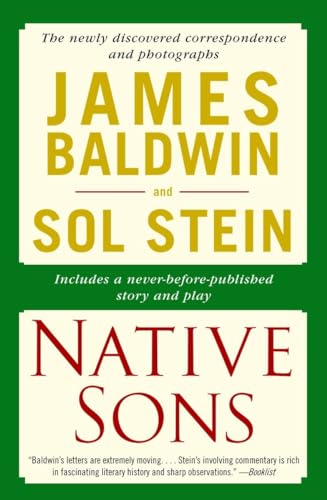
James Baldwin was beginning to be recognized as the most brilliant black writer of his generation when his first book of essays, Notes of a Native Son, established his reputation in 1955. No one was more pleased by the book’s reception than Baldwin’s high school friend Sol Stein. A rising New York editor, novelist, and playwright, Stein had suggested that Baldwin do the book and coaxed his old friend through the long and sometimes agonizing process of putting the volume together and seeing it into print. Now, in this fascinating new book, Sol Stein documents the story of his intense creative partnership with Baldwin through newly uncovered letters, photos, inscriptions, and an illuminating memoir of the friendship that resulted in one of the classics of American literature. Included in this book are the two works they created together–the story “Dark Runner” and the play Equal in Paris, both published here for the first time.
Though a world of difference separated them–Baldwin was black and gay, living in self-imposed exile in Europe; Stein was Jewish and married, with a growing family to support–the two men shared the same fundamental passion. Nothing mattered more to either of them than telling and writing the truth, which was not always welcome. As Stein wrote Baldwin in a long, heartfelt letter, “You are the only friend with whom I feel comfortable about all three: heart, head, and writing.” In this extraordinary book, Stein unfolds how that shared passion played out in the months surrounding the creation and publication of Baldwin’s Notes of a Native Son, in which Baldwin’s main themes are illuminated.
A literary event published to honor the eightieth anniversary of James Baldwin’s birth, Native Sons is a celebration of one of the most fruitful and influential friendships in American letters.
Die Inhaltsangabe kann sich auf eine andere Ausgabe dieses Titels beziehen.
Über die Autorin bzw. den Autor
For over three decades, Sol Stein edited and published some of the leading writers of the Twentieth century, including James Baldwin, Dylan Thomas, W. H. Auden, and Lionel Trilling. A prize-winning playwright and the author of nine novels, as well as nonfiction books, screenplays, and TV dramas, Stein lives in New York.
Born in 1924, James Baldwin made a name for himself with his first novel, Go Tell It on the Mountain in 1953. His legendary Notes of a Native Son appeared two years later, and he went on to publish fiction, poetry, plays, and essays that profoundly influenced the literature of Twentieth-century America. Baldwin died in France in 1987.
Von der hinteren Coverseite
James Baldwin was beginning to be recognized as the most brilliant black writer of his generation when his first book of essays, "Notes of a Native Son," established his reputation in 1955. No one was more pleased by the book's reception than Baldwin's high school friend Sol Stein. A rising New York editor, novelist, and playwright, Stein had suggested that Baldwin do the book and coaxed his old friend through the long and sometimes agonizing process of putting the volume together and seeing it into print. Now, in this fascinating new book, Sol Stein documents the story of his intense creative partnership with Baldwin through newly uncovered letters, photos, inscriptions, and an illuminating memoir of the friendship that resulted in one of the classics of American literature. Included in this book are the two works they created together-the story "Dark Runner" and the play "Equal in Paris, both published here for the first time.
Though a world of difference separated them-Baldwin was black and gay, living in self-imposed exile in Europe; Stein was Jewish and married, with a growing family to support-the two men shared the same fundamental passion. Nothing mattered more to either of them than telling and writing the truth, which was not always welcome. As Stein wrote Baldwin in a long, heartfelt letter, "You are the only friend with whom I feel comfortable about all three: heart, head, and writing." In this extraordinary book, Stein unfolds how that shared passion played out in the months surrounding the creation and publication of Baldwin's "Notes of a Native Son, in which Baldwin's main themes are illuminated.
A literary event published to honor the eightieth anniversary ofJames Baldwin's birth, "Native Sons is a celebration of one of the most fruitful and influential friendships in American letters.
"From the Hardcover edition.
Auszug. © Genehmigter Nachdruck. Alle Rechte vorbehalten.
Chapter 1
Notes of a Native American
The Story of a Friendship in Black and White
Sol Stein
One thing you always have to keep in mind is how little you can take for granted. When one talks about the sixties, for example, one tends to assume that everyone knows what you're talking about, but, in fact, many of them were hardly born yet when the sixties were going on. That means you have to rethink everything as if it happened in ancient Rome or Greece.
-James Baldwin in Contact,
a publication of the University of Massachusetts
at Amherst, January-February 1984
I am remembering five thousand people crowded into the Cathedral of St. John the Divine for James Baldwin's funeral, and I imagine my lifelong friend Jimmy and me watching that event, an elbow poking the other's rib for attention as in the old days when our lives intersected.
I knew James Baldwin first in our early teenage years, when I was thirteen and he was fifteen. It all began in the tower of DeWitt Clinton High School in the north Bronx at a time when students anywhere in the five boroughs of New York City didn't need to be bused anywhere but could elect to go to a high school of their choice. Baldwin, known then and since as Jimmy, went the distance by subway, bus, and foot from Harlem in Manhattan to DeWitt Clinton at the far northern edge of New York City, an exceptional school where his last formal education took place. In this day of failed busing, it is hard to imagine that in 1939 a poor boy could travel many miles to a different borough to seize an education he could not get locally.
When DeWitt Clinton first opened the doors at its present site in May of 1929, it claimed to be the largest secondary school for boys in the world. The three-story building and its athletic field and stadium occupied about twenty-six acres and had a single-session capacity of over five thousand students. A recently remodeled room just off its library displays a picture gallery of onetime Clinton students that includes such luminaries as Paddy Chayevsky, Countee Cullen, Burt Lancaster, Ralph Lauren, Jan Peerce, Richard Rodgers, A. M. Rosenthal, Daniel Schorr, Neil Simon, and Lionel Trilling. Clinton was a garden in which black and white teenagers could become fast friends, an environment that a few years later made possible Notes of a Native Son, which in 1999 was selected by a distinguished panel as one of "the 100 best nonfiction books of the century."
Our home away from home was in what we called the Magpie Tower, the place where DeWitt Clinton's award-winning literary magazine, The Magpie, was edited by students as young as thirteen and fourteen. Our core group, besides Baldwin and me, included Richard Avedon and Emile Capouya, working under the tutelage of a faculty member, Wilmer Stone. Avedon was then a poet and shy. When we were called upon to sell the issue of January 1941, Avedon and I would stand in front of each classroom, Avedon silent, his hands clasped in front of him, while I recited a poem of his from memory. America had not yet formally entered World War II, but London was burning. Avedon's poem that lingers still in my memory is about the loss of a childhood friend in the firebombing of London. What we all wrote then is today mostly embarrassing, but the learning process was astonishing. On Friday afternoons, after classes officially let out, the Magpie gang would assemble in the tower above the three floors of the school building to hear our faculty advisor read our stories aloud to us in the most boring monotone imaginable. We were eager to see our stories in print and were learning to take criticism in a most painful way that was also instructive, for we learned then what all writers must eventually learn, that the reader has to be moved by the words alone, without help from the histrionic talents of the author.
Stone's private critiques of our work could be withering. Avedon told me a couple of years ago that on one occasion Stone asked him what kind of reading matter his parents had lying around the house. Avedon mentioned magazines like Good Housekeeping and McCall's. Stone told him, "That's what's wrong with your writing." At that moment, Avedon said, he decided to give up writing and turned, brilliantly, to photography.
More than forty years later, in the preface to the 1984 edition of Notes of a Native Son, Baldwin begins, "It was Sol Stein, high school buddy, editor, novelist, playwright, who first suggested this book. My reaction was not
enthusiastic: as I remember, I told him that I was too young to publish my memoirs. I had never thought of these essays as a possible book. . . . Sol's suggestion had the startling and unkind effect of causing me to realize that time had passed. It was though he had dashed cold water in my face. Sol persisted, however. . . ."
I don't remember Baldwin's resistance to doing the book. I do remember the editorial process, helped by recently finding my line-by-line editorial notes and Baldwin's responses, which are included in the correspondence section of this book. Writers can be wary of editors they don't know well. By the time Baldwin and I had to deal with Notes of a Native Son, the overlay of a friendship of a dozen years made the process easier.
A friendship that endures might reasonably be defined as a house in which disagreements are confined to an attic that can be opened for memoirs but never for continuation of a former argument. Baldwin and I came to our friendship with differences. He was black and I was white, he loved men and I loved women, he assumed his ancestors came to America in chains and I assumed my parents, who slipped over the border separately and illegally, came here because they had nowhere else to go. Despite the differences-we lived many miles apart-because of our friendship our families took a liking to each other. There are surviving photographs of Jimmy bouncing two of my pajama-clad children on his knee. I loved and admired Baldwin's mother, Berdis, and believed it was reciprocal even at our last warm meeting after Jimmy's death. Berdis visited with my family when Jimmy was abroad. I was welcome in Berdis's apartment on 131st Street in Harlem, but not by the policeman who stopped me outside and wanted to know what my white face was doing in that neighborhood.
Berdis had a secret that to my knowledge and Jimmy's say-so was never
divulged: the identity of Jimmy's father. The now legendary stepfather Jimmy wrote about was the preacher who married Berdis, presumably legitimized her son, and gave her eight more children. My mother, Zelda Zam, enjoyed Jimmy's brightness, his dancing hands. Like Berdis Baldwin, she had her secret. According to family legend, in the old country, hiding in the cellar during a pogrom, through a crack in the door my mother saw her first fiancé killed by one of Petlyura's Cossacks. In America she had another secret I discovered as a child during the Great Depression. In the old country, my mother at a young age was the head of secondary evening schools in Kiev, the largest city in the Ukraine. To make a living in America she sold Compton's Encyclopedia door-to-door, and one day, when the Depression bottomed, I opened the heavy sample case she took to work every day and found the knee pads she wore when cleaning other people's floors. Baldwin's mother, Berdis, may also have done the same.
Jimmy Baldwin and I, both Depression-era kids, responded differently to food. At my mother's table, Jimmy would eat like a bird, one small piece at a time, taking two hours over a simple meal, while I devoured all of it in the first few minutes. One might suppose that Jimmy was stretching out the pleasure of food, while I was gulping it down before it vanished. One of my few memories of Depression eating was the time my mother and father planted...
„Über diesen Titel“ kann sich auf eine andere Ausgabe dieses Titels beziehen.
Suchergebnisse für Native Sons: A Friendship That Created One Of The Great...

Beispielbild für diese ISBN
Native Sons
Anbieter: World of Books (was SecondSale), Montgomery, IL, USA
Verkäuferbewertung 5 von 5 Sternen

Zustand: Good. Item in good condition. Textbooks may not include supplemental items i.e. CDs, access codes etc. Artikel-Nr. 00106134880
Gebraucht kaufen
EUR 6,46
Versand gratis
Versand innerhalb von USA
Versand innerhalb von USA
Anzahl: 1 verfügbar
Beispielbild für diese ISBN
Native Sons
Anbieter: PBShop.store US, Wood Dale, IL, USA
Verkäuferbewertung 5 von 5 Sternen
PAP. Zustand: New. New Book. Shipped from UK. Established seller since 2000. Artikel-Nr. L2-9780345469366
Neu kaufen
EUR 20,13
Versand gratis
Versand innerhalb von USA
Versand innerhalb von USA
Anzahl: Mehr als 20 verfügbar
Beispielbild für diese ISBN
Native Sons
Anbieter: PBShop.store UK, Fairford, GLOS, Vereinigtes Königreich
Verkäuferbewertung 5 von 5 Sternen
PAP. Zustand: New. New Book. Shipped from UK. Established seller since 2000. Artikel-Nr. L2-9780345469366
Neu kaufen
EUR 18,45
EUR 4,84 Versand
Versand von Vereinigtes Königreich nach USA
Versand von Vereinigtes Königreich nach USA
Anzahl: Mehr als 20 verfügbar
Beispielbild für diese ISBN
Native Sons
Verlag:
Random House Publishing Group, 2005
ISBN 10: 0345469364
ISBN 13: 9780345469366
Neu
Softcover
Anbieter: Ria Christie Collections, Uxbridge, Vereinigtes Königreich
Verkäuferbewertung 5 von 5 Sternen
Zustand: New. In. Artikel-Nr. ria9780345469366_new
Neu kaufen
EUR 19,30
EUR 13,94 Versand
Versand von Vereinigtes Königreich nach USA
Versand von Vereinigtes Königreich nach USA
Anzahl: Mehr als 20 verfügbar
Beispielbild für diese ISBN
Native Sons: A Friendship That Created One Of The Great Works Of The Twentieth Century: Notes Of A Native Son
Anbieter: Revaluation Books, Exeter, Vereinigtes Königreich
Verkäuferbewertung 5 von 5 Sternen
Paperback. Zustand: Brand New. reprint edition. 217 pages. 9.25x6.25x0.75 inches. In Stock. Artikel-Nr. x-0345469364
Neu kaufen
EUR 21,73
EUR 11,64 Versand
Versand von Vereinigtes Königreich nach USA
Versand von Vereinigtes Königreich nach USA
Anzahl: 2 verfügbar
Beispielbild für diese ISBN
Native Sons
Anbieter: Kennys Bookstore, Olney, MD, USA
Verkäuferbewertung 5 von 5 Sternen
Zustand: New. Artikel-Nr. V9780345469366
Neu kaufen
EUR 27,33
EUR 9,04 Versand
Versand innerhalb von USA
Versand innerhalb von USA
Anzahl: Mehr als 20 verfügbar