
Verwandte Artikel zu The Serial Killer Files: The Who, What, Where, How,...
The Serial Killer Files: The Who, What, Where, How, and Why of the World's Most Terrifying Murderers - Softcover
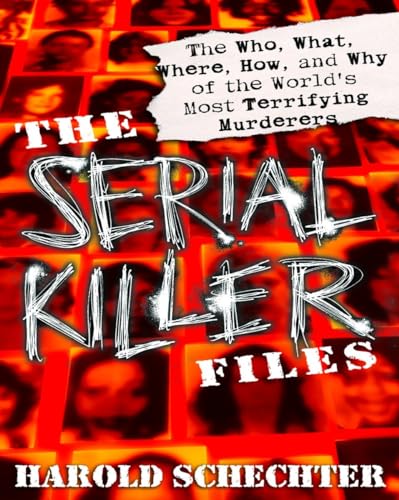
Inhaltsangabe
THE DEFINITIVE DOSSIER ON HISTORY’S MOST HEINOUS!
Hollywood’s make-believe maniacs like Jason, Freddy, and Hannibal Lecter can’t hold a candle to real life monsters like John Wayne Gacy, Ted Bundy, Jeffrey Dahmer, and scores of others who have terrorized, tortured, and terminated their way across civilization throughout the ages. Now, from the much-acclaimed author of Deviant, Deranged, and Depraved, comes the ultimate resource on the serial killer phenomenon.
Rigorously researched and packed with the most terrifying, up-to-date information, this innovative and highly compelling compendium covers every aspect of multiple murderers—from psychology to cinema, fetishism to fan clubs, “trophies” to trading cards. Discover:
WHO THEY ARE: Those featured include Ed Gein, the homicidal mama’s boy who inspired fiction’s most famous Psycho, Norman Bates; Angelo Buono and Kenneth Bianchi, sex-crazed killer cousins better known as the Hillside Stranglers; and the Beanes, a fifteenth-century cave-dwelling clan with an insatiable appetite for human flesh
HOW THEY KILL: They shoot, stab, and strangle. Butcher, bludgeon, and burn. Drown, dismember, and devour . . . and other methods of massacre too many and monstrous to mention here.
WHY THEY DO IT: For pleasure and for profit. For celebrity and for “companionship.” For the devil and for dinner. For the thrill of it, for the hell of it, and because “such men are monsters, who live . . .
beyond the frontiers of madness.”
PLUS: in-depth case studies, classic killers’ nicknames, definitions of every kind of deviance and derangement, and much, much more.
For more than one hundred profiles of lethal loners and killer couples, Bluebeards and black widows, cannibals and copycats— this is an indispensable, spine-tingling, eye-popping investigation into the dark hearts and mad minds of that twisted breed of human whose crimes are the most frightening . . . and fascinating.
Die Inhaltsangabe kann sich auf eine andere Ausgabe dieses Titels beziehen.
Über die Autorin bzw. den Autor
Harold Schechter is a professor of American literature and popular culture at Queens College of the City University of New York. He is widely celebrated for both fiction and true-crime writing, including The Devil's Gentleman and The Serial Killer Files. He is also the editor of the Library of America volume, True Crime: An American Anthology. He lives in Brooklyn and Mattituck, Long Island, with his wife, the poet Kimiko Hahn.
Von der hinteren Coverseite
THE DEFINITIVE DOSSIER ON HISTORY'S MOST HEINOUS!
Hollywood's make-believe maniacs like Jason, Freddy, and Hannibal Lecter can't hold a candle to real life monsters like John Wayne Gacy, Ted Bundy, Jeffrey Dahmer, and scores of others who have terrorized, tortured, and terminated their way across civilization throughout the ages. Now, from the much-acclaimed author of "Deviant, Deranged, and "Depraved, comes "the ultimate resource on the serial killer phenomenon.
Rigorously researched and packed with the most terrifying, up-to-date information, this innovative and highly compelling compendium covers every aspect of multiple murderers--from psychology to cinema, fetishism to fan clubs, "trophies" to trading cards. Discover:
WHO THEY ARE: Those featured include Ed Gein, the homicidal mama's boy who inspired fiction's most famous "Psycho, Norman Bates; Angelo Buono and Kenneth Bianchi, sex-crazed killer cousins better known as the Hillside Stranglers; and the Beanes, a fifteenth-century cave-dwelling clan with an insatiable appetite for human flesh
HOW THEY KILL: They shoot, stab, and strangle. Butcher, bludgeon, and burn. Drown, dismember, and devour . . . and other methods of massacre too many and monstrous to mention here.
WHY THEY DO IT: For pleasure and for profit. For celebrity and for "companionship." For the devil and for dinner. For the thrill of it, for the hell of it, and because "such men are monsters, who live . . .
beyond the frontiers of madness."
"PLUS: in-depth case studies, classic killers' nicknames, definitions of every kind of deviance and derangement, and much, much more.
For more than one hundred profiles of lethal loners and killercouples, Bluebeards and black widows, cannibals and copycats-- this is an indispensable, spine-tingling, eye-popping investigation into the dark hearts and mad minds of that twisted breed of human whose crimes are the most frightening . . . and fascinating.
Auszug. © Genehmigter Nachdruck. Alle Rechte vorbehalten.
WHAT IT MEANS
ORIGIN OF THE TERM
One reason people tend to think that serial murder is a frighteningly new phenomenon is that, until about twenty years ago, no one ever heard of such a thing. For most of the twentieth century, the news media never referred to serial killers. But that isn't because homicidal psychos didn't exist in the past.
Indeed, one of the most infamous American serial killers of all time, Albert Fish, committed his atrocities around the time of the Great Depression. After his arrest, his unspeakable crimes were covered extensively by the newspapers. Nowhere, however, is Fish described as a serial killer. The reason is simple. The phrase hadn't been invented yet. Back then, the type of crime we now define as serial murder was simply lumped together under the general rubric of "mass murder."
Credit for coining the phrase "serial killer" is commonly given to former FBI Special Agent Robert Ressler, one of the founding members of the Bureau's elite Behavioral Science Unit (aka the "Mind Hunters" or the "Psyche Squad"). Along with his colleague John Douglas, Ressler served as a model for the character Jack Crawford in Thomas Harris's Hannibal Lecter trilogy.
In his 1992 memoir, Whoever Fights Monsters, Ressler writes that, in the early 1970s, while attending a weeklong conference at the British police academy, he heard a fellow participant refer to "crimes in series," meaning "a series of rapes, burglaries, arsons, or murders." Ressler was so impressed by the phrase that, upon returning to Quantico, he began to use the term "serial killer" in his own lectures to describe "the killing of those who do one murder, then another and another in a fairly repetitive way."
In thinking up the term, Ressler also says he had in mind the movie-matinee adventure serials of his boyhood: Spy Smasher, Flash Gordon, The Masked Marvel, etc. Like a child looking forward to the latest installment of his favorite cliffhanger, the serial killer can't wait to commit his next atrocity.
That is Ressler's version of how he came to invent the phrase that has now become such a vital part of our language. There is just one problem with the story. There is documented proof that the expression "serial murderer" existed at least a dozen years before Ressler supposedly invented it.
According to Jesse Sheidlower, editor of the major new revision of the Oxford English Dictionary, the term can be traced as far back as 1961, where it appears in a citation from Merriam-Webster's Third New International Dictionary. The quote, which is attributed to the German critic Siegfried Kracauer, is:
[He] denies that he is the pursued serial murderer.
-first documented use of the term "serial murderer," as it appears in Merriam-Webster's 1961 Third New International Dictionary
By the mid-1960s, the term "serial murderer" had become common enough, at least overseas, that it was used repeatedly in the 1966 book The Meaning of Murder by the British writer John Brophy.
Jack the Ripper, still unidentified and still the most famous of all serial murderers, was not altogether true to type. The typical serial murderer kills once too often and gets caught.
-from The Meaning of Murder (New York: Thomas Y. Crowell, 1966), p. 189
It's possible that, during his visit to England (where Brophy's book was originally published), Ressler picked up the term, perhaps subliminally. To give credit where it is due, it was evidently Ressler who altered the phrase from "serial murderer" to the slightly more punchy "serial killer."
In any event, if he can't really be credited with coining the expression, Ressler certainly helped introduce it into American culture. Surprisingly, it did not enter into common usage until quite recently. The earliest published example of the phrase "serial killer" that the editors of the Oxford English Dictionary have been able to come up with is only twenty years old. It comes from the article "Leading the Hunt in Atlanta's Murders" by M. A. Farber, published in the May 3, 1981, issue of the New York Times Magazine.
Here, reprinted for the first time, is the passage containing the first known published use of the term "serial killer":
Someone, raising a question that trails Brown from forum to forum, asks about race and the murders. Some Atlantans fear racial violence if a "serial" killer is discovered to be white.
DEFINITIONS
Since the term "serial killer" was invented to describe a specific type of criminal, you'd think the definition would be clear-cut. However, confusion surrounds the term. Even the experts can't agree.
Let's start with the official FBI definition:
Three or more separate events in three or more separate locations with an emotional cooling-off period between homicides.
-FBI Crime Classification Manual (1992)
This definition stresses three elements:
1.Quantity. There have to be at least three murders.
2.Place. The murders have to occur at different locations.
3.Time. There has to be a "cooling-off period"-an interval between the murders that can last anywhere from several hours to several years.
The last two characteristics are meant to differentiate serial killing from mass murder, in which a suicidal, rage-filled individual slaughters a bunch of people at once: a disgruntled employee, for example, who shows up at his office with an automatic weapon and blows away a half dozen coworkers before turning the gun on himself.
There are several problems with the FBI definition. In one respect, it's much too broad, since it can be applied to homicidal types who aren't serial killers: professional hit men, for example, or Western outlaws like William "Billy the Kid" Bonney, who is said to have gunned down twenty-one men before he reached the age of twenty-one. "Mad bombers" like Ted Kaczynski also meet the FBI's criteria. But none of these types match the common conception of a serial killer.
In another respect, the FBI definition is overly narrow, since it specifies that a serial killer has to commit his crimes "in three or more separate locations." To be sure, some serial killers range far and wide in their search for prey. Ted Bundy, for example, murdered women in several different states. Others, however, prefer to do their dirty work in one place. John Wayne Gacy, for example, turned the basement of his suburban split-level into a private torture chamber and even disposed of his victims' remains at home, stashing them in the crawl space until he ran out of room.
The main defect in the FBI definition however, is what's missing from it-namely, any sense of the specific nature of the crimes. When Siegfried Kracauer first used the term "serial murderer," he was discussing the character played by Peter Lorre in Fritz Lang's classic movie, M: a repulsive, moon-faced pervert who preys on little girls. A few years later, John Brophy used it to describe killers like Jack the Ripper and Earle Leonard Nelson, the infamous "Gorilla Murderer" of the 1920s who strangled and raped several dozen women across the United States and up into Canada. And when Robert Ressler and his colleagues in the Behavioral Science Unit adopted the term in the 1970s, they applied it to homicidal psychopaths like Ted Bundy, John Wayne Gacy, and Edmund Kemper. In all these cases, there was one common thread: a strong component of depraved sexuality.
Recognizing this fact, some experts stress the sexual motivations behind serial murder, defining it as the act of ultraviolent deviants, who get twisted pleasure from inflicting extreme harm on...
„Über diesen Titel“ kann sich auf eine andere Ausgabe dieses Titels beziehen.
Weitere beliebte Ausgaben desselben Titels

Suchergebnisse für The Serial Killer Files: The Who, What, Where, How,...

Beispielbild für diese ISBN
The Serial Killer Files The Wh
Verlag:
Random House Publishing Group, 2003
ISBN 10: 0345465660
ISBN 13: 9780345465665
Gebraucht
Softcover
Anbieter: World of Books (was SecondSale), Montgomery, IL, USA
Verkäuferbewertung 5 von 5 Sternen

Zustand: Good. Item in good condition. Textbooks may not include supplemental items i.e. CDs, access codes etc. Artikel-Nr. 00100152519
Gebraucht kaufen
EUR 3,93
Versand gratis
Versand innerhalb von USA
Versand innerhalb von USA
Anzahl: 11 verfügbar
Beispielbild für diese ISBN
The Serial Killer Files The Wh
Verlag:
Random House Publishing Group, 2003
ISBN 10: 0345465660
ISBN 13: 9780345465665
Gebraucht
Softcover
Anbieter: World of Books (was SecondSale), Montgomery, IL, USA
Verkäuferbewertung 5 von 5 Sternen
Zustand: Very Good. Item in very good condition! Textbooks may not include supplemental items i.e. CDs, access codes etc. Artikel-Nr. 00106888358
Gebraucht kaufen
EUR 3,93
Versand gratis
Versand innerhalb von USA
Versand innerhalb von USA
Anzahl: 3 verfügbar
Beispielbild für diese ISBN
The Serial Killer Files The Wh
Verlag:
Random House Publishing Group, 2003
ISBN 10: 0345465660
ISBN 13: 9780345465665
Gebraucht
Softcover
Anbieter: World of Books (was SecondSale), Montgomery, IL, USA
Verkäuferbewertung 5 von 5 Sternen
Zustand: Acceptable. Item in acceptable condition! Textbooks may not include supplemental items i.e. CDs, access codes etc. Artikel-Nr. 00093820761
Gebraucht kaufen
EUR 3,93
Versand gratis
Versand innerhalb von USA
Versand innerhalb von USA
Anzahl: 2 verfügbar
Beispielbild für diese ISBN
The Serial Killer Files: The W
Anbieter: World of Books (was SecondSale), Montgomery, IL, USA
Verkäuferbewertung 5 von 5 Sternen
Zustand: Good. Item in good condition. Textbooks may not include supplemental items i.e. CDs, access codes etc. Artikel-Nr. 00087380288
Gebraucht kaufen
EUR 3,94
Versand gratis
Versand innerhalb von USA
Versand innerhalb von USA
Anzahl: 6 verfügbar
Beispielbild für diese ISBN
The Serial Killer Files: The Who, What, Where, How, and Why of the World's Most Terrifying Murderers
Verlag:
Random House Publishing Group, 2003
ISBN 10: 0345465660
ISBN 13: 9780345465665
Gebraucht
Softcover
Anbieter: World of Books (was SecondSale), Montgomery, IL, USA
Verkäuferbewertung 5 von 5 Sternen
Zustand: Good. Item in good condition. Textbooks may not include supplemental items i.e. CDs, access codes etc. Artikel-Nr. 00089404559
Gebraucht kaufen
EUR 3,98
Versand gratis
Versand innerhalb von USA
Versand innerhalb von USA
Anzahl: 8 verfügbar
Beispielbild für diese ISBN
The Serial Killer Files: The Who, What, Where, How, and Why of the World's Most Terrifying Murderers
Verlag:
Random House Publishing Group (edition 1), 2003
ISBN 10: 0345465660
ISBN 13: 9780345465665
Gebraucht
Paperback
Anbieter: BooksRun, Philadelphia, PA, USA
Verkäuferbewertung 5 von 5 Sternen
Paperback. Zustand: Very Good. 1. It's a well-cared-for item that has seen limited use. The item may show minor signs of wear. All the text is legible, with all pages included. It may have slight markings and/or highlighting. Artikel-Nr. 0345465660-11-6
Gebraucht kaufen
EUR 4,97
Versand gratis
Versand innerhalb von USA
Versand innerhalb von USA
Anzahl: 1 verfügbar
Beispielbild für diese ISBN
The Serial Killer Files: The Who, What, Where, How, and Why of the World's Most Terrifying Murderers
Verlag:
Random House Publishing Group, 2003
ISBN 10: 0345465660
ISBN 13: 9780345465665
Gebraucht
Softcover
Anbieter: Wonder Book, Frederick, MD, USA
Verkäuferbewertung 5 von 5 Sternen
Zustand: Good. Good condition. A copy that has been read but remains intact. May contain markings such as bookplates, stamps, limited notes and highlighting, or a few light stains. Artikel-Nr. Z05C-01676
Gebraucht kaufen
EUR 6,24
Versand gratis
Versand innerhalb von USA
Versand innerhalb von USA
Anzahl: 1 verfügbar
Beispielbild für diese ISBN
The Serial Killer Files: The Who, What, Where, How, and Why of the World's Most Terrifying Murderers
Verlag:
Random House Publishing Group, 2003
ISBN 10: 0345465660
ISBN 13: 9780345465665
Gebraucht
Softcover
Anbieter: Wonder Book, Frederick, MD, USA
Verkäuferbewertung 5 von 5 Sternen
Zustand: Good. Good condition. A copy that has been read but remains intact. May contain markings such as bookplates, stamps, limited notes and highlighting, or a few light stains. Bundled media such as CDs, DVDs, floppy disks or access codes may not be included. Artikel-Nr. O11C-01617
Gebraucht kaufen
EUR 6,24
Versand gratis
Versand innerhalb von USA
Versand innerhalb von USA
Anzahl: 1 verfügbar
Beispielbild für diese ISBN
The Serial Killer Files : The Who, What, Where, How, and Why of the World's Most Terrifying Murderers
Verlag:
Random House Publishing Group, 2003
ISBN 10: 0345465660
ISBN 13: 9780345465665
Gebraucht
Softcover
Anbieter: Better World Books, Mishawaka, IN, USA
Verkäuferbewertung 5 von 5 Sternen
Zustand: Good. Former library copy. Pages intact with minimal writing/highlighting. The binding may be loose and creased. Dust jackets/supplements are not included. Includes library markings. Stock photo provided. Product includes identifying sticker. Better World Books: Buy Books. Do Good. Artikel-Nr. 8544899-6
Gebraucht kaufen
EUR 6,32
Versand gratis
Versand innerhalb von USA
Versand innerhalb von USA
Anzahl: 1 verfügbar
Beispielbild für diese ISBN
The Serial Killer Files : The Who, What, Where, How, and Why of the World's Most Terrifying Murderers
Verlag:
Random House Publishing Group, 2003
ISBN 10: 0345465660
ISBN 13: 9780345465665
Gebraucht
Softcover
Anbieter: Better World Books, Mishawaka, IN, USA
Verkäuferbewertung 5 von 5 Sternen
Zustand: Very Good. Pages intact with possible writing/highlighting. Binding strong with minor wear. Dust jackets/supplements may not be included. Stock photo provided. Product includes identifying sticker. Better World Books: Buy Books. Do Good. Artikel-Nr. 4490835-6
Gebraucht kaufen
EUR 6,32
Versand gratis
Versand innerhalb von USA
Versand innerhalb von USA
Anzahl: 1 verfügbar