
Verwandte Artikel zu Bury Us Upside Down: The Misty Pilots and the Secret...
Inhaltsangabe
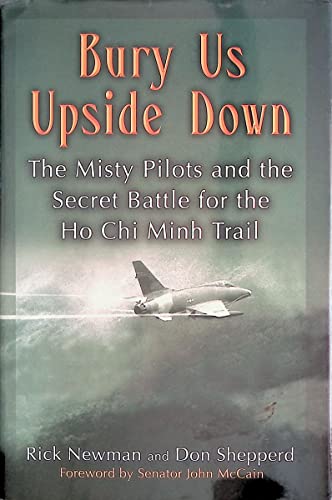
Describes the top-secret missions flown by the pilots of the U.S. Air Force unit known as the Commando Sabre Operation, formed in 1967 to locate targets along the Ho Chi Minh Trail.
Die Inhaltsangabe kann sich auf eine andere Ausgabe dieses Titels beziehen.
Über die Autorin bzw. den Autor
Rick Newman is a writer and editor at U.S. News & World Report who covered the Pentagon for seven years, including U.S. missions in Bosnia, Kosovo, and the Persian Gulf. He has written hundreds of stories on the military, including dozens of exclusives, and more than twenty cover stories.
Don Shepperd (Misty 34) reported for duty at Phu Cat Air Base on December 19, 1967, and flew fifty-eight missions as a Misty during his four-month tour. With a total of 247 combat missions in Vietnam, he retired from the Air Force in 1998 as a two-star general and head of the Air National Guard. In 2001 he joined CNN as one of their principal military analysts.
Auszug. © Genehmigter Nachdruck. Alle Rechte vorbehalten.
Chapter one
“MISSING MAN”
The casket seemed like overkill. But it was too awkward for anybody to mention.
As seventy-five guests sat anxiously in the chapel at Arlington National Cemetery, the organist softly playing “Amazing Grace,” a military caisson clanked to a stop outside the gates. Pallbearers from the Air Force Honor Guard, every thread of their uniforms neatly in place, lowered a flag-draped coffin from the horse-drawn carriage. The men carried it up the steps and methodically marched it down the aisle, then set it before the small altar at the front of the chapel. The stiff, practiced precision of the pallbearers’ movements, their reverential bearing, all of the military formality—it was impressive, to be sure. Yet it was starkly at odds with what was inside the casket: practically nothing.
In the second pew, Jean Kahoon grew uncomfortable as she listened to friends and colleagues eulogize Howard Keith Williams, her big brother. He had been shot down while flying an F-100 fighter jet over North Vietnam twenty-four years earlier and never heard from again. John Buckmelter, a childhood friend, described how Howard had fallen in love with flying when he was just a boy hanging out at the Jefferson County airfield near Steubenville, Ohio. Roger Williams, Howard’s younger brother, described how pleased he had been to be able to go to Vietnam as an Army soldier at the same time Howard, his hero, had gone over to fly jets. Fellow pilots Roger Wise and Chuck O’Connor told stories of going to flight school and learning how to be fighter jocks with “Willy.” “He was always a little more focused, a little more mature,” O’Connor recalled.
But there was so much more to him, thought Jean, than his military career and his fascination with flying. There was the neighborhood sled-riding hill where she and her brother and dozens of other kids would go careening over rocks and bushes and have to jump off their sleds to avoid landing in the creek at the bottom. There were all the jobs Howard worked as a kid to pick up spending money and add to the family clothing fund: the paper routes, the lawns he mowed, the summer labor at their grandfather’s farm in West Virginia where they’d bale hay and plow up potatoes and milk cows. Best of all was the three-man band Howard helped form. He played trumpet and was good enough to get paying gigs at local nightclubs on weekends. In her mind, Jean could still see the drum majorette her brother had dated for a while in high school, the one with the great legs who wore her skirt so short it barely covered her panties.
Then there were all the special things between Jean and Howard, born two years apart and the oldest of eight children. Jean helped Howard deliver the papers and took over the route when he moved on to bigger jobs. She was with Howard at the farm in West Virginia when he tried chewing tobacco for the first time—a short-lived habit. And all the nights they spent together hiding in the attic, talking and drawing, came cascading back. Their dad had been a carpenter for U.S. Steel, and he had been injured and out of work for a while. The family could afford just one upstairs bedroom for the girls, and one for the boys. But the setup had its charms. Each bedroom had a closet that led to a crawl space at the top of the house. That’s where the family kept its supply of drawing paper—blank newsprint that occasionally came bundled with the morning news. Jean and Howard would sneak up there once the younger kids were asleep and spend hours drawing cartoons and planning out the future. They’d clamber back down to their beds once they heard their mom climbing the steps to check on the kids. Not once did they ever get caught—not surprising, since Mom knew what they were up to all along.
And there, in a box twenty feet in front of her, Jean’s big brother Howard, who caused her profound heartache when he left home and giddy joy whenever he came back to visit, had been literally reduced to shards: a bone fragment, one tooth, a sliver from a signal mirror that was part of his survival gear, and a piece of a plastic Ace comb. The remains, recovered by American investigators a year earlier, in 1991, were so sparse that Jean wondered, what’s the point of putting them in a casket? She even had her doubts about whether they were actually Howard’s. There had been so much that didn’t make sense, so many fishy explanations, that it was hard to believe anything the government said.
Was it just coincidence that Howard had told her, in the last letter she ever got from him in Vietnam, that he was flying reconnaissance missions up north, taking pictures and getting shot at, and that he feared he might not make it home? Or that he wanted her to listen to a song that he said was about siblings like them—“Bang Bang, My Baby Shot Me Down”? And how could the U.S. government not have known for twenty-three years what happened to Howard? That coffin, which contained her brother’s so-called remains, was about as hollow as everything else the government had offered about her brother in the years since she had last heard from him.
Jean wasn’t the only person in the chapel bothered by the contents of the casket. In the front row, Keith Williams—Howard’s son, who was six when his dad disappeared over North Vietnam—had his own reservations. It was Keith who had flown to Travis Air Force Base near San Francisco when the remains were first returned to the United States, to “escort” them to the San Francisco airport. It seemed ridiculous to him that the Air Force had put a handful of body parts into a full-sized coffin. And he began wondering all over again how his father had died, and how much pain he had gone through. As Keith had gotten older, people who seemed to know such things had whispered to him horror stories about American pilots who had gone down in that part of North Vietnam, close to the border with Laos. Often they were murdered the moment they were discovered by local Vietnamese militias. Other times they were captured and tortured, only to die miserably before they ever made it to infamous prisons like the Hanoi Hilton. They were even shot at in their parachutes while descending. Those who got tangled in trees could be wounded and left hanging until they bled to death.
On the flight out to Travis, Keith had begun writing a eulogy on three-by-five-inch note cards, a eulogy he stood to give in the chapel at Arlington. Most of his recollections were the vaguest of sketches, filled in over the years by the stories he heard from friends and relatives and colleagues who had flown with his dad. So Keith described his dad largely as others had to him. He was “a man whose love of life and family propelled him to excel in all of life’s endeavors . . . As a self-taught artist, he shared with us his aesthetic ideal. . . . Music was another pastime my father pursued with dedication and single-mindedness. With a few songbooks, a tuning pipe, and hours of devotion, he brought laughter and joy to those who heard him play.”
His true passion, however, had been flying: “Diving, turning, zooming, and rolling amid the clouds allowed my father to push himself and his aircraft to the limits. Covering a mile every six seconds, my father was privy to a view of the world reserved for very few individuals. A world with no lines or boundaries between people or nations, with a crisp blue sky surrounding him, just on the...
„Über diesen Titel“ kann sich auf eine andere Ausgabe dieses Titels beziehen.
Suchergebnisse für Bury Us Upside Down: The Misty Pilots and the Secret...

Beispielbild für diese ISBN
Bury Us Upside Down: The Misty Pilots and the Secret Battle for the Ho Chi Minh Trail
Anbieter: World of Books (was SecondSale), Montgomery, IL, USA
Verkäuferbewertung 5 von 5 Sternen

Hardback. Zustand: Very Good. They had the most dangerous job n the Air Force. Now Bury Us Upside Down reveals the never-before-told story of the Vietnam War's top-secret jet-fighter outfit-an all-volunteer unit composed of truly extraordinary men who flew missions from which heroes are made. In today's wars, computers, targeting pods, lasers, and precision-guided bombs help FAC (forward air controller) pilots identify and destroy targets from safe distances. But in the search for enemy traffic on the elusive Ho Chi Minh Trail, always risking enemy fire, capture, and death, pilots had to drop low enough to glimpse the telltale signs of movement such as suspicious dust on treetops or disappearing tire marks on a dirt road (indicating a hidden truck park). Written by an accomplished journalist and veteran, Bury Us Upside Down is the stunning story of these brave Americans, the men who flew in the covert Operation Commando Sabre-or Misty-the most innovative air operation of the war. In missions that lasted for hours, the pilots of Misty flew zigzag patterns searching for enemy troops, vehicles, and weapons, without benefit of night-vision goggles, infrared devices, or other now common sensors. What they gained in exhilarating autonomy also cost them: of 157 pilots, 34 were shot down, 3 captured, and 7 killed. Here is a firsthand account of courage and technical mastery under fire. Here, too, is a tale of forbearance and loss, including the experience of the family of a missing Misty flier-Howard K. Williams-as they learn, after twenty-three years, that his remains have been found. Now that bombs are smart and remote sensors are even smarter, the missions that the Mistys flew would now be considered no less than suicidal. Bury Us Upside Down reminds us that for some, such dangers simply came with the territory. From the Hardcover edition. Artikel-Nr. 00108768963
Gebraucht kaufen
EUR 6,40
Versand gratis
Versand innerhalb von USA
Versand innerhalb von USA
Anzahl: 2 verfügbar
Beispielbild für diese ISBN
Bury Us Upside Down: The Misty Pilots and the Secret Battle for the Ho Chi Minh Trail
Anbieter: World of Books (was SecondSale), Montgomery, IL, USA
Verkäuferbewertung 5 von 5 Sternen
Hardback. Zustand: Good. They had the most dangerous job n the Air Force. Now Bury Us Upside Down reveals the never-before-told story of the Vietnam War's top-secret jet-fighter outfit-an all-volunteer unit composed of truly extraordinary men who flew missions from which heroes are made. In today's wars, computers, targeting pods, lasers, and precision-guided bombs help FAC (forward air controller) pilots identify and destroy targets from safe distances. But in the search for enemy traffic on the elusive Ho Chi Minh Trail, always risking enemy fire, capture, and death, pilots had to drop low enough to glimpse the telltale signs of movement such as suspicious dust on treetops or disappearing tire marks on a dirt road (indicating a hidden truck park). Written by an accomplished journalist and veteran, Bury Us Upside Down is the stunning story of these brave Americans, the men who flew in the covert Operation Commando Sabre-or Misty-the most innovative air operation of the war. In missions that lasted for hours, the pilots of Misty flew zigzag patterns searching for enemy troops, vehicles, and weapons, without benefit of night-vision goggles, infrared devices, or other now common sensors. What they gained in exhilarating autonomy also cost them: of 157 pilots, 34 were shot down, 3 captured, and 7 killed. Here is a firsthand account of courage and technical mastery under fire. Here, too, is a tale of forbearance and loss, including the experience of the family of a missing Misty flier-Howard K. Williams-as they learn, after twenty-three years, that his remains have been found. Now that bombs are smart and remote sensors are even smarter, the missions that the Mistys flew would now be considered no less than suicidal. Bury Us Upside Down reminds us that for some, such dangers simply came with the territory. From the Hardcover edition. Artikel-Nr. 00105130940
Gebraucht kaufen
EUR 6,40
Versand gratis
Versand innerhalb von USA
Versand innerhalb von USA
Anzahl: 2 verfügbar
Beispielbild für diese ISBN
Bury Us Upside Down: The Misty Pilots and the Secret Battle for the Ho Chi Minh Trail
Verlag:
Presidio Press (edition First Edition), 2006
ISBN 10: 0345465377
ISBN 13: 9780345465375
Gebraucht
Hardcover
Erstausgabe
Anbieter: BooksRun, Philadelphia, PA, USA
Verkäuferbewertung 5 von 5 Sternen
Hardcover. Zustand: Very Good. First Edition. With dust jacket. It's a well-cared-for item that has seen limited use. The item may show minor signs of wear. All the text is legible, with all pages included. It may have slight markings and/or highlighting. Artikel-Nr. 0345465377-11-1-29
Gebraucht kaufen
EUR 6,41
Versand gratis
Versand innerhalb von USA
Versand innerhalb von USA
Anzahl: 2 verfügbar
Beispielbild für diese ISBN
Bury Us Upside Down : The Misty Pilots and the Secret Battle for the Ho Chi Minh Trail
Verlag:
Random House Publishing Group, 2006
ISBN 10: 0345465377
ISBN 13: 9780345465375
Gebraucht
Hardcover
Erstausgabe
Anbieter: Better World Books, Mishawaka, IN, USA
Verkäuferbewertung 5 von 5 Sternen
Zustand: Good. 1st. Pages intact with minimal writing/highlighting. The binding may be loose and creased. Dust jackets/supplements are not included. Stock photo provided. Product includes identifying sticker. Better World Books: Buy Books. Do Good. Artikel-Nr. 4311520-6
Gebraucht kaufen
EUR 6,92
Versand gratis
Versand innerhalb von USA
Versand innerhalb von USA
Anzahl: 1 verfügbar
Beispielbild für diese ISBN
Bury Us Upside Down : The Misty Pilots and the Secret Battle for the Ho Chi Minh Trail
Verlag:
Random House Publishing Group, 2006
ISBN 10: 0345465377
ISBN 13: 9780345465375
Gebraucht
Hardcover
Erstausgabe
Anbieter: Better World Books, Mishawaka, IN, USA
Verkäuferbewertung 5 von 5 Sternen
Zustand: Very Good. 1st. Pages intact with possible writing/highlighting. Binding strong with minor wear. Dust jackets/supplements may not be included. Stock photo provided. Product includes identifying sticker. Better World Books: Buy Books. Do Good. Artikel-Nr. 3940386-20
Gebraucht kaufen
EUR 6,92
Versand gratis
Versand innerhalb von USA
Versand innerhalb von USA
Anzahl: 1 verfügbar
Beispielbild für diese ISBN
Bury Us Upside Down : The Misty Pilots and the Secret Battle for the Ho Chi Minh Trail
Verlag:
Random House Publishing Group, 2006
ISBN 10: 0345465377
ISBN 13: 9780345465375
Gebraucht
Hardcover
Erstausgabe
Anbieter: Better World Books: West, Reno, NV, USA
Verkäuferbewertung 5 von 5 Sternen
Zustand: Good. 1st. Pages intact with minimal writing/highlighting. The binding may be loose and creased. Dust jackets/supplements are not included. Stock photo provided. Product includes identifying sticker. Better World Books: Buy Books. Do Good. Artikel-Nr. 4311520-6
Gebraucht kaufen
EUR 6,92
Versand gratis
Versand innerhalb von USA
Versand innerhalb von USA
Anzahl: 1 verfügbar
Beispielbild für diese ISBN
Bury Us Upside Down : The Misty Pilots and the Secret Battle for the Ho Chi Minh Trail
Verlag:
Random House Publishing Group, 2006
ISBN 10: 0345465377
ISBN 13: 9780345465375
Gebraucht
Hardcover
Erstausgabe
Anbieter: Better World Books, Mishawaka, IN, USA
Verkäuferbewertung 5 von 5 Sternen
Zustand: Very Good. 1st. Former library copy. Pages intact with possible writing/highlighting. Binding strong with minor wear. Dust jackets/supplements may not be included. Includes library markings. Stock photo provided. Product includes identifying sticker. Better World Books: Buy Books. Do Good. Artikel-Nr. 9864525-6
Gebraucht kaufen
EUR 6,92
Versand gratis
Versand innerhalb von USA
Versand innerhalb von USA
Anzahl: 1 verfügbar
Beispielbild für diese ISBN
Bury Us Upside Down: The Misty Pilots and the Secret Battle for the Ho Chi Minh Trail
Anbieter: ThriftBooks-Reno, Reno, NV, USA
Verkäuferbewertung 5 von 5 Sternen
Hardcover. Zustand: Good. No Jacket. Missing dust jacket; Pages can have notes/highlighting. Spine may show signs of wear. ~ ThriftBooks: Read More, Spend Less. Artikel-Nr. G0345465377I3N01
Gebraucht kaufen
EUR 7,40
Versand gratis
Versand innerhalb von USA
Versand innerhalb von USA
Anzahl: 1 verfügbar
Beispielbild für diese ISBN
Bury Us Upside Down: The Misty Pilots and the Secret Battle for the Ho Chi Minh Trail
Anbieter: ThriftBooks-Dallas, Dallas, TX, USA
Verkäuferbewertung 5 von 5 Sternen
Hardcover. Zustand: Good. No Jacket. Missing dust jacket; Pages can have notes/highlighting. Spine may show signs of wear. ~ ThriftBooks: Read More, Spend Less. Artikel-Nr. G0345465377I3N01
Gebraucht kaufen
EUR 7,40
Versand gratis
Versand innerhalb von USA
Versand innerhalb von USA
Anzahl: 1 verfügbar
Beispielbild für diese ISBN
Bury Us Upside Down: The Misty Pilots and the Secret Battle for the Ho Chi Minh Trail
Anbieter: ThriftBooks-Phoenix, Phoenix, AZ, USA
Verkäuferbewertung 5 von 5 Sternen
Hardcover. Zustand: Good. No Jacket. Missing dust jacket; Pages can have notes/highlighting. Spine may show signs of wear. ~ ThriftBooks: Read More, Spend Less. Artikel-Nr. G0345465377I3N01
Gebraucht kaufen
EUR 7,40
Versand gratis
Versand innerhalb von USA
Versand innerhalb von USA
Anzahl: 1 verfügbar