
Verwandte Artikel zu Six Days of War: June 1967 and the Making of the Modern...
Inhaltsangabe
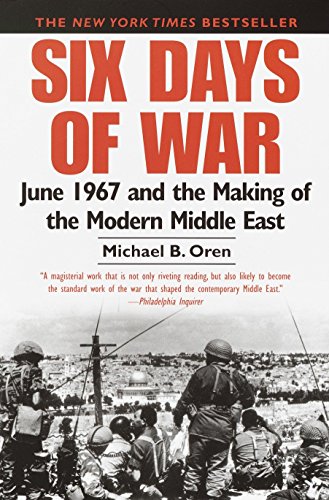
NEW YORK TIMES BESTSELLER • The first comprehensive account of the epoch-making Six-Day War, from the author of Ally—now featuring a fiftieth-anniversary retrospective
Though it lasted for only six tense days in June, the 1967 Arab-Israeli war never really ended. Every crisis that has ripped through this region in the ensuing decades, from the Yom Kippur War of 1973 to the ongoing intifada, is a direct consequence of those six days of fighting.
Writing with a novelist’s command of narrative and a historian’s grasp of fact and motive, Michael B. Oren reconstructs both the lightning-fast action on the battlefields and the political shocks that electrified the world. Extraordinary personalities—Moshe Dayan and Gamal Abdul Nasser, Lyndon Johnson and Alexei Kosygin—rose and toppled from power as a result of this war; borders were redrawn; daring strategies brilliantly succeeded or disastrously failed in a matter of hours. And the balance of power changed—in the Middle East and in the world. A towering work of history and an enthralling human narrative, Six Days of War is the most important book on the Middle East conflict to appear in a generation.
Praise for Six Days of War
“Powerful . . . A highly readable, even gripping account of the 1967 conflict . . . [Oren] has woven a seamless narrative out of a staggering variety of diplomatic and military strands.”—The New York Times
“With a remarkably assured style, Oren elucidates nearly every aspect of the conflict. . . . Oren’s [book] will remain the authoritative chronicle of the war. His achievement as a writer and a historian is awesome.”—The Atlantic Monthly
“This is not only the best book so far written on the six-day war, it is likely to remain the best.”—The Washington Post Book World
“Phenomenal . . . breathtaking history . . . a profoundly talented writer. . . .
This book is not only one of the best books on this critical episode in Middle East history; it’s one of the best-written books I’ve read this year, in any genre.”—The Jerusalem Post
“[In] Michael Oren’s richly detailed and lucid account, the familiar story is thrilling once again. . . . What makes this book important is the breadth and depth of the research.”—The New York Times Book Review
“A first-rate new account of the conflict.”—The Washington Post
“The definitive history of the Six-Day War . . . [Oren’s] narrative is precise but written with great literary flair. In no one else’s study is there more understanding or more surprise.”—Martin Peretz, Publisher, The New Republic
“Compelling, perhaps even vital, reading.”—San Jose Mercury News
Die Inhaltsangabe kann sich auf eine andere Ausgabe dieses Titels beziehen.
Über die Autorin bzw. den Autor
Michael B. Oren is an American-born Israeli historian and author, and was Israel’s ambassador to the United States from 2009 to 2013. He has written three New York Times bestsellers—Ally: My Journey Across the American-Israeli Divide; Power, Faith, and Fantasy: America in the Middle East, 1776 to the Present; and Six Days of War: June 1967 and the Making of the Modern Middle East, which won the Los Angeles Times Book Prize for history and the National Jewish Book Award. Throughout his illustrious career as a Middle East scholar, Dr. Oren has been a distinguished fellow at the Shalem Center in Jerusalem, a contributing editor to The New Republic, and a visiting professor at Harvard, Yale, and Georgetown. The Forward named Oren one of the five most influential American Jews, and The Jerusalem Post listed him as one of the world’s ten most influential Jews. He currently lives with his family in Tel Aviv. He is a member of the Knesset and the Deputy Minister for Diplomacy in the Prime Minister's Office.
Von der hinteren Coverseite
Though it lasted for only six tense days in June, the 1967 Arab-Israeli war never really ended. Every crisis that has ripped through this region in the ensuing decades, from the Yom Kippur War of 1973 to the ongoing intifada, is a direct consequence of those six days of fighting. Michael B. Oren’s magnificent Six Days of War, an internationally acclaimed bestseller, is the first comprehensive account of this epoch-making event.
Writing with a novelist’s command of narrative and a historian’s grasp of fact and motive, Oren reconstructs both the lightning-fast action on the battlefields and the political shocks that electrified the world. Extraordinary personalities—Moshe Dayan and Gamal Abdul Nasser, Lyndon Johnson and Alexei Kosygin—rose and toppled from power as a result of this war; borders were redrawn; daring strategies brilliantly succeeded or disastrously failed in a matter of hours. And the balance of power changed—in the Middle East and in the world. A towering work of history and an enthralling human narrative, Six Days of War is the most important book on the Middle East conflict to appear in a generation.
Auszug. © Genehmigter Nachdruck. Alle Rechte vorbehalten.
Afterwood
MORE THAN TWO YEARS HAVE PASSED since the outbreak of the latest Middle Eastern turmoil, and there is still no cease-fire in sight. Called by Palestinians the al-Aqsa Intifada, and by the Israelis the “disturbances,” the “events,” or, simply, the Palestinian terror, the violence that erupted in September 2000, and which has raged ever since, is in every sense a war. No less than in 1948 and 1967, Arabs and Israelis are today once again battling over the final disposition of the area known in Arabic as Filastin and in Hebrew as Eretz Yisrael—the Land of Israel. As in the processes leading up to previous Arab-Israeli confrontations, mounting violence between Palestinians and Israelis threatens to set the entire region ablaze.
In many respects, the current fighting resembles the civil war in Palestine
that broke out in November 1947, following the UN’s decision to partition the
country into independent Jewish and Arab states. The Zionist leadership accepted
the notion of territorial compromise, but the Arabs of Palestine saw no
reason to forfeit what they considered their exclusive national rights, and determined
to block the partition with attacks against Jewish settlements, road
systems, and neighborhoods. Other Arab forces, most prominently those associated
with the militant Muslim Brotherhood, aided the Palestinian Arabs from
across the border. The Jews, for their part, initially showed restraint, but in
April 1948, fearing annihilation, they too went to war. Subsequently, dozens of
Arab villages and towns were destroyed, their populations displaced, and their
leaders either killed or rendered ineffective. But the Palestinians’ defeat generated
sympathy throughout the Arab world and intensified the pressure on Arab
leaders to intervene against the Jews. The result came one month later with the
advent of the first Arab-Israeli war.
A remarkably similar process occurred more than fifty years later, in the
latter half of 2000, when the Clinton Administration again proposed to partition
the land between the Palestinians and the Jews. Specifically, the United
States called for the creation of a Palestinian state in virtually all of the West
Bank and the entire Gaza Strip—Israeli settlements would either be removed
or concentrated in blocks—with its capital in East Jerusalem. A small number
of Palestinian refugees would be repatriated to Israel; the rest were to receive
compensation. The Palestinian state would live side by side with Israel in relations
of full peace, but while Israeli prime minister Ehud Barak approved the
formula, the Palestinian Authority under its president, Yasser Arafat, rejected
it. Rather, Arafat demanded the return of all the refugees—a move that, if implemented,
would have created a Palestinian majority in Israel. As in 1947–48, the
issue was not merely the borders of the Jewish state, but its very existence.
The Palestinians consequently embarked on an armed offensive using tactics
reminiscent of those employed in 1947–48—roadside ambushes, snipers,
and car bombs—together with the innovation of suicide bombers. Militant Islamic
elements once more played a prominent role in the campaign. At first,
Israel’s reaction was again restrained, but as casualties rapidly mounted, the
IDF finally struck back. In April 2002, Israeli forces reoccupied much of the
West Bank, causing extensive damage to Palestinian cities and villages, and
killing or isolating many Palestinian leaders. As in 1948, the Palestinians’ plight
aroused sympathy in neighboring Arab countries and placed pressure on their
leaders to intercede. Soon Hezbollah guerrillas in Lebanon were launching
rockets into northern Israel; the Syrian army went on high alert, as did units in
Jordan, Egypt, and Iraq. Israel mobilized its reserves. The region careered toward
yet another Arab-Israeli war.
The fighting in 2000–2002 recalled not only the events of 1947–48 but,
even more poignantly, those of 1967. That war, this book asserts, was the result
of a series of incidents triggered by Palestinian guerrilla raids and Israel’s
retaliations against them. Today, more than three decades later, the Middle
East is still in the grips of a context of conflict in which a single spark can ignite
a regional conflagration. Such a spark was kindled in September 2000, when
Ariel Sharon, then head of Israel’s parliamentary opposition, paid a visit to the
Haram al-Sharif, or Temple Mount, in Jerusalem.
Though the visit had been cleared with the Palestinian Authority, many
Palestinians viewed it as a provocation and protested against it violently. Firing
on the rioters, Israeli forces provided the pretext for launching an intifada, or
popular uprising, named after the Haram’s al-Aqsa mosque. Mass demonstrations
of Palestinian youths soon escalated into armed attacks against Israeli
targets, most of them civilian, and increasingly fierce countermeasures by Israel.
Israeli reprisals in turn instigated unrest in adjacent Arab countries. The
“street” was once again agitating—a déjà vu of 1967—and Arab rulers had little
choice but to act.
Unlike in 1948 and 1967, however, war between Arabs and Israelis did not
erupt in 2002. Though the region has remained in many ways unchanged, several
fundamental transformations nevertheless have combined to mitigate the
dangers of war.
There is, firstly, the existence of peace treaties between Israel and Egypt and
Israel and Jordan. In spite of their failure to bring about any true reconciliation
between their signatories, these agreements have nonetheless provided the nations
with open channels of communication and venues for reducing tensions.
Another change is the emergence of the U.S.-Israeli alliance that not only guarantees
Israel a decisive military edge over its enemies, but also affords Washington
far-reaching influence over Israeli actions. Finally, there is the nonconventional
weaponry now in the arsenals of virtually every Middle Eastern state, which has
sharply elevated the stakes in any Arab-Israeli confrontation.
Yet for every change curtailing the chances of war, another could equally
contribute to its outbreak. Absent today is the peculiar stability engendered by
the Cold War, of a rational counterpart whom the U.S. president might hotline
in a crisis, and superpower constraints over key regional players such as Iraq,
Iran, and Syria. The once neat division between Arab radicals and Arab conservatives
has been replaced by internal fissures within each Arab country—between
each regime and its domestic, often Islamic, opposition—and even the
lines in the Arab-Israeli conflict have become obscured. Most destabilizing,
arguably, is the growth of terrorist organizations, global in outlook and adamant
in their theology, transcending all borders and contemptuous of any attempt
to restrain them.
These countervailing changes, coupled with the continuing friction surrounding
nondemocratic Middle Eastern regimes and Arab resistance to the
very idea of a Jewish state, might have set the stage for an Arab-Israeli war
bigger and possibly more destructive than those of 1948 and 1967. Instead, war
in 2002 was averted by the timely intervention of the United States. As tensions
in the region spiraled toward an explosion, President George W. Bush
strongly advised Syria to rein in its Hezbollah allies and told the Palestinian
Authority that its support of terror was totally unacceptable to Americans. At
the same time, Washington publicly...
„Über diesen Titel“ kann sich auf eine andere Ausgabe dieses Titels beziehen.
Suchergebnisse für Six Days of War: June 1967 and the Making of the Modern...

Beispielbild für diese ISBN
Six Days of War: June 1967 and the Making of the Modern Middle East
Verlag:
Countrysport Press,U.S., 2003
ISBN 10: 0345461924
ISBN 13: 9780345461926
Gebraucht
Paperback
Anbieter: World of Books (was SecondSale), Montgomery, IL, USA
Verkäuferbewertung 5 von 5 Sternen

Paperback. Zustand: Fair. NEW YORK TIMES BESTSELLER * The first comprehensive account of the epoch-making Six-Day War, from the author of Ally--now featuring a fiftieth-anniversary retrospective Though it lasted for only six tense days in June, the 1967 Arab-Israeli war never really ended. Every crisis that has ripped through this region in the ensuing decades, from the Yom Kippur War of 1973 to the ongoing intifada, is a direct consequence of those six days of fighting. Writing with a novelist's command of narrative and a historian's grasp of fact and motive, Michael B. Oren reconstructs both the lightning-fast action on the battlefields and the political shocks that electrified the world. Extraordinary personalities--Moshe Dayan and Gamal Abdul Nasser, Lyndon Johnson and Alexei Kosygin--rose and toppled from power as a result of this war; borders were redrawn; daring strategies brilliantly succeeded or disastrously failed in a matter of hours. And the balance of power changed--in the Middle East and in the world. A towering work of history and an enthralling human narrative, Six Days of War is the most important book on the Middle East conflict to appear in a generation. Praise for Six Days of War "Powerful . . . A highly readable, even gripping account of the 1967 conflict . . . [Oren] has woven a seamless narrative out of a staggering variety of diplomatic and military strands."--The New York Times "With a remarkably assured style, Oren elucidates nearly every aspect of the conflict. . . . Oren's [book] will remain the authoritative chronicle of the war. His achievement as a writer and a historian is awesome."--The Atlantic Monthly "This is not only the best book so far written on the six-day war, it is likely to remain the best."--The Washington Post Book World "Phenomenal . . . breathtaking history . . . a profoundly talented writer. . . . This book is not only one of the best books on this critical episode in Middle East history; it's one of the best-written books I've read this year, in any genre."--The Jerusalem Post "[In] Michael Oren's richly detailed and lucid account, the familiar story is thrilling once again. . . . What makes this book important is the breadth and depth of the research."--The New York Times Book Review "A first-rate new account of the conflict."--The Washington Post "The definitive history of the Six-Day War . . . [Oren's] narrative is precise but written with great literary flair. In no one else's study is there more understanding or more surprise."--Martin Peretz, Publisher, The New Republic "Compelling, perhaps even vital, reading."--San Jose Mercury News. Artikel-Nr. 00096481703
Gebraucht kaufen
EUR 4,80
Versand gratis
Versand innerhalb von USA
Versand innerhalb von USA
Anzahl: 8 verfügbar
Beispielbild für diese ISBN
Six Days of War: June 1967 and the Making of the Modern Middle East
Verlag:
Countrysport Press,U.S., 2003
ISBN 10: 0345461924
ISBN 13: 9780345461926
Gebraucht
Paperback
Anbieter: World of Books (was SecondSale), Montgomery, IL, USA
Verkäuferbewertung 5 von 5 Sternen
Paperback. Zustand: Good. NEW YORK TIMES BESTSELLER * The first comprehensive account of the epoch-making Six-Day War, from the author of Ally--now featuring a fiftieth-anniversary retrospective Though it lasted for only six tense days in June, the 1967 Arab-Israeli war never really ended. Every crisis that has ripped through this region in the ensuing decades, from the Yom Kippur War of 1973 to the ongoing intifada, is a direct consequence of those six days of fighting. Writing with a novelist's command of narrative and a historian's grasp of fact and motive, Michael B. Oren reconstructs both the lightning-fast action on the battlefields and the political shocks that electrified the world. Extraordinary personalities--Moshe Dayan and Gamal Abdul Nasser, Lyndon Johnson and Alexei Kosygin--rose and toppled from power as a result of this war; borders were redrawn; daring strategies brilliantly succeeded or disastrously failed in a matter of hours. And the balance of power changed--in the Middle East and in the world. A towering work of history and an enthralling human narrative, Six Days of War is the most important book on the Middle East conflict to appear in a generation. Praise for Six Days of War "Powerful . . . A highly readable, even gripping account of the 1967 conflict . . . [Oren] has woven a seamless narrative out of a staggering variety of diplomatic and military strands."--The New York Times "With a remarkably assured style, Oren elucidates nearly every aspect of the conflict. . . . Oren's [book] will remain the authoritative chronicle of the war. His achievement as a writer and a historian is awesome."--The Atlantic Monthly "This is not only the best book so far written on the six-day war, it is likely to remain the best."--The Washington Post Book World "Phenomenal . . . breathtaking history . . . a profoundly talented writer. . . . This book is not only one of the best books on this critical episode in Middle East history; it's one of the best-written books I've read this year, in any genre."--The Jerusalem Post "[In] Michael Oren's richly detailed and lucid account, the familiar story is thrilling once again. . . . What makes this book important is the breadth and depth of the research."--The New York Times Book Review "A first-rate new account of the conflict."--The Washington Post "The definitive history of the Six-Day War . . . [Oren's] narrative is precise but written with great literary flair. In no one else's study is there more understanding or more surprise."--Martin Peretz, Publisher, The New Republic "Compelling, perhaps even vital, reading."--San Jose Mercury News. Artikel-Nr. 00101900536
Gebraucht kaufen
EUR 4,80
Versand gratis
Versand innerhalb von USA
Versand innerhalb von USA
Anzahl: Mehr als 20 verfügbar
Beispielbild für diese ISBN
Six Days of War: June 1967 and the Making of the Modern Middle East
Verlag:
Presidio Press (edition ), 2003
ISBN 10: 0345461924
ISBN 13: 9780345461926
Gebraucht
Paperback
Anbieter: BooksRun, Philadelphia, PA, USA
Verkäuferbewertung 5 von 5 Sternen
Paperback. Zustand: Very Good. It's a well-cared-for item that has seen limited use. The item may show minor signs of wear. All the text is legible, with all pages included. It may have slight markings and/or highlighting. Artikel-Nr. 0345461924-11-1
Gebraucht kaufen
EUR 5,23
Versand gratis
Versand innerhalb von USA
Versand innerhalb von USA
Anzahl: 2 verfügbar
Beispielbild für diese ISBN
Six Days of War: June 1967 and the Making of the Modern Middle East
Verlag:
Presidio Press (edition ), 2003
ISBN 10: 0345461924
ISBN 13: 9780345461926
Gebraucht
Paperback
Anbieter: BooksRun, Philadelphia, PA, USA
Verkäuferbewertung 5 von 5 Sternen
Paperback. Zustand: Fair. The item might be beaten up but readable. May contain markings or highlighting, as well as stains, bent corners, or any other major defect, but the text is not obscured in any way. Artikel-Nr. 0345461924-7-1-13
Gebraucht kaufen
EUR 5,32
Versand gratis
Versand innerhalb von USA
Versand innerhalb von USA
Anzahl: 1 verfügbar
Foto des Verkäufers
Six Days of War: June 1967 and the Making of the Modern Middle East
Anbieter: Dream Books Co., Denver, CO, USA
Verkäuferbewertung 5 von 5 Sternen
Zustand: good. Gently used with minimal wear on the corners and cover. A few pages may contain light highlighting or writing, but the text remains fully legible. Dust jacket may be missing, and supplemental materials like CDs or codes may not be included. May be ex-library with library markings. Ships promptly! Artikel-Nr. DBV.0345461924.G
Gebraucht kaufen
EUR 5,75
Versand gratis
Versand innerhalb von USA
Versand innerhalb von USA
Anzahl: 1 verfügbar
Beispielbild für diese ISBN
Six Days of War: June 1967 and the Making of the Modern Middle East
Verlag:
Presidio Press (edition ), 2003
ISBN 10: 0345461924
ISBN 13: 9780345461926
Gebraucht
Paperback
Anbieter: BooksRun, Philadelphia, PA, USA
Verkäuferbewertung 5 von 5 Sternen
Paperback. Zustand: Fair. The item might be beaten up but readable. May contain markings or highlighting, as well as stains, bent corners, or any other major defect, but the text is not obscured in any way. Artikel-Nr. 0345461924-7-1
Gebraucht kaufen
EUR 5,78
Versand gratis
Versand innerhalb von USA
Versand innerhalb von USA
Anzahl: 2 verfügbar
Beispielbild für diese ISBN
Six Days of War: June 1967 and the Making of the Modern Middle East
Anbieter: ThriftBooks-Atlanta, AUSTELL, GA, USA
Verkäuferbewertung 5 von 5 Sternen
Paperback. Zustand: Good. No Jacket. Pages can have notes/highlighting. Spine may show signs of wear. ~ ThriftBooks: Read More, Spend Less. Artikel-Nr. G0345461924I3N00
Gebraucht kaufen
EUR 5,98
Versand gratis
Versand innerhalb von USA
Versand innerhalb von USA
Anzahl: 2 verfügbar
Beispielbild für diese ISBN
Six Days of War: June 1967 and the Making of the Modern Middle East
Anbieter: ThriftBooks-Dallas, Dallas, TX, USA
Verkäuferbewertung 5 von 5 Sternen
Paperback. Zustand: Good. No Jacket. Former library book; Pages can have notes/highlighting. Spine may show signs of wear. ~ ThriftBooks: Read More, Spend Less. Artikel-Nr. G0345461924I3N10
Gebraucht kaufen
EUR 5,98
Versand gratis
Versand innerhalb von USA
Versand innerhalb von USA
Anzahl: 1 verfügbar
Beispielbild für diese ISBN
Six Days of War: June 1967 and the Making of the Modern Middle East
Anbieter: ThriftBooks-Reno, Reno, NV, USA
Verkäuferbewertung 5 von 5 Sternen
Paperback. Zustand: Good. No Jacket. Pages can have notes/highlighting. Spine may show signs of wear. ~ ThriftBooks: Read More, Spend Less. Artikel-Nr. G0345461924I3N00
Gebraucht kaufen
EUR 5,98
Versand gratis
Versand innerhalb von USA
Versand innerhalb von USA
Anzahl: 1 verfügbar
Beispielbild für diese ISBN
Six Days of War: June 1967 and the Making of the Modern Middle East
Anbieter: ThriftBooks-Dallas, Dallas, TX, USA
Verkäuferbewertung 5 von 5 Sternen
Paperback. Zustand: Good. No Jacket. Pages can have notes/highlighting. Spine may show signs of wear. ~ ThriftBooks: Read More, Spend Less. Artikel-Nr. G0345461924I3N00
Gebraucht kaufen
EUR 5,98
Versand gratis
Versand innerhalb von USA
Versand innerhalb von USA
Anzahl: 2 verfügbar