
Verwandte Artikel zu Mr. Fix-It Introduces You to Your Home
Inhaltsangabe
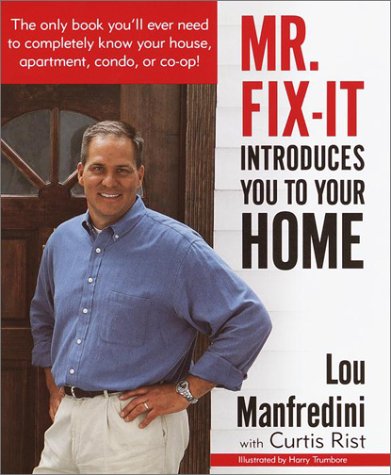
Accompanied by an indispensable tool guide and a glossary of home repair terms, an entertaining guide is filled with practical advice and simple directions that assist readers in better understanding their home, whether they are repairing, renovating, purchasing, or landscaping.
Die Inhaltsangabe kann sich auf eine andere Ausgabe dieses Titels beziehen.
Über die Autorin bzw. den Autor
Lou Manfredini started working in a hardware store when he was thirteen years old. He worked as a carpenter’s apprentice in college and opened his own construction company in Chicago in 1985. His media career began ten years later when he pitched the idea of a call-in show to a local radio station. WGN-AM picked up the show, and Mr. Fix-It was born. The radio show is now nationally syndicated, and Lou is also a frequent contributor to television and print media as well. He appears regularly on the Today Show, and has a bimonthly column in USA WEEKEND. He still runs his own construction company, and actively builds and renovates homes. Lou lives in Chicago with his wife and four children.
Curtis Rist is the coauthor of This Old House Homeowner's Manual&
Auszug. © Genehmigter Nachdruck. Alle Rechte vorbehalten.
Searching for our dream home a few years ago, my wife, Mary Beth, and I knew only vaguely what we wanted—until we walked up to a slightly tired-looking brick Georgian. The place was far from trendy; in fact, it had been built back when FDR was president. There was no hot tub in the backyard, no “family recycling center,” and no skylights. It had the original kitchen, the original furniture, and even the original owner—a kind lady who had lived there since 1941. Yet as we stepped inside on that wintry day, I closed the two-inch-thick front door behind us and heard a sturdy thunk, like an old Mercedes. “This is the house,” I instantly whispered to my wife. “What are you talking about? We haven’t even been through it,” she responded. But I persisted: “I’m telling you, this is the house!”
And I was right. With Mary Beth’s enthusiastic approval, we bought the place—metal kitchen cabinets and all—the next day.
Lots of people, especially real estate agents, think they can divine exactly what a house should be in order to appeal to people. They might come up with an ideal square footage, promote a certain bedroom-to-bathroom ratio, and go on and on about the value of a deck versus a patio. I think that’s mostly nonsense. Because when it comes down to it, the only thing that’s truly important in a house is the way it feels—a place that feels solid, not tinny; a home that keeps you cool in the summer and toasty warm in the winter; a house that will stand up for the ages, rather than fall apart before the decade’s out. Whether you’re renovating a home, building an addition, or simply maintaining what you’ve got, I believe it’s a lot better to let yourself be guided by that principle rather than try to add a few haphazard things that might attract some future buyers.
More than anything, I want you to think of your house as a place to treasure and care for, not patch together. We all allow ourselves on occasion to do slipshod things to our cars, for instance, whether we skip the occasional oil change, hold off on the scheduled maintenance, or even pocket the insurance money instead of repairing that bashed-in fender. Unfortunately, too many people take the same approach to a house. Yet while a car will eventually end up on the scrap heap, a well-maintained house will only grow in value. This investment goes far deeper than simply owning a few shares of some dot-com or blue-chip stock. It’s an investment in ourselves and our quality of life. As the very symbol of family life, a house demands respect from the people that live in it.
That sense of respect is what I hope you can develop by reading this book. As you’ll discover, this is not a typical how-to volume, with tips on how to fix a broken bathroom tile, regrout
a kitchen backsplash, or patch a leaky roof. There are probably plenty of those already on your bookshelf—and if you’re like most homeowners who try to wade through them, you probably find yourself lost in a bewildering vocabulary of floor joists, wall studs, R-values for insulation, and the secret coding of blueprints. It’s as if these books were written in another language. Instead, this is a book that will help you begin to understand a house in its entirety, in a language you can follow. While you may not find the exact details you’ll need for every project you want to undertake, you’ll walk away with something far more important: an intuitive understanding of your home that will empower you to make the right decisions for its future as well as for your own.
I’ll start by taking you on a tour of your house, from the ground up. We’ll look at how a house works—it’s more like a living, breathing organism than a pile of brick and lumber. We’ll untangle the mess of wiring that lies coiled behind your walls, and the plumbing that snakes its way to sinks and bathroom fixtures. We’ll focus on basements and attics, kitchens and bathrooms, rooms to live in and rooms to sleep in. And for those apartment dwellers among you, trust me—there’s an awful lot going on behind your walls that you need to know about, too. The aim is to give you a greater appreciation of the things that are covered up by paint and paper on your walls, and the systems that flow just beneath the plush carpets and polished wood of your floors. Why do you need to know these things? Because it is this unseen portion of your house that does more to make you feel comfortable and secure than any cushy sofa or swath of fabric hanging in a window ever will. And if the hidden things aren’t working properly, before long that lovely paint will be peeling off the walls and those plush carpets will be damp and moldy. Who needs that?
I began in the construction business eighteen years ago, and since then I’ve seen thousands of houses go up, and renovated countless more. I’ve worked on every aspect of the home, from sewers to shingles, from basement footings to chimney tops. What I’d like to do is share with you my sense of what a house is and how it works and help you avoid the many mistakes I’ve made over the years. Everyone wishes they had a friend in the home improvement business, whether that’s a carpenter they could trust or a hardware store guy who could really answer their questions. My aim is for you to begin to feel that way about me.
I’ll have plenty of advice for you as we move along, but first I want to tell you about what I think is the golden rule of home improvement: Whatever you do to your house, whether repairing it, maintaining it, or renovating it, you have an obligation to make sure the job gets done right. That means getting the training you need to tackle it yourself, or hiring someone qualified to do it for you. My goal when I work on a house is simply to do the best work possible. When the next person comes along to renovate in twenty or thirty years, I want him to look back and say, “Wow, the last person who worked on this really did a great job.” As a builder, I know it’s the only mark that’s worth leaving. And as a homeowner, you should have the same standards. Because, ultimately, a good home is tactile. You can feel it in the weight of the knob when you close a door, the sturdiness of the handrail as you climb the stairs, and the way the kitchen drawers glide smoothly as you pull them open. And all that translates into value, by creating a home that is a pleasure to live in. Sloppiness is always offensive, but good craftsmanship—regardless of the style, taste, or décor—is always a pleasure.
Although I hate to think about it, I know that someday, when it’s time, Mary Beth and I won’t have any trouble selling our home. The new buyers will surely quibble over our color scheme and choice in carpeting. But when that front door closes, they’ll know—as I did—that the best home really is a castle. My hope is that this book will help you turn yours into the fortress of your dreams.
„Über diesen Titel“ kann sich auf eine andere Ausgabe dieses Titels beziehen.
Suchergebnisse für Mr. Fix-It Introduces You to Your Home

Beispielbild für diese ISBN
Mr. Fix-It Introduces You to Your Home
Anbieter: World of Books (was SecondSale), Montgomery, IL, USA
Verkäuferbewertung 5 von 5 Sternen

Zustand: Good. Item in good condition. Textbooks may not include supplemental items i.e. CDs, access codes etc. Artikel-Nr. 00056644550
Gebraucht kaufen
EUR 3,71
Versand gratis
Versand innerhalb von USA
Versand innerhalb von USA
Anzahl: 3 verfügbar
Beispielbild für diese ISBN
Mr. Fix-It Introduces You to Your Home
Anbieter: World of Books (was SecondSale), Montgomery, IL, USA
Verkäuferbewertung 5 von 5 Sternen
Zustand: Very Good. Item in very good condition! Textbooks may not include supplemental items i.e. CDs, access codes etc. Artikel-Nr. 00102470451
Gebraucht kaufen
EUR 4,14
Versand gratis
Versand innerhalb von USA
Versand innerhalb von USA
Anzahl: 3 verfügbar
Beispielbild für diese ISBN
Mr. Fix-It Introduces You to Your Home
Anbieter: World of Books (was SecondSale), Montgomery, IL, USA
Verkäuferbewertung 5 von 5 Sternen
Zustand: Good. Item in good condition. Textbooks may not include supplemental items i.e. CDs, access codes etc. Artikel-Nr. 00055096183
Gebraucht kaufen
EUR 5,09
Versand gratis
Versand innerhalb von USA
Versand innerhalb von USA
Anzahl: 4 verfügbar
Beispielbild für diese ISBN
Mr. Fix-It Introduces You to Your Home
Anbieter: ThriftBooks-Dallas, Dallas, TX, USA
Verkäuferbewertung 5 von 5 Sternen
Hardcover. Zustand: As New. No Jacket. Pages are clean and are not marred by notes or folds of any kind. ~ ThriftBooks: Read More, Spend Less. Artikel-Nr. G0345449878I2N00
Gebraucht kaufen
EUR 5,79
Versand gratis
Versand innerhalb von USA
Versand innerhalb von USA
Anzahl: 1 verfügbar
Beispielbild für diese ISBN
Mr. Fix-It Introduces You to Your Home
Anbieter: Wonder Book, Frederick, MD, USA
Verkäuferbewertung 5 von 5 Sternen
Zustand: Very Good. Very Good condition. Good dust jacket. A copy that may have a few cosmetic defects. May also contain light spine creasing or a few markings such as an owner's name, short gifter's inscription or light stamp. Bundled media such as CDs, DVDs, floppy disks or access codes may not be included. Artikel-Nr. E20I-00236
Gebraucht kaufen
EUR 6,21
Versand gratis
Versand innerhalb von USA
Versand innerhalb von USA
Anzahl: 1 verfügbar
Beispielbild für diese ISBN
Mr. Fix-It Introduces You to Your Home
Verlag:
Random House Publishing Group, 2002
ISBN 10: 0345449878
ISBN 13: 9780345449870
Gebraucht
Hardcover
Anbieter: Better World Books, Mishawaka, IN, USA
Verkäuferbewertung 5 von 5 Sternen
Zustand: Very Good. Pages intact with possible writing/highlighting. Binding strong with minor wear. Dust jackets/supplements may not be included. Stock photo provided. Product includes identifying sticker. Better World Books: Buy Books. Do Good. Artikel-Nr. 48890536-6
Gebraucht kaufen
EUR 6,46
Versand gratis
Versand innerhalb von USA
Versand innerhalb von USA
Anzahl: 1 verfügbar
Beispielbild für diese ISBN
Mr. Fix-It Introduces You to Your Home
Verlag:
Random House Publishing Group, 2002
ISBN 10: 0345449878
ISBN 13: 9780345449870
Gebraucht
Hardcover
Anbieter: Better World Books, Mishawaka, IN, USA
Verkäuferbewertung 5 von 5 Sternen
Zustand: Good. Former library copy. Pages intact with minimal writing/highlighting. The binding may be loose and creased. Dust jackets/supplements are not included. Includes library markings. Stock photo provided. Product includes identifying sticker. Better World Books: Buy Books. Do Good. Artikel-Nr. 45650204-6
Gebraucht kaufen
EUR 6,46
Versand gratis
Versand innerhalb von USA
Versand innerhalb von USA
Anzahl: 1 verfügbar
Beispielbild für diese ISBN
Mr. Fix-It Introduces You to Your Home
Verlag:
Ballantine Books (edition 1), 2002
ISBN 10: 0345449878
ISBN 13: 9780345449870
Gebraucht
Hardcover
Anbieter: BooksRun, Philadelphia, PA, USA
Verkäuferbewertung 5 von 5 Sternen
Hardcover. Zustand: Very Good. 1. It's a well-cared-for item that has seen limited use. The item may show minor signs of wear. All the text is legible, with all pages included. It may have slight markings and/or highlighting. Artikel-Nr. 0345449878-11-1
Gebraucht kaufen
EUR 6,54
Versand gratis
Versand innerhalb von USA
Versand innerhalb von USA
Anzahl: 1 verfügbar