
Verwandte Artikel zu The Mailroom: Hollywood History from the Bottom Up
Inhaltsangabe
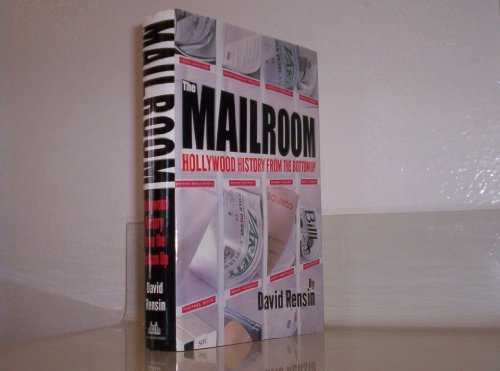
A tell-all journey inside a talent agency mailroom traces sixty-five years of Hollywood history to recount the real stories behind how careers have been made--or destroyed--offering entertaining anecdotes and behind-the-scenes gossip about Barry Diller, David Geffen, Mike Ovitz, and other Hollywood insiders.
Die Inhaltsangabe kann sich auf eine andere Ausgabe dieses Titels beziehen.
Über die Autorin bzw. den Autor
<b>David Rensin</b> is the coauthor of show business legend Bernie Brillstein’s widely lauded memoir, <i>Where Did I Go Right</i>, as well as Olympian Louis Zamperini’s World War II survival saga, <i>Devil At My Heels</i> and composer/performer Yanni’s memoir, <i>Yanni: In Words</i>. Rensin also co-wrote Tim Allen’s #1 bestseller <i>Don’t Stand Too Close To a Naked Man</i> and Allen’s follow-up bestseller,<i> I’m Not Really Here</i>. He has co-written bestsellers with Chris Rock, Jeff Foxworthy, and Garry Shandling, and co-authored a groundbreaking humorous sociology of men named Bob, called <i>The Bob Book</i>. He lives in Los Angeles with his wife and son.
Aus dem Klappentext
It’s like something out of a Hollywood potboiler: start out in the mailroom, end up a mogul. Only for dozens of Hollywood’s brightest, it happens to be true. Some of the biggest names in entertainment—including David Geffen, Barry Diller, and Mike Ovitz—began as trainees in musty talent agency mailrooms. Now, in this fascinating new book, veteran Hollywood writer David Rensin travels behind the scenes and through sixty-five years of show business history to tell the real stories of the marvelous careers that began—and in some cases ended––in the mailroom.<br><br>Based on more than two hundred interviews, Rensin unfolds the never-before-told history of an American institution––in the voices of the people who lived it. Through seven decades of glamour and humiliation, lousy pay and incredible perks, killer egos and a kill-or-be-killed ethos, you’ll go where the trainees go, do what they must do to get ahead, and hear the best insider stories from the Hollywood everyone knows about but no one <i>really</i> knows. The kids in <i>The Mailroom</i> have done it all: from hanging out with Elvis to delivering a senior agent’s urine sample to the doctor; from pouring drinks for Sinatra to sending ice to Johnny Carson on the Nile; from crashing the Academy Awards ceremony to hoping to deliver more than just the mail to sexy actresses’ homes.<br><br><i>The Mailroom </i>reveals why Harvard MBAs fight to turn down secure six-digit corporate salaries to start work at a major agency for less than $400 a week; what it takes to appease impossible bosses, outsmart the competition, and “agent” the agents; and how a hungry, star-struck kid can become the next Geffen or Diller by sorting mail, eavesdropping on crucial conversations, and trying anything to get noticed. <br><br>Full of revealing stories and delicious dish, <i>The Mailroom </i>is not only a non-stop, engrossing read, but a crash course, taught by the experts, on how to succeed in Hollywood through hard work, shrewd manipulation, and a hell of a lot of nerve. <i>The Mailroom </i>is classic Hollywood—a vibrant and complex tapestry of dreams, desire, exploitation, power, and genuine talent. If you want to know who rules Hollywood and how they got their power, if you want to know how to start with nothing and get ahead in <i>any</i> business, this is the book you must read.
Auszug. © Genehmigter Nachdruck. Alle Rechte vorbehalten.
KIDS AT WORK
William Morris Agency, New York, 1937-1951
LOU Weiss, 1937 ; Sol Leon, 1938 ; Larry Auerbach, 1944 ;
Hilly Elkins, 1950 ; Leonard Hirshan, 1951
My sense of what I had to do was simple:
get out of the mailroom as fast as I could.
--Hilly Elkins
lou weiss: My recollection of all this is unfortunately perfect.
I was interested in the entertainment business because my uncle was George Burns. My mother was one of his seven sisters, and whenever he was in town, we'd all go to see him perform. I loved being backstage near talented people.
My mother wanted me to go to college. I'd rather have hung out with the guys and played ball, or gone to a poolroom, or chased the girls, but school is what she wanted. When she died young, in July 1937, I immediately dropped out of school and went to work. Another uncle, Willie Burns--George's manager and writer--called Abe Lastfogel, the boss at the William Morris Agency, and asked him to give me a job of any sort. Nat Lefkowitz and Morris Stoller interviewed me, and in August 1937, when I was nineteen, I got a job as an office boy at twelve dollars a week.
sol leon: I grew up in Brooklyn. My father was in the women's coats and suits business. He was able to put me through the first year of college at NYU-Heights, but when the Depression hit he said, "Sorry. I can't afford to send you back."
I got a job and went to Brooklyn Law at night. I sat next to Nat Lefkowitz in class for four years; it was alphabetical. Morris Stoller was also there. Lefkowitz and Stoller worked at William Morris; Nat practically ran the place under Bill Morris Jr. When I became disenchanted with the law, I asked him to find a place for me.
I started October 1, 1938; I was twenty-five. Nat made me head of the mailroom, while Stoller trained me in business affairs. I had nothing directly to do with handling mail. My job was to tear off the Teletypes and distribute them. Get theater tickets. Get train tickets for Mr. Lastfogel; he didn't fly to California then. Anything that had to be delivered or sorted, I'd delegate. I just told the kids what to do.
weiss: Before Sol Leon came to oversee the mailroom, "Uncle Henry"--Bill Morris Sr.'s wife's cousin--supervised the office boys. He was an elderly guy who didn't hesitate to crack the whip and make sure we weren't off playing cards someplace. I wish now that I had behaved myself better. I wasted a lot of time. I'd rather have gone dancing than deliver a script, listen to great bands and vocalists in Harlem than sort mail. I hung out at the Savoy Ballroom and watched Billy Eckstine and Sarah Vaughn and Ella Fitzgerald and Ellington. I was also hooked on comics and comedy writers. I loved to go to Lindy's and hang around, try to get myself recognized.
leon: I wanted to fire Lou Weiss, but I couldn't because he was George Burns's nephew.
weiss: Maybe because I always dressed better than Sol Leon [laughs]. He'd get very upset.
larry auerbach: My father was in the dairy restaurant business in Brooklyn. After the stock market crashed, he opened a smaller place but he didn't own the building, and when the city built a new highway, they tore it down, leaving him to sell off his tables and chairs. He was dejected and sad, and the pain of watching him spend more than a year looking for another situation is still vivid.
I had a work ethic early. When school let out for the summer, I'd always find a job. At twelve I helped my grandparents at their cleaning store, making deliveries. At thirteen I worked for a friend of the family, stacking cans neatly in the Epicurean Department of Gimbel's. The next summer a friend to whom my uncle sold stationery asked me, "Would you like to work in a theatrical agency?"
I had no idea what that was, so he told me a little bit about it, and I said, "Yeah, it sounds better than delivering suits."
I got the job at William Morris in June 1944. It was just for the summer, running things around town, mimeographing. I didn't care. It was New York, the big city, exciting and glamorous. I was just shy of fifteen, a little younger than most people in the mailroom. A few years later I was also the youngest ever made an agent at William Morris--to my knowledge. Norman Brokaw claims he was, but what's the difference now?
hilly elkins: I went to the theater often and from the first was attracted to the idea of putting together what I saw on the stage. When I was fifteen I auditioned for a radio program at WNYC and got in. I ran the sound board, produced, directed, wrote, acted.
At Brooklyn College my drama coach was Gordon Davidson's dad. Gordon--who has for years been artistic director of the Center Theatre Group/Mark Taper Forum of Los Angeles--and I were friends and opened a tent theater in Belle Harbor. I had a combination job: producer, star, and janitor. It didn't lose too much money, but we ran it into the ground.
I thought maybe learning the agency business would be a good way of getting a rounded entertainment education. People were in either the theater, nightclubs, or motion pictures. But now it was the beginning of television. Milton Berle and the Colgate Comedy Hour. The only players were William Morris and what was then MCA. I thought it was an interesting opportunity.
I came in cold. Sid Feinberg interviewed me. I was eighteen; I already had my college degree and was starting law school. I gave it up for a job in the mailroom.
leonard hirshan: I could say I loved movies and went all the time when I was ten years old, and knew about directors and scripts, and loved the actors, and said to my father that one day I would grow up and be an agent--but that's not true. No one tells their parents they want to grow up to be an agent. Until I applied for a job at William Morris, I hadn't the slightest idea of what the agency business was, or any desire to be in show business. The fates pushed me there.
I got out of the navy in December 1947 and applied to NYU. I'm a very compulsive person, so I went to school all year long and graduated in about half the normal time, in August 1950, on a Friday. Having been accepted at NYU law school, I started the next Monday, but after a few months I burned out. I decided to take a leave of absence after the first semester, get a job for a while, and then go back.
I asked my uncle, who had booked shows at the Temple Emmanuel, what kind of temporary situations I could find. He lived in the same building as Nat Kalcheim, an important agent at the Morris office, who told him to have me call Sid Feinberg.
RULE #1
weiss: We called the boss Mr. Lastfogel, never Abe. Years later I was sitting with him and Elvis' manager, Colonel Parker at Hillcrest Country Club in Los Angeles, and Colonel Parker said, "Abe, why don't you let Lou call you Abe?"
Mr. Lastfogel said, "He can call me Abe."
I said, "I don't call my father Sam. I'm not going to call you Abe."
It was automatic with all of us.
hirshan: There was a Nedicks stand in the lobby of our building, 1270 Sixth Avenue, where they sold hot dogs and orange drinks. Whenever I walked by, I'd want something to eat and drink, but I wouldn't do it because I didn't want anyone from the office to think that's where I got my food--until the day I saw Mr. Lastfogel standing there with a hot dog and drink. That's when I realized the democracy of William Morris and dropped all my airs.
weiss: Mrs. Lastfogel--Frances Arms--was a comic and a performer, and it was rare that she'd ever come up to the office. But one day she did and said, "Get Lou Weiss out of the stockroom." I couldn't imagine what she wanted. To my surprise she said, "Lou, let me see the new dance steps." We put on a record and...
„Über diesen Titel“ kann sich auf eine andere Ausgabe dieses Titels beziehen.
Suchergebnisse für The Mailroom: Hollywood History from the Bottom Up

Beispielbild für diese ISBN
The Mailroom Hollywood History
Anbieter: World of Books (was SecondSale), Montgomery, IL, USA
Verkäuferbewertung 5 von 5 Sternen

Zustand: Good. Item in good condition. Textbooks may not include supplemental items i.e. CDs, access codes etc. Artikel-Nr. 00105233832
Gebraucht kaufen
EUR 5,71
Versand gratis
Versand innerhalb von USA
Versand innerhalb von USA
Anzahl: 4 verfügbar
Beispielbild für diese ISBN
The Mailroom: Hollywood History from the Bottom Up
Anbieter: ThriftBooks-Dallas, Dallas, TX, USA
Verkäuferbewertung 5 von 5 Sternen
Hardcover. Zustand: Very Good. No Jacket. May have limited writing in cover pages. Pages are unmarked. ~ ThriftBooks: Read More, Spend Less. Artikel-Nr. G0345442342I4N00
Gebraucht kaufen
EUR 5,96
Versand gratis
Versand innerhalb von USA
Versand innerhalb von USA
Anzahl: 1 verfügbar
Beispielbild für diese ISBN
The Mailroom: Hollywood History from the Bottom Up
Anbieter: ThriftBooks-Atlanta, AUSTELL, GA, USA
Verkäuferbewertung 5 von 5 Sternen
Hardcover. Zustand: Good. No Jacket. Missing dust jacket; Pages can have notes/highlighting. Spine may show signs of wear. ~ ThriftBooks: Read More, Spend Less. Artikel-Nr. G0345442342I3N01
Gebraucht kaufen
EUR 5,96
Versand gratis
Versand innerhalb von USA
Versand innerhalb von USA
Anzahl: 1 verfügbar
Beispielbild für diese ISBN
The Mailroom: Hollywood History from the Bottom Up
Anbieter: ThriftBooks-Atlanta, AUSTELL, GA, USA
Verkäuferbewertung 5 von 5 Sternen
Hardcover. Zustand: Fair. No Jacket. Readable copy. Pages may have considerable notes/highlighting. ~ ThriftBooks: Read More, Spend Less. Artikel-Nr. G0345442342I5N00
Gebraucht kaufen
EUR 5,96
Versand gratis
Versand innerhalb von USA
Versand innerhalb von USA
Anzahl: 1 verfügbar
Beispielbild für diese ISBN
The Mailroom : Hollywood History from the Bottom Up
Verlag:
Random House Publishing Group, 2003
ISBN 10: 0345442342
ISBN 13: 9780345442345
Gebraucht
Hardcover
Erstausgabe
Anbieter: Better World Books, Mishawaka, IN, USA
Verkäuferbewertung 5 von 5 Sternen
Zustand: Good. 1st Edition. Former library copy. Pages intact with minimal writing/highlighting. The binding may be loose and creased. Dust jackets/supplements are not included. Includes library markings. Stock photo provided. Product includes identifying sticker. Better World Books: Buy Books. Do Good. Artikel-Nr. 4205721-6
Gebraucht kaufen
EUR 8,66
Versand gratis
Versand innerhalb von USA
Versand innerhalb von USA
Anzahl: 1 verfügbar
Beispielbild für diese ISBN
The Mailroom : Hollywood History from the Bottom Up
Verlag:
Random House Publishing Group, 2003
ISBN 10: 0345442342
ISBN 13: 9780345442345
Gebraucht
Hardcover
Erstausgabe
Anbieter: Better World Books, Mishawaka, IN, USA
Verkäuferbewertung 5 von 5 Sternen
Zustand: Very Good. 1st Edition. Pages intact with possible writing/highlighting. Binding strong with minor wear. Dust jackets/supplements may not be included. Stock photo provided. Product includes identifying sticker. Better World Books: Buy Books. Do Good. Artikel-Nr. 7816682-75
Gebraucht kaufen
EUR 8,66
Versand gratis
Versand innerhalb von USA
Versand innerhalb von USA
Anzahl: 1 verfügbar
Beispielbild für diese ISBN
The Mailroom : Hollywood History from the Bottom Up
Verlag:
Random House Publishing Group, 2003
ISBN 10: 0345442342
ISBN 13: 9780345442345
Gebraucht
Hardcover
Erstausgabe
Anbieter: Better World Books, Mishawaka, IN, USA
Verkäuferbewertung 5 von 5 Sternen
Zustand: Good. 1st Edition. Pages intact with minimal writing/highlighting. The binding may be loose and creased. Dust jackets/supplements are not included. Stock photo provided. Product includes identifying sticker. Better World Books: Buy Books. Do Good. Artikel-Nr. 8270082-6
Gebraucht kaufen
EUR 8,66
Versand gratis
Versand innerhalb von USA
Versand innerhalb von USA
Anzahl: 1 verfügbar
Beispielbild für diese ISBN
The Mailroom : Hollywood History from the Bottom Up
Verlag:
Random House Publishing Group, 2003
ISBN 10: 0345442342
ISBN 13: 9780345442345
Gebraucht
Hardcover
Erstausgabe
Anbieter: Better World Books: West, Reno, NV, USA
Verkäuferbewertung 5 von 5 Sternen
Zustand: Very Good. 1st Edition. Pages intact with possible writing/highlighting. Binding strong with minor wear. Dust jackets/supplements may not be included. Stock photo provided. Product includes identifying sticker. Better World Books: Buy Books. Do Good. Artikel-Nr. 7816682-75
Gebraucht kaufen
EUR 8,66
Versand gratis
Versand innerhalb von USA
Versand innerhalb von USA
Anzahl: 1 verfügbar
Beispielbild für diese ISBN
The Mailroom : Hollywood History from the Bottom Up
Verlag:
Random House Publishing Group, 2003
ISBN 10: 0345442342
ISBN 13: 9780345442345
Gebraucht
Hardcover
Erstausgabe
Anbieter: Better World Books: West, Reno, NV, USA
Verkäuferbewertung 5 von 5 Sternen
Zustand: Fine. 1st Edition. Used book that is in almost brand-new condition. May contain a remainder mark. Better World Books: Buy Books. Do Good. Artikel-Nr. 11501183-6
Gebraucht kaufen
EUR 8,66
Versand gratis
Versand innerhalb von USA
Versand innerhalb von USA
Anzahl: 1 verfügbar
Foto des Verkäufers
The mailroom : Hollywood history from the bottom up. [Norman Brokaw: William Morris Agency, Los Angeles, 1943; Ron Meyer: Paul Kohner Agency, Los Angeles, 1963;
Verlag:
New York :; Ballantine Books, 2003., 2003
ISBN 10: 0345442342
ISBN 13: 9780345442345
Gebraucht
Hardcover
Erstausgabe
Anbieter: Joseph Valles - Books, Stockbridge, GA, USA
Verkäuferbewertung 5 von 5 Sternen
Hardcover. Zustand: Very Good. Zustand des Schutzumschlags: Very Good. 1st Edition. 1st edition, 1st printing ; xxiii, 439 pp. ; 25 cm. ; ISBN: 0345442342; 9780345442345 ; LCCN: 2003-544683 ; LC: PN1993.5.U65; Dewey: 791.43/09794/93 ; OCLC: 51565606 ; beige and red cloth with gold lettering, in color photographic dustjacket ; " I delivered to Marilyn Monroe. She had just started, but I knew who she was. Her guy at William Morris was Johnny Hyde, a terrific agent, and there was some romance going on between them. I also took something to Gloria DeHaven. She opened the door i n her underwear. I was too young to know if I was getting an invitation to come inside, and if I was, I didn't know what to do about it. The only thing I remember is that her underwear was pink. Later I decided that I had really blown it!" ; VG/VG. Book. Artikel-Nr. 4374
Gebraucht kaufen
EUR 24,45
EUR 14,90 Versand
Versand innerhalb von USA
Versand innerhalb von USA
Anzahl: 1 verfügbar