
Verwandte Artikel zu The Childhood Roots of Adult Happiness: Five Steps...
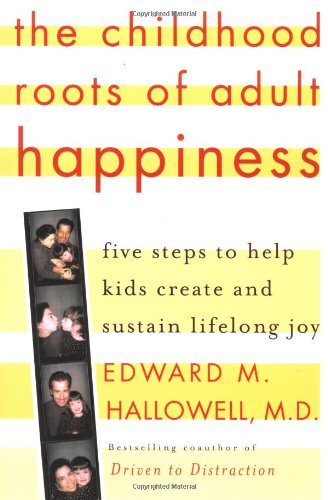
The Childhood Roots of Adult Happiness: Five Steps to Help Kids Create and Sustain Lifelong Joy - Hardcover
Inhaltsangabe
Outlining a five-step plan that parents can use to help their children achieve lifelong happiness, the co-author of Driven to Distraction emphasizes the role of connection, play, practice, mastery, and recognition in raising youngsters with a healthy self-esteem, moral awareness, and spiritual values that hold the key to fostering trust, respect, and joy.
Die Inhaltsangabe kann sich auf eine andere Ausgabe dieses Titels beziehen.
Über die Autorin bzw. den Autor
<b>Edward M. Hallowell, M.D.</b>, is an instructor at Harvard Medical School and director of the Hallowell Center for Cognitive and Emotional Health in Sudbury, Massachusetts, an outpatient treatment center serving children and adults with a wide range of emotional and learning problems. He is the coauthor of <i>Driven to Distraction </i>(with John J. Ratey, M.D.) and the author of <i>When You Worry About the Child You Love</i>, <i>Worry</i>, and <i>Connect</i>, among other titles. He and his wife have three children and they live in Arlington, Massachusetts. He welcomes hearing from readers, and can be reached through his Web site: www.DrHallowell.com.
Aus dem Klappentext
Here, at last, is a book brimming with the good news of raising children—the basic reassuring news about happiness and unconditional love, about enduring family connections and kids who grow up right. Edward M. Hallowell, M.D., father of three and a clinical psychiatrist, has thought long and hard about what makes children feel good about themselves and the world they live in. Now, in <i>The Childhood Roots of Adult Happiness</i>, Dr. Hallowell shares his findings with all of us who care about children. <br><br>As Dr. Hallowell argues, we don’t need statistical studies or complicated expert opinions to raise children. What we <i>do</i> need is love, wonder, and the confidence to trust our instincts. This inspiring book outlines a 5-step plan that all parents can use in giving their children the gift of happiness that will last a lifetime. Connection, play, practice, mastery, and recognition: as fundamental as these five concepts are, they hold the key to raising children with healthy self-esteem, moral awareness, and spiritual values. Dr. Hallowell explores each step in depth and shows how they work together to foster trust, respect, and joy.<br><br>Privilege, wealth, and expensive “extras” are <i>not</i> necessary for happiness—there are many stories here of children who have overcome poverty, abandonment, and shocking deprivation to find true fulfillment. Dr. Hallowell encourages us as parents to reconnect with the moments in our own childhoods that made a difference; he explores the impact of genetics and environmental factors on the inner workings of a child’s mind; and he discusses how activities like team sports, community service, religious observance, and household chores can foster a child’s sense of mastery. <br><br>Like the works of T. Berry Brazelton and Benjamin Spock, <i>The Childhood Roots of Adult Happiness </i>is infused with the wisdom and humanity of a doctor who truly loves and understands children. Writing with the warmth of a friend and the authority of an expert, Dr. Hallowell gives us a book at once practical and exuberant, joyous and informative, eye-opening and reassuring. Ultimately, this book is a celebration of childhood and of the magic that happens between parents and the children they love.
Auszug. © Genehmigter Nachdruck. Alle Rechte vorbehalten.
WHAT DO I REALLY WANT FOR MY CHILDREN? Think of your children. Bring their faces to your mind. Then ask yourself, "What do I really want for them in their lives?"
Don't assume you know. Before you spend another day as a parent (or as a teacher or a coach or anyone else involved with children), try to answer this deceptively simple question: What do I really want for my children?
Is it trophies and prizes and stardom? Do you want them all to grow up and become president of the United States? Is it riches and financial security? Is it true love? Or is it just a better life than the one you have now?
On some days you might quickly reply, "I just want them to clean up their rooms, do their homework, and obey me when I speak." On other days, when you are caught up in the pressures your children are feeling at school, you might desperately reply, "I just want my children to get high SAT scores and be admitted to Prestige College."
But if you linger over the question, your reply will almost certainly include one particular word: the simple, even silly-seeming word happy. Most of us parents just want our children to be happy, now and forever. Oh, sure, we also want them to be good people; we want them to contribute to the world; we want them to care for others and lead responsible lives. But deep down, most of us, more than anything else, want our children to be happy.
If we take certain steps, we can actually make it happen. Recent research has proved that parents and teachers can greatly increase the chances that their children and students will grow up to be happy, responsible adults by instilling certain qualities that might not seem of paramount importance but in fact are-inner qualities such as optimism, playfulness, a can-do attitude, and connectedness (the feeling of being a part of something larger than yourself). While traditional advice urges parents to instill discipline and a strong work ethic in their children, that advice can backfire when put into practice. The child may resist or do precisely the opposite of what is asked or even comply, but joylessly. That joylessness can last a whole life long.
We need a more reliable route to lifelong joy than can be provided by lectures on discipline or rewards for high grades and hard work. Of course, discipline and hard work matter, as do grades and civil behavior. But how you reach those goals is key. The engine of a happy life runs better on the power of connection and play than on the power of fear and guilt.
A happy life. Such a simple term for such a universal, heartfelt goal. You may not be able to define happiness, but you know it when you see it. Can you bring to mind a happy day from your own childhood? Let me tell you about one from mine.
I remember a day when I was eight years old, living in Chatham, Massachusetts. The night before, we'd had a big snowstorm, what they call in New England a nor'easter, and the storm had covered my little town on the elbow of Cape Cod with snowdrifts so high we could barely open our doors. Naturally school was closed that day.
I lived next door to my cousin Jamie, and I had spent the night at his house. When we woke up and found ourselves buried under snow, we let out a hoot. A snow day!
After shoveling out, we took the new toboggan Jamie had received for Christmas to the nearby golf course, which was full of hills. We trudged our way up the highest hill, each step spilling the powdery snow over the tops of our buckled galoshes and down into them, soaking our socks and feet. We were little mountaineers, scaling the summit of Mount Toboggan.
At last we made it to the top of what seemed like a sledders' heaven. We angled the toboggan this way and that, trying to figure out which route would give us the longest ride. I got in front, Jamie gave us a push and jumped on behind me, and our first ride began. We nearly tipped over right at the start, but we held steady, gathered speed, and zoomed down the hill, through the reeds surrounding the pond below, and out over the snow that covered the frozen water. When we came to a stop in the middle of what was called the lily pond, we both cried out, "Let's do that again!" and started the long trek back up the hill.
We tobogganed down that hill maybe fifty times that day. We added thrills to the rides by building moguls and banked curves on our course. As the snow packed down, icy spots propelled us to breakneck speeds. We never went home for lunch-we didn't even think about lunch-and no one came looking for us. They knew we were safe.
That was as happy a day as I have ever had. Even though the conditions of my life were far from perfect at the time-my parents had divorced because of my father's mental illness, and my mother was now seeing the man who would become the stepfather I grew to hate-that didn't matter. I felt loved and secure in the world, even though my world was insecure.
Jamie was my best friend. Although he was two years older than I, he treated me like a pal, not an annoying younger cousin. When we tobogganed down that hill, free from school, free from schedules, free to do exactly what we wanted to do, I felt as good as a person can feel. I was with my great friend Jamie, doing something that was exciting and fun.
I didn't know it at the time, but I was also doing what I recommend in this book. I was learning how to create and sustain joy, a tremendously important skill. I was also acquiring the all-important qualities of playfulness, optimism, a can-do attitude, and connectedness-qualities that have deepened in me since then, qualities that make me, for the most part, a happy man.
On that day, and on others just as special, I learned about the ingredients of happiness. I imagine you've had days like that, too. I want to remind you of those days in this book and give you some ideas about how to create them in children's lives today.
One way to define happiness is as a feeling that your life is going well. That feeling doesn't have to start in childhood, but that's a good place for it to start if you want it to become a habit that endures. The problem is that there is no foolproof plan for exactly how to start it there (or anywhere else). We are left to wonder why some children are happy while others are not, even though the circumstances of their lives may be similar; we also wonder why some happy children grow up to be unhappy adults while some unhappy children turn into happy adults. At first glance happiness can seem as if it depends on the luck of the draw.
I know. I am a parent myself. I am the father, and my wife, Sue, is the mother, of three young children, aged twelve, nine, and six as I write these words. I am also a child and adult psychiatrist still active in my practice, and I am the author of several books about children, families, and schools. I am immersed, both personally and professionally, in childhood. I researched and wrote this book because I wanted a reliable guide for myself and others about what can-and should-go right for children.
There is a psychologist with a name that seems impossible to pronounce, Mihaly Csikszentmihalyi, who is revolutionizing psychology, turning it from a field that studies mainly misery into a field that studies joy. (By the way, his name is pronounced ME-high Chick-sent-ME-high.) His detailed, empirical studies of the roots of happiness have led him to conclude, "Happiness is not something that happens to people but something that they make happen." His research shows that people are happiest in a state he has named "flow." In a state of flow, you are one with what you are doing.
Children know flow well. They call it play. Play is one of the childhood roots of adult happiness. But there are others-four others, to be exact-in the schema I outline in this...
„Über diesen Titel“ kann sich auf eine andere Ausgabe dieses Titels beziehen.
Suchergebnisse für The Childhood Roots of Adult Happiness: Five Steps...

Beispielbild für diese ISBN
The Childhood Roots of Adult Happiness: Five Steps to Help Kids Create and Sustain Lifelong Joy
Anbieter: World of Books (was SecondSale), Montgomery, IL, USA
Verkäuferbewertung 5 von 5 Sternen

Zustand: Good. Item in good condition. Textbooks may not include supplemental items i.e. CDs, access codes etc. Artikel-Nr. 00087307177
Gebraucht kaufen
EUR 4,51
Versand gratis
Versand innerhalb von USA
Versand innerhalb von USA
Anzahl: 4 verfügbar
Beispielbild für diese ISBN
The Childhood Roots of Adult Happiness: Five Steps to Help Kids Create and Sustain Lifelong Joy
Anbieter: World of Books (was SecondSale), Montgomery, IL, USA
Verkäuferbewertung 5 von 5 Sternen
Zustand: Acceptable. Item in acceptable condition! Textbooks may not include supplemental items i.e. CDs, access codes etc. Artikel-Nr. 00089139484
Gebraucht kaufen
EUR 4,51
Versand gratis
Versand innerhalb von USA
Versand innerhalb von USA
Anzahl: 1 verfügbar
Beispielbild für diese ISBN
The Childhood Roots of Adult Happiness: Five Steps to Help Kids Create and Sustain Lifelong Joy
Anbieter: World of Books (was SecondSale), Montgomery, IL, USA
Verkäuferbewertung 5 von 5 Sternen
Zustand: Very Good. Item in very good condition! Textbooks may not include supplemental items i.e. CDs, access codes etc. Artikel-Nr. 00088454603
Gebraucht kaufen
EUR 4,51
Versand gratis
Versand innerhalb von USA
Versand innerhalb von USA
Anzahl: 2 verfügbar
Beispielbild für diese ISBN
The Childhood Roots of Adult Happiness: Five Steps to Help Kids Create and Sustain Lifelong Joy
Verlag:
Ballantine Books (edition First Edition), 2002
ISBN 10: 0345442326
ISBN 13: 9780345442321
Gebraucht
Hardcover
Erstausgabe
Anbieter: BooksRun, Philadelphia, PA, USA
Verkäuferbewertung 5 von 5 Sternen
Hardcover. Zustand: Very Good. First Edition. With dust jacket. It's a well-cared-for item that has seen limited use. The item may show minor signs of wear. All the text is legible, with all pages included. It may have slight markings and/or highlighting. Artikel-Nr. 0345442326-11-1-29
Gebraucht kaufen
EUR 4,90
Versand gratis
Versand innerhalb von USA
Versand innerhalb von USA
Anzahl: 1 verfügbar
Beispielbild für diese ISBN
The Childhood Roots of Adult Happiness: Five Steps to Help Kids Create and Sustain Lifelong Joy
Anbieter: ThriftBooks-Dallas, Dallas, TX, USA
Verkäuferbewertung 5 von 5 Sternen
Hardcover. Zustand: Very Good. No Jacket. May have limited writing in cover pages. Pages are unmarked. ~ ThriftBooks: Read More, Spend Less. Artikel-Nr. G0345442326I4N00
Gebraucht kaufen
EUR 5,94
Versand gratis
Versand innerhalb von USA
Versand innerhalb von USA
Anzahl: 1 verfügbar
Beispielbild für diese ISBN
The Childhood Roots of Adult Happiness: Five Steps to Help Kids Create and Sustain Lifelong Joy
Anbieter: ThriftBooks-Atlanta, AUSTELL, GA, USA
Verkäuferbewertung 5 von 5 Sternen
Hardcover. Zustand: As New. No Jacket. Pages are clean and are not marred by notes or folds of any kind. ~ ThriftBooks: Read More, Spend Less. Artikel-Nr. G0345442326I2N00
Gebraucht kaufen
EUR 5,94
Versand gratis
Versand innerhalb von USA
Versand innerhalb von USA
Anzahl: 1 verfügbar
Beispielbild für diese ISBN
The Childhood Roots of Adult Happiness : Five Steps to Help Kids Create and Sustain Lifelong Joy
Verlag:
Random House Publishing Group, 2002
ISBN 10: 0345442326
ISBN 13: 9780345442321
Gebraucht
Hardcover
Erstausgabe
Anbieter: Better World Books, Mishawaka, IN, USA
Verkäuferbewertung 5 von 5 Sternen
Zustand: Good. 1st. Pages intact with minimal writing/highlighting. The binding may be loose and creased. Dust jackets/supplements are not included. Stock photo provided. Product includes identifying sticker. Better World Books: Buy Books. Do Good. Artikel-Nr. 5239121-6
Gebraucht kaufen
EUR 6,33
Versand gratis
Versand innerhalb von USA
Versand innerhalb von USA
Anzahl: 1 verfügbar
Beispielbild für diese ISBN
The Childhood Roots of Adult Happiness : Five Steps to Help Kids Create and Sustain Lifelong Joy
Verlag:
Random House Publishing Group, 2002
ISBN 10: 0345442326
ISBN 13: 9780345442321
Gebraucht
Hardcover
Erstausgabe
Anbieter: Better World Books, Mishawaka, IN, USA
Verkäuferbewertung 5 von 5 Sternen
Zustand: Good. 1st. Former library copy. Pages intact with minimal writing/highlighting. The binding may be loose and creased. Dust jackets/supplements are not included. Includes library markings. Stock photo provided. Product includes identifying sticker. Better World Books: Buy Books. Do Good. Artikel-Nr. GRP77967821
Gebraucht kaufen
EUR 6,33
Versand gratis
Versand innerhalb von USA
Versand innerhalb von USA
Anzahl: 2 verfügbar
Beispielbild für diese ISBN
The Childhood Roots of Adult Happiness: Five Steps to Help Kids Create and Sustain Lifelong Joy
Verlag:
Ballantine Books, 2002
ISBN 10: 0345442326
ISBN 13: 9780345442321
Gebraucht
Hardcover
Signiert
Anbieter: Wonder Book, Frederick, MD, USA
Verkäuferbewertung 5 von 5 Sternen
Zustand: Very Good. Signed Copy . Very Good dust jacket. Inscribed by author on title page. Artikel-Nr. F01OS-01335
Gebraucht kaufen
EUR 12,65
Versand gratis
Versand innerhalb von USA
Versand innerhalb von USA
Anzahl: 1 verfügbar
Beispielbild für diese ISBN
The Childhood Roots of Adult Happiness: Five Steps to Help Kids Create and Sustain Lifelong Joy
Anbieter: WorldofBooks, Goring-By-Sea, WS, Vereinigtes Königreich
Verkäuferbewertung 5 von 5 Sternen
Paperback. Zustand: Very Good. The book has been read, but is in excellent condition. Pages are intact and not marred by notes or highlighting. The spine remains undamaged. Artikel-Nr. GOR008501778
Gebraucht kaufen
EUR 8,75
EUR 6,59 Versand
Versand von Vereinigtes Königreich nach USA
Versand von Vereinigtes Königreich nach USA
Anzahl: 4 verfügbar