
Verwandte Artikel zu Why God Won't Go Away: Brain Science and the Biology...
Inhaltsangabe
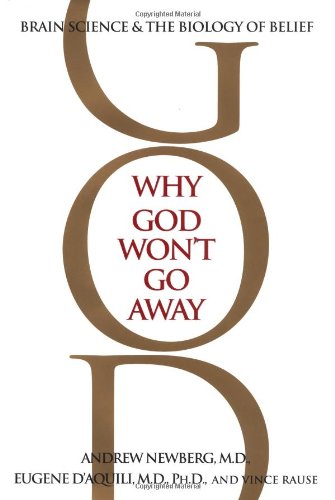
A landmark introduction to the new field of neurotheology explores the complex relationship that exists between spirituality belief and the human brain, examining the link between transcendant religious experience and actual neurological events that occur within the brain. 35,000 first printing.
Die Inhaltsangabe kann sich auf eine andere Ausgabe dieses Titels beziehen.
Über die Autorin bzw. den Autor
Andrew B. Newberg, M.D., is an assistant professor in the Department of Radiology in the Division of Nuclear Medicine and an instructor in the Department of Religious Studies at the University of Pennsylvania. He has spent more than six years studying brain physiology and function, with focus on the neurology of religious and mystical experiences. The co-author, with Dr. Eugene d'Aquili, of The Mystical Mind, Dr. Newberg has presented his work at scientific and religious conferences around the world.
Eugene d'Aquili, M.D., Ph.D., was a clinical assistant professor in the Department of Psychiatry at the University of Pennsylvania for twenty years. His numerous books include Biogenetic Structuralism; Brain, Symbol and Experience; and The Mystical Mind.
Auszug. © Genehmigter Nachdruck. Alle Rechte vorbehalten.
Chapter One
A Photograph of God? An introduction to the Biology of Belief
In a small, dark room at the lab of a large university hospital, a young man named Robert lights candles and a stick of jasmine incense; he then settles to the floor and folds his legs easily into the lotus position. A devout Buddhist and accomplished practitioner of Tibetan meditation, Robert is about to begin another meditative voyage inward. As always, his goal is to quiet the constant chatter of the conscious mind and lose himself in the deeper, simpler reality within. It’s a journey he’s made a thousand times before, but this time, as he drifts off into that inner spiritual reality-as the material world around him recedes like a fading dream-he remains tethered to the physical here and now by a length of common cotton twine.
One end of that twine lies in a loose coil at Robert’s side. The other end runs beneath a closed laboratory door and into an adjoining room, where I sit, beside my friend and longtime research partner Dr. Eugene d’Aquili, with the twine wrapped around my finger. Gene and I are waiting for Robert to tug on the twine, which will be our signal that his meditative state is approaching its transcendent peak. It is this peak moment of spiritual intensity that interests us.
For years, Gene and I have been studying the relationship between religious experience and brain function, and we hope that by monitoring Robert’s brain activity at the most intense and mystical moments of his meditation, we might shed some light on the mysterious connection between human consciousness and the persistent and peculiarly human longing to connect with something larger than ourselves.
In earlier conversations, Robert has struggled to describe for us how he feels as his meditation progresses toward this spiritual peak. First, he says, his conscious mind quiets, allowing a deeper, simpler part of himself to emerge. Robert believes that this inner self is the truest part of who he is, the part that never changes. For Robert, this inner self is not a metaphor or an attitude; it is literal, constant, and real. It is what remains when worries, fears, desires, and all other preoccupations of the conscious mind are stripped away. He considers this inner self the very essence of his being. If pressed, he might even call it his soul.
Whatever Robert calls this deeper consciousness, he claims that when it emerges during those moments of meditation when he is most completely absorbed in looking inward, he suddenly understands that his inner self is not an isolated entity, but that he is inextricably connected to all of creation. Yet when he tries to put this intensely personal insight into words he finds falling back on familiar cliches that have been employed for centuries to express the elusive nature of spiritual experience. “There’s a sense of timelessness and infinity,” he might say. “It feels like I am part of everyone and everything in existence.”
To the traditional scientific mind, of course, these terms are useless. Science concerns itself with that which can be weighed, counted, calculated, and measured-anything that can’t be verified by objective observation simply can’t be called scientific. Although individual scientists might be personally intrigued by Robert’s experience, as professionals they’d likely dismiss his comments as too personal and speculative to signify anything concrete in the physical world.
Years of research, however, have led Gene and me to believe that experiences like Robert’s are real, and can be measured and verified by solid science. That’s exactly why I’m huddling, beside Gene, in this cramped examination room, holding kite string between my fingers: I’m waiting for Robert’s moment of mystical transcendence to arrive, because I intend to take its picture.
We wait one hour, while Robert meditates. Then I feel a gentle jerk on the twine. This is my cue to inject a radioactive material into a long intravenous line that also runs into Robert’s room, and into a vein into his left arm. We wait a few moments more for Robert to end his meditation, then we whisk him off to a room in the hospital’s Nuclear Medicine Department, where a massive, state-of-the-art SPECT camera awaits. In moments, Robert is reclining on a metal table, the camera’s three large crystal heads orbiting his skull with a precise, robotic whir.
The SPECT camera (the acronym stands for single photon emission computed tomography) is a high-tech imaging tool that detects radioactive emissions. The SPECT camera scans inside Robert’s head by detecting the location of the radioactive tracer we injected when Robert tugged on the string. Because the tracer is carried by blood flow, and because this particular tracer locks almost immediately into brain cells and remains there for hours, the SPECT scans of Robert’s head will give us an accurate freeze-frame of blood flow patterns in Robert’s brain just moments after injection-at the point of his meditative climax.
Increased blood flow to a given part of the brain correlates with heightened activity in that particular area, and vice-versa. Since we have a good idea of the specific functions that are performed by various brain regions, we expect the SPECT images to tell us a lot about what Robert’s brain was doing during the peak moments of his meditation.
We aren’t disappointed. The finished scan images show unusual activity in a small lump of gray matter nestled in the top rear section of the brain. The proper name of this highly specialized bundle of neurons is the posterior superior parietal lobe, but for the purposes of this book, Gene and I have dubbed it the orientation association area, of OAA.
The primary job of the OAA is to orient the individual in physical space-it keeps track of which end is up, helps us judge angles and distances, and allows us to negotiate safely the dangerous physical landscape around us. To perform this crucial function, it must first generate a clear, consistent cognition of the physical limits of the self. In simpler terms, it must draw a sharp distinction between the individual and everything else, to sort out the you from the infinite not-you that makes up the rest of the universe.
It may seem strange that the brain requires a specialized mechanism to keep tabs on this you/not-you dichotomy; from the vantage point of normal consciousness, the distinction seems ridiculously clear. But that’s only because the OAA does its job so seamlessly and so well. In fact, people who suffer injuries to the orientation area have great difficulty maneuvering in physical space. When they approach their beds, for example, their brains are so baffled by the constantly shifting calculus of angles, depths, and distances that the simple task of lying down becomes an impossible challenge. Without the orientation area’s help in keeping track of the body’s shifting coordinates, they cannot locate themselves in space mentally or physically, so they miss the bed entirely and fall to the floor; or they manage to get their body onto the mattress, but when they try to recline they can only huddle awkwardly against the wall.
In normal circumstances, however, the OAA helps create such a distinct, accurate sense of our physical orientation to the world that we hardly need to give the matter any thought at all. To do its job so well, the orientation area depends on a constant stream of nerve impulses from each of the body’s senses. The OAA sorts and processes these impulses virtually instantaneously during every moment of our lives. It manages a staggering workload at capacities and speeds that would stress the circuits of a...
„Über diesen Titel“ kann sich auf eine andere Ausgabe dieses Titels beziehen.
Suchergebnisse für Why God Won't Go Away: Brain Science and the Biology...

Beispielbild für diese ISBN
Why God Won't Go Away: Brain Science and the Biology of Belief
Anbieter: World of Books (was SecondSale), Montgomery, IL, USA
Verkäuferbewertung 5 von 5 Sternen

Zustand: Good. Item in good condition. Textbooks may not include supplemental items i.e. CDs, access codes etc. Artikel-Nr. 00104182831
Gebraucht kaufen
EUR 5,62
Versand gratis
Versand innerhalb von USA
Versand innerhalb von USA
Anzahl: 8 verfügbar
Beispielbild für diese ISBN
Why God Won't Go Away : Brain Science and the Biology of Belief
Verlag:
Random House Publishing Group, 2001
ISBN 10: 0345440331
ISBN 13: 9780345440334
Gebraucht
Hardcover
Erstausgabe
Anbieter: Better World Books: West, Reno, NV, USA
Verkäuferbewertung 5 von 5 Sternen
Zustand: Good. 1st. Pages intact with minimal writing/highlighting. The binding may be loose and creased. Dust jackets/supplements are not included. Stock photo provided. Product includes identifying sticker. Better World Books: Buy Books. Do Good. Artikel-Nr. 4324669-6
Gebraucht kaufen
EUR 6,09
Versand gratis
Versand innerhalb von USA
Versand innerhalb von USA
Anzahl: 1 verfügbar
Beispielbild für diese ISBN
Why God Won't Go away: Brain Science and the Biology of Belief
Anbieter: WorldofBooks, Goring-By-Sea, WS, Vereinigtes Königreich
Verkäuferbewertung 5 von 5 Sternen
Hardback. Zustand: Very Good. The book has been read, but is in excellent condition. Pages are intact and not marred by notes or highlighting. The spine remains undamaged. Artikel-Nr. GOR004133228
Gebraucht kaufen
EUR 20,50
EUR 6,51 Versand
Versand von Vereinigtes Königreich nach USA
Versand von Vereinigtes Königreich nach USA
Anzahl: 3 verfügbar
Beispielbild für diese ISBN
Why God Won't Go away: Brain Science and the Biology of Belief
Anbieter: WorldofBooks, Goring-By-Sea, WS, Vereinigtes Königreich
Verkäuferbewertung 5 von 5 Sternen
Hardback. Zustand: Good. The book has been read but remains in clean condition. All pages are intact and the cover is intact. Some minor wear to the spine. Artikel-Nr. GOR006508190
Gebraucht kaufen
EUR 20,50
EUR 6,51 Versand
Versand von Vereinigtes Königreich nach USA
Versand von Vereinigtes Königreich nach USA
Anzahl: 1 verfügbar
Beispielbild für diese ISBN
Why God Won't Go away: Brain Science and the Biology of Belief
Anbieter: Revaluation Books, Exeter, Vereinigtes Königreich
Verkäuferbewertung 5 von 5 Sternen
Hardcover. Zustand: Brand New. 1st edition. 226 pages. 9.75x6.50x0.75 inches. In Stock. Artikel-Nr. 0345440331
Neu kaufen
EUR 37,09
EUR 11,63 Versand
Versand von Vereinigtes Königreich nach USA
Versand von Vereinigtes Königreich nach USA
Anzahl: 1 verfügbar
Foto des Verkäufers
Why Won't God Go Away _ Brain Science and the Biology of Belief
Verlag:
Ballantine Books, New York, 2001
ISBN 10: 0345440331
ISBN 13: 9780345440334
Gebraucht
Hardcover
Anbieter: San Francisco Book Company, Paris, Frankreich
Verkäuferbewertung 5 von 5 Sternen
Hardcover. Zustand: Good. Zustand des Schutzumschlags: good. Cloth/dust jacket Octavo. red cloth spine gilt lettering dust jacket 226 pp dust jacket worn at corners. Artikel-Nr. 87232
Gebraucht kaufen
EUR 12,00
EUR 45,00 Versand
Versand von Frankreich nach USA
Versand von Frankreich nach USA
Anzahl: 1 verfügbar