
Verwandte Artikel zu Best Friends, Worst Enemies: Understanding the Social...
Inhaltsangabe
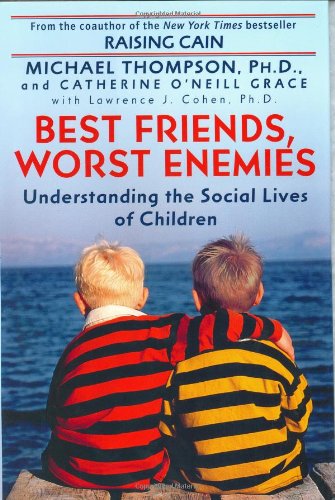
Details the complex nature of children's friendships by providing thought-provoking discussions and heartwarming stories on the difference between friendship and popularity, how boys and girls deal with intimacy and commitments, and more.
Die Inhaltsangabe kann sich auf eine andere Ausgabe dieses Titels beziehen.
Über die Autorin bzw. den Autor
Michael Thompson, Ph.D., is a clinical psychologist, lecturer, consultant and former seventh grade teacher. He conducts workshops on the development of boys and social cruelty in childhood for both public and private schools across the United States. He is the author of Speaking of Boys and coauthor, with Dan Kindlon, Ph.D., of The New York Times bestseller Raising Cain. The father of a daughter and a son, he and his wife observe children’s friendships from their home in Arlington, Massachusetts.
Catherine O’Neill Grace, a writer and editor, is a former elementary, middle, and high school teacher, and was the editor of Independent School magazine. She wrote a column for young readers about health and psychology in The Washington Post for fifteen years, and is the author of numerous nonfiction books for children. She and her husband, a headmaster, live on the campus of a boarding school near Boston.
Auszug. © Genehmigter Nachdruck. Alle Rechte vorbehalten.
An Invitation to a Birthday Party
My daughter’s twelfth-birthday party was a nightmare, a social train wreck. It was, of course, a sleepover. I still have the photos of the group at breakfast, seated around the dining room table: sluggish, cranky, ready to go home. And I was ready for them to go. There had been moments during the party the night before when I wanted to send them all packing instantly. “Get out,” I wanted to shout. “You’re all mean! You’re all horrible.”
My daughter, Joanna, now sixteen, has long since forgotten that party. It’s ancient history to her; she has moved on with her life. When I reminded her recently of the events of that night, she gave a shrug of acknowledgment and went back to what she was doing. I can’t forget it that easily.
Let me set the scene—time, place, and characters—for the drama. Joanna’s birthday is in late June. That’s a good month for birthdays, close enough to the end of the school year so that most of the kids you might want to invite are still around town. At the same time, late-June birthdays don’t conflict with the inevitable round of end-of-school events. Best of all, the weather is usually good, which means we can hold a swimming party in our backyard, which borders a lake. When Joanna was nine or ten years old all we needed to throw a successful birthday party were some water balloons, a dock for kids to jump off, and of course cake and ice cream. But parties for twelve-year-olds are a lot more complicated than swimming and cake.
My wife, Theresa, and I had a sense of foreboding about the party when we saw Joanna’s guest list. That year our daughter was leaving her public school to go to a private school that offered extensive support for her reading difficulties. Her departure made it inevitable that she was going to lose some friends. Her final social gesture as she left her public school was to invite the entire cool group from her class to her birthday party.
One girl who came to the party was Maria. Maria, like Joanna, was a little different from the mainstream of the class. Her mother was Irish Catholic, her father Korean. They represented an unusual diversity in the town. Maria wasn’t absolutely at the center of the cool group either, but she was eager to be, and we had sensed in the past that Maria felt competitive with Joanna. Therein lies the tale of the birthday party.
Twelve girls arrived over about a forty-minute span: Maria and ten other schoolmates, joined by Joanna’s lifelong friend, Erin-Claire. Erin-Claire is the daughter of dear friends. She has never gone to school with Joanna, but they have known each other since infancy and share a great loyalty. It would be unthinkable for Joanna to have a birthday party without Erin-Claire, and vice versa. E.C., as she is known, occupies a special category in Joanna’s life, that of absolutely trustworthy friend.
Almost as soon as the girls arrived, the political machinations started. There was the usual discomfort and stiffness that afflicts most parties—child and adult—at the start. But there was more than just ice-breaking discomfort here. An invisible divider was up.
The wall crystallized when the girls were shown two adjoining rooms, Joanna’s bedroom and the guest room. Maria immediately began to designate which girls should sleep in which room. Naturally, she picked the four coolest girls and said that they would be with her in the guest room. The girls obediently dropped their sleeping bags and backpacks where Maria told them to.
While Maria was upstairs orchestrating the sleeping arrangements, Joanna was downstairs trying to organize some games. The party was slowly beginning to warm up. Girls were swimming, jumping off the dock, and talking. The water balloons were clearly not going to fly. Twelve-year-olds considered themselves too old for those, it seemed, even though Joanna had wanted them. To her it was a tradition. I worried that my daughter’s tastes weren’t sufficiently sophisticated for this twelve- year-old crowd.
Then word filtered downstairs about Maria’s management of the sleeping arrangements. Joanna immediately felt hurt. She began to feel attacked and aggrieved. She physically moved away from the rest of the group. E.C. sat with her. The rest of the girls were uncomfortable. Clearly no one knew how to take the lead in either stopping Maria or reaching out to Joanna. The in-group, including Maria, who had come outside, gathered together more tightly. Joanna and E.C. became a separate group of two. Joanna cried a bit, displayed some anger, and talked with E.C. She was clearly very sad, and E.C. was being a steadfast friend to her.
This went on for about half an hour or more, but it seemed much longer. I watched the scene with intense dismay and a sense of helplessness. I had heard what Maria was doing, but I hadn’t known how to intervene when I was upstairs. I saw that Maria, for some unhappy reason, felt compelled to take over the sleeping arrangements.
What happened next was quite wonderful. Joanna had insisted that we buy cans of shaving cream when we shopped for the water balloons. She had seen some boys squirting shaving cream all over one another during a celebration in our town and she had been entranced with their freedom—as well as a bit disappointed that girls apparently weren’t allowed to do that sort of thing in public. For her birthday she had wanted the possibility of shaving cream attacks.
Joanna and E.C. began to squirt shaving cream at one another. They started small, working their way up until they were covered from head to toe, hair included. All the other girls, who were hanging out by the edge of the lake, turned to watch and soon signaled that they too wanted to join the action. Joanna and E.C. each picked up a can of shaving cream and began squirting the other girls. I grabbed the camera and snapped pictures. It turned into a free-for-all—and the party was suddenly working. The best thing about it was that all the girls started to seem like girls again, carefree and innocent. Gone, for the moment, was the poisonous political atmosphere. There were only laughing girls covered with shaving cream, creating wild masks and hairdos with the foam all over their heads.
The party proceeded cheerfully for three more hours. The meat-eaters ate hot dogs and hamburgers; the vegetarians ate salad and chips. Things seemed so peaceful that I was unprepared when I heard shouting and weeping coming from the front stairwell. I ran in, and there stood Maria, angry, defiant, and shrieking denials at Joanna: “I didn’t do anything. It’s your problem!” And then Maria burst into a fury of tears.
Apparently, because of her social success with the shaving cream as well as the steadfast support of her friend E.C., Joanna had recovered enough confidence to confront Maria and accuse her of trying to wreck her birthday party.
Theresa took Maria aside to talk with her, and out poured a story of social misery. Maria felt genuinely overwhelmed by Joanna’s accusation and proclaimed herself innocent of any malicious intent. She hadn’t done anything, she sobbed; she had just wanted to be sure that she had friends to sleep next to at the sleep-over. Maybe nobody liked her, maybe she ought to go home right then.
In my mind Maria had been a power-hungry villain who tried to take over the party from a less socially powerful and more vulnerable Joanna. But it turned out that the “villain” was just another insecure middle schooler. Her “victim,” meanwhile, had made a powerful stand of open confrontation.
As Theresa talked to Maria I talked with Joanna, who was accompanied by E.C. (They were...
„Über diesen Titel“ kann sich auf eine andere Ausgabe dieses Titels beziehen.
Suchergebnisse für Best Friends, Worst Enemies: Understanding the Social...

Beispielbild für diese ISBN
Best Friends, Worst Enemies: Understanding the Social Lives of Children
Anbieter: World of Books (was SecondSale), Montgomery, IL, USA
Verkäuferbewertung 5 von 5 Sternen

Zustand: Good. Item in good condition. Textbooks may not include supplemental items i.e. CDs, access codes etc. Artikel-Nr. 00056023182
Gebraucht kaufen
EUR 3,91
Versand gratis
Versand innerhalb von USA
Versand innerhalb von USA
Anzahl: 2 verfügbar
Beispielbild für diese ISBN
Best Friends, Worst Enemies: Understanding the Social Lives of Children
Anbieter: World of Books (was SecondSale), Montgomery, IL, USA
Verkäuferbewertung 5 von 5 Sternen
Zustand: Acceptable. Item in good condition. Textbooks may not include supplemental items i.e. CDs, access codes etc. Artikel-Nr. 00060595041
Gebraucht kaufen
EUR 3,91
Versand gratis
Versand innerhalb von USA
Versand innerhalb von USA
Anzahl: 1 verfügbar
Beispielbild für diese ISBN
Best Friends, Worst Enemies: Understanding the Social Lives of Children
Anbieter: Wonder Book, Frederick, MD, USA
Verkäuferbewertung 5 von 5 Sternen
Zustand: Very Good. Very Good condition. Very Good dust jacket. Artikel-Nr. B14G-00573
Gebraucht kaufen
EUR 4,75
Versand gratis
Versand innerhalb von USA
Versand innerhalb von USA
Anzahl: 1 verfügbar
Beispielbild für diese ISBN
Best Friends, Worst Enemies: Understanding the Social Lives of Children
Verlag:
Ballantine Books (edition 1), 2001
ISBN 10: 0345438094
ISBN 13: 9780345438096
Gebraucht
Hardcover
Anbieter: BooksRun, Philadelphia, PA, USA
Verkäuferbewertung 5 von 5 Sternen
Hardcover. Zustand: Very Good. 1. With dust jacket. It's a well-cared-for item that has seen limited use. The item may show minor signs of wear. All the text is legible, with all pages included. It may have slight markings and/or highlighting. Artikel-Nr. 0345438094-8-18-29
Gebraucht kaufen
EUR 5,57
Versand gratis
Versand innerhalb von USA
Versand innerhalb von USA
Anzahl: 1 verfügbar
Beispielbild für diese ISBN
Best Friends, Worst Enemies: Understanding the Social Lives of Children
Verlag:
Ballantine Books (edition 1), 2001
ISBN 10: 0345438094
ISBN 13: 9780345438096
Gebraucht
Hardcover
Anbieter: BooksRun, Philadelphia, PA, USA
Verkäuferbewertung 5 von 5 Sternen
Hardcover. Zustand: Very Good. 1. With dust jacket. It's a well-cared-for item that has seen limited use. The item may show minor signs of wear. All the text is legible, with all pages included. It may have slight markings and/or highlighting. Artikel-Nr. 0345438094-8-1-29
Gebraucht kaufen
EUR 6,08
Versand gratis
Versand innerhalb von USA
Versand innerhalb von USA
Anzahl: 1 verfügbar
Beispielbild für diese ISBN
Best Friends, Worst Enemies : Understanding the Social Lives of Children
Verlag:
Ballantine Books, 2001
ISBN 10: 0345438094
ISBN 13: 9780345438096
Gebraucht
Hardcover
Erstausgabe
Anbieter: Better World Books, Mishawaka, IN, USA
Verkäuferbewertung 5 von 5 Sternen
Zustand: Very Good. 1st. Pages intact with possible writing/highlighting. Binding strong with minor wear. Dust jackets/supplements may not be included. Stock photo provided. Product includes identifying sticker. Better World Books: Buy Books. Do Good. Artikel-Nr. 5611601-20
Gebraucht kaufen
EUR 6,21
Versand gratis
Versand innerhalb von USA
Versand innerhalb von USA
Anzahl: 1 verfügbar
Beispielbild für diese ISBN
Best Friends, Worst Enemies : Understanding the Social Lives of Children
Verlag:
Ballantine Books, 2001
ISBN 10: 0345438094
ISBN 13: 9780345438096
Gebraucht
Hardcover
Erstausgabe
Anbieter: Better World Books, Mishawaka, IN, USA
Verkäuferbewertung 5 von 5 Sternen
Zustand: Very Good. 1st. Former library copy. Pages intact with possible writing/highlighting. Binding strong with minor wear. Dust jackets/supplements may not be included. Includes library markings. Stock photo provided. Product includes identifying sticker. Better World Books: Buy Books. Do Good. Artikel-Nr. GRP89768826
Gebraucht kaufen
EUR 6,21
Versand gratis
Versand innerhalb von USA
Versand innerhalb von USA
Anzahl: 1 verfügbar
Beispielbild für diese ISBN
Best Friends, Worst Enemies : Understanding the Social Lives of Children
Verlag:
Ballantine Books, 2001
ISBN 10: 0345438094
ISBN 13: 9780345438096
Gebraucht
Hardcover
Erstausgabe
Anbieter: Better World Books, Mishawaka, IN, USA
Verkäuferbewertung 5 von 5 Sternen
Zustand: Good. 1st. Former library copy. Pages intact with minimal writing/highlighting. The binding may be loose and creased. Dust jackets/supplements are not included. Includes library markings. Stock photo provided. Product includes identifying sticker. Better World Books: Buy Books. Do Good. Artikel-Nr. GRP67842516
Gebraucht kaufen
EUR 6,21
Versand gratis
Versand innerhalb von USA
Versand innerhalb von USA
Anzahl: 1 verfügbar
Beispielbild für diese ISBN
Best Friends, Worst Enemies : Understanding the Social Lives of Children
Verlag:
Ballantine Books, 2001
ISBN 10: 0345438094
ISBN 13: 9780345438096
Gebraucht
Hardcover
Erstausgabe
Anbieter: Better World Books, Mishawaka, IN, USA
Verkäuferbewertung 5 von 5 Sternen
Zustand: Good. 1st. Pages intact with minimal writing/highlighting. The binding may be loose and creased. Dust jackets/supplements are not included. Stock photo provided. Product includes identifying sticker. Better World Books: Buy Books. Do Good. Artikel-Nr. GRP64595478
Gebraucht kaufen
EUR 6,21
Versand gratis
Versand innerhalb von USA
Versand innerhalb von USA
Anzahl: 1 verfügbar
Beispielbild für diese ISBN
Best Friends, Worst Enemies: Understanding the Social Lives of Children
Anbieter: Wonder Book, Frederick, MD, USA
Verkäuferbewertung 5 von 5 Sternen
Zustand: As New. Like New condition. Very Good dust jacket. A near perfect copy that may have very minor cosmetic defects. Artikel-Nr. K13C-02186
Gebraucht kaufen
EUR 6,28
Versand gratis
Versand innerhalb von USA
Versand innerhalb von USA
Anzahl: 1 verfügbar