
Verwandte Artikel zu Running for Shelter: A Laura Principal Mystery
Inhaltsangabe
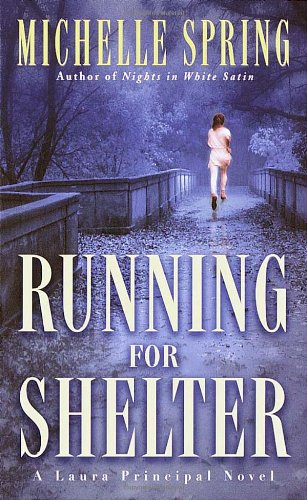
Looking forward to vacationing with her friend Helen, private investigator Laura Principal is hired to track down a missing painting at the same time she is checking out a series of thefts at a local theater.
Die Inhaltsangabe kann sich auf eine andere Ausgabe dieses Titels beziehen.
Über die Autorin bzw. den Autor
Michelle Spring grew up in Victoria, Vancouver Island, British Columbia, and later moved to Cambridge, England, where she currently lives with her husband and two young children. Under the name Michelle Stanworth, she has had an academic career that spans two and a half decades, four academic books, an affiliated lectureship at Cambridge University, and, most recently, the Professorship of Sociology at Anglia University in Cambridge. Her first novel, Every Breath You Take, was nominated for both an Anthony Award and an Arthur Ellis Award as Best First Novel. She is also the author of Nights in White Satin and Standing in the Shadows, another Arthur Ellis Award nominee.
Aus dem Klappentext
rincipal rings the bell at theatrical producer Thomas Butler's London mansion, a young maid opens the door. And suddenly, Laura is plunged into a mystery whose depths she fears to plumb.<br><br>The maid asks Laura to help her find some missing money, but overnight she disappears. Neighbors say she was abducted; the Butlers insist no such person ever existed. But beneath the vicious underpinnings of affluence--in clubs, country houses, and charming mews--Laura uncovers the unbelievable truth. Proving it, though, could be fatal.
Auszug. © Genehmigter Nachdruck. Alle Rechte vorbehalten.
If it hadn't been for my promise to Helen, I would never have risked the
roads on such a drenching day. Rainwater sheeted across the windscreen,
creating gaps in vision. The Saab might sometimes have been a
semisubmersible for all I could see of the route. And more than once during the journey, I had to slow to a snail's pace where Norfolk topsoil, under pressure of the deluge, had surged out of one field and relocated in another, pressing the road into temporary service as a riverbed. I wondered what it would be
like to have to abandon my car here in the dark in the middle of nowhere.
I felt vulnerable--as if the cultivated Norfolk countryside might be
nothing more than a veneer over a wilder and less hospitable core.
But the sense of abandonment among the elements was a fleeting phenomenon,
and I had little time to savor the sensation of exposure. With a
'nuff-said suddenness--as if it had already proved its point--the downpour
ceased.
Burnham St. Stephens came into view. In the village high street, an
elderly couple, umbrellas stolidly furled, sauntered along the pathway
behind their dogs, and all was calm. The puddles by the roadside were
placid. The row of terraced houses that adjoined the churchyard, their
lights shimmering through thin curtains, looked as cozy as kittens, and
the wilderness retreated into my unconscious again.
It was good to be back. As soon as the car rolled to a halt outside
Wildfell Cottage, I opened the window and breathed deeply of the moist
night air. The sounds of the engine died away. Gradually I tuned in to the
undertones that pricked the silence of the countryside. Even, after a
moment, the snuffling of a hedgehog, working her way around the patch of
meadow that we refer to as a lawn.
The door to the cottage opened, and Helen stood framed in the glow of
light. "It's just me, Helen," I called softly.
"Laura!" Helen stepped forward into the dark. Her voice was round with
pleasure, and her welcome brought me ease. She ushered me inside, unlaced
my damp boots, shooed away the neighbor's cat, and settled me on the sofa,
plumping the downy cushions behind my back. She poured me a glass of red
wine from the bottle that was breathing on the hearth.
"Cheers," she said with a smile, snuggling down in the armchair. When she
lifted her wine in my direction, the reflection from the fire made
rainbows in the glass. For the first time, I regretted all the weekends at
Wildfell Cottage I had recently missed. Best friends need to be sometimes
together, and Helen and I had a lot of catching up to do.
"To you, Helen. And," I added, as her eleven-year-old daughter came in
from the kitchen with a tray of hors d'oeuvres, "to the chef. Ginny, these
phyllo pastry parcels are wonderful. Don't tell me you learned this at
school." In my day, cookery classes rarely went beyond the white sauce.
Helen took that as a cue for an old joke. Our shared history, Helen's and
mine, goes all the way back to our undergraduate days, when we lived in
rooms on the same corridor in Newnham. Even then, a passion for shopping
was one of the qualities by which you could tell us apart. My rooms were
plain and comfortable and none too neat; Helen's, by contrast, were
bursting with treasures from bric-a-brac sales. Today, when I want
excitement, I head anywhere but for the high street. Helen's idea of
adventure is to stalk the shops and the market stalls until she captures a
party frock or an early edition of Stendhal at a knockdown price.
"If you spent more time in Marks and Spencers," she teased, "you would
realize that the best hors d'oeuvres come out of a freezer."
"Wrong, Helen," I said, pulling a face that wouldn't look amiss in bedlam.
"If I spent more time in Marks and Spencers, I'd go mad."
I shifted my legs so that Ginny could squeeze onto the sofa beside me. "It
must be two months since you've been to the cottage, Laura," she declared,
making herself comfortable and offering me another savory. "What's the
story?"
I tried to pass it off. "You know what it's like, Ginny. In my business,
things seldom go according to plan. A little case here, a little case
there . . ."
"Here a case, there a case, everywhere a case, case . . ." Ginny intoned,
picking up the refrain. She's growing up.
I am in the extraordinary position--extraordinary, that is, for a woman
who's not an heiress--of having three separate locations where I can warm
my toes. The house in Cambridge is the official residence, the address to
which the Inland Revenue writes and the place where I store my bits and
pieces. The flat in Camden Town is where I often stay when
I am working in London; my partner, Sonny, calls it "our home," but I am
not so sure. For one thing, Sonny created it--the blinds, the tiles in the
kitchen, and the stain on the bathroom ceiling are all down to him. For
another, the title deeds are actually in his name.
And here in North Norfolk, just five minutes' drive from Holkham Bay, is
Wildfell Cottage. The cottage is really a converted barn--though those bald
words hardly convey its beauty--and it is set in the wooded corner of what
was once a farm, on three graceful acres of land bisected by a stream.
Helen is my co-owner, our friend Stevie is a tenant, and Wildfell is my
favorite place of all.
We come here often in summer. In the mild evenings, we sit in the garden
until dark, breathing in the heady scent of honeysuckle. And even in the
winter, when our visits are more sporadic, the cottage remains a fine
place to catch up on your reading or your sleep, to warm yourself on
friendship or simply to wash away the tensions of the town.
But life and work had kept me on a London treadmill for many weeks past,
and at Wildfell I had made myself conspicuous by my absence.
"What have you been up to then?" I asked Ginny. Changing the subject.
"We've got a new math teacher at school. Mr. Stephenson."
"Are you trying to tell me that he's a little on the formal side?"
"A little!" Ginny exclaimed. "You should have been there yesterday--" and
she was off, on a tale of pupil derring-do and teacher-don't. She peppered
her account with exclamations designed to convey how monstrously unfair it
all was. Within a minute, her enthusiasm kindling mine, Ginny had me
giggling.
When Helen Cochrane and I first took over Wildfell Cottage, little Ginny
was just a big-headed baby with a foolish grin. The week after we pocketed
the keys, the Cochrane household fell apart; Helen's husband went to work
one morning and simply disappeared, shedding in one fell swoop the
frightening responsibilities of fatherhood and marriage. It was at
Wildfell that Helen and I huddled together waiting for news, while the
police scoured the southern counties and reporters vied for the story. One
of the most searing memories I carry from that time is the sound of Ginny's sorrow. The slightest noise--a footfall upstairs, the wind in the garden--would set her off again.
"Da-da-da-da-da," she would intone for minutes on end, until Helen or I,
unable to bear her song of loss, would succeed in rocking her to sleep.
James Cochrane turned up again, of course. He made a new life for himself,
and with Helen's help--generous for her daughter's sake--he repaired his
relationship with Ginny. But Wildfell has never ceased to represent a
place of safety for Helen and Ginny and me, a kind of spiritual
center--living proof that home is where you make it.
Suddenly, Ginny looked at her watch. "Ten...
„Über diesen Titel“ kann sich auf eine andere Ausgabe dieses Titels beziehen.
Suchergebnisse für Running for Shelter: A Laura Principal Mystery

Beispielbild für diese ISBN
Running for Shelter: A Laura P
Anbieter: World of Books (was SecondSale), Montgomery, IL, USA
Verkäuferbewertung 5 von 5 Sternen

Zustand: Good. Item in good condition. Textbooks may not include supplemental items i.e. CDs, access codes etc. Artikel-Nr. 00104022182
Gebraucht kaufen
EUR 5,63
Versand gratis
Versand innerhalb von USA
Versand innerhalb von USA
Anzahl: 1 verfügbar
Beispielbild für diese ISBN
Running for Shelter
Anbieter: ThriftBooks-Dallas, Dallas, TX, USA
Verkäuferbewertung 5 von 5 Sternen
Unknown. Zustand: Good. No Jacket. Pages can have notes/highlighting. Spine may show signs of wear. ~ ThriftBooks: Read More, Spend Less. Artikel-Nr. G0345435494I3N00
Gebraucht kaufen
EUR 5,76
Versand gratis
Versand innerhalb von USA
Versand innerhalb von USA
Anzahl: 1 verfügbar
Beispielbild für diese ISBN
Running for Shelter
Anbieter: Better World Books, Mishawaka, IN, USA
Verkäuferbewertung 5 von 5 Sternen
Zustand: Good. Pages intact with minimal writing/highlighting. The binding may be loose and creased. Dust jackets/supplements are not included. Stock photo provided. Product includes identifying sticker. Better World Books: Buy Books. Do Good. Artikel-Nr. 50254167-6
Gebraucht kaufen
EUR 8,06
Versand gratis
Versand innerhalb von USA
Versand innerhalb von USA
Anzahl: 1 verfügbar