
Verwandte Artikel zu Newton's Cannon (The Age of Unreason, Band 1)
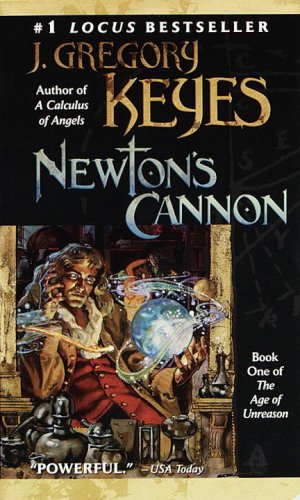
Inhaltsangabe
A dazzling quest whose outcome will raise humanity to unparalleled heights of glory--or ring down a curtain of endless night . . .
1681: When Sir Isaac Newton turns his restless mind to the ancient art of alchemy, he unleashes Philosopher's Mercury, a primal source of matter and a key to manipulating the four elements of Earth, Air, Fire, and Water. Now, as France and England battle for its control, Louis XIV calls for a new weapon--a mysterious device known only as Newton's Cannon.
Half a world away, a young apprentice named Benjamin Franklin stumbles across a dangerous secret. Pursued by a deadly enemy--half scientist, half sorcerer--Ben makes his fugitive way to England. Only Newton himself can help him now. But who will help Sir Isaac? For he was not the first to unleash the Philosopher's Mercury. Others were there before him. Creatures as scornful of science as they are of mankind. And burning to be rid of both . . .
Die Inhaltsangabe kann sich auf eine andere Ausgabe dieses Titels beziehen.
Über die Autorin bzw. den Autor
J. Gregory Keyes is a teacher at the University of Georgia and is pursuing a Ph.D. in the anthropology of belief system and mythology. He was born in Mississippi and raised there and on the Navajo reservation in Arizona. He is the author of The Waterborn and The Blackgod.
From the Trade Paperback edition.
Aus dem Klappentext
uest whose outcome will raise humanity to unparalleled heights of glory--or ring down a curtain of endless night . . .
1681: When Sir Isaac Newton turns his restless mind to the ancient art of alchemy, he unleashes Philosopher's Mercury, a primal source of matter and a key to manipulating the four elements of Earth, Air, Fire, and Water. Now, as France and England battle for its control, Louis XIV calls for a new weapon--a mysterious device known only as Newton's Cannon.
Half a world away, a young apprentice named Benjamin Franklin stumbles across a dangerous secret. Pursued by a deadly enemy--half scientist, half sorcerer--Ben makes his fugitive way to England. Only Newton himself can help him now. But who will help Sir Isaac? For he was not the first to unleash the Philosopher's Mercury. Others were there before him. Creatures as scornful of science as they are of mankind. And burning to be rid of both . . .
Auszug. © Genehmigter Nachdruck. Alle Rechte vorbehalten.
Louis awoke to the clatter of Bontemps, his valet, putting away his folding bed, as he did every morning. A frigid wind blustered in through the open windows of his bedchamber, and Louis greeted it with none of his former pleasure. Once, it would have invigorated him. Now, he imagined the wind as death's frustrated caress.
Another metallic click, a sigh, and he heard Bontemps retreating. Louis arranged in his mind the day to come. The order in his days was his only remaining comfort. He had made Versailles into a great and precise clock, and though he was king, he was carried along by its mechanisms as surely as his lowliest servant or courtier. More certainly, in fact, since a servant might slip briefly away and steal a private moment, encounter a mistress, take a nap. This was his only private moment, in bed, pretending to be asleep. It gave him time to think and to remember.
The Persian elixir had given him new life and a body that felt younger than it had in thirty years, but it had robbed him of everything else. Gone were his brother Phillipe; his son Monseigneur; his grandson, the duke of Burgundy, and his wife, the duchess Marie-Adelaide, whose death had broken his heart. It was as if God were sweeping clean the line of Louis XIV. The dust had also claimed almost all of his old friends and companions. But worst of all was the loss of his wife, Maintenon.
Now he had only France, and France was a restless, thankless mistress. He knew--though his ministers tried to keep it from him--that there were whispers against him now. As the years passed and he grew stronger and more full of health, those who had hidden their wishes that he would die and make way for a new regime were allowing themselves snide asides. They were plotting. There were even some who whispered that the real Louis was dead, and he the devil's proxy.
He had returned to Versailles to show them he was king and to restore the image of glory to accompany his renewed health.
In the antechamber outside, he now heard the subdued chatter of the ever-present courtiers, awaiting their chance to see him. He heard footsteps entering, and he knew without opening his eyes that the porte-buchon du Roi had come in to light the fire in the fireplace.
The gears of Versailles creaked on. More footsteps as the royal watchmaker entered the room, wound Louis' watch, and departed.
Yes, he had been right to return to Versailles. Five years ago, when he was dying, his chateau of Marly--comfortable, pleasant, intimate Marly--had seemed the place to spend the remainder of his days. Versailles was drafty; it was an instrument of torture that cost a sizable fraction of the treasury each year to maintain. But Versailles was splendid, a fit dwelling for Apollo. The nation needed him here.
A shuffling from the side door was his wig maker, bringing his dressing wig and the wig of the day.
That meant he had a few more moments. Beneath the covers, he stretched, and was gratified to feel muscles respond to his commands. Since his brush with death, his body felt fresh and alive. All his old appetites were returning to him. All of them, and some would not be denied gratification much longer.
Why, then, if his body was again sound, did a feeling of dread still hound him? Why did his dreams grow persistently darker? Why did he fear being alone?
The clock struck eight. "Awaken, Sire," Bontemps said. "Your day has begun."
Louis snapped his eyes open. "Good morning, Bontemps," he said, attempting a smile. He shook his head, gazing at the lean, fiftyish face looking down at him.
"Are you ready, Your Majesty?" he asked.
"Indeed, Bontemps," he said. "You may admit whom you wish."
The morning lever continued. His doctors came in and inquired about his health. When the chamberlain admitted the first of the courtiers--the ones who had earned invitations to the grande entree through diligence--Louis found himself dreading their presence, their fawning submission, their requests.
He felt that way until he saw Adrienne de Mornay de Montchevreuil among them.
"Mademoiselle," he exclaimed, reaching to embrace her. "To what do I owe this exquisite pleasure?"
Adrienne returned his embrace and then curtsied. "I am well, as I always am in your presence, Sire." Her smile was as flawless as a perfect ruby. "I hope Your Majesty is well."
"Of course, my dear." He smiled and cast his eyes over the remainder of the courtiers, all young men, all with that hopeful light in their eyes, all wondering what advantage they might be able to extract from this dear girl.
Adrienne wore the uniform of Saint Cyr, the simple gown with black ribbons that showed she had achieved that school's highest rank--just as she had always dressed when she was his late wife's secretary. Louis generally disapproved of such informal dress, demanding that the ladies wear the grand habit, but Adrienne's clothing suited her as the clothing of the court ladies did not. It matched her thoughtful features and wide, intelligent eyes. She wore the uniform, he suspected, as a badge, a quiet proclamation that she had attended the school and had passed all of its tests. It meant that she was as educated as any woman in France, and more so than most. Louis was suddenly suspicious that she wore the gown also to remind him of how dear she had been to his wife. What was she about, this young woman?
"It is good to see you," he said. "Your letters comforted me greatly after the queen's death." That would let her know that he had been reminded, and she would now press the advantage she believed she had.
Adrienne continued to smile, a faint grin not unlike that on the Mona Lisa, which hung across from his bed. "As you know, Sire, I have taken up residence at the Academy of Sciences, serving the philosophers there."
"Ah yes, Paris. How do you find it?"
Her smile broadened. "As you do, Sire: stifling. But the work of your magi is most fascinating. Of course, I understand little of what they do and say, but nonetheless--"
"I, too, find their theories incomprehensible, yet their results are to my liking. They are a great resource to France--as are those who serve them."
She bowed her head. "I shall not waste Your Majesty's precious time, but I will tell you that I did not come to ask a boon for myself. There is a member of your academy, a certain Fatio de Duillier. A most remarkable man--"
"Near to your heart?" Louis asked, a trifle coldly.
"No, Sire," Adrienne replied quite strongly. "I would never bother you on such an account."
"And what does this young man desire?"
Adrienne caught his shifting mood, his growing impatience. "He has tried for many months to receive an audience with Your Majesty and failed," she said. "He wished only that you receive a letter from him." She paused and looked him in the eye, something that few dared to do. "It is a short letter," she finished.
He considered her for a moment. "I will receive this letter," he said at last. "This young man should know how fortunate he is to have your favor."
"Thank you, Sire." She curtsied once more, understanding that she was dismissed. A sudden thought struck Louis, and he summoned her back.
"Mademoiselle," he said, "I am planning a small entertainment on the Grand Canal several afternoons hence. I would be pleased if you would join my company on the barge."
Adrienne's eyes widened slightly, and an expression he could not identify crossed her face. "I would be pleased to,...
„Über diesen Titel“ kann sich auf eine andere Ausgabe dieses Titels beziehen.
Suchergebnisse für Newton's Cannon (The Age of Unreason, Band 1)

Beispielbild für diese ISBN
Newton's Cannon (The Age of Unreason, Book 1)
Verlag:
Del Rey (edition 1st Mass Market Ed), 1999
ISBN 10: 0345433785
ISBN 13: 9780345433787
Gebraucht
Mass Market Paperback
Anbieter: BooksRun, Philadelphia, PA, USA
Verkäuferbewertung 5 von 5 Sternen

Mass Market Paperback. Zustand: Very Good. 1st Mass Market Ed. It's a well-cared-for item that has seen limited use. The item may show minor signs of wear. All the text is legible, with all pages included. It may have slight markings and/or highlighting. Artikel-Nr. 0345433785-11-1
Gebraucht kaufen
EUR 4,43
Versand gratis
Versand innerhalb von USA
Versand innerhalb von USA
Anzahl: 2 verfügbar
Beispielbild für diese ISBN
Newton's Cannon (The Age of Unreason, Book 1)
Anbieter: World of Books (was SecondSale), Montgomery, IL, USA
Verkäuferbewertung 5 von 5 Sternen
Zustand: Good. Item in good condition. Textbooks may not include supplemental items i.e. CDs, access codes etc. Artikel-Nr. 00109423893
Gebraucht kaufen
EUR 5,50
Versand gratis
Versand innerhalb von USA
Versand innerhalb von USA
Anzahl: 2 verfügbar
Beispielbild für diese ISBN
Newton's Cannon : Book One of the AGE of UNREASON
Verlag:
Random House Publishing Group, 1999
ISBN 10: 0345433785
ISBN 13: 9780345433787
Gebraucht
Softcover
Anbieter: Better World Books, Mishawaka, IN, USA
Verkäuferbewertung 5 von 5 Sternen
Zustand: Good. 1st Mass Market Ed. Pages intact with minimal writing/highlighting. The binding may be loose and creased. Dust jackets/supplements are not included. Stock photo provided. Product includes identifying sticker. Better World Books: Buy Books. Do Good. Artikel-Nr. GRP65340972
Gebraucht kaufen
EUR 6,18
Versand gratis
Versand innerhalb von USA
Versand innerhalb von USA
Anzahl: 2 verfügbar
Beispielbild für diese ISBN
Newton's Cannon : Book One of the AGE of UNREASON
Verlag:
Random House Publishing Group, 1999
ISBN 10: 0345433785
ISBN 13: 9780345433787
Gebraucht
Softcover
Anbieter: Better World Books, Mishawaka, IN, USA
Verkäuferbewertung 5 von 5 Sternen
Zustand: Very Good. 1st Mass Market Ed. Pages intact with possible writing/highlighting. Binding strong with minor wear. Dust jackets/supplements may not be included. Stock photo provided. Product includes identifying sticker. Better World Books: Buy Books. Do Good. Artikel-Nr. GRP67606288
Gebraucht kaufen
EUR 6,18
Versand gratis
Versand innerhalb von USA
Versand innerhalb von USA
Anzahl: 1 verfügbar
Beispielbild für diese ISBN
Newton's Cannon (The Age of Unreason, Book 1)
Anbieter: Wonder Book, Frederick, MD, USA
Verkäuferbewertung 5 von 5 Sternen
Zustand: Very Good. Very Good condition. A copy that may have a few cosmetic defects. May also contain light spine creasing or a few markings such as an owner's name, short gifter's inscription or light stamp. Artikel-Nr. W10B-03011
Gebraucht kaufen
EUR 6,42
Versand gratis
Versand innerhalb von USA
Versand innerhalb von USA
Anzahl: 3 verfügbar
Beispielbild für diese ISBN
Newton's Cannon: Signed
Anbieter: ThriftBooks-Atlanta, AUSTELL, GA, USA
Verkäuferbewertung 5 von 5 Sternen
Paperback. Zustand: Good. No Jacket. Pages can have notes/highlighting. Spine may show signs of wear. ~ ThriftBooks: Read More, Spend Less. Artikel-Nr. G0345433785I3N00
Gebraucht kaufen
EUR 6,42
Versand gratis
Versand innerhalb von USA
Versand innerhalb von USA
Anzahl: 1 verfügbar
Beispielbild für diese ISBN
Newton's Cannon: Signed
Anbieter: ThriftBooks-Atlanta, AUSTELL, GA, USA
Verkäuferbewertung 5 von 5 Sternen
Paperback. Zustand: Fair. No Jacket. Readable copy. Pages may have considerable notes/highlighting. ~ ThriftBooks: Read More, Spend Less. Artikel-Nr. G0345433785I5N00
Gebraucht kaufen
EUR 6,42
Versand gratis
Versand innerhalb von USA
Versand innerhalb von USA
Anzahl: 1 verfügbar
Beispielbild für diese ISBN
Newton's Cannon: Signed
Anbieter: ThriftBooks-Dallas, Dallas, TX, USA
Verkäuferbewertung 5 von 5 Sternen
Paperback. Zustand: Good. No Jacket. Pages can have notes/highlighting. Spine may show signs of wear. ~ ThriftBooks: Read More, Spend Less. Artikel-Nr. G0345433785I3N00
Gebraucht kaufen
EUR 6,42
Versand gratis
Versand innerhalb von USA
Versand innerhalb von USA
Anzahl: 1 verfügbar
Foto des Verkäufers
Newton's Cannon (The Age of Unreason, Book 1)
Anbieter: Southampton Books, Sag Harbor, NY, USA
Verkäuferbewertung 5 von 5 Sternen
Paperback. Zustand: Like New. FIRST THUS. First Edition Thus, First Printing. Not price-clipped. Published by Del Rey Books, 1999. 12mo. Paperback. Book is like new with toning on page ends. 100% positive feedback. 30 day money back guarantee. NEXT DAY SHIPPING! Excellent customer service. Please email with any questions. All books packed carefully and ship with free delivery confirmation/tracking. All books come with free bookmarks. Ships from Sag Harbor, New York. Artikel-Nr. 386324
Gebraucht kaufen
EUR 18,37
EUR 4,45 Versand
Versand innerhalb von USA
Versand innerhalb von USA
Anzahl: 1 verfügbar
Beispielbild für diese ISBN
Newton's Cannon (1) (The Age of Unreason)
Verlag:
Del Rey Books, 2002
ISBN 10: 0345433785
ISBN 13: 9780345433787
Gebraucht
paperback / softback
Erstausgabe
Anbieter: Zardoz Books, Westbury, WILTS, Vereinigtes Königreich
Verkäuferbewertung 4 von 5 Sternen

paperback / softback. Zustand: fine. fine 1st edition 2002 Del Rey Books paperback book In stock shipped from our UK warehouse. Artikel-Nr. 189714
Gebraucht kaufen
EUR 6,01
EUR 23,51 Versand
Versand von Vereinigtes Königreich nach USA
Versand von Vereinigtes Königreich nach USA
Anzahl: 1 verfügbar