
Verwandte Artikel zu Manifold: Space
Inhaltsangabe
“As always, [Stephen] Baxter plays with space and time with consummate skill. . . . He continues to be one of the leading writers of hard science fiction, and one of the most thought-provoking as well.”—Science Fiction Chronicle
The year is 2020. Fueled by an insatiable curiosity, Reid Malenfant ventures to the far edge of the solar system, where he discovers a strange artifact left behind by an alien civilization: A gateway that functions as a kind of quantum transporter, allowing virtually instantaneous travel over the vast distances of interstellar space. What lies on the other side of the gateway? Malenfant decides to find out. Yet he will soon be faced with an impossible choice that will push him beyond terror, beyond sanity, beyond humanity itself. Meanwhile on Earth the Japanese scientist Nemoto fears her worst nightmares are coming true. Startling discoveries reveal that the Moon, Venus, even Mars once thrived with life—life that was snuffed out not just once but many times, in cycles of birth and destruction. And the next chilling cycle is set to begin again . . .
“When the travel bug bites and usual planets don’t excite, perhaps it’s time to burst the bounds of this old solar system and really see the sights. . . . Baxter’s expansive new novel is just the ticket.”—The Washington Times
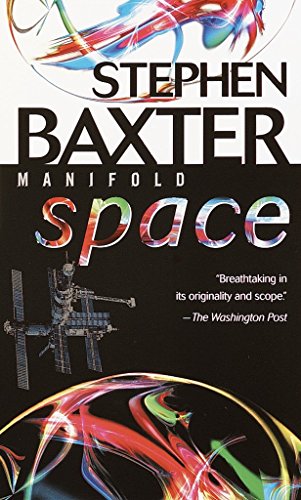
“Breathtaking in its originality and scope.”—The Washington Post
Die Inhaltsangabe kann sich auf eine andere Ausgabe dieses Titels beziehen.
Über die Autorin bzw. den Autor
Stephen Baxter is a trained engineer with degrees from Cambridge (mathematics) and Southampton Universities (doctorate in aeroengineering research). Baxter is the winner of both The British Science Fiction Award and the Locus Award, as well as being a nominee for an Arthur C. Clarke Award, most recently for Manifold: Time. His novel Voyage won the Sidewise Award for Best Alternate History Novel of the Year; he also won the John W. Campbell Award and the Philip K. Dick Award for his novel The Time Ships.
Von der hinteren Coverseite
The year is 2020. Fueled by an insatiable curiosity, Reid Malenfant ventures to the far edge of the solar system, where he discovers a strange artifact left behind by an alien civilization: A gateway that functions as a kind of quantum transporter, allowing virtually instantaneous travel over the vast distances of interstellar space. What lies on the other side of the gateway? Malenfant decides to find out. Yet he will soon be faced with an impossible choice that will push him beyond terror, beyond sanity, beyond humanity itself. Meanwhile on Earth the Japanese scientist Nemoto fears her worst nightmares are coming true. Startling discoveries reveal that the Moon, Venus, even Mars once thrived with life?life that was snuffed out not just once but many times, in cycles of birth and destruction. And the next chilling cycle is set to begin again . . .
Auszug. © Genehmigter Nachdruck. Alle Rechte vorbehalten.
Gaijin
A passenger in the Hope-3 tug, Reid Malenfant descended toward the Moon.
The Farside base, called Edo, was a cluster of concrete components—habitation modules, power plants, stores, manufacturing facilities—half buried in the cratered plain. Comms masts sprouted like angular flowers. The tug pad was just a splash of scorched moondust concrete, a couple of kilometers farther out. Around the station itself, the regolith was scarred by tractor traffic.
Robots were everywhere, rolling, digging, lifting; Edo was growing like a colony of bacilli in nutrient.
A hi-no-maru, a Japanese Sun flag, was fixed to a pole at the center of Edo.
“You are welcome to my home,” Nemoto said.
She met him in the pad’s air lock: a large, roomy chamber blown into the regolith. Her face was broad, pale, her eyes black; her hair was elaborately shaved, showing the shape of her skull. She smiled, apparently habitually. She could have been no more than half Malenfant’s age, perhaps thirty.
Nemoto helped Malenfant don the suit he’d been fitted with during the flight from Earth. The suit was a brilliant orange. It clung to him comfortably, the joints easy and loose, although the sewn-in plates of tungsten armor were heavy.
“It’s a hell of a development from the old EMUs I wore when I was flying shuttle,” he said, trying to make conversation.
Nemoto listened politely, after the manner of young people, to his fragments of reminiscence from a vanished age. She told him the suit had been manufactured on the Moon, and was made largely of spider silk. “I will take you to the factory. A chamber in the lunar soil, full of immense spinnerets. A nightmare vision! . . .”
Malenfant felt disoriented, restless.
He was here to deliver a lecture, on colonizing the Galaxy, to senior executives of Nishizaki Heavy Industries. But here he was being led off the tug by Nemoto, the junior researcher who’d invited him out to the Moon, just a kid. He hoped he wasn’t making some kind of fool of himself.
Reid Malenfant used to be an astronaut. He’d flown the last shuttle mission—STS-194, on Discovery—when, ten years ago, the space transportation system had reached the end of its design life, and the International Space Station had finally been abandoned, incomplete. No American had flown into space since—save as the guest of the Japanese, or the Europeans, or the Chinese.
In this year 2020, Malenfant was sixty years old and feeling a lot older—increasingly stranded, a refugee in this strange new century, his dignity woefully fragile.
Well, he thought, whatever the dubious politics, whatever the threat to his dignity, he was here. It had been the dream of his long life to walk on another world. Even if it was as the guest of the Japanese.
And even if he was too damn old to enjoy it.
They stepped through a transit tunnel and directly into a small tractor, a lozenge of tinted glass. The tractor rolled away from the tug pad. The wheels were large and open, and absorbed the unevenness of the mare; Malenfant felt as if he were riding across the Moon in a soap bubble.
Every surface in the cabin was coated with fine gray moondust. He could smell the dust; the scent was, as he knew it would be, like wood ash, or gunpowder.
Beyond the window, the Mare Ingenii—the Sea of Longing—stretched to the curved horizon, pebble-strewn. It was late in the lunar afternoon, and the sunlight was low, flat, the shadows of the surface rubble long and sharp. The lighting was a rich tan when he looked away from the Sun, a more subtle gray elsewhere. Earth was hidden beneath the horizon, of course, but Malenfant could see a comsat crawl across the black sky.
He longed to step through the glass, to touch that ancient soil.
Nemoto locked in the autopilot and went to a little galley area. She emerged with green tea, rice crackers and dried ika cuttlefish. Malenfant wasn’t hungry, but he accepted the food. Such items as the fish were genuine luxuries here, he knew; Nemoto was trying to honor him.
The motion of the tea, as she poured it in the one-sixth gravity, was complex, interesting.
“I am honored you have accepted my invitation to travel here, to Edo,” Nemoto said. “You will, of course, tour the town, as you wish. There is even a Makudonarudo here: a McDonald’s. You may enjoy a bifubaaga! Soya, of course.”
He put down his plate and tried to meet her direct gaze. “Tell me why I’ve been brought out here. I don’t see how my work, on long-term space utilization, can be of real interest to your employers.”
She eyed him. “You do have a lecture to deliver, I am afraid. But . . . no, your work is not of primary concern to Nishizaki.”
“Then I don’t understand.”
“It is I who invited you, I who arranged the funding. You ask why. I wished to meet you. I am a researcher, like you.”
“Hardly a researcher,” he said. “I call myself a consultant, nowadays. I am not attached to a university.”
“Nor I. Nishizaki Heavy Industries pays my wages; my research must be focused on serving corporate objectives.” She eyed him, and took some more fish. “I am salariman. A good company worker, yes? But I am, at heart, a scientist. And I have made some observations which I am unable to reconcile with the accepted paradigm. I searched for recent scientific publications concerning the subject area of my . . . hypothesis. I found only yours.
“My subject is infrared astronomy. At our research station, away from Edo, the company maintains radiometers, photometers, photo-polarimeters, cameras. I work at a range of wavelengths, from twenty to a hundred microns. Of course a space-borne platform is to be preferred: The activities of humankind are thickening the Moon’s atmosphere with each passing day, blocking the invisible light I collect. But the lunar site is cheap to maintain, and is adequate for the company’s purposes. We are considering the future exploitation of the asteroids, you see. Infrared astronomy is a powerful tool in the study of those distant rocks. With it we can deduce a great deal about surface textures, compositions, internal heat, rotation characteristics—”
“Tell me about your paradigm-busting hypothesis.”
“Yes.” She sipped her green tea. “I believe I have observational evidence of the activity of extraterrestrial intelligences in the Solar System,” she said calmly.
The silence stretched between them, electric. Her words were shocking, quite unexpected.
But now he saw why she’d brought him here.
Since his retirement from NASA, Malenfant had avoided following his colleagues into the usual ex-astronaut gravy ponds: lucrative aerospace executive posts and junior political positions. Instead, he’d thrown his weight behind research into what he regarded as long-term thinking: SETI, using gravitational lensing to hunt for planets and ET signals, advanced propulsion systems, schemes for colonizing the planets, terraforming, interstellar travel, exploration of the venerable Fermi paradox.
All the stuff that Emma had so disapproved of. You’re wasting your time, Malenfant. Where’s the money to be made out of gravitational lensing?
But his wife was long gone, of course, struck down by cancer: the result of a random cosmic accident, a heavy particle that had come whizzing out of an ancient supernova and flown across the universe to damage her just so . . . It could have been him; it could have been neither of them; it could have happened a few years later,...
„Über diesen Titel“ kann sich auf eine andere Ausgabe dieses Titels beziehen.
Suchergebnisse für Manifold: Space

Beispielbild für diese ISBN
Manifold: Space
Anbieter: World of Books (was SecondSale), Montgomery, IL, USA
Verkäuferbewertung 5 von 5 Sternen

Zustand: Good. Item in good condition. Textbooks may not include supplemental items i.e. CDs, access codes etc. Artikel-Nr. 00087056573
Gebraucht kaufen
EUR 4,46
Versand gratis
Versand innerhalb von USA
Versand innerhalb von USA
Anzahl: 10 verfügbar
Beispielbild für diese ISBN
Manifold: Space
Anbieter: World of Books (was SecondSale), Montgomery, IL, USA
Verkäuferbewertung 5 von 5 Sternen
Zustand: Very Good. Item in very good condition! Textbooks may not include supplemental items i.e. CDs, access codes etc. Artikel-Nr. 00102277732
Gebraucht kaufen
EUR 4,46
Versand gratis
Versand innerhalb von USA
Versand innerhalb von USA
Anzahl: 1 verfügbar
Beispielbild für diese ISBN
Manifold: Space
Anbieter: World of Books (was SecondSale), Montgomery, IL, USA
Verkäuferbewertung 5 von 5 Sternen
Zustand: Acceptable. Item in acceptable condition! Textbooks may not include supplemental items i.e. CDs, access codes etc. Artikel-Nr. 00091648497
Gebraucht kaufen
EUR 4,46
Versand gratis
Versand innerhalb von USA
Versand innerhalb von USA
Anzahl: 3 verfügbar
Beispielbild für diese ISBN
Manifold: Space
Verlag:
Del Rey (edition ), 2002
ISBN 10: 0345430786
ISBN 13: 9780345430786
Gebraucht
Mass Market Paperback
Anbieter: BooksRun, Philadelphia, PA, USA
Verkäuferbewertung 5 von 5 Sternen
Mass Market Paperback. Zustand: Fair. The item might be beaten up but readable. May contain markings or highlighting, as well as stains, bent corners, or any other major defect, but the text is not obscured in any way. Artikel-Nr. 0345430786-7-1
Gebraucht kaufen
EUR 4,47
Versand gratis
Versand innerhalb von USA
Versand innerhalb von USA
Anzahl: 1 verfügbar
Beispielbild für diese ISBN
Manifold: Space
Verlag:
Del Rey (edition ), 2002
ISBN 10: 0345430786
ISBN 13: 9780345430786
Gebraucht
Mass Market Paperback
Anbieter: BooksRun, Philadelphia, PA, USA
Verkäuferbewertung 5 von 5 Sternen
Mass Market Paperback. Zustand: Very Good. It's a well-cared-for item that has seen limited use. The item may show minor signs of wear. All the text is legible, with all pages included. It may have slight markings and/or highlighting. Artikel-Nr. 0345430786-8-1
Gebraucht kaufen
EUR 4,71
Versand gratis
Versand innerhalb von USA
Versand innerhalb von USA
Anzahl: 1 verfügbar
Beispielbild für diese ISBN
Space
Verlag:
Del Rey Books, 2002
ISBN 10: 0345430786
ISBN 13: 9780345430786
Gebraucht
Mass Market Paperback
Anbieter: ThriftBooks-Dallas, Dallas, TX, USA
Verkäuferbewertung 5 von 5 Sternen
Mass Market Paperback. Zustand: As New. No Jacket. Pages are clean and are not marred by notes or folds of any kind. ~ ThriftBooks: Read More, Spend Less. Artikel-Nr. G0345430786I2N00
Gebraucht kaufen
EUR 6,10
Versand gratis
Versand innerhalb von USA
Versand innerhalb von USA
Anzahl: 1 verfügbar
Beispielbild für diese ISBN
Manifold: Space
Anbieter: Wonder Book, Frederick, MD, USA
Verkäuferbewertung 5 von 5 Sternen
Zustand: Very Good. Very Good condition. A copy that may have a few cosmetic defects. May also contain light spine creasing or a few markings such as an owner's name, short gifter's inscription or light stamp. Artikel-Nr. Q22A-04364
Gebraucht kaufen
EUR 6,40
Versand gratis
Versand innerhalb von USA
Versand innerhalb von USA
Anzahl: 2 verfügbar
Beispielbild für diese ISBN
Manifold: Space
Anbieter: Better World Books, Mishawaka, IN, USA
Verkäuferbewertung 5 von 5 Sternen
Zustand: Very Good. 1st THUS. Former library copy. Pages intact with possible writing/highlighting. Binding strong with minor wear. Dust jackets/supplements may not be included. Includes library markings. Stock photo provided. Product includes identifying sticker. Better World Books: Buy Books. Do Good. Artikel-Nr. 13610372-75
Gebraucht kaufen
EUR 7,18
Versand gratis
Versand innerhalb von USA
Versand innerhalb von USA
Anzahl: 2 verfügbar
Beispielbild für diese ISBN
Manifold: Space
Anbieter: Better World Books, Mishawaka, IN, USA
Verkäuferbewertung 5 von 5 Sternen
Zustand: Good. 1st THUS. Pages intact with minimal writing/highlighting. The binding may be loose and creased. Dust jackets/supplements are not included. Stock photo provided. Product includes identifying sticker. Better World Books: Buy Books. Do Good. Artikel-Nr. 446823-6
Gebraucht kaufen
EUR 7,18
Versand gratis
Versand innerhalb von USA
Versand innerhalb von USA
Anzahl: 4 verfügbar
Beispielbild für diese ISBN
Manifold: Space
Anbieter: Browse Awhile Books, Tipp City, OH, USA
Verkäuferbewertung 5 von 5 Sternen
Mass Market Paperback. Zustand: Very Good. The second book in the Manifold series. Artikel-Nr. 1142512
Gebraucht kaufen
EUR 3,66
EUR 6,22 Versand
Versand innerhalb von USA
Versand innerhalb von USA
Anzahl: 1 verfügbar