Inhaltsangabe
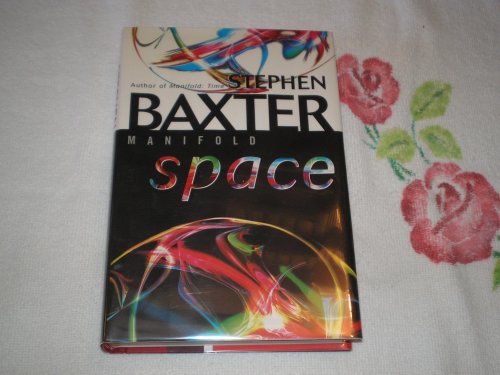
In the sequel to Manifold: Time, space explorer Reid Malenfant continues his odyssey through the universe, while Earth is faced with the dual threat of alien invasion and overwhelming ecological devastation. 20,000 first printing.
Die Inhaltsangabe kann sich auf eine andere Ausgabe dieses Titels beziehen.
Über die Autorin bzw. den Autor
Stephen Baxter is a trained engineer with degrees from Cambridge (mathematics) and Southampton Universities (doctorate in aeroengineering research). Baxter is the winner of both The British Science Fiction Award and the Locus Award, as well as being a nominee for an Arthur C. Clarke Award, most recently for Manifold: Time. His novel Voyage won the Sidewise Award for Best Alternate History Novel of the Year; he also won the John W. Campbell Award and the Philip K. Dick Award for his novel The Time Ships.
Aus dem Klappentext
can combine mind bending scientific speculation with breathtaking adventure like award-winning author Stephen Baxter. In Manifold: Time, Baxter told a thrilling story in which the fate of the universe hung in the balance. It followed visionary Reid Malenfant, a man who willed humankind to explore space, and ultimately was faced with a harrowing choice between a past that never was and a future that must never be. Now, in Manifold: Space, Reid Malenfant is back. But this is a different Malenfant. And a different universe.
Fueled by an insatiable curiosity, Malenfant ventures to the far edge of the solar system, where he discovers a strange artifact left behind by an alien civilization: A gateway that functions as a kind of quantum transporter, allowing virtually instantaneous travel over the vast distances of interstellar space. What lies on the other side of the gateway? Malenfant decides to find out.
Yet as Malenfant embarks on a grand tour of the universe, back on Earth the
Auszug. © Genehmigter Nachdruck. Alle Rechte vorbehalten.
TITLE: MANIFOLD: SPACE
Prologue
My name is Reid Malenfant.
You know me. And you know I'm an incorrigible space cadet.
You know I've campaigned for, among other things, private mining
expeditions to the asteroids. In fact, in the past I've tried to get you
to pay for such things. I've bored you with that often enough already,
right?
So tonight I want to be a little more personal. Tonight I want to talk
about why I gave over my life to a single, consuming project.
It started with a simple question:
Where is everybody?
As a kid I used to lie at night out on the lawn, soaking up dew and
looking at the stars, trying to feel the Earth turning under me. It felt
wonderful to be alive--hell, to be ten years old, anyhow.
But I knew that the Earth was just a ball of rock, on the fringe of a
nondescript galaxy.
As I lay there staring at the stars--the thousands I could pick out with my
naked eyes, the billions that make up the great wash of our Galaxy, the
uncounted trillions in the galaxies beyond--I just couldn't believe, even
then, that there was nobody out there looking back at me down here. Was it
really possible that this was the only place where life had taken
hold--that only here were there minds and eyes capable of looking out and
wondering?
But if not, where are they? Why isn't there evidence of extraterrestrial
civilization all around us?
Consider this. Life on Earth got started just about as soon as it could--as
soon as the rocks cooled and the oceans gathered. Of course it took a good
long time to evolve us. Nevertheless we have to believe that what applies
on Earth ought to apply on all the other worlds out there, like or unlike
Earth; life ought to be popping up everywhere. And, as there are hundreds
of billions of stars out there in the Galaxy, there are presumably
hundreds of billions of opportunities for life to come swarming up out of
the ponds--and even more opportunities in the other galaxies that crowd our
universe.
Furthermore, life spread over Earth as fast and as far as it could. And
already we're starting to spread to other worlds. Again, this can't be a
unique trait of Earth life.
So, if life sprouts everywhere, and spreads as fast and as far as it can,
how come nobody has come spreading all over us?
The universe is a big place. There are huge spaces between the stars. But
it's not that big. Even crawling along with dinky ships that only reach a
fraction of light speed--ships we could easily start building now--we could
colonize the Galaxy in a few tens of millions of years. One hundred
million, tops.
One hundred million years. It seems an immense time--after all, one hundred
million years ago the dinosaurs ruled Earth. But the Galaxy is one hundred
times older still. There has been time for Galactic colonization to have
happened many times since the birth of the stars.
Remember, all it takes is for one race somewhere to have evolved the will
and the means to colonize; and once the process has started it's hard to
see what could stop it.
But, as a kid on that lawn, I didn't see them. I seemed to be surrounded
by emptiness and silence.
Even we blare out on radio frequencies. Why, with our giant radio
telescopes we could detect a civilization no more advanced than ours
anywhere in the Galaxy. But we don't.
More advanced civilizations ought to be much more noticeable. We could
spot somebody building a shell around their star, or throwing in nuclear
waste. We could probably see evidence of such things even in other
galaxies. But we don't. Those other galaxies, other islands of stars, seem
to be as barren as this one.
Maybe we're just unlucky. Maybe we're living at the wrong time. The Galaxy
is an old place; maybe They have been, flourished, and gone already. But
consider this: Even if They are long gone, surely we should see Their
mighty ruins, all around us. But we don't even see that. The stars show no
signs of engineering. The Solar System appears to be primordial, in the
sense that it shows no signs of the great projects we can already
envisage, like terraforming the planets, or tinkering with the Sun, and so
on.
We can think of lots of rationalizations for this absence.
Maybe there is something that kills off every civilization like ours
before we get too far--for example, maybe we all destroy ourselves in
nuclear wars or eco collapse. Or maybe there is something more sinister:
plagues of killer robots sliding silently between the stars, killing off
fledgling cultures for their own antique purposes.
Or maybe the answer is more benevolent. Maybe we're in some kind of
quarantine--or a zoo.
But none of these filtering mechanisms convinces me. You see, you have to
believe that this magic suppression mechanism, whatever it is, works for
every race in this huge Galaxy of ours. All it would take would be for one
race to survive the wars, or evade the vacuum robots, or come sneaking
through the quarantine to sell trinkets to the natives--or even just to
start broadcasting some ET version of The Simpsons, anywhere in the
Galaxy--and we'd surely see or hear them.
But we don't.
This paradox was first stated clearly by a twentieth-century physicist
called Enrico Fermi. It strikes me as a genuine mystery. The
contradictions are basic: Life seems capable of emerging everywhere; just
one star-faring race could easily have covered the Galaxy by now; the
whole thing seems inevitable--but it hasn't happened.
Thinking about paradoxes is the way human understanding advances. I think
the Fermi paradox is telling us something very profound about the
universe, and our place in it. Or was.
Of course, everything is different now.
PART ONE
Foreigners
a.d. 2020-2042
. . . And he felt as if he were drowning, struggling up from some thick,
viscous fluid, up toward the light. He wanted to open his mouth, to
scream--but he had no mouth, and no words. What would he scream?
I.
I am.
I am Reid Malenfant.
z
He could see the sail.
It was a gauzy sheet draped across the crowded stars of this place.
Where, Malenfant? Why, the core of the Galaxy, he thought, wonder breaking
through his agony.
And within the sail, cupped, he could see the neutron star, an angry ball
of red laced with eerie synchrotron blue, like a huge toy.
A star with a sail attached to it. Beautiful. Scary.
Triumph surged. I won, he thought. I resolved the koan, the great
conundrum of the cosmos; Nemoto would be pleased. And now, together, we're
fixing an unsatisfactory universe. Hell of a thing.
But if you see all this, Malenfant, then what are you?
He looked down at himself.
Tried to.
A sense of body, briefly. Spread-eagled against the sail's gauzy netting.
Clinging by fingers and toes, monkey digits, here at the center of the
Galaxy. A metaphor, of course, an illusion to comfort his poor human mind.
Welcome to reality.
The pain! Oh, God, the pain.
Terror flooded over him. And anger.
And, through it, he remembered the Moon, where it began . . .
Chapter 1
Gaijin
A passenger in the Hope-3 tug, Reid Malenfant descended toward the Moon.
The Farside base, called Edo, was a cluster of concrete
components--habitation modules, power plants, stores, manufacturing
facilities--half buried in the cratered plain. Comms masts sprouted like
angular flowers. The tug pad was just a splash of scorched moondust
concrete, a couple of kilometers farther out. Around the station itself,
the regolith was scarred by...
„Über diesen Titel“ kann sich auf eine andere Ausgabe dieses Titels beziehen.
Weitere beliebte Ausgaben desselben Titels

Suchergebnisse für Space (Manifolf Trilogy, Band 2)

Foto des Verkäufers
Manifold: Space
Anbieter: Dream Books Co., Denver, CO, USA
Verkäuferbewertung 5 von 5 Sternen

Zustand: acceptable. This copy has clearly been enjoyedâ"expect noticeable shelf wear and some minor creases to the cover. Binding is strong, and all pages are legible. May contain previous library markings or stamps. Artikel-Nr. DBV.0345430778.A
Gebraucht kaufen
EUR 4,12
Versand gratis
Versand innerhalb von USA
Versand innerhalb von USA
Anzahl: 1 verfügbar
Beispielbild für diese ISBN
Manifold: Space
Anbieter: ThriftBooks-Reno, Reno, NV, USA
Verkäuferbewertung 5 von 5 Sternen
Hardcover. Zustand: Good. No Jacket. Missing dust jacket; Pages can have notes/highlighting. Spine may show signs of wear. ~ ThriftBooks: Read More, Spend Less. Artikel-Nr. G0345430778I3N01
Gebraucht kaufen
EUR 5,63
Versand gratis
Versand innerhalb von USA
Versand innerhalb von USA
Anzahl: 1 verfügbar
Beispielbild für diese ISBN
Manifold: Space
Anbieter: ThriftBooks-Atlanta, AUSTELL, GA, USA
Verkäuferbewertung 5 von 5 Sternen
Hardcover. Zustand: Good. No Jacket. Pages can have notes/highlighting. Spine may show signs of wear. ~ ThriftBooks: Read More, Spend Less. Artikel-Nr. G0345430778I3N00
Gebraucht kaufen
EUR 5,63
Versand gratis
Versand innerhalb von USA
Versand innerhalb von USA
Anzahl: 1 verfügbar
Beispielbild für diese ISBN
Manifold: Space
Anbieter: ThriftBooks-Reno, Reno, NV, USA
Verkäuferbewertung 5 von 5 Sternen
Hardcover. Zustand: Very Good. No Jacket. May have limited writing in cover pages. Pages are unmarked. ~ ThriftBooks: Read More, Spend Less. Artikel-Nr. G0345430778I4N00
Gebraucht kaufen
EUR 5,63
Versand gratis
Versand innerhalb von USA
Versand innerhalb von USA
Anzahl: 1 verfügbar
Beispielbild für diese ISBN
Manifold: Space
Anbieter: ThriftBooks-Atlanta, AUSTELL, GA, USA
Verkäuferbewertung 5 von 5 Sternen
Hardcover. Zustand: Good. No Jacket. Missing dust jacket; Pages can have notes/highlighting. Spine may show signs of wear. ~ ThriftBooks: Read More, Spend Less. Artikel-Nr. G0345430778I3N01
Gebraucht kaufen
EUR 5,63
Versand gratis
Versand innerhalb von USA
Versand innerhalb von USA
Anzahl: 1 verfügbar
Beispielbild für diese ISBN
Manifold: Space
Anbieter: ThriftBooks-Phoenix, Phoenix, AZ, USA
Verkäuferbewertung 5 von 5 Sternen
Hardcover. Zustand: Good. No Jacket. Pages can have notes/highlighting. Spine may show signs of wear. ~ ThriftBooks: Read More, Spend Less. Artikel-Nr. G0345430778I3N00
Gebraucht kaufen
EUR 5,63
Versand gratis
Versand innerhalb von USA
Versand innerhalb von USA
Anzahl: 1 verfügbar
Beispielbild für diese ISBN
Manifold: Space
Anbieter: ThriftBooks-Dallas, Dallas, TX, USA
Verkäuferbewertung 5 von 5 Sternen
Hardcover. Zustand: Very Good. No Jacket. May have limited writing in cover pages. Pages are unmarked. ~ ThriftBooks: Read More, Spend Less. Artikel-Nr. G0345430778I4N00
Gebraucht kaufen
EUR 5,63
Versand gratis
Versand innerhalb von USA
Versand innerhalb von USA
Anzahl: 1 verfügbar
Beispielbild für diese ISBN
Manifold : Space
Verlag:
Random House Publishing Group, 2001
ISBN 10: 0345430778
ISBN 13: 9780345430779
Gebraucht
Hardcover
Anbieter: Better World Books, Mishawaka, IN, USA
Verkäuferbewertung 5 von 5 Sternen
Zustand: Good. First American Edition. Used book that is in clean, average condition without any missing pages. Artikel-Nr. GRP66269128
Gebraucht kaufen
EUR 5,97
Versand gratis
Versand innerhalb von USA
Versand innerhalb von USA
Anzahl: 1 verfügbar
Beispielbild für diese ISBN
Manifold : Space
Verlag:
Random House Publishing Group, 2001
ISBN 10: 0345430778
ISBN 13: 9780345430779
Gebraucht
Hardcover
Anbieter: Better World Books, Mishawaka, IN, USA
Verkäuferbewertung 5 von 5 Sternen
Zustand: Good. First American Edition. Former library book; may include library markings. Used book that is in clean, average condition without any missing pages. Artikel-Nr. GRP89096390
Gebraucht kaufen
EUR 5,97
Versand gratis
Versand innerhalb von USA
Versand innerhalb von USA
Anzahl: 1 verfügbar
Beispielbild für diese ISBN
Manifold: Space
Anbieter: A Squared Books (Don Dewhirst), South Lyon, MI, USA
Verkäuferbewertung 5 von 5 Sternen
hardcover. Zustand: As New. Zustand des Schutzumschlags: Very Good. 2001; New York; burgundy paper over red cloth covered boards with black titles; mild wear; dust jacket is lightly edge worn; Interior is clean and unmarked; 8vo, 7 3/4"-9 3/4" tall; 452 pages. Artikel-Nr. SKU1165071
Gebraucht kaufen
EUR 7,48
EUR 5,54 shipping
Versand innerhalb von USA
Versand innerhalb von USA
Anzahl: 1 verfügbar