
Verwandte Artikel zu Manifold: Time
Inhaltsangabe
“Reading Manifold: Time is like sending your mind to the gym for a brisk workout. If you don’t feel both exhausted and exhilirated when you’re done, you haven’t been working hard enough.”—The New York Times Book Review
The year is 2010. More than a century of ecological damage, industrial and technological expansion, and unchecked population growth has left the Earth on the brink of devastation. As the world’s governments turn inward, one man dares to envision a bolder, brighter future. That man, Reid Malenfant, has a very different solution to the problems plaguing the planet: the exploration and colonization of space. Now Malenfant gambles the very existence of time on a single desperate throw of the dice. Battling national sabotage and international outcry, as apocalyptic riots sweep the globe, he builds a spacecraft and launches it into deep space. The odds are a trillion to one against him. Or are they?
“A staggering novel! If you ever thought you understood time, you’ll be quickly disillusioned when you read Manifold: Time.”—Sir Arthur C. Clarke
Die Inhaltsangabe kann sich auf eine andere Ausgabe dieses Titels beziehen.
Über die Autorin bzw. den Autor
Stephen Baxter is a trained engineer with degrees from Cambridge (mathematics) and Southampton Universities (doctorate in aeroengineering research). He has worked with Rolls Royce Ltd., and at the Royal Aircraft Establishment, U.K. In his research, Baxter visited NASA launch centers, viewed a shuttle launch, and interviewed both a NASA mission controller and an astronaut. He also conducted extensive research into the history of NASA, scientific studies of Mars, astronauts, and other key players.
As an acclaimed author, Stephen Baxter is the winner of both The British Science Fiction Award and the Locus Award, as well as being a nominee for an Arthur C. Clarke Award and a Hugo Award. His novel Voyage won the Sidewise Award for Best Alternate History Novel of the Year; he also won the John W. Campbell Award and the Philip K. Dick Award for his novel The Time Ships.
Von der hinteren Coverseite
The year 2010. More than a century of ecological damage, industrial and technological expansion, and unchecked population growth has left the Earth on the brink of devastation. As the world's governments turn inward, one man dares to envision a bolder, brighter future. That man, Reid Malenfant, has a very different solution to the problems plaguing the planet: the exploration and colonization of space. Now Malenfant gambles the very existence of time on a single desperate throw of the dice. Battling national sabotage and international outcry, as apocalyptic riots sweep the globe, he builds a spacecraft and launches it into deep space. The odds are a trillion to one against him. Or are they?
Aus dem Klappentext
The year is 2010. More than a century of ecological damage, industrial and technological expansion, and unchecked population growth has left the Earth on the brink of devastation. As the world's governments turn inward, one man dares to envision a bolder, brighter future. That man, Reid Malenfant, has a very different solution to the problems plaguing the planet: the exploration and colonization of space. Now Malenfant gambles the very existence of time on a single desperate throw of the dice. Battling national sabotage and international outcry, as apocalyptic riots sweep the globe, he builds a spacecraft and launches it into deep space. The odds are a trillion to one against him. Or are they?
Auszug. © Genehmigter Nachdruck. Alle Rechte vorbehalten.
Reid Malenfant You know me. And you know I'm a space cadet.
You know I've campaigned for, among other things, private mining expeditions to the asteroids. In fact, in the past I've tried to get you to pay for such things. I've bored you with that often enough already, right?
So tonight I want to look a little farther out. Tonight I want to tell you why I care so much about this issue that I devoted my life to it.
The world isn't big enough any more. You don't need me to stand here and tell you that. We could all choke to death, be extinct in a hundred years.
Or we could be on our way to populating the Galaxy.
Yes, the Galaxy. Want me to tell you how?
Turns out it's all a question of economics.
Let's say we set out to the stars. We might use ion rockets, solar sails, gravity assists. It doesn't matter.
We'll probably start as we have in the Solar System, with automated probes. Humans may follow. One percent of the helium-3 fusion fuel available from the planet Uranus, for example, would be enough to send a giant interstellar ark, each ark containing a billion people, to every star in the Galaxy. But it may be cheaper for the probes to manufacture humans in situ, using cell synthesis and artificial womb technology.
The first wave will be slow, no faster than we can afford. It doesn't matter. Not in the long term.
When the probe reaches a new system, it phones home, and starts to build.
Here is the heart of the strategy. A target system, we assume, is uninhabited. We can therefore anticipate massive exploitation of the system's resources, without restraint, by the probe. Such resources are useless for any other purpose, and are therefore economically free to us.
I thought you'd enjoy that line. There's nothing an entre- preneur likes more than the sound of the word free.
More probes will be built and launched from each of the first wave of target stars. The probes will reach new targets; and again, more probes will be spawned, and fired onward. The volume covered by the probes will grow rapidly, like the expansion of gas into a vacuum.
Our ships will spread along the spiral arm, along lanes rich with stars, farming the Galaxy for humankind.
Once started, the process will be self-directing, self-financing. It would take, the double-domes think, ten to a hundred million years for the colonization of the Galaxy to be completed in this manner. But we must invest merely in the cost of the initial generation of probes.
Thus the cost of colonizing the Galaxy will be less, in real terms, than that of our Apollo program of fifty years ago.
This vision isn't mine alone. It isn't original. The rocket pioneer Robert Goddard wrote an essay in 1918--ninety-two years ago--called The Ultimate Migration, in which he imagined space arks built from asteroid materials carrying our far-future descendants away from the death of the sun. The engineering detail has changed; the essence of the vision hasn't.
We can do this. If we succeed, we will live forever.
The alternative is extinction.
And, people, when we're gone, we're gone.
As far as we can see we're alone, in an indifferent universe. We see no sign of intelligence anywhere away from Earth. We may be the first. Perhaps we're the last. It took so long for the Solar System to evolve intelligence it seems unlikely there will be others, ever.
If we fail, then the failure is for all time. If we die, mind and consciousness and soul die with us: hope and dreams and love, everything that makes us human. There will be nobody even to mourn us.
To be the first is an awesome responsibility. It's a responsibility we must grasp.
I am offering you a practical route to an infinite future for humankind, a future of unlimited potential. Someday, you know it, I'll come back to you again for money: seedcorn money, that's all, so we can take a first step--self-financing even in the medium term--beyond the bounds of Earth. But I want you to see why I'll be doing that. Why I must.
We can do this. We will do this. We're on our own. It's up to us.
This is just the beginning. Join me.
Thank you.
Michael
This is what I have learned, Malenfant. This is how it is, how it was, how it came to be.
In the afterglow of the Big Bang, humans spread in waves across the universe, sprawling and brawling and breeding and dying and evolving. There were wars, there was love, there was life and death. Minds flowed together in great rivers of consciousness, or shattered in sparkling droplets. There was immortality to be had, of a sort, a continuity of identity through replication and confluence across billions upon billions of years.
Everywhere they found life.
Nowhere did they find mind--save what they brought with them or created--no other against which human advancement could be tested.
With time, the stars died like candles. But humans fed on bloated gravitational fat, and achieved a power undreamed of in earlier ages.
They learned of other universes from which theirs had evolved. Those earlier, simpler realities too were empty of mind, a branching tree of emptiness reaching deep into the hyperpast.
It is impossible to understand what minds of that age--the peak of humankind, a species hundreds of billions of times older than humankind--were like. They did not seek to acquire, not to breed, not even to learn. They had nothing in common with us, their ancestors of the afterglow.
Nothing but the will to survive. And even that was to be denied them by time.
The universe aged: indifferent, harsh, hostile, and ultimately lethal.
There was despair and loneliness.
There was an age of war, an obliteration of trillion-year memories, a bonfire of identity. There was an age of suicide, as the finest of humanity chose self-destruction against further purposeless time and struggle.
The great rivers of mind guttered and dried.
But some persisted: just a tributary, the stubborn, still unwilling to yield to the darkness, to accept the increasing confines of a universe growing inexorably old.
And, at last, they realized that this was wrong. It wasn't supposed to have been like this.
Burning the last of the universe's resources, the final downstreamers--dogged, all but insane--reached to the deepest past. And--oh.
Watch the Moon, Malenfant. Watch the Moon. It's starting--
„Über diesen Titel“ kann sich auf eine andere Ausgabe dieses Titels beziehen.
Suchergebnisse für Manifold: Time

Beispielbild für diese ISBN
Manifold: Time
Anbieter: World of Books (was SecondSale), Montgomery, IL, USA
Verkäuferbewertung 5 von 5 Sternen

Zustand: Fair. "Reading Manifold: Time is like sending your mind to the gym for a brisk workout. If you don't feel both exhausted and exhilirated when you're done, you haven't been working hard enough."--The New York Times Book Review The year is 2010. More than a century of ecological damage, industrial and technological expansion, and unchecked population growth has left the Earth on the brink of devastation. As the world's governments turn inward, one man dares to envision a bolder, brighter future. That man, Reid Malenfant, has a very different solution to the problems plaguing the planet: the exploration and colonization of space. Now Malenfant gambles the very existence of time on a single desperate throw of the dice. Battling national sabotage and international outcry, as apocalyptic riots sweep the globe, he builds a spacecraft and launches it into deep space. The odds are a trillion to one against him. Or are they? "A staggering novel! If you ever thought you understood time, you'll be quickly disillusioned when you read Manifold: Time."--Sir Arthur C. Clarke. Artikel-Nr. 00101727677
Gebraucht kaufen
EUR 3,89
Versand gratis
Versand innerhalb von USA
Versand innerhalb von USA
Anzahl: 1 verfügbar
Beispielbild für diese ISBN
Manifold: Time
Anbieter: World of Books (was SecondSale), Montgomery, IL, USA
Verkäuferbewertung 5 von 5 Sternen
Zustand: Good. "Reading Manifold: Time is like sending your mind to the gym for a brisk workout. If you don't feel both exhausted and exhilirated when you're done, you haven't been working hard enough."--The New York Times Book Review The year is 2010. More than a century of ecological damage, industrial and technological expansion, and unchecked population growth has left the Earth on the brink of devastation. As the world's governments turn inward, one man dares to envision a bolder, brighter future. That man, Reid Malenfant, has a very different solution to the problems plaguing the planet: the exploration and colonization of space. Now Malenfant gambles the very existence of time on a single desperate throw of the dice. Battling national sabotage and international outcry, as apocalyptic riots sweep the globe, he builds a spacecraft and launches it into deep space. The odds are a trillion to one against him. Or are they? "A staggering novel! If you ever thought you understood time, you'll be quickly disillusioned when you read Manifold: Time."--Sir Arthur C. Clarke. Artikel-Nr. 00110109881
Gebraucht kaufen
EUR 3,89
Versand gratis
Versand innerhalb von USA
Versand innerhalb von USA
Anzahl: 3 verfügbar
Beispielbild für diese ISBN
Manifold: Time
Anbieter: World of Books (was SecondSale), Montgomery, IL, USA
Verkäuferbewertung 5 von 5 Sternen
Zustand: Very Good. "Reading Manifold: Time is like sending your mind to the gym for a brisk workout. If you don't feel both exhausted and exhilirated when you're done, you haven't been working hard enough."--The New York Times Book Review The year is 2010. More than a century of ecological damage, industrial and technological expansion, and unchecked population growth has left the Earth on the brink of devastation. As the world's governments turn inward, one man dares to envision a bolder, brighter future. That man, Reid Malenfant, has a very different solution to the problems plaguing the planet: the exploration and colonization of space. Now Malenfant gambles the very existence of time on a single desperate throw of the dice. Battling national sabotage and international outcry, as apocalyptic riots sweep the globe, he builds a spacecraft and launches it into deep space. The odds are a trillion to one against him. Or are they? "A staggering novel! If you ever thought you understood time, you'll be quickly disillusioned when you read Manifold: Time."--Sir Arthur C. Clarke. Artikel-Nr. 00110821288
Gebraucht kaufen
EUR 3,89
Versand gratis
Versand innerhalb von USA
Versand innerhalb von USA
Anzahl: 1 verfügbar
Beispielbild für diese ISBN
Manifold: Time
Verlag:
Del Rey (edition Reprint), 2000
ISBN 10: 034543076X
ISBN 13: 9780345430762
Gebraucht
Mass Market Paperback
Anbieter: BooksRun, Philadelphia, PA, USA
Verkäuferbewertung 5 von 5 Sternen
Mass Market Paperback. Zustand: Very Good. Reprint. It's a well-cared-for item that has seen limited use. The item may show minor signs of wear. All the text is legible, with all pages included. It may have slight markings and/or highlighting. Artikel-Nr. 034543076X-11-6
Gebraucht kaufen
EUR 4,60
Versand gratis
Versand innerhalb von USA
Versand innerhalb von USA
Anzahl: 1 verfügbar
Beispielbild für diese ISBN
Manifold: Time
Anbieter: Better World Books: West, Reno, NV, USA
Verkäuferbewertung 5 von 5 Sternen
Zustand: Good. 1 Edition. Pages intact with minimal writing/highlighting. The binding may be loose and creased. Dust jackets/supplements are not included. Stock photo provided. Product includes identifying sticker. Better World Books: Buy Books. Do Good. Artikel-Nr. GRP102288433
Gebraucht kaufen
EUR 6,18
Versand gratis
Versand innerhalb von USA
Versand innerhalb von USA
Anzahl: 2 verfügbar
Beispielbild für diese ISBN
Manifold: Time
Anbieter: Better World Books, Mishawaka, IN, USA
Verkäuferbewertung 5 von 5 Sternen
Zustand: Very Good. 1 Edition. Pages intact with possible writing/highlighting. Binding strong with minor wear. Dust jackets/supplements may not be included. Stock photo provided. Product includes identifying sticker. Better World Books: Buy Books. Do Good. Artikel-Nr. GRP73178162
Gebraucht kaufen
EUR 6,18
Versand gratis
Versand innerhalb von USA
Versand innerhalb von USA
Anzahl: 2 verfügbar
Beispielbild für diese ISBN
Manifold: Time
Verlag:
Del Rey Books, New York, 2000
ISBN 10: 034543076X
ISBN 13: 9780345430762
Gebraucht
Mass-market paperback
Erstausgabe
Anbieter: Ground Zero Books, Ltd., Silver Spring, MD, USA
Verkäuferbewertung 5 von 5 Sternen
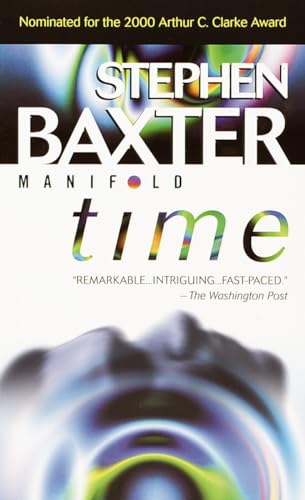
Mass-market paperback. 474 p. This work was nominated for the 2000 Arthur C. Clarke Award. Baxter's novel looks ahead to the year 2010, where after more than a century of ecological damage, industrial and technological expansion, and unchecked population growth, the Earth is on the brink of devastation. One man, Reid Malenfant, dares to envision a bolder, brighter future. Good. No dust jacket as issued. Some pages creased. First Mass Market Edition [stated]. Presumed first printing. Artikel-Nr. 60464
Gebraucht kaufen
EUR 5,97
EUR 4,46 Versand
Versand innerhalb von USA
Versand innerhalb von USA
Anzahl: 1 verfügbar
Beispielbild für diese ISBN
Manifold: Time
Anbieter: Saturday Books, Dudley, Vereinigtes Königreich
Verkäuferbewertung 4 von 5 Sternen

Soft cover. Zustand: Good. The book would appear as used, tanned on top edge, but the pages are unmarked, and the binding firm. Artikel-Nr. 362
Gebraucht kaufen
EUR 2,46
EUR 11,05 Versand
Versand von Vereinigtes Königreich nach USA
Versand von Vereinigtes Königreich nach USA
Anzahl: 1 verfügbar
Beispielbild für diese ISBN
Manifold: Time
Anbieter: Robinson Street Books, IOBA, Binghamton, NY, USA
Verkäuferbewertung 4 von 5 Sternen
Mass Market Paperback. Zustand: Very Good. Prompt Shipment, shipped in Boxes, Tracking PROVIDEDVery good paperback, some creasing. Artikel-Nr. graypb2216236
Gebraucht kaufen
EUR 12,40
EUR 8,47 Versand
Versand innerhalb von USA
Versand innerhalb von USA
Anzahl: 1 verfügbar
Beispielbild für diese ISBN
Manifold: Time
Anbieter: Revaluation Books, Exeter, Vereinigtes Königreich
Verkäuferbewertung 5 von 5 Sternen
Paperback. Zustand: Brand New. reprint edition. 480 pages. 7.00x4.25x1.25 inches. In Stock. Artikel-Nr. xr034543076X
Neu kaufen
EUR 12,95
EUR 11,94 Versand
Versand von Vereinigtes Königreich nach USA
Versand von Vereinigtes Königreich nach USA
Anzahl: 1 verfügbar