
Verwandte Artikel zu The Last Gift of Time: Life Beyond Sixty
Inhaltsangabe
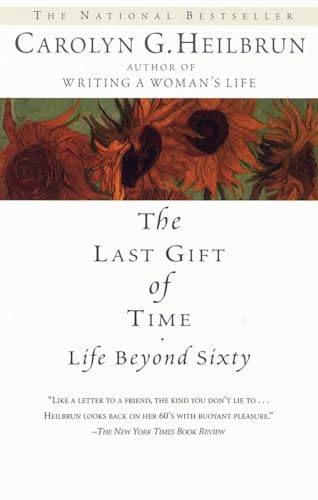
From the author of Writing a Woman's Life comes an inspirational reflection on aging and the gift of life in your 70s and beyond.
When she was young, distinguished author and critic Carolyn Heilbrun solemnly vowed to end her life when she turned seventy. But on the advent of that fateful birthday, she realized that her golden years had been full of unforeseen pleasures. Now, the astute and ever-insightful Heilbrun muses on the emotional and intellectual insights that brought her "to choose each day for now, to live." There are reflections on her new house and her sturdy, comfortable marriage; sweet solitude and the pleasures of sex at an advanced age; the fascination with e-mail and the joy of discovering unexpected friends. Even the encroachments of loss, pain, and sadness that come with age cannot spoil Heilbrun's moveable feast. They are merely the price of bountiful living.
Die Inhaltsangabe kann sich auf eine andere Ausgabe dieses Titels beziehen.
Über die Autorin bzw. den Autor
Carolyn G. Heilbrun is the Avalon Foundation Professor in the Humanities Emeriti at Columbia University. In addition to her many works of criticism, which include the bestselling Writing a Woman’s Life and Hamlet’s Mother and Other Women, she is also the author of the acclaimed Kate Fansler series of mysteries under the name of Amanda Cross.
Von der hinteren Coverseite
young, distinguished author and critic Carolyn Heilbrun solemnly vowed to end her life when she turned seventy. But on the advent of that fateful birthday, she realized that her golden years had been full of unforeseen pleasures. Now, the astute and ever-insightful Heilbrun muses on the emotional and intellectual insights that brought her "to choose each day for now, to live." There are reflections on her new house and her sturdy, comfortable marriage; sweet solitude and the pleasures of sex at an advanced age; the fascination with e-mail and the joy of discovering unexpected friends. Even the encroachments of loss, pain, and sadness that come with age cannot spoil Heilbrun's moveable feast. They are merely the price of bountiful living.
Auszug. © Genehmigter Nachdruck. Alle Rechte vorbehalten.
PREFACE
Since [nature] has fitly planned the other acts of life’s drama, it is not likely that she has neglected the final act as if she were a careless playwright.
—CICERO, De Senectute
LOOKING BACK, I can now perceive myself, a woman already in her sixties, engrossed in the question of what alterations in her life a woman might undertake upon turning fifty. In my writings, my public remarks, and my daily cogitations, I had concentrated on how a woman might best contemplate the start of a decade I had long since passed. This turning point of fifty, I had become convinced, ought to form as vital a milestone in a woman’s life as graduation, promotion, marriage, or the birth or adoption of a child. At fifty, I had concluded, a woman might celebrate a rite of passage, a ritual as regularly marked as a confirmation. Trying to develop a ritual for this crossroads—the point at which a woman has lived thirty years of adult life in one mode and must discover a new mode for the second thirty years likely to be granted her—I wanted to suggest, to (if I am honest) urge women to see this new life as different, as a beginning, as a time requiring the questioning of all previous habits and activities, as, inevitably, a time of profound change.
When I was already sixty-two, I published Writing a Woman’s Life, a work in which I proposed that female lives be looked at differently than had been customary for those writing biographies of women, or for women writing autobiographies, or for women looking anew at their own lives. I mused not only on aging but on friendship, marriage, and the gambits women used to escape a conventional and defining life, maneuvers of which the motive was often unconscious. Later, in articles and speeches, I suggested that aging might be gain rather than loss, and that the impersonation of youth was unlikely to provide the second span of womanhood with meaning and purpose.
What I had scarcely considered at all was the decade I was myself just passing through, the sixties. I, who had thought only of the rite of passage at fifty, have now discovered, at seventy, that the past ten years, the years of my sixties, were in their turn notably rewarding. (I am, of course, aware that my perspective is that of someone who has enjoyed many advantages. I have had a privileged education, worked for over thirty years as a professor of English at Columbia University before my retirement, and now enjoy a comfortable income. At the moment of recording this, I am in good health.) I was savoring a combination of serenity and activity that had hardly been publicly attributed, at least as far as I could discern, to women in their seventh decade. There seemed to be few accounts depicting the pleasures of this time of life. More familiar as an account of turning seventy was Doris Grumbach’s Coming into the End Zone, a beautifully written journal about reaching her seventieth birthday that was a cry of despair and disillusion. She hated her aging body, she feared the streets of her city, she bemoaned the deaths of many beloved friends, and she created the impression, engraved on her narrative by her graceful, exact prose, that the better part of life had passed.
Her sixties, it was clear, had led inevitably to this moment of disillusion. Why were my sixties different? Why were those years, against all prognoses, worthy of commemoration? Grumbach and I share certain biographical details: We both grew up on the Upper West Side in Manhattan, the children of humanistic Jews; we both went to summer camps; we both had expensive educations. We had both married and had children, she four, I three; we both have grandchildren. At seventy, we were both living with longtime partners. We share certain quirks endemic to our age: an aversion to movies made from great novels, to ethnic food, travel, the doom-calls of dental hygienists, and women made over by plastic surgery, and a (daily) devotion to Progresso minestrone for lunch. And there, perhaps providing a clue to our different states of mind on reaching seventy, the similarities end. We have, as far as I remember, never met, although our mutual friend, the writer May Sarton, had offered us a tenuous connection.
Our differences are significant. Grumbach is a famous critic, in both print and television; she has many writer friends, from this profession and from the writers’ colonies MacDowell and Yaddo; she is an intimate of renowned writers; she was beautiful and a devoted swimmer. Almost all the friends and writers she mentions are men; with the exception of an admired woman professor who influenced her in college, Grumbach leaves the impression of life full of male companionship and collegiality.
My sixties seemed to me, despite the usual setbacks and unkindnesses, so much luckier and more auspicious than Grumbach’s that I felt impelled to seek the reason. That she suffered from deafness was not the answer: that condition, as she presented it, seemed almost a blessing to her in these noisy times. The most obvious difference was that I had acquired, in my late fifties and sixties, after a lifetime of solitude and few close and constant companions, women friends and colleagues, themselves now mature adults, whose intimacy helped to make the sixties my happiest decade. The men friends I had, all longtime familiars since graduate school, continued their welcome conversations; it was the newly befriended women, however, who made the significant difference for me.
Perhaps I am one of those who are born (as someone, probably Oscar Wilde, is said to have remarked of Max Beerbohm) blessed with the gift of eternal old age. If, like the poet Philip Larkin, I now appear to have been born aspiring to the age of sixty, I did not, like him, perceive that age as doom. Alan Bennett wrote of him: “Apparently [Larkin] is sixty, but when was he anything else? He has made a habit of being sixty, he has made a profession of it … he has been sixty for the last twenty-five years.” As Larkin’s biographer, Andrew Motion, observed about Larkin’s sixtieth birthday, “Every word of praise told him his work was a thing of the past. Every mention of his birthday was a reminder of mortality.” William Styron, writing of his terrible bout with depression, noted that it began at age sixty, “that hulking milestone of mortality.” Is it death he fears, or age, or the loss of talent?
Depression weighs upon Grumbach as she contemplates the death of so many young men from AIDS, a despair echoed in these lines from Marilyn Hacker’s “Against Elegies”:
My old friends, my new friends who are old,
or older, sixty, seventy, take pills
with meals or after dinner. Arthritis
scourges them. But irremediable night is
farther away from them; they seem to hold
it at bay better than the young-middle-aged
whom something, or another something, kills
before the chapter’s finished, the play
staged.
The curtains stay down when the light fades.…
The sixty-five-year-olds are splendid, vying
with each other in work hours and wit.
They bring their generosity along,
setting the tone, or not giving a shit.
How well, or how eccentrically, they dress!
Their anecdotes are to the point, or wide
enough to make room for discrepancies.
But their children are dying.
The young and middle-aged in Hacker’s poem are dead or dying. And yet, the human irony is that those of us who have reached seventy are rarely grateful: since we did not wish to die, surely we must have wished to grow old? But, ill-satisfied, we tend to sneer at our flabby bodies and the inevitable fate that dumped old age upon us....
„Über diesen Titel“ kann sich auf eine andere Ausgabe dieses Titels beziehen.
Suchergebnisse für The Last Gift of Time: Life Beyond Sixty

Beispielbild für diese ISBN
The Last Gift of Time: Life Beyond Sixty
Anbieter: World of Books (was SecondSale), Montgomery, IL, USA
Verkäuferbewertung 5 von 5 Sternen

Paperback. Zustand: Fair. From the author of Writing a Woman's Life comes an inspirational reflection on aging and the gift of life in your 70s and beyond. When she was young, distinguished author and critic Carolyn Heilbrun solemnly vowed to end her life when she turned seventy. But on the advent of that fateful birthday, she realized that her golden years had been full of unforeseen pleasures. Now, the astute and ever-insightful Heilbrun muses on the emotional and intellectual insights that brought her "to choose each day for now, to live." There are reflections on her new house and her sturdy, comfortable marria≥ sweet solitude and the pleasures of sex at an advanced a≥ the fascination with e-mail and the joy of discovering unexpected friends. Even the encroachments of loss, pain, and sadness that come with age cannot spoil Heilbrun's moveable feast. They are merely the price of bountiful living. Artikel-Nr. 00060578753
Gebraucht kaufen
EUR 3,90
Versand gratis
Versand innerhalb von USA
Versand innerhalb von USA
Anzahl: 8 verfügbar
Beispielbild für diese ISBN
The Last Gift of Time: Life Beyond Sixty
Anbieter: World of Books (was SecondSale), Montgomery, IL, USA
Verkäuferbewertung 5 von 5 Sternen
Paperback. Zustand: Good. From the author of Writing a Woman's Life comes an inspirational reflection on aging and the gift of life in your 70s and beyond. When she was young, distinguished author and critic Carolyn Heilbrun solemnly vowed to end her life when she turned seventy. But on the advent of that fateful birthday, she realized that her golden years had been full of unforeseen pleasures. Now, the astute and ever-insightful Heilbrun muses on the emotional and intellectual insights that brought her "to choose each day for now, to live." There are reflections on her new house and her sturdy, comfortable marria≥ sweet solitude and the pleasures of sex at an advanced a≥ the fascination with e-mail and the joy of discovering unexpected friends. Even the encroachments of loss, pain, and sadness that come with age cannot spoil Heilbrun's moveable feast. They are merely the price of bountiful living. Artikel-Nr. 00094221910
Gebraucht kaufen
EUR 3,90
Versand gratis
Versand innerhalb von USA
Versand innerhalb von USA
Anzahl: 19 verfügbar
Beispielbild für diese ISBN
The Last Gift of Time: Life Beyond Sixty
ISBN 10: 0345422953
ISBN 13: 9780345422958
Gebraucht
Paperback
Anbieter: BooksRun, Philadelphia, PA, USA
Verkäuferbewertung 5 von 5 Sternen
Paperback. Zustand: Fair. First Ballantine Books Edition. The item might be beaten up but readable. May contain markings or highlighting, as well as stains, bent corners, or any other major defect, but the text is not obscured in any way. Artikel-Nr. 0345422953-7-1
Gebraucht kaufen
EUR 4,46
Versand gratis
Versand innerhalb von USA
Versand innerhalb von USA
Anzahl: 1 verfügbar
Beispielbild für diese ISBN
The Last Gift of Time: Life Beyond Sixty
ISBN 10: 0345422953
ISBN 13: 9780345422958
Gebraucht
Paperback
Anbieter: BooksRun, Philadelphia, PA, USA
Verkäuferbewertung 5 von 5 Sternen
Paperback. Zustand: Very Good. First Ballantine Books Edition. It's a well-cared-for item that has seen limited use. The item may show minor signs of wear. All the text is legible, with all pages included. It may have slight markings and/or highlighting. Artikel-Nr. 0345422953-11-6
Gebraucht kaufen
EUR 4,72
Versand gratis
Versand innerhalb von USA
Versand innerhalb von USA
Anzahl: 1 verfügbar
Beispielbild für diese ISBN
The Last Gift of Time: Life Beyond Sixty
Verlag:
Random House Publishing Group, 1998
ISBN 10: 0345422953
ISBN 13: 9780345422958
Gebraucht
Paperback
Anbieter: ThriftBooks-Dallas, Dallas, TX, USA
Verkäuferbewertung 5 von 5 Sternen
Paperback. Zustand: Good. No Jacket. Pages can have notes/highlighting. Spine may show signs of wear. ~ ThriftBooks: Read More, Spend Less. Artikel-Nr. G0345422953I3N00
Gebraucht kaufen
EUR 6,05
Versand gratis
Versand innerhalb von USA
Versand innerhalb von USA
Anzahl: 1 verfügbar
Beispielbild für diese ISBN
The Last Gift of Time: Life Beyond Sixty
Verlag:
Random House Publishing Group, 1998
ISBN 10: 0345422953
ISBN 13: 9780345422958
Gebraucht
Paperback
Anbieter: ThriftBooks-Dallas, Dallas, TX, USA
Verkäuferbewertung 5 von 5 Sternen
Paperback. Zustand: Very Good. No Jacket. May have limited writing in cover pages. Pages are unmarked. ~ ThriftBooks: Read More, Spend Less. Artikel-Nr. G0345422953I4N00
Gebraucht kaufen
EUR 6,05
Versand gratis
Versand innerhalb von USA
Versand innerhalb von USA
Anzahl: 1 verfügbar
Beispielbild für diese ISBN
The Last Gift of Time: Life Beyond Sixty
Verlag:
Random House Publishing Group, 1998
ISBN 10: 0345422953
ISBN 13: 9780345422958
Gebraucht
Paperback
Anbieter: ThriftBooks-Atlanta, AUSTELL, GA, USA
Verkäuferbewertung 5 von 5 Sternen
Paperback. Zustand: Very Good. No Jacket. May have limited writing in cover pages. Pages are unmarked. ~ ThriftBooks: Read More, Spend Less. Artikel-Nr. G0345422953I4N00
Gebraucht kaufen
EUR 6,05
Versand gratis
Versand innerhalb von USA
Versand innerhalb von USA
Anzahl: 1 verfügbar
Beispielbild für diese ISBN
The Last Gift of Time : Life Beyond Sixty
Verlag:
Random House Publishing Group, 1998
ISBN 10: 0345422953
ISBN 13: 9780345422958
Gebraucht
Softcover
Anbieter: Better World Books: West, Reno, NV, USA
Verkäuferbewertung 5 von 5 Sternen
Zustand: Very Good. 1st Ballantine Books Ed. Pages intact with possible writing/highlighting. Binding strong with minor wear. Dust jackets/supplements may not be included. Stock photo provided. Product includes identifying sticker. Better World Books: Buy Books. Do Good. Artikel-Nr. 5351365-6
Gebraucht kaufen
EUR 6,19
Versand gratis
Versand innerhalb von USA
Versand innerhalb von USA
Anzahl: 1 verfügbar
Beispielbild für diese ISBN
The Last Gift of Time : Life Beyond Sixty
Verlag:
Random House Publishing Group, 1998
ISBN 10: 0345422953
ISBN 13: 9780345422958
Gebraucht
Softcover
Anbieter: Better World Books, Mishawaka, IN, USA
Verkäuferbewertung 5 von 5 Sternen
Zustand: Good. 1st Ballantine Books Ed. Pages intact with minimal writing/highlighting. The binding may be loose and creased. Dust jackets/supplements are not included. Stock photo provided. Product includes identifying sticker. Better World Books: Buy Books. Do Good. Artikel-Nr. GRP64805824
Gebraucht kaufen
EUR 6,19
Versand gratis
Versand innerhalb von USA
Versand innerhalb von USA
Anzahl: 2 verfügbar
Beispielbild für diese ISBN
The Last Gift of Time : Life Beyond Sixty
Verlag:
Random House Publishing Group, 1998
ISBN 10: 0345422953
ISBN 13: 9780345422958
Gebraucht
Softcover
Anbieter: Better World Books: West, Reno, NV, USA
Verkäuferbewertung 5 von 5 Sternen
Zustand: Good. 1st Ballantine Books Ed. Pages intact with minimal writing/highlighting. The binding may be loose and creased. Dust jackets/supplements are not included. Stock photo provided. Product includes identifying sticker. Better World Books: Buy Books. Do Good. Artikel-Nr. GRP64805824
Gebraucht kaufen
EUR 6,19
Versand gratis
Versand innerhalb von USA
Versand innerhalb von USA
Anzahl: 1 verfügbar