
Verwandte Artikel zu I Only Say This Because I Love You: Talking to Your...
I Only Say This Because I Love You: Talking to Your Parents, Partner, Sibs, and Kids When You're All Adults - Softcover
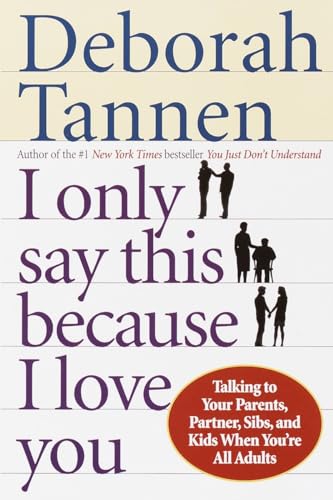
Inhaltsangabe
Why does talk in families so often go in circles, leaving us tied up in knots? In this illuminating book, Deborah Tannen, the linguist and and bestselling author of You Just Don't Understand and many other books, reveals why talking to family members is so often painful and problematic even when we're all adults.
Searching for signs of acceptance and belonging, we find signs of disapproval and rejection. Why do the seeds of family love so often yield a harvest of criticism and judgment? In I Only Say This Because I Love You, Tannen shows how important it is, in family talk, to learn to separate word meanings, or messages, from heart meanings, or metamessages —unstated but powerful meanings that come from the history of our relationships and the way things are said.
Presenting real conversations from people's lives, Tannen reveals what is actually going on in family talk, including how family conversations must balance the longing for connection with the desire for control, as we struggle to be close without giving up our freedom.
This eye-opening book explains why grown women so often feel criticized by their mothers; and why mothers feel they can't open their mouths around their grown daughters; why growing up male or female, or as an older or younger sibling, results in different experiences of family that persist throughout our lives; and much, much more. By helping us to understand and redefine family talk, Tannen provides the tools to improve relationships with family members of every age.
Die Inhaltsangabe kann sich auf eine andere Ausgabe dieses Titels beziehen.
Über die Autorin bzw. den Autor
Deborah Tannen is the author of You Just Don't Understand, which was on the New York Times bestseller list for nearly four years, including eight months at number one, and has been translated into twenty-six languages. Among her many books are The Argument Culture, Talking from 9 to 5, and That's Not What I Meant! A linguistics professor at Georgetown University in Washington, D.C., she is a frequent guest on such radio and television shows as The Oprah Winfrey Show, Today, Good Morning America, CNN's TalkBack Live, and NPR's All Things Considered.
Von der hinteren Coverseite
Why does talk in families so often go in circles, leaving us tied up in knots? In this illuminating book, Deborah Tannen, the linguist and and bestselling author of You Just Don't Understand and many other books, reveals why talking to family members is so often painful and problematic even when we're all adults. Searching for signs of acceptance and belonging, we find signs of disapproval and rejection. Why do the seeds of family love so often yield a harvest of criticism and judgment? In I Only Say This Because I Love You, Tannen shows how important it is, in family talk, to learn to separate word meanings, or messages, from heart meanings, or metamessages -- unstated but powerful meanings that come from the history of our relationships and the way things are said. Presenting real conversations from people's lives, Tannen reveals what is actually going on in family talk, including how family conversations must balance the longing for connection with the desire for control, as we struggle to be close without giving up our freedom.
This eye-opening book explains why grown women so often feel criticized by their mothers; and why mothers feel they can't open their mouths around their grown daughters; why growing up male or female, or as an older or younger sibling, results in different experiences of family that persist throughout our lives; and much, much more. By helping us to understand and redefine family talk, Tannen provides the tools to improve relationships with family members of every age.
Aus dem Klappentext
k in families so often go in circles, leaving us tied up in knots? In this illuminating book, Deborah Tannen, the linguist and and bestselling author of You Just Don't Understand and many other books, reveals why talking to family members is so often painful and problematic even when we're all adults. Searching for signs of acceptance and belonging, we find signs of disapproval and rejection. Why do the seeds of family love so often yield a harvest of criticism and judgment? In I Only Say This Because I Love You, Tannen shows how important it is, in family talk, to learn to separate word meanings, or messages, from heart meanings, or metamessages unstated but powerful meanings that come from the history of our relationships and the way things are said. Presenting real conversations from people's lives, Tannen reveals what is actually going on in family talk, including how family conversations must balance the longing for connection with the desire for control, as we s
Auszug. © Genehmigter Nachdruck. Alle Rechte vorbehalten.
One
“I Can’t Even Open My Mouth”
Separating Messages from Metamessages in Family Talk
Do you really need another piece of cake?” Donna asks George.
“You bet I do,” he replies, with that edge to his voice that implies, “If I wasn’t sure I needed it before, I am darned sure now.”
Donna feels hamstrung. She knows that George is going to say later that he wished he hadn’t had that second piece of cake.
“Why are you always watching what I eat?” George asks.
“I was just watching out for you,” Donna replies. “I only say it because I love you.”
Elizabeth, in her late twenties, is happy to be making Thanksgiving dinner for her extended family in her own home. Her mother, who is visiting, is helping out in the kitchen. As Elizabeth pre- pares the stuffing for the turkey, her mother remarks, “Oh, you put onions in the stuffing?”
Feeling suddenly as if she were sixteen years old again, Elizabeth turns on her mother and says, “I’m making the stuffing, Mom. Why do you have to criticize everything I do?”
“I didn’t criticize,” her mother replies. “I just asked a question. What’s got into you? I can’t even open my mouth.”
The allure of family — which is, at heart, the allure of love — is to have someone who knows you so well that you don’t have to explain yourself. It is the promise of someone who cares enough about you to protect you against the world of strangers who do not wish you well. Yet, by an odd and cruel twist, it is the family itself that often causes pain. Those we love are looking at us so close-up that they see all our blemishes—see them as if through a magnifying glass. Family members have innumerable opportunities to witness our faults and feel they have a right to point them out. Often their intention is to help us improve. They feel, as Donna did, “I only say it because I love you.”
Family members also have a long shared history, so everything we say in a conversation today echoes with meanings from the past. If you have a tendency to be late, your parent, sibling, or spouse may say, “We have to leave at eight” — and then add, “It’s really important. Don’t be late. Please start your shower at seven, not seven-thirty!” These extra injunctions are demeaning and interfering, but they are based on experience. At the same time, having experienced negative judgments in the past, we develop a sixth sense to sniff out criticism in almost anything a loved one says — even an innocent question about ingredients in the stuffing. That’s why Elizabeth’s mother ends up feeling as if she can’t even open her mouth — and Elizabeth ends up feeling criticized.
When we are children our family constitutes the world. When we grow up family members — not only our spouses but also our grown-up children and adult sisters and brothers — keep this larger-than-life aura. We overreact to their judgments because it feels as if they were handed down by the Supreme Court and are unassailable assessments of our value as human beings. We bristle because these judgments seem unjust; or because we sense a kernel of truth we would rather not face; or because we fear that if someone who knows us so well judges us harshly we must really be guilty, so we risk losing not only that person’s love but everyone else’s, too. Along with this heavy load of implications comes a dark resentment that a loved one is judging us at all — and has such power to wound.
“I still fight with my father,” a man who had reached a high position in journalism said to me. “He’s been dead twenty-one years.” I asked for an example. “He’d tell me that I had to comb my hair and dress better, that I’d learn when I grew up that appearance is important.” When he said this I noticed that his hair was uncombed, and the tails of his faded shirt were creeping out from the waist of his pants. He went on, “I told him I’d ignore that. And now sometimes when I’m going somewhere important, I’ll look in the mirror and think — I’ll say to him in my mind, ‘See? I am a success and it didn’t matter.’ ”
This man’s “fights” with his father are about approval. No matter what age we’ve reached, no matter whether our parents are alive or dead, whether we were close to them or not, there are times when theirs are the eyes through which we view ourselves, theirs the standards against which we measure ourselves when we wonder whether we have measured up. The criticism of parents carries extra weight, even when children are adults.
I Care, Therefore I Criticize
Some family members feel they have not only a right but an obligation to tell you when they think you’re doing something wrong. A woman from Thailand recalls that when she was in her late teens and early twenties, her mother frequently had talks with her in which she tried to set her daughter straight. “At the end of each lecture,” the woman says, “my mother would always tell me, ‘I have to complain about you because I am your mother and I love you. Nobody else will talk to you the way I do because they don’t care.’ ”
It sometimes seems that family members operate under the tenet “I care, therefore I criticize.” To the one who is being told to do things differently, what comes through loudest and clearest is the criticism. But the one offering suggestions and judgments is usually focused on the caring. A mother, for example, was expressing concern about her daughter’s boyfriend: He didn’t have a serious job, he didn’t seem to want one, and she didn’t think he was a good prospect for marriage. The daughter protested that her mother disapproved of everyone she dated. Her mother responded indignantly, “Would you rather I didn’t care?”
As family members we wonder why our parents, children, siblings, and spouses are so critical of us. But as family members we also feel frustrated because comments we make in the spirit of caring are taken as criticizing.
Both sentiments are explained by the double meaning of giving advice: a loving sign of caring, a hurtful sign of criticizing. It’s impossible to say which is right; both meanings are there. Sorting out the ambiguous meanings of caring and criticizing is difficult because language works on two levels: the message and the meta- message. Separating these levels — and being aware of both — is crucial to improving communication in the family.
The Intimate Critic: When Metamessages Hurt
Because those closest to us have front-row seats to view our faults, we quickly react — sometimes overreact — to any hint of criticism. The result can be downright comic, as in Phyllis Richman’s novel Who’s Afraid of Virginia Ham? One scene, a conversation between the narrator and her adult daughter, Lily, shows how criticism can be the metronome providing the beat for the family theme song. The dialogue goes like this:
Lily:Am I too critical of people?
Mother:What people? Me?
Lily:Mamma, don’t be so self-centered.
Mother:Lily, don’t be so critical.
Lily:I knew it. You do think I’m critical. Mamma, why do you always have to find something wrong with me?
The mother then protests that it was Lily who asked if she was too critical, and now she’s criticizing her mother for answering. Lily responds, “I can’t follow this. Sometimes you’re impossibly...
„Über diesen Titel“ kann sich auf eine andere Ausgabe dieses Titels beziehen.
Suchergebnisse für I Only Say This Because I Love You: Talking to Your...

Beispielbild für diese ISBN
I Only Say This Because I Love You: Talking to Your Parents, Partner, Sibs, and Kids When You're All Adults
Anbieter: World of Books (was SecondSale), Montgomery, IL, USA
Verkäuferbewertung 5 von 5 Sternen

Paperback. Zustand: Good. Why does talk in families so often go in circles, leaving us tied up in knots? In this illuminating book, Deborah Tannen, the linguist and and bestselling author of You Just Don't Understand and many other books, reveals why talking to family members is so often painful and problematic even when we're all adults. Searching for signs of acceptance and belonging, we find signs of disapproval and rejection. Why do the seeds of family love so often yield a harvest of criticism and judgment? In I Only Say This Because I Love You, Tannen shows how important it is, in family talk, to learn to separate word meanings, or messages, from heart meanings, or metamessages -unstated but powerful meanings that come from the history of our relationships and the way things are said. Presenting real conversations from people's lives, Tannen reveals what is actually going on in family talk, including how family conversations must balance the longing for connection with the desire for control, as we struggle to be close without giving up our freedom. This eye-opening book explains why grown women so often feel criticized by their mothers; and why mothers feel they can't open their mouths around their grown daughters; why growing up male or female, or as an older or younger sibling, results in different experiences of family that persist throughout our lives; and much, much more. By helping us to understand and redefine family talk, Tannen provides the tools to improve relationships with family members of every age. Artikel-Nr. 00097232305
Gebraucht kaufen
EUR 3,72
Versand gratis
Versand innerhalb von USA
Versand innerhalb von USA
Anzahl: 4 verfügbar
Beispielbild für diese ISBN
I Only Say This Because I Love You: Talking to Your Parents, Partner, Sibs, and Kids When You're All Adults
Verlag:
Random House Publishing Group (edition ), 2002
ISBN 10: 0345407520
ISBN 13: 9780345407528
Gebraucht
Paperback
Anbieter: BooksRun, Philadelphia, PA, USA
Verkäuferbewertung 5 von 5 Sternen
Paperback. Zustand: Very Good. It's a well-cared-for item that has seen limited use. The item may show minor signs of wear. All the text is legible, with all pages included. It may have slight markings and/or highlighting. Artikel-Nr. 0345407520-8-18
Gebraucht kaufen
EUR 4,58
Versand gratis
Versand innerhalb von USA
Versand innerhalb von USA
Anzahl: 1 verfügbar
Beispielbild für diese ISBN
I Only Say This Because I Love You: Talking to Your Parents, Partner, Sibs, and Kids When You're All Adults
Verlag:
Random House Publishing Group (edition Reprint), 2002
ISBN 10: 0345407520
ISBN 13: 9780345407528
Gebraucht
Paperback
Anbieter: BooksRun, Philadelphia, PA, USA
Verkäuferbewertung 5 von 5 Sternen
Paperback. Zustand: Fair. Reprint. The item might be beaten up but readable. May contain markings or highlighting, as well as stains, bent corners, or any other major defect, but the text is not obscured in any way. Artikel-Nr. 0345407520-7-18
Gebraucht kaufen
EUR 4,73
Versand gratis
Versand innerhalb von USA
Versand innerhalb von USA
Anzahl: 1 verfügbar
Foto des Verkäufers
I Only Say This Because I Love You: Talking to Your Parents, Partner, Sibs, and Kids When You're All Adults
Verlag:
Random House Publishing Group, 2002
ISBN 10: 0345407520
ISBN 13: 9780345407528
Gebraucht
Softcover
Anbieter: Dream Books Co., Denver, CO, USA
Verkäuferbewertung 5 von 5 Sternen
Zustand: good. Gently used with minimal wear on the corners and cover. A few pages may contain light highlighting or writing, but the text remains fully legible. Dust jacket may be missing, and supplemental materials like CDs or codes may not be included. May be ex-library with library markings. Ships promptly! Artikel-Nr. DBV.0345407520.G
Gebraucht kaufen
EUR 6,06
Versand gratis
Versand innerhalb von USA
Versand innerhalb von USA
Anzahl: 1 verfügbar
Beispielbild für diese ISBN
I Only Say This Because I Love You: Talking to Your Parents, Partner, Sibs, and Kids When You're All Adults
Verlag:
Random House Publishing Group, 2002
ISBN 10: 0345407520
ISBN 13: 9780345407528
Gebraucht
Paperback
Anbieter: ThriftBooks-Atlanta, AUSTELL, GA, USA
Verkäuferbewertung 5 von 5 Sternen
Paperback. Zustand: Very Good. No Jacket. May have limited writing in cover pages. Pages are unmarked. ~ ThriftBooks: Read More, Spend Less. Artikel-Nr. G0345407520I4N00
Gebraucht kaufen
EUR 6,18
Versand gratis
Versand innerhalb von USA
Versand innerhalb von USA
Anzahl: 1 verfügbar
Beispielbild für diese ISBN
I Only Say This Because I Love You: Talking to Your Parents, Partner, Sibs, and Kids When You're All Adults
Verlag:
Random House Publishing Group, 2002
ISBN 10: 0345407520
ISBN 13: 9780345407528
Gebraucht
Softcover
Anbieter: Wonder Book, Frederick, MD, USA
Verkäuferbewertung 5 von 5 Sternen
Zustand: Very Good. Very Good condition. A copy that may have a few cosmetic defects. May also contain light spine creasing or a few markings such as an owner's name, short gifter's inscription or light stamp. Artikel-Nr. G10K-00065
Gebraucht kaufen
EUR 6,29
Versand gratis
Versand innerhalb von USA
Versand innerhalb von USA
Anzahl: 3 verfügbar
Beispielbild für diese ISBN
I Only Say This Because I Love You: Talking to Your Parents, Partner, Sibs, and Kids When You're All Adults
Verlag:
Random House Publishing Group, 2002
ISBN 10: 0345407520
ISBN 13: 9780345407528
Gebraucht
Softcover
Signiert
Anbieter: Wonder Book, Frederick, MD, USA
Verkäuferbewertung 5 von 5 Sternen
Zustand: Good. Signed Copy . Signed by author on title page. Pages slightly foxed. Artikel-Nr. V17OS-00599
Gebraucht kaufen
EUR 6,29
Versand gratis
Versand innerhalb von USA
Versand innerhalb von USA
Anzahl: 1 verfügbar
Beispielbild für diese ISBN
I Only Say This Because I Love You: Talking to Your Parents, Partner, Sibs, and Kids When You're All Adults
Verlag:
Random House Publishing Group, 2002
ISBN 10: 0345407520
ISBN 13: 9780345407528
Gebraucht
Softcover
Anbieter: Wonder Book, Frederick, MD, USA
Verkäuferbewertung 5 von 5 Sternen
Zustand: Good. Good condition. A copy that has been read but remains intact. May contain markings such as bookplates, stamps, limited notes and highlighting, or a few light stains. Artikel-Nr. V17A-04753
Gebraucht kaufen
EUR 6,29
Versand gratis
Versand innerhalb von USA
Versand innerhalb von USA
Anzahl: 2 verfügbar
Beispielbild für diese ISBN
I Only Say This Because I Love You : Talking to Your Parents, Partner, Sibs, and Kids When You're All Adults
Verlag:
Random House Publishing Group, 2002
ISBN 10: 0345407520
ISBN 13: 9780345407528
Gebraucht
Softcover
Anbieter: Better World Books, Mishawaka, IN, USA
Verkäuferbewertung 5 von 5 Sternen
Zustand: Good. Reprint. Pages intact with minimal writing/highlighting. The binding may be loose and creased. Dust jackets/supplements are not included. Stock photo provided. Product includes identifying sticker. Better World Books: Buy Books. Do Good. Artikel-Nr. 3208540-6
Gebraucht kaufen
EUR 6,43
Versand gratis
Versand innerhalb von USA
Versand innerhalb von USA
Anzahl: 2 verfügbar
Beispielbild für diese ISBN
I Only Say This Because I Love You : Talking to Your Parents, Partner, Sibs, and Kids When You're All Adults
Verlag:
Random House Publishing Group, 2002
ISBN 10: 0345407520
ISBN 13: 9780345407528
Gebraucht
Softcover
Anbieter: Better World Books, Mishawaka, IN, USA
Verkäuferbewertung 5 von 5 Sternen
Zustand: Very Good. Reprint. Pages intact with possible writing/highlighting. Binding strong with minor wear. Dust jackets/supplements may not be included. Stock photo provided. Product includes identifying sticker. Better World Books: Buy Books. Do Good. Artikel-Nr. 3208541-6
Gebraucht kaufen
EUR 6,43
Versand gratis
Versand innerhalb von USA
Versand innerhalb von USA
Anzahl: 1 verfügbar