
Verwandte Artikel zu The Proud Tower: A Portrait of the World Before the...
The Proud Tower: A Portrait of the World Before the War, 1890-1914; Barbara W. Tuchman's Great War Series - Softcover
Buch 2 von 2: Great War Series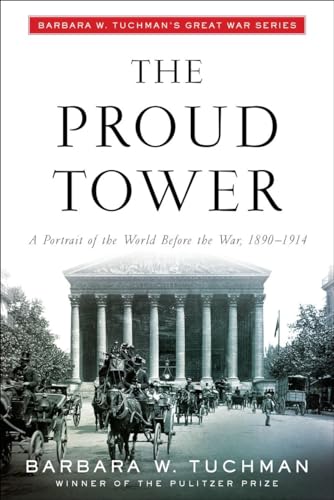
Inhaltsangabe
The classic account of the lead-up to World War I, told with “a rare combination of impeccable scholarship and literary polish” (The New York Times)—from the Pulitzer Prize–winning author of The Guns of August
During the fateful quarter century leading up to World War I, the climax of a century of rapid, unprecedented change, a privileged few enjoyed Olympian luxury as the underclass was “heaving in its pain, its power, and its hate.” In The Proud Tower, Barbara W. Tuchman brings the era to vivid life: the decline of the Edwardian aristocracy; the Anarchists of Europe and America; Germany and its self-depicted hero, Richard Strauss; Diaghilev’s Russian ballet and Stravinsky’s music; the Dreyfus Affair; the Peace Conferences in The Hague; and the enthusiasm and tragedy of Socialism, epitomized by the assassination of Jean Jaurès on the night the Great War began and an epoch came to a close.
The Proud Tower, The Guns of August, and The Zimmermann Telegram comprise Barbara W. Tuchman’s classic histories of the First World War era.
Die Inhaltsangabe kann sich auf eine andere Ausgabe dieses Titels beziehen.
Über die Autorin bzw. den Autor
Barbara W. Tuchman (1912–1989) achieved prominence as a historian with The Zimmermann Telegram and international fame with The Guns of August—a huge bestseller and winner of the Pulitzer Prize. Her other works include Bible and Sword, The Proud Tower, Stilwell and the American Experience in China (for which Tuchman was awarded a second Pulitzer Prize), Notes from China, A Distant Mirror, Practicing History, The March of Folly, and The First Salute.
Von der hinteren Coverseite
plomatic origins, so-called, of the War are only the fever chart of the patient; they do not tell us what caused the fever. To probe for underlying causes and deeper forces one must operate within the framework of a whole society and try to discover what moved the people in it."
--Barbara W. Tuchman
The fateful quarter-century leading up to the World War I was a time when the world of Privilege still existed in Olympian luxury and the world of Protest was heaving in its pain, its power, and its hate. The age was the climax of a century of the most accelerated rate of change in history, a cataclysmic shaping of destiny.
In The Proud Tower, Barbara Tuchman concentrates on society rather than the state. With an artist's selectivity, Tuchman bings to vivid life the people, places, and events that shaped the years leading up to the Great War: the Edwardian aristocracy and the end of their reign; the Anarchists of Europe and America, who voiced the protest of the oppressed; Germany, a
Auszug. © Genehmigter Nachdruck. Alle Rechte vorbehalten.
I
The Patricians
The last government in the Western world to possess all the attributes of aristocracy in working condition took office in England in June of 1895. Great Britain was at the zenith of empire when the Conservatives won the General Election of that year, and the Cabinet they formed was her superb and resplendent image. Its members represented the greater landowners of the country who had been accustomed to govern for generations. As its superior citizens they felt they owed a duty to the State to guard its interests and manage its affairs. They governed from duty, heritage and habit—and, as they saw it, from right.
The Prime Minister was a Marquess and lineal descendant of the father and son who had been chief ministers to Queen Elizabeth and James I. The Secretary for War was another Marquess who traced his inferior title of Baron back to the year 1181, whose great-grandfather had been Prime Minister under George III and whose grandfather had served in six cabinets under three reigns. The Lord President of the Council was a Duke who owned 186,000 acres in eleven counties, whose ancestors had served in government since the Fourteenth Century, who had himself served thirty-four years in the House of Commons and three times refused to be Prime Minister. The Secretary for India was the son of another Duke whose family seat was received in 1315 by grant from Robert the Bruce and who had four sons serving in Parliament at the same time. The President of the Local Government Board was a pre-eminent country squire who had a Duke for brother-in-law, a Marquess for son-in-law, an ancestor who had been Lord Mayor of London in the reign of Charles II, and who had himself been a Member of Parliament for twenty-seven years. The Lord Chancellor bore a family name brought to England by a Norman follower of William the Conqueror and maintained thereafter over eight centuries without a title. The Lord Lieutenant for Ireland was an Earl, a grandnephew of the Duke of Wellington and a hereditary trustee of the British Museum. The Cabinet also included a Viscount, three Barons and two Baronets. Of its six commoners, one was a director of the Bank of England, one was a squire whose family had represented the same county in Parliament since the Sixteenth Century, one—who acted as Leader of the House of Commons—was the Prime Minister’s nephew and inheritor of a Scottish fortune of £4,000,000, and one, a notable and disturbing cuckoo in the nest, was a Birmingham manufacturer widely regarded as the most successful man in England.
Besides riches, rank, broad acres and ancient lineage, the new Government also possessed, to the regret of the Liberal Opposition and in the words of one of them, “an almost embarrassing wealth of talent and capacity.” Secure in authority, resting comfortably on their electoral majority in the House of Commons and on a permanent majority in the House of Lords, of whom four-fifths were Conservatives, they were in a position, admitted the same opponent, “of unassailable strength.”
Enriching their ranks were the Whig aristocrats who had seceded from the Liberal party in 1886 rather than accept Mr. Gladstone’s insistence on Home Rule for Ireland. They were for the most part great landowners who, like their natural brothers the Tories, regarded union with Ireland as sacrosanct. Led by the Duke of Devonshire, the Marquess of Lansdowne and Mr. Joseph Chamberlain, they had remained independent until 1895, when they joined with the Conservative party, and the two groups emerged as the Unionist party, in recognition of the policy that had brought them together. With the exception of Mr. Chamberlain, this coalition represented that class in whose blood, training and practice over the centuries, landowning and governing had been inseparable. Ever since Saxon chieftains met to advise the King in the first national assembly, the landowners of England had been sending members to Parliament and performing the duties of High Sheriff, Justice of the Peace and Lord Lieutenant of the Militia in their own counties. They had learned the practice of government from the possession of great estates, and they undertook to manage the affairs of the nation as inevitably and unquestionably as beavers build a dam. It was their ordained role and natural task.
But it was threatened. By a rising rumble of protest from below, by the Radicals of the Opposition who talked about taxing unearned increment on land, by Home Rulers who wanted to detach the Irish island from which so much English income came, by Trade Unionists who talked of Labour representation in Parliament and demanded the legal right to strike and otherwise interfere with the free play of economic forces, by Socialists who wanted to nationalize property and Anarchists who wanted to abolish it, by upstart nations and strange challenges from abroad. The rumble was distant, but it spoke with one voice that said Change, and those whose business was government could not help but hear.
Planted firmly across the path of change, operating warily, shrewdly yet with passionate conviction in defence of the existing order, was a peer who was Chancellor of Oxford University for life, had twice held the India Office, twice the Foreign Office and was now Prime Minister for the third time. He was Robert Arthur Talbot Gascoyne-Cecil, Lord Salisbury, ninth Earl and third Marquess of his line.
Lord Salisbury was both the epitome of his class and uncharacteristic of it—except insofar as the freedom to be different was a class characteristic. He was six feet four inches tall, and as a young man had been thin, ungainly, stooping and shortsighted, with hair unusually black for an Englishman. Now sixty-five, his youthful lankiness had turned to bulk, his shoulders had grown massive and more stooped than ever, and his heavy bald head with full curly gray beard rested on them as if weighted down. Melancholy, intensely intellectual, subject to sleepwalking and fits of depression which he called “nerve storms,” caustic, tactless, absent-minded, bored by society and fond of solitude, with a penetrating, skeptical, questioning mind, he had been called the Hamlet of English politics. He was above the conventions and refused to live in Downing Street. His devotion was to religion, his interest in science. In his own home he attended private chapel every morning before breakfast, and had fitted up a chemical laboratory where he conducted solitary experiments. He harnessed the river at Hatfield for an electric power plant on his estate and strung up along the old beams of his home one of England’s first electric light systems, at which his family threw cushions when the wires sparked and sputtered while they went on talking and arguing, a customary occupation of the Cecils.
Lord Salisbury cared nothing for sport and little for people. His aloofness was enhanced by shortsightedness so intense that he once failed to recognize a member of his own Cabinet, and once, his own butler. At the close of the Boer War he picked up a signed photograph of King Edward and, gazing at it pensively, remarked, “Poor Buller [referring to the Commander-in-Chief at the start of the War], what a mess he made of it.” On another occasion he was seen in prolonged military conversation with a minor peer under the impression that he was talking to Field Marshal Lord Roberts.
For the upper-class Englishman’s alter ego, most intimate companion and constant preoccupation, his horse, Lord Salisbury had no more regard. Riding was to him purely a means of locomotion to which the horse was “a necessary but extremely inconvenient adjunct.” Nor was he addicted to shooting. When Parliament rose he did not go north to slaughter grouse upon the moors or stalk deer in Scottish forests, and when...
„Über diesen Titel“ kann sich auf eine andere Ausgabe dieses Titels beziehen.
Weitere beliebte Ausgaben desselben Titels

Suchergebnisse für The Proud Tower: A Portrait of the World Before the...

Beispielbild für diese ISBN
The Proud Tower A Portrait of
Verlag:
Random House Trade Paperbacks, 1996
ISBN 10: 0345405013
ISBN 13: 9780345405012
Gebraucht
Softcover
Anbieter: World of Books (was SecondSale), Montgomery, IL, USA
Verkäuferbewertung 5 von 5 Sternen

Zustand: Good. Item in good condition. Textbooks may not include supplemental items i.e. CDs, access codes etc. Artikel-Nr. 00105040822
Gebraucht kaufen
EUR 4,10
Versand gratis
Versand innerhalb von USA
Versand innerhalb von USA
Anzahl: 12 verfügbar
Beispielbild für diese ISBN
The Proud Tower A Portrait of
Verlag:
Random House Trade Paperbacks, 1996
ISBN 10: 0345405013
ISBN 13: 9780345405012
Gebraucht
Softcover
Anbieter: World of Books (was SecondSale), Montgomery, IL, USA
Verkäuferbewertung 5 von 5 Sternen
Zustand: Acceptable. Item in acceptable condition! Textbooks may not include supplemental items i.e. CDs, access codes etc. Artikel-Nr. 00105295440
Gebraucht kaufen
EUR 4,10
Versand gratis
Versand innerhalb von USA
Versand innerhalb von USA
Anzahl: 1 verfügbar
Beispielbild für diese ISBN
The Proud Tower A Portrait of
Verlag:
Random House Trade Paperbacks, 1996
ISBN 10: 0345405013
ISBN 13: 9780345405012
Gebraucht
Softcover
Anbieter: World of Books (was SecondSale), Montgomery, IL, USA
Verkäuferbewertung 5 von 5 Sternen
Zustand: Good. Item in good condition. Textbooks may not include supplemental items i.e. CDs, access codes etc. Artikel-Nr. 00102827027
Gebraucht kaufen
EUR 5,89
Versand gratis
Versand innerhalb von USA
Versand innerhalb von USA
Anzahl: 7 verfügbar
Beispielbild für diese ISBN
The Proud Tower: A Portrait of the World Before the War, 1890-1914; Barbara W. Tuchman's Great War Series
Anbieter: ThriftBooks-Reno, Reno, NV, USA
Verkäuferbewertung 5 von 5 Sternen
Paperback. Zustand: Fair. No Jacket. Readable copy. Pages may have considerable notes/highlighting. ~ ThriftBooks: Read More, Spend Less. Artikel-Nr. G0345405013I5N00
Gebraucht kaufen
EUR 6,04
Versand gratis
Versand innerhalb von USA
Versand innerhalb von USA
Anzahl: 5 verfügbar
Beispielbild für diese ISBN
The Proud Tower: A Portrait of the World Before the War, 1890-1914; Barbara W. Tuchman's Great War Series
Anbieter: ThriftBooks-Atlanta, AUSTELL, GA, USA
Verkäuferbewertung 5 von 5 Sternen
Paperback. Zustand: Good. No Jacket. Pages can have notes/highlighting. Spine may show signs of wear. ~ ThriftBooks: Read More, Spend Less. Artikel-Nr. G0345405013I3N00
Gebraucht kaufen
EUR 6,04
Versand gratis
Versand innerhalb von USA
Versand innerhalb von USA
Anzahl: 1 verfügbar
Beispielbild für diese ISBN
The Proud Tower: A Portrait of the World Before the War, 1890-1914; Barbara W. Tuchman's Great War Series
Anbieter: ThriftBooks-Reno, Reno, NV, USA
Verkäuferbewertung 5 von 5 Sternen
Paperback. Zustand: Good. No Jacket. Former library book; Pages can have notes/highlighting. Spine may show signs of wear. ~ ThriftBooks: Read More, Spend Less. Artikel-Nr. G0345405013I3N10
Gebraucht kaufen
EUR 6,04
Versand gratis
Versand innerhalb von USA
Versand innerhalb von USA
Anzahl: 1 verfügbar
Beispielbild für diese ISBN
The Proud Tower: A Portrait of the World Before the War, 1890-1914; Barbara W. Tuchman's Great War Series
Anbieter: ThriftBooks-Phoenix, Phoenix, AZ, USA
Verkäuferbewertung 5 von 5 Sternen
Paperback. Zustand: Fair. No Jacket. Readable copy. Pages may have considerable notes/highlighting. ~ ThriftBooks: Read More, Spend Less. Artikel-Nr. G0345405013I5N00
Gebraucht kaufen
EUR 6,04
Versand gratis
Versand innerhalb von USA
Versand innerhalb von USA
Anzahl: 4 verfügbar
Beispielbild für diese ISBN
The Proud Tower: A Portrait of the World Before the War, 1890-1914; Barbara W. Tuchman's Great War Series
Anbieter: ThriftBooks-Atlanta, AUSTELL, GA, USA
Verkäuferbewertung 5 von 5 Sternen
Paperback. Zustand: Good. No Jacket. Former library book; Pages can have notes/highlighting. Spine may show signs of wear. ~ ThriftBooks: Read More, Spend Less. Artikel-Nr. G0345405013I3N10
Gebraucht kaufen
EUR 6,04
Versand gratis
Versand innerhalb von USA
Versand innerhalb von USA
Anzahl: 1 verfügbar
Beispielbild für diese ISBN
The Proud Tower: A Portrait of the World Before the War, 1890-1914; Barbara W. Tuchman's Great War Series
Anbieter: ThriftBooks-Dallas, Dallas, TX, USA
Verkäuferbewertung 5 von 5 Sternen
Paperback. Zustand: Fair. No Jacket. Readable copy. Pages may have considerable notes/highlighting. ~ ThriftBooks: Read More, Spend Less. Artikel-Nr. G0345405013I5N00
Gebraucht kaufen
EUR 6,04
Versand gratis
Versand innerhalb von USA
Versand innerhalb von USA
Anzahl: 5 verfügbar
Beispielbild für diese ISBN
The Proud Tower: A Portrait of the World Before the War, 1890-1914; Barbara W. Tuchman's Great War Series
Anbieter: ThriftBooks-Atlanta, AUSTELL, GA, USA
Verkäuferbewertung 5 von 5 Sternen
Paperback. Zustand: Fair. No Jacket. Readable copy. Pages may have considerable notes/highlighting. ~ ThriftBooks: Read More, Spend Less. Artikel-Nr. G0345405013I5N00
Gebraucht kaufen
EUR 6,04
Versand gratis
Versand innerhalb von USA
Versand innerhalb von USA
Anzahl: 5 verfügbar