
Verwandte Artikel zu Dr. Dean Ornish's Program for Reversing Heart Disease:...
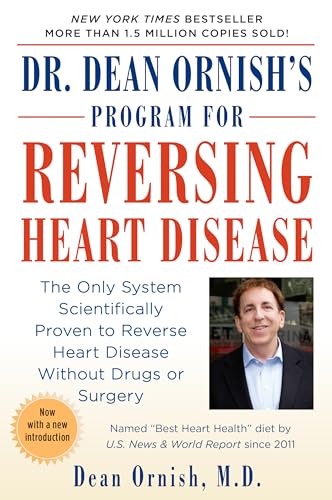
Dr. Dean Ornish's Program for Reversing Heart Disease: The Only System Scientifically Proven to Reverse Heart Disease Without Drugs or Surgery - Softcover
Inhaltsangabe
The Ornish Diet has been named the “#1 best diet for heart disease” by U.S. News & World Report for seven consecutive years!
Dr. Dean Ornish is the first clinician to offer documented proof that heart disease can be halted, or even reversed, simply by changing your lifestyle. Based on his internationally acclaimed scientific study, which has now been ongoing for years, Dr. Ornish's program has yielded amazing results. Participants reduced or discontinued medications; they learned how to lower high blood pressure; their chest pain diminished or disappeared; they felt more energetic, happy, and calm; they lost weight while eating more; and blockages in coronary arteries were actually reduced.
In his breakthrough book, Dr. Ornish presents this and other dramatic evidence and guides you, step-by-step, through the extraordinary Opening Your Heart program, which is winning landmark approval from America's health insurers. The program takes you beyond the purely physical side of health care to include the psychological, emotional and spiritual aspects so vital to healing. This book represents the best modern medicine has to offer. It can inspire you to open your heart to a longer, better, happier life.
Die Inhaltsangabe kann sich auf eine andere Ausgabe dieses Titels beziehen.
Über die Autorin bzw. den Autor
Dean Ornish, M.D., is the founder and president of the nonprofit Preventive Medicine Research Institute and clinical professor of medicine at the University of California, San Francisco, and also clinical professor of medicine at the University of California, San Diego. Dr. Ornish was trained in internal medicine at the Baylor College of Medicine, Harvard Medical School, and the Massachusetts General Hospital. His research has been published in the leading peer-reviewed medical journals, including the Journal of the American Medical Association, The Lancet, and The New England Journal of Medicine. His work has been featured in all major media, including cover stories in Newsweek, Time, and U.S. News & World Report. He has received numerous awards, including the 1994 Outstanding Young Alumnus Award from the University of Texas, Austin, and the National Public Health Hero Award from the University of California, Berkeley. Dr. Ornish is the medical editor for the Huffington Post and his TED talks have been viewed by more than 5 million people. The author of six books, all national bestsellers, he was recognized by Life magazine as “one of the 50 most influential members of his generation” and by Forbes magazine as “one of the world’s seven most powerful teachers.” Dr. Ornish lives in the San Francisco area with his wife and partner, Anne, and children, Lucas (Luke) and Jasmine (Jazz).
Von der hinteren Coverseite
"Whether or not you think you'll ever be concerned about your heart, this is likely to be the most useful book about health you'll read this year, maybe ever."
ESQUIRE
In this breakthrough book, Dr. Dean Ornish presents dramatic evidence that heart disease can be halted or even reversed simply by changing your life-style. Step-by-step he will guide you through the extraordinary Opening Your Heart program that takes you beyond the purely physical side of health care to include the psychological, emotional, and spiritual aspects so vital to healing. This book represents the best modern medicine has to offer. It can inspire you to open your heart to a longer, better, happier life.
Aus dem Klappentext
r or not you think you'll ever be concerned about your heart, this is likely to be the most useful book about health you'll read this year, maybe ever."
ESQUIRE
In this breakthrough book, Dr. Dean Ornish presents dramatic evidence that heart disease can be halted or even reversed simply by changing your life-style. Step-by-step he will guide you through the extraordinary Opening Your Heart program that takes you beyond the purely physical side of health care to include the psychological, emotional, and spiritual aspects so vital to healing. This book represents the best modern medicine has to offer. It can inspire you to open your heart to a longer, better, happier life.
Auszug. © Genehmigter Nachdruck. Alle Rechte vorbehalten.
1
“Why Don’t You Do Something
More Conventional?”
“Who are you gonna believe, me or your own eyes?”
—Groucho Marx, in Duck Soup
“Not everything that counts can be counted.”
—Denis Burkitt, M.D., in The Cancer Survivors
“Innovation is a very difficult thing in the real world.”
—Richard P. Feynman, Ph.D., in Surely You’re Joking, Mr. Feynman!
“Keep an open mind, but not so open that your brains fall out.”
—Unknown”
Forty million people in this country suffer from diagnosed cardiovascular disease, and an even larger number don’t yet know that they have a heart problem. Sixty million people have high blood pressure. Eighty million have elevated cholesterol levels. Over 1.5 million Americans have heart attacks every year. And for almost one third of them, having a heart attack was their first indication that they had a heart problem— clearly, not the best way to find out.
Although lifestyle factors play a major role in all of these, I was trained to treat hypertension, high levels of blood cholesterol, and coronary heart disease primarily by prescribing drugs. Yet increasing evidence indicates that medications to lower blood pressure and cholesterol prevent or reverse heart disease in only a small percentage of people. These drugs sometimes make people worse. And moderate dietary changes are not enough to reverse heart disease for most people.
Faced with this new information, many people are beginning to wonder, “Well, why bother? There’s not much I can do to make a difference. Bring out the bacon and eggs!”
Fortunately, my colleagues and I are finding that the comprehensive lifestyle program described in this book can lower cholesterol and blood pressure more than has ever been reported without drugs and can even begin to reverse severe coronary heart disease in many people without using cholesterol-lowering drugs or surgery. Of course, none of us is going to live forever, but we don’t have to suffer the premature death, disability, and cost that come from heart disease.
I first became interested in conducting research on heart disease in 1975 when I was a medical student at the Baylor College of Medicine in Houston. In 1977, I had the privilege of studying with Dr. Michael DeBakey, assisting in the operating room when he performed coronary bypass surgery. His surgical skill was amazing, the technology was impressive, and the circumstances were dramatic. After a while, though, I became a little disheartened as I saw the limitations of technological approaches that literally and figuratively bypassed the underlying causes of the problem. It was the difference between temporizing and healing.
Bypass surgery became, for me, a metaphor for the inadequacy of treating a problem without also addressing the underlying causes. We would operate on patients, their chest pain would usually go away, and they were told that they were cured. Most would go home and continue to do the same things that led to the problem in the first place. They would smoke, eat a high-fat, high-cholesterol diet, manage stress poorly, and lead sedentary lives.
At that time, even the hospital had several cigarette machines in the lobby, and just about the only foods available in the hospital cafeteria were cheeseburgers, fried fish, and french fries. In many hospitals, it’s still that way. Some even have McDonald’s or Burger King franchises right in the hospital. (Now, though, Baylor has a lowfat gourmet restaurant.) Several years ago, Dr. Robert Wissler, an eminent pathologist at the University of Chicago, fed his patients’ regular hospital diet to baboons. The baboons developed arterial blockages.
I began to wonder: What would happen if, instead of bypassing the problem, patients began to change what seemed to be the underlying causes of their heart disease?
I went to the medical library and began reading extensively. There were many research studies proving that diets high in fat and cholesterol cause blood cholesterol levels and blood pressure to go up, whereas low-fat, low-cholesterol diets cause blood cholesterol levels and blood pressure to go down. Epidemiological studies showed that high blood cholesterol levels increase the risk of heart disease in virtually all countries throughout the world.
Other studies indicated that emotional stress increases blood pressure and blood levels of cholesterol independent of diet—the type of stress is not that important. Indianapolis 500 race car drivers have higher cholesterol levels after the race than before. Tax accountants have increased cholesterol levels around April 15 when compared with the rest of the year. Medical students have higher cholesterol levels during exams. Likewise, other research studies demonstrated that stress management techniques can lower cholesterol levels and blood pressure independent of diet. Furthermore, evidence showed that smoking increased the risk of heart disease, and regular exercise helped to decrease the risk.
Each investigator worked in his or her own area—for example, Dr. Herbert Benson studied meditation, Dr. Ralph Paffenbarger studied exercise, Dr. Frank Sacks studied diet, and so on. Surprisingly, no one at that time had studied a comprehensive lifestyle program that used all of these lifestyle interventions, and no one had examined the effects of these lifestyle changes not only on risk factors such as cholesterol and blood pressure but also, more importantly, the effects of a comprehensive lifestyle program on the underlying heart disease process.
It seemed like an exciting opportunity, so in 1977 I decided to take a year off between my second and third years of medical school in order to conduct a small pilot study of ten patients using this combined lifestyle program. The Chief of Medicine, Dr. Antonio Gotto, was very supportive and provided most of the testing facilities, and the Franzheim Synergy Trust provided a grant to help support the study. The Plaza Hotel in Houston donated ten rooms to us for one month.
One of the advantages of being a second-year medical student was that I hadn’t had enough clinical experience to be jaded, to know that it was “impossible” to reverse heart disease, so I told the patients that this program might help them get better. Since most of them had heard from their physicians that their heart disease was only likely to stabilize or worsen over time—the so-called natural history of the disease process—I was unwittingly giving many of them hope for the first time since their illness had been diagnosed.
It was hard to find eligible patients. We were looking for people who had documented coronary heart disease and chest pain but who were not going to have bypass surgery. More bypass surgery is performed in Houston than anywhere in the world, so if a patient had anigiographically documented heart disease and chest pain, then most of the time he or she underwent bypass surgery. As a result, we had to look through over ten thousand patients’ charts to find even one hundred patients who were eligible for the study.
Eventually, ten people volunteered. They all experienced remarkable improvements after one month on our program. People who had had incapacitating chest pain with even minimal exertion—showering, shaving, gentle sexual activity, walking short distances—became essentially pain-free and were able to do all of these activities without difficulty. In most cases, these improvements began to occur after only a few days.
Many of...
„Über diesen Titel“ kann sich auf eine andere Ausgabe dieses Titels beziehen.
Suchergebnisse für Dr. Dean Ornish's Program for Reversing Heart Disease:...

Beispielbild für diese ISBN
Dr. Dean Ornish's Program for
Anbieter: World of Books (was SecondSale), Montgomery, IL, USA
Verkäuferbewertung 5 von 5 Sternen

Zustand: Acceptable. Item in acceptable condition! Textbooks may not include supplemental items i.e. CDs, access codes etc. Artikel-Nr. 00100304613
Gebraucht kaufen
EUR 3,90
Versand gratis
Versand innerhalb von USA
Versand innerhalb von USA
Anzahl: 7 verfügbar
Beispielbild für diese ISBN
Dr. Dean Ornish's Program for
Anbieter: World of Books (was SecondSale), Montgomery, IL, USA
Verkäuferbewertung 5 von 5 Sternen
Zustand: Good. Item in good condition. Textbooks may not include supplemental items i.e. CDs, access codes etc. Artikel-Nr. 00079596446
Gebraucht kaufen
EUR 3,90
Versand gratis
Versand innerhalb von USA
Versand innerhalb von USA
Anzahl: Mehr als 20 verfügbar
Beispielbild für diese ISBN
Dr. Dean Ornish's Program for
Anbieter: World of Books (was SecondSale), Montgomery, IL, USA
Verkäuferbewertung 5 von 5 Sternen
Zustand: Very Good. Item in very good condition! Textbooks may not include supplemental items i.e. CDs, access codes etc. Artikel-Nr. 00108550607
Gebraucht kaufen
EUR 3,90
Versand gratis
Versand innerhalb von USA
Versand innerhalb von USA
Anzahl: 6 verfügbar
Beispielbild für diese ISBN
Dr. Dean Ornish's Program for
Anbieter: World of Books (was SecondSale), Montgomery, IL, USA
Verkäuferbewertung 5 von 5 Sternen
Zustand: Good. Item in very good condition! Textbooks may not include supplemental items i.e. CDs, access codes etc. Artikel-Nr. 00078929286
Gebraucht kaufen
EUR 3,90
Versand gratis
Versand innerhalb von USA
Versand innerhalb von USA
Anzahl: 4 verfügbar
Beispielbild für diese ISBN
Dr. Dean Ornish's Program for Reversing Heart Disease: The Only System Scientifically Proven to Reverse Heart Disease Without Drugs or Surgery
Verlag:
Ballantine Books (edition Reprint), 1992
ISBN 10: 0345373537
ISBN 13: 9780345373533
Gebraucht
Paperback
Anbieter: BooksRun, Philadelphia, PA, USA
Verkäuferbewertung 5 von 5 Sternen
Paperback. Zustand: Fair. Reprint. The item might be beaten up but readable. May contain markings or highlighting, as well as stains, bent corners, or any other major defect, but the text is not obscured in any way. Artikel-Nr. 0345373537-7-1
Gebraucht kaufen
EUR 5,10
Versand gratis
Versand innerhalb von USA
Versand innerhalb von USA
Anzahl: 1 verfügbar
Beispielbild für diese ISBN
Dr. Dean Ornish's Program for Reversing Heart Disease: The Only System Scientifically Proven to Reverse Heart Disease Without Drugs or Surgery
Verlag:
Random House Publishing Group, 1992
ISBN 10: 0345373537
ISBN 13: 9780345373533
Gebraucht
Paperback
Anbieter: ThriftBooks-Phoenix, Phoenix, AZ, USA
Verkäuferbewertung 5 von 5 Sternen
Paperback. Zustand: Very Good. No Jacket. May have limited writing in cover pages. Pages are unmarked. ~ ThriftBooks: Read More, Spend Less. Artikel-Nr. G0345373537I4N00
Gebraucht kaufen
EUR 5,74
Versand gratis
Versand innerhalb von USA
Versand innerhalb von USA
Anzahl: 3 verfügbar
Beispielbild für diese ISBN
Dr. Dean Ornish's Program for Reversing Heart Disease: The Only System Scientifically Proven to Reverse Heart Disease Without Drugs or Surgery
Verlag:
Random House Publishing Group, 1992
ISBN 10: 0345373537
ISBN 13: 9780345373533
Gebraucht
Paperback
Anbieter: ThriftBooks-Dallas, Dallas, TX, USA
Verkäuferbewertung 5 von 5 Sternen
Paperback. Zustand: Very Good. No Jacket. Former library book; May have limited writing in cover pages. Pages are unmarked. ~ ThriftBooks: Read More, Spend Less. Artikel-Nr. G0345373537I4N10
Gebraucht kaufen
EUR 5,74
Versand gratis
Versand innerhalb von USA
Versand innerhalb von USA
Anzahl: 1 verfügbar
Beispielbild für diese ISBN
Dr. Dean Ornish's Program for Reversing Heart Disease: The Only System Scientifically Proven to Reverse Heart Disease Without Drugs or Surgery
Verlag:
Random House Publishing Group, 1992
ISBN 10: 0345373537
ISBN 13: 9780345373533
Gebraucht
Paperback
Anbieter: ThriftBooks-Dallas, Dallas, TX, USA
Verkäuferbewertung 5 von 5 Sternen
Paperback. Zustand: Very Good. No Jacket. May have limited writing in cover pages. Pages are unmarked. ~ ThriftBooks: Read More, Spend Less. Artikel-Nr. G0345373537I4N00
Gebraucht kaufen
EUR 5,74
Versand gratis
Versand innerhalb von USA
Versand innerhalb von USA
Anzahl: 4 verfügbar
Beispielbild für diese ISBN
Dr. Dean Ornish's Program for Reversing Heart Disease: The Only System Scientifically Proven to Reverse Heart Disease Without Drugs or Surgery
Verlag:
Random House Publishing Group, 1992
ISBN 10: 0345373537
ISBN 13: 9780345373533
Gebraucht
Paperback
Anbieter: ThriftBooks-Atlanta, AUSTELL, GA, USA
Verkäuferbewertung 5 von 5 Sternen
Paperback. Zustand: Very Good. No Jacket. May have limited writing in cover pages. Pages are unmarked. ~ ThriftBooks: Read More, Spend Less. Artikel-Nr. G0345373537I4N00
Gebraucht kaufen
EUR 5,74
Versand gratis
Versand innerhalb von USA
Versand innerhalb von USA
Anzahl: 4 verfügbar
Beispielbild für diese ISBN
Dr. Dean Ornish's Program for Reversing Heart Disease: The Only System Scientifically Proven to Reverse Heart Disease Without Drugs or Surgery
Verlag:
Random House Publishing Group, 1992
ISBN 10: 0345373537
ISBN 13: 9780345373533
Gebraucht
Paperback
Anbieter: ThriftBooks-Phoenix, Phoenix, AZ, USA
Verkäuferbewertung 5 von 5 Sternen
Paperback. Zustand: Very Good. No Jacket. Former library book; May have limited writing in cover pages. Pages are unmarked. ~ ThriftBooks: Read More, Spend Less. Artikel-Nr. G0345373537I4N10
Gebraucht kaufen
EUR 5,74
Versand gratis
Versand innerhalb von USA
Versand innerhalb von USA
Anzahl: 1 verfügbar